
TL;DR:
- Mobile forensic investigations involve systematically extracting, preserving, and analysing mobile device data for legally admissible evidence. Proper preparation, documentation, and choosing appropriate acquisition methods are critical to maintaining evidence integrity and courtroom defensibility. Challenges such as device encryption, cloud data, and legal complexities require skilled, ethical examiners following rigorous procedures to ensure accurate and credible results.
Mobile forensic investigations are the structured, methodical process of extracting, preserving, and analysing data from mobile devices to produce legally admissible digital evidence. The discipline sits at the intersection of technical expertise and legal procedure, making it indispensable for law enforcement, litigation support, and corporate cybersecurity teams. Tools like Cellebrite UFED and Oxygen Forensic Detective have become standard instruments in the field, while concepts such as physical versus logical extraction define the depth of data recovery achievable. Getting this process right from the outset determines whether evidence survives cross-examination or collapses under scrutiny.
What tools and preparations are needed before a mobile forensic investigation?
Preparation is the foundation of every defensible mobile forensic investigation. Arriving at a scene or receiving a device without the correct equipment and documented authorisation creates gaps that opposing counsel will exploit. The following tools and procedural prerequisites form the minimum standard for any professional engagement.
Essential hardware and software
The core toolkit for mobile device analysis includes Faraday bags or Faraday cages to block all wireless signals, forensic software platforms such as Cellebrite UFED, Oxygen Forensic Detective, and MSAB XRY, plus hardware write-blockers to prevent any data being written to the device during acquisition. Power supplies and charged cables for the specific device model are equally critical. Running out of battery mid-acquisition corrupts the process and may render data unrecoverable.
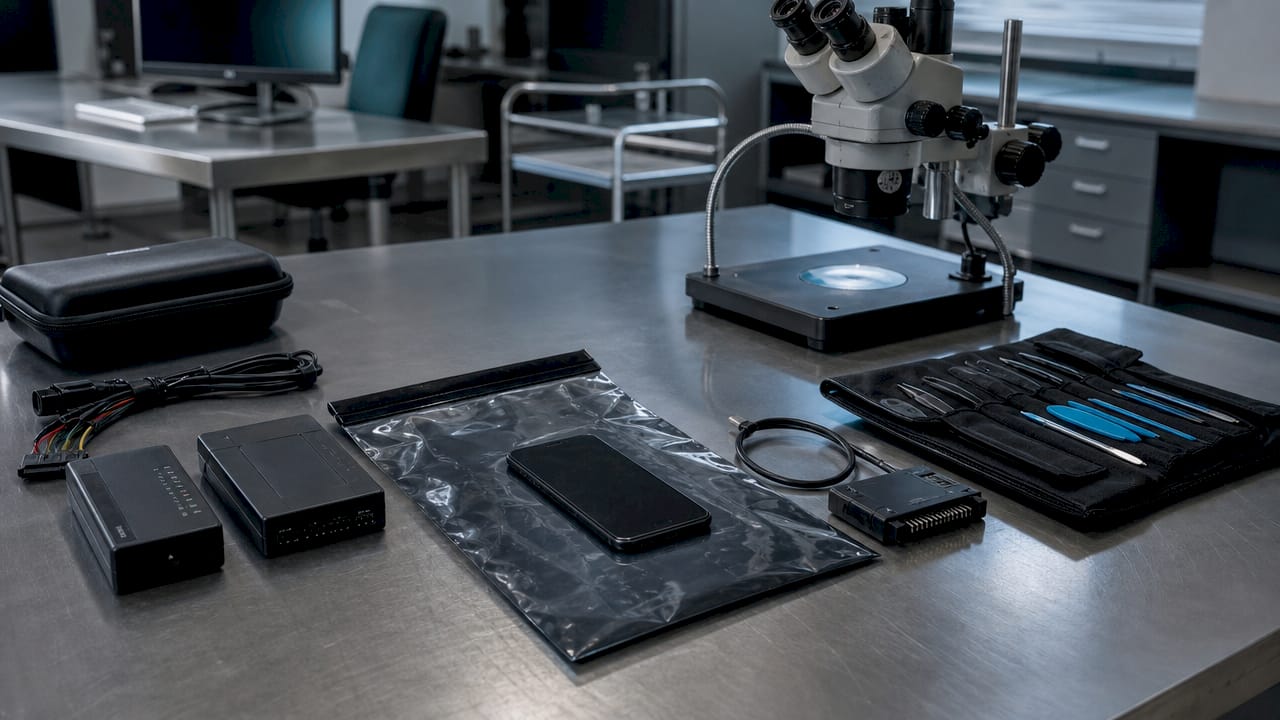
| Tool | Function |
|---|---|
| Faraday bag | Blocks cellular, Wi-Fi, and Bluetooth signals to prevent remote wipe |
| Cellebrite UFED | Extracts data across logical, file system, and physical acquisition methods |
| Oxygen Forensic Detective | Parses app data, cloud backups, and social media artefacts |
| MSAB XRY | Supports a wide range of device types including feature phones and IoT devices |
| Hardware write-blocker | Prevents any write operations to the device during acquisition |
| SHA-256 hashing tool | Generates a digital fingerprint to verify evidence integrity |
Legal and procedural prerequisites
Before touching any device, confirm you hold the appropriate legal authority. For law enforcement, this means a valid search warrant or equivalent judicial order. For corporate investigators, written authorisation from the data controller and, where applicable, the device owner is required. Chain of custody documentation must begin at the moment of seizure, not after acquisition. Every interaction with the device, including who handled it, when, and under what conditions, must be recorded contemporaneously.
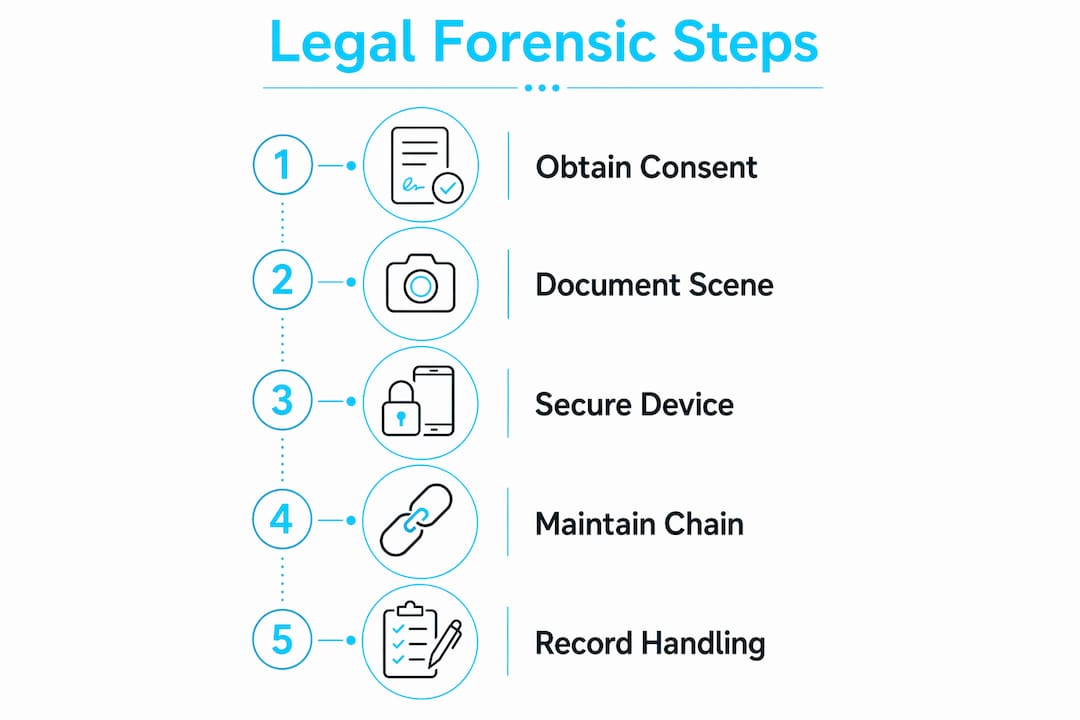
Pro Tip: Photograph the device in situ before moving it. Capture the screen state, any visible notifications, and the physical environment. These images become part of the evidentiary record and establish the device’s condition at the point of seizure.
How to conduct step-by-step mobile device analysis
A methodical workflow separates forensically sound evidence from data that will be challenged in court. The following sequence reflects current best practice for step-by-step mobile device analysis and applies across criminal, civil, and corporate contexts.
-
Device seizure and isolation. Place the device into Airplane mode if accessible, then immediately transfer it to a Faraday bag. 64% of high-stakes espionage cases involved attempted remote data wipes, confirming that signal isolation is non-negotiable. Do not power the device off unless instructed by a senior examiner, as this may trigger encryption states that complicate acquisition.
-
Documentation of initial device state. Record the make, model, IMEI, serial number, operating system version, and battery level. Photograph the device from all angles. Note whether the screen is locked, unlocked, or displaying any specific content. This documentation establishes the baseline condition before any forensic interaction.
-
Selection of acquisition method. Choose the appropriate method based on device type, operating system version, and the legal authority available. The spectrum runs from least invasive to most invasive.
-
Data acquisition. Execute the chosen method using validated forensic software. Generate a SHA-256 hash of the acquired data immediately upon completion to create a verifiable digital fingerprint. Any subsequent analysis must be performed on a forensic copy, never on the original image.
-
Analysis and reporting. Apply keyword filtering, timeline visualisation, and link analysis to isolate relevant artefacts. Attempting to manually review entire data sets is both inefficient and unrealistic given the volume of data modern smartphones hold. Document every analytical step and finding in a structured report.
Acquisition methods compared
Forensic acquisition methods range from simple manual interaction to chip-off memory removal, with each step increasing data capture depth alongside invasiveness and legal complexity.
| Method | Data yield | Invasiveness | Typical use case |
|---|---|---|---|
| Manual | Visible on-screen data only | Minimal | Locked out devices, quick triage |
| Logical | App data, contacts, messages | Low | Standard investigations, supported devices |
| File system | Full file system including deleted artefacts | Moderate | Deeper analysis where logical is insufficient |
| Physical | Raw memory image, maximum recovery | High | High-stakes cases, supported chipsets |
| JTAG | Direct board-level access | Very high | Damaged or locked devices |
| Chip-off | Physical memory chip removal | Extreme | Last resort, irreversible process |
Physical acquisition recovers approximately 30% more actionable artefacts than logical extractions on supported hardware. That uplift is significant in high-stakes litigation where deleted messages or location data can be decisive.
Pro Tip: Never escalate to a more invasive acquisition method without documenting the justification. Courts expect examiners to use the least invasive method capable of recovering the required evidence. Unjustified escalation can undermine the entire investigation.
What legal and technical challenges arise in mobile forensic investigations?
Modern mobile devices present a formidable set of obstacles. Understanding these challenges before beginning an investigation allows practitioners to plan mitigations rather than improvise under pressure.
Hardware-backed encryption increasingly blocks traditional physical extractions, with specialists now relying on root access, cold boot exploits, or chip-off techniques where legally authorised. Apple’s Secure Enclave and Android’s Titan M chip represent architectures specifically designed to resist forensic access. Success in physical extraction depends heavily on the specific device chipset and available exploits, not on generic tool capabilities alone.
Encrypted messaging applications present a separate layer of difficulty. End-to-end encrypted apps such as Signal require live memory capture and advanced decryption methods that go well beyond standard logical or physical acquisition. If the device is powered off before acquisition, this window closes permanently.
Common pitfalls and how to address them:
- Anti-tamper triggers. Entering incorrect passcodes can activate data wipe protocols. Always consult device-specific guidance before attempting any bypass.
- Data volume overload. Modern smartphones hold hundreds of gigabytes. AI-assisted analysis identifying behavioural patterns accelerates review and reduces human error significantly.
- OS version fragmentation. A technique valid for iOS 16 may fail entirely on iOS 17. Maintain up-to-date tool subscriptions and version-specific knowledge.
- Cloud synchronisation. Evidence may reside in iCloud, Google Drive, or OneDrive rather than on the device itself. Separate legal authority is typically required to access cloud data.
- Jurisdictional complexity. Cross-border investigations involving data stored in foreign jurisdictions require mutual legal assistance treaty processes that add time and procedural requirements.
“Chain of custody documentation is often the deciding factor in evidence admissibility; even minor procedural lapses can lead to evidence rejection in court.” — Kandi Brian, cybersecurity instructor
Pro Tip: Use AI-powered legal document tools to cross-reference forensic findings against case documents early in the review process. Identifying relevant data threads before full analysis saves considerable time and focuses the investigation.
How does maintaining chain of custody protect evidence integrity?
Chain of custody is the documented, unbroken record of every person who handled a piece of evidence, every location it occupied, and every action taken upon it. A single undocumented transfer can render months of forensic work inadmissible. For mobile forensic evidence, the standard is particularly demanding because digital data is inherently mutable.
Best practices for preserving chain of custody in mobile investigations include:
- Record the device’s network connectivity status and battery level at the point of seizure.
- Use tamper-evident packaging and seal devices with signed evidence tape.
- Generate a SHA-256 hash at acquisition and again before any analytical work begins. Any discrepancy between the two hashes indicates the data has been altered.
- Maintain a formal, contemporaneous ledger recording every handling event, including dates, times, personnel, and environmental conditions such as temperature and humidity for chip-off procedures.
- Use electronically signed logs where possible to create an auditable, timestamped record.
The Daubert Standard, referenced under Federal Rule of Evidence 702, requires forensic tools and techniques to have known error rates and community acceptance. This means examiners must be prepared to demonstrate not only what they found, but precisely how they found it and why their methodology is scientifically sound. Every handling event must be documented, including device state, network connectivity, and environmental factors, to maintain defensibility under cross-examination.
What are the best practices for presenting mobile forensic evidence in court?
Forensic findings that cannot be clearly communicated to a judge or jury carry little practical value regardless of their technical quality. Presentation is a professional discipline in its own right, and one that many technically skilled examiners underestimate.
The role of mobile forensics in court extends well beyond producing a report. Examiners must be prepared to explain their methodology in plain language, acknowledge the limitations of their tools, and withstand rigorous cross-examination from opposing experts. Transparency about what the evidence does not show is as important as what it does show.
Key standards for court-ready forensic reporting:
- Use only validated, peer-reviewed tools with documented error rates. Cellebrite UFED is used in over five million investigations annually and supports over 30,000 device types, making it one of the most defensible platforms available.
- Structure reports with an executive summary, methodology section, findings, and limitations. Judges and legal teams need to navigate reports quickly.
- Prepare a separate section addressing alternative interpretations of the data. Courts respond well to examiners who have considered and ruled out competing hypotheses.
- The expert witness role in digital forensics requires impartiality. An examiner who appears to advocate for one side loses credibility with the tribunal.
- Retain all working files, tool logs, and intermediate outputs. Defence counsel may request these under disclosure obligations.
Key takeaways
Mobile forensic investigations succeed or fail on the quality of preparation, documentation, and methodological rigour applied at every stage, from seizure through to court presentation.
| Point | Details |
|---|---|
| Isolate devices immediately | Place seized devices in a Faraday bag at once to prevent remote wiping. |
| Match acquisition method to case needs | Physical extraction yields 30% more artefacts than logical but carries greater legal and technical risk. |
| Hash every acquisition | Generate a SHA-256 hash at acquisition and before analysis to prove evidence integrity. |
| Document every handling event | Chain of custody lapses are the most common cause of evidence rejection in court. |
| Prepare for encryption barriers | Hardware-backed encryption and end-to-end encrypted apps require specialist techniques beyond standard acquisition tools. |
What I have learned from years of mobile forensic casework
The cases that go wrong rarely fail because of a technical error. They fail because someone skipped a documentation step under time pressure, or assumed that a logical extraction would be sufficient without checking the device’s encryption state first. In my experience at Computerforensicslab, the most technically gifted examiners are not always the most effective ones. The examiners who produce evidence that holds up in court are those who treat procedure with the same rigour they apply to technical analysis.
The arrival of AI-assisted review tools has genuinely changed the pace at which large data sets can be processed. What once took a team several weeks to triage can now be focused down to relevant artefacts in days. That efficiency gain is real, but it introduces a new risk: over-reliance on automated outputs without human verification. I have seen AI-assisted tools misclassify artefacts in ways that would have been immediately obvious to an experienced examiner reviewing the raw data. The technology accelerates the work; it does not replace the judgement.
Encryption is the defining challenge of this decade in mobile forensics. Legal professionals who instruct forensic examiners need to understand that a locked, encrypted device may yield nothing at all, regardless of the tools deployed. Setting realistic expectations at the outset of an investigation, rather than promising results that the technology cannot deliver, is both an ethical obligation and a practical necessity. The field rewards honesty about its own limitations.
— Computer
How Computerforensicslab supports your mobile forensic investigations
Computerforensicslab provides specialist digital forensic investigation services to legal professionals, law enforcement agencies, and corporate security teams across the UK. Our examiners handle the full spectrum of mobile device analysis, from logical extractions through to advanced chip-off procedures, with court-ready reporting and expert witness support included as standard. Whether you are building a litigation case, investigating employee misconduct, or responding to a data breach, our team applies the methodologies outlined in this guide to every engagement. Explore our full range of digital forensics services or contact us directly to discuss your case requirements.
FAQ
What is mobile forensics?
Mobile forensics is the scientific process of recovering, preserving, and analysing digital evidence from mobile devices in a manner that is legally admissible. It covers data extraction, deleted file recovery, and the analysis of application data, call records, and location history.
What is the difference between logical and physical acquisition?
Logical acquisition extracts data through the device’s operating system interface, while physical acquisition creates a raw image of the device’s memory. Physical acquisition recovers approximately 30% more artefacts but requires compatible hardware and carries greater legal and technical complexity.
How does chain of custody affect evidence admissibility?
Chain of custody documentation records every handling event for a piece of evidence. Even minor procedural lapses, such as an undocumented transfer, can lead to evidence being rejected by the court under the Daubert Standard or equivalent legal tests.
Can encrypted devices be forensically examined?
Encrypted devices present significant barriers, but specialists can use techniques such as root access, cold boot exploits, or chip-off procedures where legally authorised. End-to-end encrypted messaging applications require live memory capture and are unrecoverable if the device has been powered off before acquisition.
When should a corporate team instruct a professional forensic examiner?
A professional examiner should be instructed whenever mobile evidence may be used in litigation, regulatory proceedings, or disciplinary hearings. Internal IT teams lack the validated tools, documented methodologies, and expert witness qualifications required to produce court-admissible evidence.