
TL;DR:
- Forensic readiness is an organization’s proactive approach to collecting and preserving digital evidence with minimal disruption during investigations. It relies on defined policies, technical architecture, and trained personnel to ensure evidence integrity and defensibility in legal and regulatory contexts. Addressing evidence sprawl and establishing clear governance are critical to maintaining investigation effectiveness and compliance.
Forensic readiness is defined as an organisation’s proactive capability to collect, preserve, and analyse digital evidence with minimal disruption when a security incident or legal dispute arises. As a structured discipline, it draws on defined logging, endpoint instrumentation, and frameworks such as ISO/IEC 27043 and NIST SP 800-86 to govern how evidence is handled before any investigation begins. Legal professionals and businesses that build this capability gain a measurable advantage: they can respond to regulatory scrutiny, litigation holds, and data breach investigations without scrambling to reconstruct what happened after the fact. The alternative is costly, slow, and often legally indefensible.
Forensic readiness explained: essential components and standards
Forensic readiness, known formally within governance frameworks as digital forensic preparedness, rests on four interlocking pillars: policy, architecture, process, and people. Each must be in place before an incident occurs, not assembled in response to one.

The technical architecture centres on instrumented endpoints, centralised log retention, and time synchronisation via NTP. Without consistent timestamps across systems, correlating events across a network becomes unreliable and legally contestable. Tools such as EDR platforms and Sysmon provide the telemetry layer, but they only deliver value when logs are retained long enough to be useful and stored in a tamper-evident format.
Maturity expectations for forensic readiness align with ISO/IEC 27043, which governs investigation principles and processes, and NIST SP 800-86, which integrates forensic capability into incident response. Both frameworks require documented evidence sources, defined retention periods, and clear authority over who may access and handle evidence. This documentation is not bureaucratic overhead. It is the foundation of chain-of-custody integrity.
Roles matter as much as tools. Coordinating legal counsel, IT operations, and the security operations centre (SOC) before an incident creates clarity about who authorises evidence collection, who handles it, and who reports findings. Ambiguity in these roles during a live investigation leads to contamination risks and procedural failures that undermine court admissibility.
- Define and document all log sources, retention periods, and custodians.
- Deploy endpoint instrumentation such as EDR or Sysmon with centralised, tamper-evident storage.
- Synchronise all system clocks via NTP to maintain timeline integrity.
- Assign and train roles across legal, IT, and SOC for evidence handling.
- Conduct simulated incident response exercises to identify gaps and test preparedness.
Pro Tip: Document your evidence sources in a single governance register that includes retention periods, data owners, and legal hold triggers. This register becomes your first reference point when regulators or courts ask how evidence was preserved.
Why does evidence sprawl undermine forensic investigations?
Evidence sprawl is the condition in which digital data generated across an organisation’s systems outpaces the capacity to preserve, locate, and govern it for investigative purposes. It is one of the most significant practical threats to forensic defensibility, and it is more common than most organisations acknowledge.
The scale of the problem is not theoretical. One organisation produced a petabyte of data per day, resulting in a 30-day blind spot where evidence was overwritten before investigators could act. That blind spot meant the organisation could not demonstrate to regulators what had or had not occurred during a critical window. The reputational and legal consequences of that gap far exceeded the cost of the logging infrastructure that would have prevented it.
Evidence sprawl creates several compounding problems for legal and security teams:
- Legal holds become unenforceable when data is distributed across ungoverned systems with inconsistent retention policies.
- Investigation timelines extend significantly when analysts must reconstruct events from incomplete or fragmented logs.
- Regulatory defensibility weakens when an organisation cannot produce a coherent, traceable account of what happened and when.
- Cross-system visibility gaps allow threat actors to operate in areas where no telemetry exists, leaving blind spots that persist long after an incident closes.
“Over-reliance on incident response tools alone leads to evidence sprawl and blind spots. Governance and data visibility are the critical differentiators between organisations that can defend their investigations and those that cannot.”
Organisations that treat forensic readiness as a governance discipline rather than a technical afterthought address these risks systematically. They maintain what practitioners call an evidence survivability map, which estimates real-world retention times for each data source so that no critical evidence window is left unprotected. This map is reviewed regularly and updated whenever new systems or data sources are introduced.
How does forensic readiness support data exfiltration investigations?
Suspected data exfiltration is one of the most legally consequential scenarios a business can face, and it is precisely where forensic readiness either proves its value or exposes its absence. The instinct in many organisations is to image endpoints immediately. In modern environments, that instinct is increasingly insufficient.
Preserving the full evidence path including cryptographic hashes, timestamps, and identity context is the decisive factor in exfiltration investigations. Authentication logs, token issuance records, and vault access logs frequently provide more probative value than endpoint images alone, particularly when the suspected actor used legitimate credentials to move data.
The table below illustrates the difference between traditional and modern forensic evidence sources in exfiltration scenarios:
| Evidence source | Traditional approach | Modern forensic readiness approach |
|---|---|---|
| Endpoint imaging | Full disk image captured post-incident | Continuous EDR telemetry with pre-incident baseline |
| Identity context | User account logs reviewed manually | IAM logs, API key activity, and token issuance records |
| Cloud and SaaS activity | Limited or absent | API gateway logs, vault access records, workload identity trails |
| Timestamps | System clock dependent | NTP-synchronised, tamper-evident log entries |
| Chain of custody | Informal, reconstructed | Pre-defined, documented, role-based access controls |
Modern forensic readiness must adapt to AI agent workflows, serverless functions, and transient infrastructure where traditional endpoint imaging captures nothing meaningful. In these environments, a log-first approach prioritising telemetry from identity and access management systems, API gateways, and cloud audit trails is the only reliable path to a defensible investigation.
Pro Tip: When scoping a data exfiltration investigation, begin with identity logs rather than endpoints. Token issuance records and API key activity often reveal the full scope of access within hours, whereas endpoint imaging can take days and may miss cloud-native activity entirely.
Privacy considerations also shape what evidence can be collected and retained. Proportionality requirements under UK GDPR mean that over-collection carries its own legal risk. Forensic readiness frameworks that build privacy controls into evidence collection workflows reduce this risk without compromising investigative integrity.
What practical steps build and maintain forensic readiness?
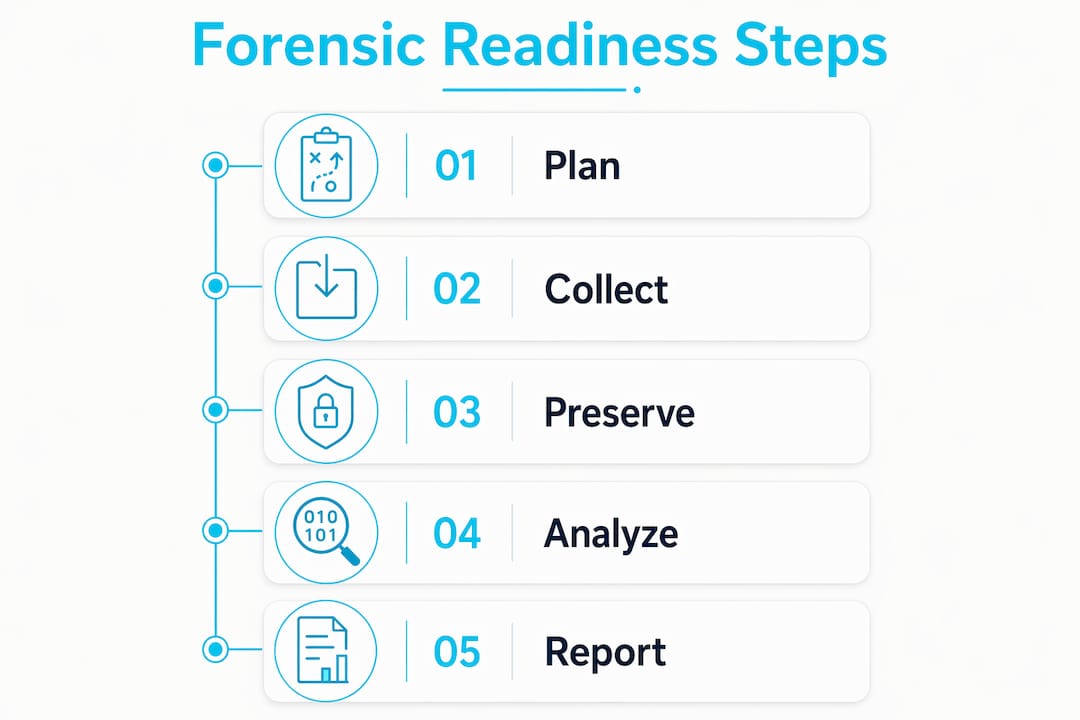
Building a forensic readiness programme requires deliberate planning across legal, security, compliance, and eDiscovery functions. The process is not a one-time project. It is a continuous governance cycle that evolves alongside the organisation’s technology and regulatory environment.
Controlled, governed workflows with traceable preservation, access auditing, and repeatable evidence handling are the operational core of any defensible programme. Without repeatability, analyst variance introduces inconsistencies that opposing counsel will exploit. With it, every investigation follows the same documented path from trigger to report.
The following steps provide a practical foundation for legal and business teams:
- Scope and document all systems, data sources, and custodians relevant to potential investigations, including cloud, SaaS, and third-party platforms.
- Define data retention and access policies that align with legal hold obligations, regulatory requirements, and operational constraints.
- Establish repeatable workflows covering evidence collection, preservation, review, and reporting, with role-based access controls at each stage.
- Align cross-functional teams including security, legal, compliance, privacy, and eDiscovery stakeholders around shared protocols and escalation paths.
- Audit and test regularly through tabletop exercises and simulated incidents to identify gaps before a real investigation demands answers.
Legal holds become manageable and defensible when forensic readiness includes clear scoping, documented authorisation, and role-based evidence access. Organisations that invest in AI-assisted document review tools, such as those explored in AI document review for law firms, can further reduce the time and cost of processing large evidence sets once collection is complete.
Forensic readiness increasingly functions as enterprise governance, requiring collaboration across legal, security, privacy, and eDiscovery functions rather than sitting solely within IT or the SOC. Organisations that treat it as a shared governance responsibility rather than a technical function are better positioned to meet regulatory expectations and defend their investigations before courts and regulators.
Understanding digital evidence preservation is a practical starting point for legal teams building their first forensic readiness framework.
Key takeaways
Forensic readiness requires policy, architecture, cross-functional governance, and regular testing to deliver defensible evidence when legal proceedings or regulatory scrutiny demand it.
| Point | Details |
|---|---|
| Define before an incident | Document log sources, retention periods, and custodians before any investigation begins. |
| Governance over tools | Frameworks like ISO/IEC 27043 and NIST SP 800-86 provide the governance layer that tools alone cannot replace. |
| Evidence sprawl is a legal risk | Uncontrolled data volumes can create blind spots that prevent organisations from defending their position before regulators. |
| Identity logs are decisive | In modern environments, IAM logs and API gateway records often provide more probative value than endpoint images. |
| Repeatability protects defensibility | Consistent, documented workflows reduce analyst variance and strengthen the legal integrity of every investigation. |
Why forensic readiness deserves a seat at the boardroom table
Having worked with legal teams and businesses navigating digital investigations, the pattern I see most often is not a failure of technology. It is a failure of governance. Organisations invest in EDR platforms, SIEM tools, and incident response retainers, then discover during a live investigation that no one documented who is authorised to collect evidence, how long logs are retained, or what the chain of custody procedure actually is.
The misconception that forensic readiness is an IT responsibility is the single most expensive mistake I encounter. When a regulator asks for evidence of what occurred during a data breach, the answer cannot come from the security team alone. Legal counsel needs to have been involved in designing the evidence handling process from the outset. Compliance needs to have signed off on retention policies. Privacy needs to have reviewed what can be collected and under what authority.
The organisations that handle investigations well are not necessarily the ones with the most sophisticated tools. They are the ones where legal, security, and compliance sat in the same room before the incident and agreed on a process. That preparation is what makes the difference between a defensible investigation and a regulatory disaster. The legal applications of digital forensics extend well beyond incident response, and treating forensic readiness as a legal governance matter rather than a technical one is the shift that most organisations still need to make.
— Computer
How Computerforensicslab supports your forensic readiness
Computerforensicslab provides specialist digital forensics services to legal professionals, businesses, and organisations that need expert support with evidence collection, preservation, and analysis. Whether you are preparing for litigation, responding to a data breach, or building a forensic readiness framework, the team brings technical rigour and legal awareness to every engagement. Services include chain-of-custody evidence handling, expert witness reporting, and forensic analysis across endpoints, cloud platforms, and mobile devices. For organisations seeking to understand how forensic consultants support legal outcomes, Computerforensicslab offers consultancy tailored to your specific regulatory and investigative context.
FAQ
What is forensic readiness in simple terms?
Forensic readiness is an organisation’s advance preparation to collect, preserve, and analyse digital evidence effectively when an incident or legal dispute occurs. It combines technical infrastructure, defined policies, and trained personnel so that investigations can proceed without delay or procedural failure.
Why is forensic readiness important for businesses?
Forensic readiness reduces the cost and disruption of digital investigations, supports regulatory compliance, and strengthens the legal defensibility of evidence. Organisations without it risk evidence loss, regulatory penalties, and weakened positions in litigation.
What frameworks govern forensic readiness?
ISO/IEC 27043 governs the principles and processes of digital investigations, while NIST SP 800-86 integrates forensic capability into incident response. Both require documented evidence sources, defined retention periods, and clear authority over evidence handling.
How does forensic readiness relate to incident response?
Forensic readiness is the preparatory foundation that makes incident response forensically defensible. It ensures that when an incident triggers a response, the evidence collected meets the standards required for legal proceedings and regulatory scrutiny.
What is evidence sprawl and why does it matter?
Evidence sprawl occurs when data volumes across an organisation’s systems exceed the capacity to preserve and govern them for investigative use. It creates blind spots where evidence is overwritten before investigators can act, directly undermining legal holds and regulatory accountability.