TL;DR:
- Secure labs protect digital evidence by using layered security controls and enforcing compliance standards. They ensure evidence integrity through documented chain-of-custody and tamper-evident logs. Operational resilience allows forensic processes to continue securely during threats, supporting legal admissibility and regulatory approval.
A secure lab is a specialised environment designed to protect digital evidence and forensic processes through controlled access, cryptographic security, and documented chain-of-custody procedures. Legal professionals, corporate clients, and private individuals all face the same core problem: digital evidence is fragile, and any break in its integrity can destroy a case. The answer to why use secure labs lies in three converging needs: legal admissibility, operational resilience, and regulatory compliance. Standards such as ISO/IEC 27001 and ISO/IEC 17025 define the baseline for accredited forensic environments. Computerforensicslab operates within these frameworks to ensure that every piece of digital evidence it handles meets the evidentiary standards required by UK courts and corporate governance bodies.
What security controls underpin why use secure labs?
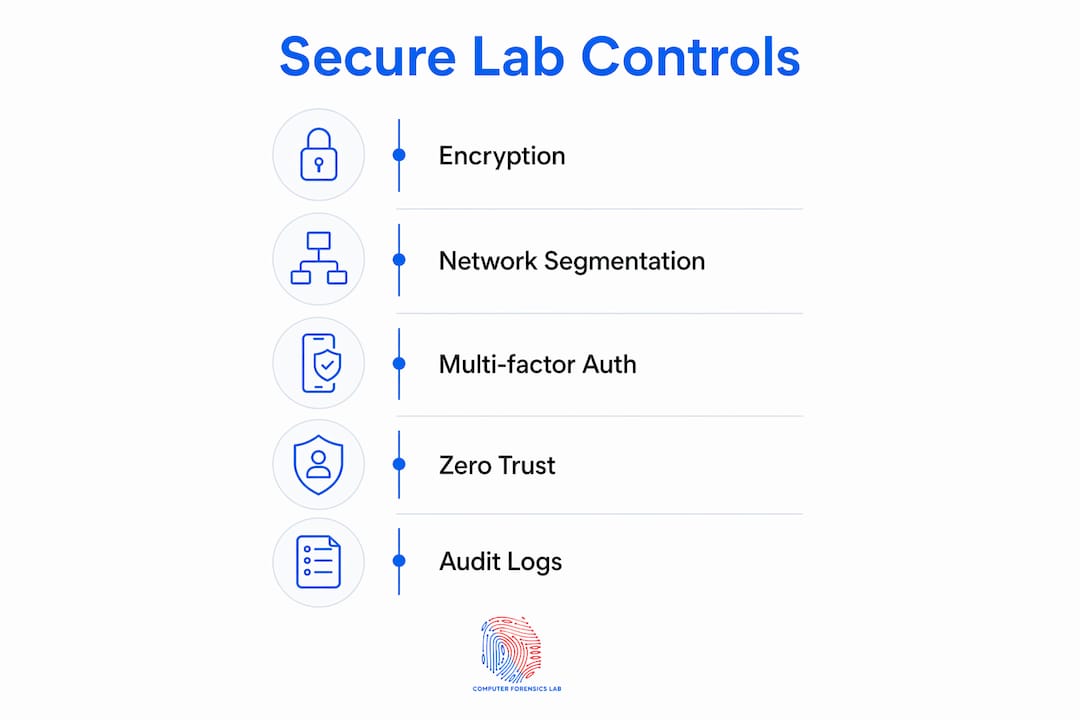
The technical foundation of a secure lab rests on layered controls that work together, not in isolation. AES-256 encryption and multi-factor authentication reduce unauthorised access incidents by approximately 45% in lab environments. That figure reflects a meaningful reduction in the most common point of failure in digital evidence handling: human access.
Network segmentation is the second critical layer. Isolating sensitive forensic zones from general IT infrastructure limits the blast radius of any cyberattack and prevents costly operational downtime. In a forensic context, downtime is not merely inconvenient. It can compromise active investigations and trigger legal challenges to evidence continuity.
Zero Trust architecture mandates continuous evaluation and authorisation of every access request, eliminating the implicit trust that insider threats exploit. It treats every user, device, and connection as potentially compromised until verified. This principle aligns directly with the evidentiary demands of UK litigation, where the burden of proof extends to the integrity of the investigation process itself.
| Security control | Primary benefit |
|---|---|
| AES-256 encryption | Protects evidence files from unauthorised decryption |
| Multi-factor authentication | Reduces unauthorised access at the identity layer |
| Network segmentation | Limits attack spread and protects forensic zones |
| Zero Trust access | Eliminates implicit trust and reduces insider risk |
| Immutable audit logging | Creates tamper-evident records for court admissibility |
Pro Tip: Configure MFA at the device level, not just the network perimeter. A forensic workstation accessed with a stolen session token bypasses perimeter controls entirely.
How do secure labs ensure legal admissibility and compliance?
Legal admissibility depends on one thing above all others: a documented, unbroken chain of custody. ISO/IEC 27001 and ISO/IEC 17025 together provide the compliance framework that forensic labs need to demonstrate both information security management and laboratory calibration standards. Accreditation under these standards signals to courts and regulators that the lab’s processes are independently verified.
Contemporaneous, unalterable logging at the device level, recorded before any data syncing occurs, significantly reduces tampering risk and strengthens chain-of-custody credibility. Post-facto documentation, by contrast, is routinely challenged in court because it cannot prove what happened at the moment of evidence capture. The difference between the two approaches can determine whether evidence is admitted or excluded.
Structured access governance reinforces this further. Role-based permissions for scientists, contractors, and third parties reduce unnecessary exposure while maintaining operational efficiency. Each access event is logged against a named identity, creating an audit trail that satisfies both internal governance and external regulatory scrutiny. For legal professionals, this means every action taken on a piece of evidence is attributable and verifiable.
Compliance best practices for secure forensic lab operations:
- Maintain ISO/IEC 27001 certification for information security management across all lab systems.
- Achieve ISO/IEC 17025 accreditation to validate laboratory calibration and testing procedures.
- Implement contemporaneous, encrypted logging at the device level before any network synchronisation.
- Apply role-based access controls with documented permission levels for every user category.
- Conduct regular internal audits against Good Laboratory Practice (GLP) requirements to pre-empt regulatory challenges.
- Retain tamper-evident logs for a defined retention period aligned with the relevant limitation period for legal proceedings.
Pro Tip: Treat your audit log as a primary exhibit, not an administrative record. Courts increasingly scrutinise the metadata of forensic processes, not just the evidence itself.
What operational benefits do secure labs offer legal and corporate clients?
The practical advantages of secure labs extend well beyond compliance. Integrating SIEM and XDR tools with identity and access management, data loss prevention, and vulnerability management strengthens detection capabilities and reduces investigation times during security incidents. Faster incident response directly reduces the window in which evidence can be altered, deleted, or exfiltrated.
Operational resilience is the quality that separates a well-designed secure lab from one that merely meets minimum standards. Resilience over maximum security is the governing principle: forensic processes must continue securely even when a threat is active. A lab that locks down completely under attack may protect data but will halt an investigation at a critical moment.
For corporate clients managing intellectual property theft or employee misconduct cases, the evidence integrity that a secure lab provides directly reduces the risk of regulatory penalties. Regulators in the UK, including the Information Commissioner’s Office, treat evidence of proper data handling as a mitigating factor in enforcement decisions. A secure lab creates that evidence automatically through its operational controls.
Key operational benefits of secure labs:
- Reduced breach risk: Layered controls prevent unauthorised access to sensitive forensic data.
- Investigation continuity: Network segmentation and resilience planning keep forensic processes running under threat conditions.
- Faster incident response: Integrated SIEM and XDR tools shorten detection-to-containment timelines.
- Regulatory protection: Documented compliance reduces exposure to ICO penalties and court challenges.
- Intellectual property safeguards: Controlled environments prevent data exfiltration during sensitive corporate investigations.
- Audit readiness: Continuous logging and access records satisfy regulatory and legal audit requirements at short notice.
What are best practices for ethical use of secure labs?
Ethical use of a secure lab begins with the data itself. Synthetic or masked datasets should replace real personal data wherever testing or validation is the objective. Using live personal data for anything beyond its authorised purpose creates privacy and compliance risks that can invalidate findings and expose the investigating party to legal liability.
Containment as a design principle makes labs safer by isolating experiments, ensuring repeatability, and maintaining defensibility for audits and courts. A lab should be treated as a control boundary, not merely a workspace. That distinction matters because accidental data leakage from a poorly contained environment can compromise both the investigation and the privacy rights of individuals whose data is involved.
Authorisation, scope limitation, and necessity are the three ethical restraints that govern responsible lab use. Every forensic process should have a documented authorisation, a defined scope, and a clear necessity. Logging minimums must capture enough detail for traceability without recording data beyond what the investigation requires. After each investigation, environment reset procedures should return the lab to a clean state, removing residual data and resetting access credentials.
Pro Tip: Document your cleanup routine as rigorously as your investigation process. An environment that is not properly reset after use creates a data contamination risk for the next case handled in that lab.
Key takeaways
Secure labs protect digital evidence integrity through layered technical controls, accredited compliance frameworks, and documented operational procedures that courts and regulators accept as reliable.
| Point | Details |
|---|---|
| Encryption and MFA reduce access risk | AES-256 and multi-factor authentication cut unauthorised access incidents by approximately 45%. |
| ISO standards underpin admissibility | ISO/IEC 27001 and ISO/IEC 17025 accreditation validates lab processes for UK courts and regulators. |
| Contemporaneous logging is non-negotiable | Device-level logs recorded before syncing create tamper-evident chain-of-custody records. |
| Resilience matters more than maximum lockdown | Labs must maintain forensic continuity during active threats, not just prevent access. |
| Ethical use requires containment and cleanup | Synthetic data, scope limitation, and environment resets protect privacy and case integrity. |
Secure labs in practice: what experience actually teaches
The most common mistake I see legal professionals and corporate clients make is treating a secure lab as a destination rather than a discipline. They invest in the physical and technical infrastructure, achieve accreditation, and then assume the work is done. It is not.
The labs that hold up under court scrutiny are the ones where the operational discipline matches the technical specification. Zero Trust architecture, for instance, aligns well with regulatory expectations, but it requires careful integration with validation controls to avoid compliance conflicts. I have seen cases where a technically sound Zero Trust implementation created audit trail gaps because the validation layer was not configured to capture the right events.
The other misunderstanding I encounter regularly is the belief that maximum security equals maximum protection. Operational resilience is the more useful goal. A lab that halts all processes under a security event may protect data in the short term, but it can destroy the timeline of an active investigation. The labs I trust are the ones designed to keep working under pressure, with controls that adapt rather than shut down.
My advice for legal professionals evaluating a secure lab provider: ask specifically how they handle environment resets between cases, how their logging architecture captures device-level events before network sync, and whether their ISO/IEC 17025 accreditation covers the specific forensic disciplines relevant to your case. Generic accreditation is not the same as discipline-specific validation.
— Computer
How Computerforensicslab supports your secure forensic investigations
Computerforensicslab provides digital forensics services from a secure London-based facility, handling digital evidence for legal professionals, law enforcement, and corporate clients across the UK. Every investigation follows documented chain-of-custody procedures, with access controls and logging that meet the evidentiary standards required by UK courts. Services cover data recovery, malware analysis, mobile and cloud forensics, and expert witness reporting. For clients managing sensitive corporate investigations or litigation support, Computerforensicslab’s forensic investigation capabilities are built around the compliance frameworks and operational controls described throughout this article. Contact Computerforensicslab directly to discuss the specific requirements of your case.
FAQ
What is a secure lab in digital forensics?
A secure lab is a controlled environment where digital evidence is examined under documented access controls, encryption, and chain-of-custody procedures that meet legal and regulatory standards such as ISO/IEC 27001 and ISO/IEC 17025.
Why do secure labs matter for legal admissibility?
Courts require evidence of an unbroken chain of custody and tamper-evident records. Secure labs produce contemporaneous, immutable logs that satisfy these requirements and withstand cross-examination.
What is the role of Zero Trust in a forensic lab?
Zero Trust architecture continuously verifies every access request, eliminating implicit trust and reducing insider threats. It aligns with regulatory expectations for role-based access and audit trails in forensic environments.
How do secure labs protect against intellectual property theft?
Controlled access, network segmentation, and data loss prevention tools prevent unauthorised exfiltration of sensitive data during corporate investigations, reducing both financial and reputational exposure.
What standards should a forensic lab hold?
A credible forensic lab should hold ISO/IEC 27001 for information security management and ISO/IEC 17025 for laboratory testing and calibration, both of which are recognised by UK courts and regulatory bodies.