
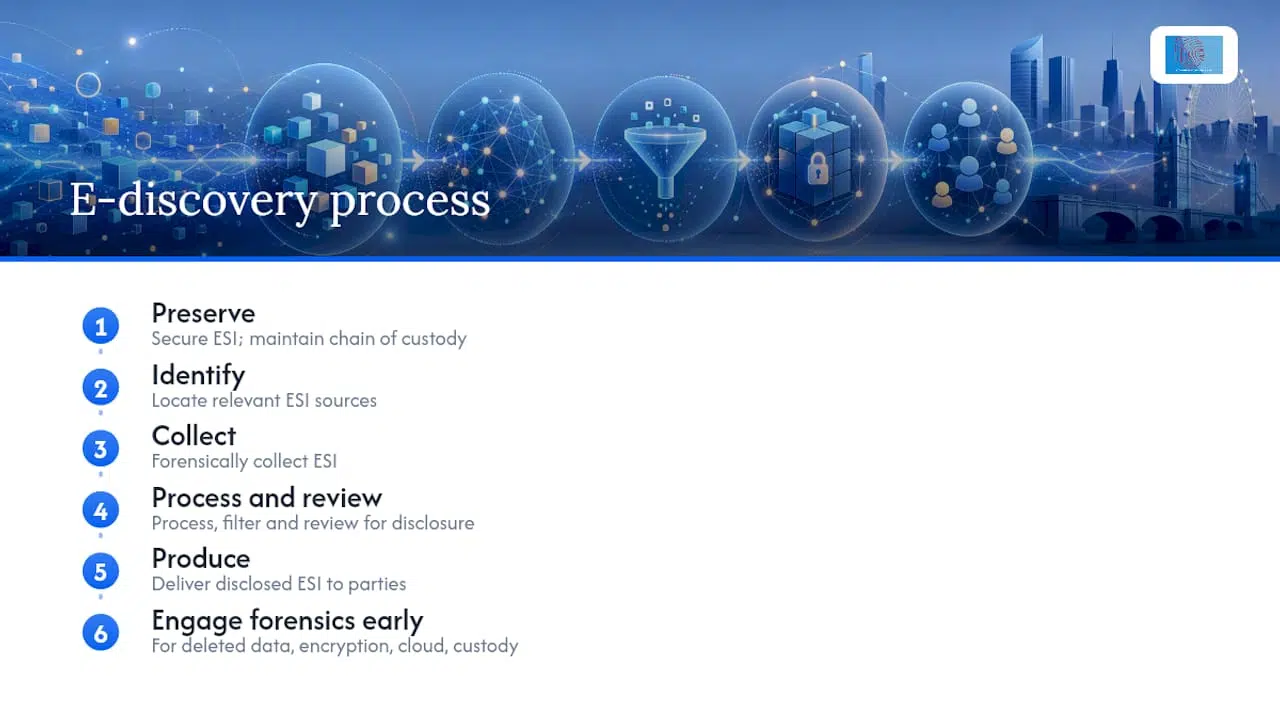
E-discovery, formally termed electronic disclosure under England and Wales practice, is the process of identifying, preserving, collecting, reviewing and producing electronically stored information (ESI) for use in litigation or regulatory investigations. The core sequence runs: preserve → identify → collect → process and review → produce. When deleted data, encryption, complex cloud environments, or chain-of-custody concerns arise, instructing a specialist digital forensics firm early is not optional — it is the step that keeps evidence admissible and the process defensible.
Key takeaways
Electronic disclosure in England and Wales requires early preservation, proportionate search methodology, and forensically sound collection to meet court expectations under CPR Part 31 and Practice Direction 31B.
| Point | Details |
|---|---|
| Duty to preserve begins early | Issue a legal hold the moment litigation is reasonably anticipated; automated deletion must be suspended immediately. |
| ESI scope is broad | Courts treat email, metadata, deleted files, IMs, social media and cloud data as disclosable documents under CPR. |
| Proportionality governs scope | English disclosure is limited to issues in dispute; disproportionate requests can be challenged and may attract costs orders. |
| TAR requires a documented protocol | Predictive coding is court-accepted but must be validated, recorded in the DRD and disclosed if challenged. |
| Computerforensicslab supports the full process | The firm provides forensic imaging, data recovery, processing support and expert witness reports for UK eDiscovery matters. |
Table of Contents
- What counts as ESI in UK proceedings?
- How eDiscovery usually runs in UK litigation
- The UK rules that govern electronic disclosure
- How English disclosure differs from US discovery
- Technologies and methods used in UK eDiscovery
- Practical steps, timings and cost drivers
- When to instruct a digital forensics firm
- Common mistakes and spoliation risks
- A forensic team’s perspective on what actually goes wrong
- Computerforensicslab’s eDiscovery and electronic disclosure services
- Sources
What counts as ESI in UK proceedings?
The definition of a “document” under the Civil Procedure Rules is deliberately broad. Under Practice Direction 31B, an electronic document includes anything stored in electronic form, and the Disclosure Pilot (PD51U) confirms that this extends well beyond emails and word-processed files to cover:
- Emails and email attachments, including calendar entries and meeting requests
- Office documents, spreadsheets and presentations in all versions and formats
- Metadata — the hidden data recording when a file was created, modified, accessed and by whom
- Deleted files and data recoverable from unallocated disk space
- Instant messages, SMS, WhatsApp, Teams, Slack and other collaboration platform data
- Social media posts, direct messages and account activity logs
- Voicemail recordings and audio files
- Server logs, database records and application data
- Backup tapes, archived data and cloud storage
- IoT device data, including vehicle telematics and smart-building systems
Three categories deserve particular attention. Metadata is frequently overlooked by parties who produce documents as flat PDFs, stripping the very information courts may need to establish authenticity and chronology. Forensic images of devices capture the complete binary state of a storage medium, preserving deleted and fragmented data that a simple file export would miss. Ephemeral messaging platforms — those configured to auto-delete after a set period — present a preservation risk the moment litigation becomes foreseeable, because the data may be gone before a legal hold is even issued.
How eDiscovery usually runs in UK litigation
1. Preservation and legal hold
The duty to preserve relevant ESI begins the moment litigation is reasonably anticipated, not when proceedings are issued. LexisNexis guidance confirms that solicitors must advise clients to suspend automated deletion routines, preserve backup cycles and notify custodians of their obligations as soon as a claim is contemplated. A legal hold notice should identify the relevant custodians, the categories of data to be preserved and the systems involved, and it should be documented in writing.
2. Identification and scoping
Once a hold is in place, the next task is mapping the data landscape: which custodians hold relevant material, on which systems (on-premises servers, cloud platforms, personal devices, third-party services), and across what date ranges. Getting this scoping exercise right early avoids expensive over-collection later. The Electronic Documents Questionnaire (EDQ) under CPR PD 31B is the formal mechanism for this discussion between parties, and negotiating it thoroughly at the outset can materially reduce downstream costs.
3. Collection and chain of custody
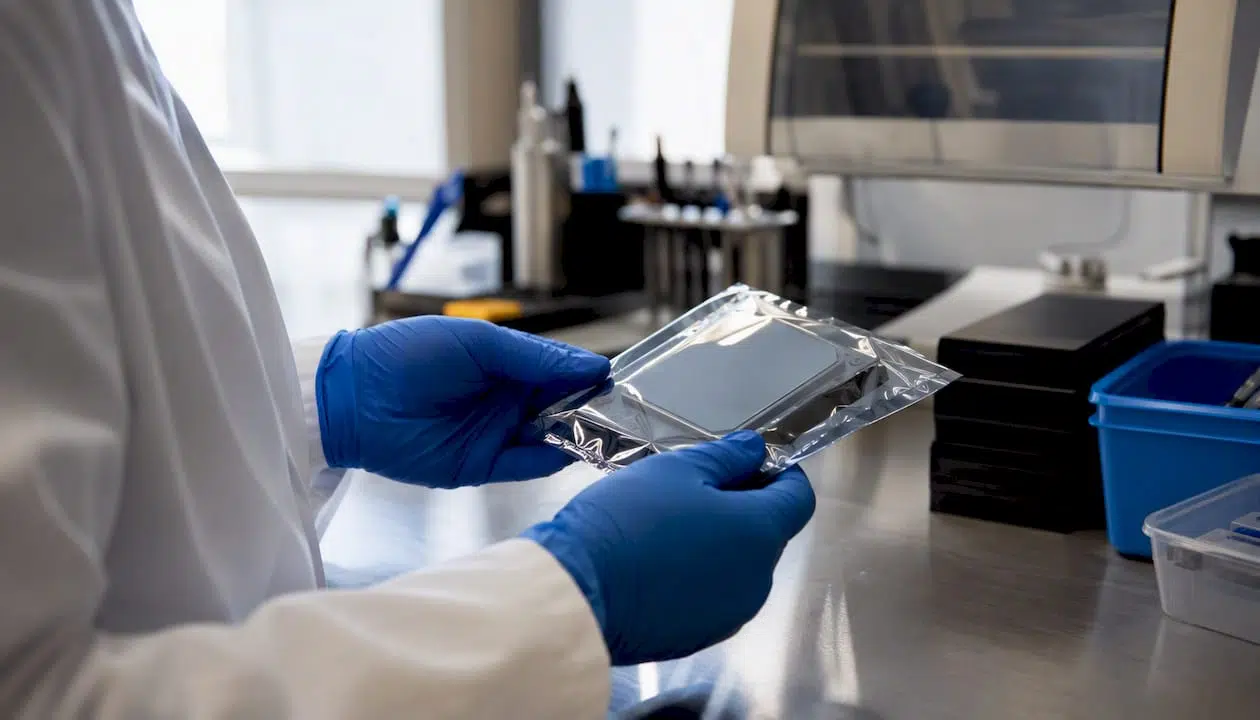
Collection methods fall broadly into two categories. A forensic image — a bit-for-bit copy of a storage device — preserves all data including deleted files, metadata and slack space, and is the appropriate method when data integrity is in dispute or deleted material is sought. A targeted export from a live system (such as a mailbox export from Microsoft 365) is faster and cheaper but captures only what is currently accessible. The choice between them should be documented, and chain-of-custody records must log who collected the data, when, from which device or system, using which tools, and how the copy was verified (typically by hash value comparison). See Computerforensicslab’s guidance on digital evidence preservation for a practical checklist.
4. Processing
Raw collected data is processed to remove system files, duplicates and near-duplicates, and to normalise formats for review. Deduplication reduces review volume significantly in large matters. Metadata is extracted and indexed at this stage, and documents are loaded into a review platform with searchable fields.
5. Review
Review covers three distinct exercises: responsiveness (is this document relevant to the issues in dispute?), privilege (does legal professional privilege, litigation privilege or another exemption apply?), and confidentiality. Technology-assisted review (TAR), also called predictive coding, uses machine-learning algorithms trained on a reviewer’s decisions to prioritise or classify the remaining population. English courts have approved predictive coding in contested cases, and the Disclosure Pilot expects parties to discuss TAR, analytics and sampling as part of the Disclosure Review Document (DRD).
6. Production
Production format matters. PD 31B requires that electronic copies be provided in a form that preserves metadata and gives the recipient equivalent ability to access, search and review the documents. Native format production (the original file with its metadata intact) is generally preferred. Where PDF or TIFF images are used, a load file containing extracted metadata must accompany them. Bates stamping provides a unique reference number for each page, essential for citation in witness statements and skeleton arguments.
Timelines vary considerably. A straightforward commercial dispute with a single custodian and modest data volumes might move from preservation to production in six to eight weeks. A multi-party, multi-jurisdiction matter with terabytes of data across legacy systems can take six months or more, particularly where encrypted devices, foreign-language review or regulatory privilege issues arise.
The UK rules that govern electronic disclosure
English disclosure is governed primarily by CPR Part 31 and its associated practice directions. Practice Direction 31B applies to cases involving electronic documents and sets out detailed requirements for early preservation, the EDQ process, and the use of technology to achieve proportionate, cost-effective disclosure.
Practice Direction 31B requires parties to discuss the scope of electronic disclosure, the tools and techniques to be used, and the format of production before the first case management conference. Parties must notify their clients to preserve disclosable documents as soon as litigation is contemplated, and must consider using technology — including search tools, analytics and TAR — to reduce the burden and cost of review.
For proceedings in the Business and Property Courts, the Disclosure Pilot (Practice Direction 57AD) introduced a more structured framework. It replaced the previous standard disclosure regime with a system of initial disclosure (documents a party relies on and key adverse documents) and extended disclosure, governed by a DRD and one of five disclosure models (A through E). Model A is no order for extended disclosure; Model E is the most extensive, requiring a thorough search across all relevant repositories. The DRD records the agreed “issues for disclosure,” the custodians, the systems to be searched, the search methodology and the technology to be used.
The duty of cooperation is explicit and ongoing. Parties and their legal representatives are expected to engage constructively on disclosure methodology, to agree search terms and parameters where possible, and to raise disputes promptly rather than allowing them to surface at trial. Mondaq’s analysis describes English disclosure as a “cards-on-the-table” regime: parties must disclose documents that help or harm their case and must act honestly throughout.
How English disclosure differs from US discovery
The contrast between English disclosure and US discovery is not merely procedural — it reflects a fundamentally different philosophy about the purpose and scope of pre-trial information exchange.
Penningtons’ analysis identifies proportionality as the defining distinction. Key practical differences include:
- Scope of search: English courts expect searches limited to issues in dispute and proportionate to the value and complexity of the case. US discovery permits far broader requests, often covering entire custodian populations and extended date ranges.
- Interrogatories and depositions: these are standard US tools with no direct English equivalent. English procedure relies on witness statements and, occasionally, requests for further information under CPR Part 18.
- Cost allocation: in England, the disclosing party generally bears its own disclosure costs. Disproportionate requests can be challenged and may result in adverse costs orders.
- Resisting foreign requests: when a US party seeks broad discovery from an English entity, English courts frequently narrow or reject requests that would be disproportionate under domestic standards. Specificity is required; fishing expeditions are not tolerated.
- Cooperation expectation: English procedure places an affirmative duty on parties to cooperate on methodology. Adversarial gamesmanship over search terms or scope is increasingly met with judicial criticism and costs sanctions.
The practical implication for cross-border matters is that solicitors acting for English parties facing US discovery requests should engage early with the proportionality argument and, where appropriate, seek a protective order or judicial guidance on the scope of any compelled production. English judges require specificity; broad foreign discovery requests are frequently narrowed if disproportionate.
Technologies and methods used in UK eDiscovery
| Technology or method | What it does | Defensibility considerations |
|---|---|---|
| Technology-assisted review (TAR / predictive coding) | Machine-learning algorithm trained on reviewer decisions to classify or prioritise documents | Requires documented seed set, validation sampling and agreed protocol; courts have approved it in contested cases |
| Analytics and clustering | Groups conceptually similar documents to speed review and identify key themes | Useful for large populations; methodology should be recorded in the DRD |
| Near-duplicate detection | Identifies documents that are near-identical but not exact duplicates | Reduces review volume; decisions on treatment of near-dupes should be documented |
| Keyword and Boolean search | Searches indexed text for specified terms and combinations | Search terms must be agreed or disclosed; over-broad terms generate unnecessary review volume |
| Forensic imaging | Bit-for-bit copy of a storage device, preserving deleted data and metadata | Gold standard for chain-of-custody integrity; required where data integrity is disputed |
| Sampling | Statistical review of a subset to estimate prevalence or validate TAR | Must be statistically defensible; methodology and results should be disclosed to the opposing party |
| Native format production | Producing documents in their original file format with metadata intact | Preferred under PD 31B; preserves authenticity and searchability |
| Load files (DAT/OPT) | Metadata and image-path files that accompany productions into review platforms | Required for structured productions; format should be agreed in advance |
A defensible TAR workflow requires documentation of seed sets, validation sampling and a protocol agreed by both parties or approved by the court where challenged. Courts are not hostile to TAR, but they expect transparency about how it was deployed and how its outputs were validated. The AIIM eDiscovery framework describes TAR, analytics and forensic imaging as standard components of a managed eDiscovery lifecycle.
Practical steps, timings and cost drivers
Early steps for in-house teams and solicitors
- Issue a written legal hold notice to all relevant custodians immediately upon anticipating litigation.
- Suspend automated deletion policies, email archiving purges and backup overwrite cycles.
- Map the data environment: identify custodians, devices, cloud accounts, collaboration platforms and any third-party data repositories.
- Engage IT or a forensic provider to preserve volatile data (RAM, server logs) before it is overwritten.
- Review any data retention policies that may have already destroyed relevant material and document the position.
- Begin the EDQ process with opposing solicitors as early as possible to agree scope and methodology.
Key cost drivers
Data volume is the primary driver of eDiscovery cost, but it is rarely the only one. The number of custodians, the mix of on-premises and cloud systems, the presence of encrypted or legacy formats, and the need for foreign-language review all compound expense. Litigation involving IoT data or proprietary database formats typically requires specialist forensic processing that adds time and cost. Expedited collection — where a party needs forensic images within 24–48 hours — commands a premium.
Pro Tip: Agreeing a targeted, defensible sampling approach with the opposing party before committing to full-population review can reduce review costs substantially. Document the sampling methodology, the confidence level and the margin of error, and record the agreement in the DRD or a consent order.
Typical timelines vary by complexity; simpler matters may complete disclosure in a matter of weeks, while larger, multi-party disputes with extensive data volumes and technical challenges can take several months or more, often requiring phased production to meet court deadlines.
When to instruct a digital forensics firm
Not every eDiscovery matter requires a specialist forensic provider. But several indicators make early instruction not just advisable but necessary.
Engage a forensic provider when:
- Deleted, overwritten or corrupted data may be relevant and needs recovery
- Devices are encrypted or protected by unknown credentials
- Chain-of-custody integrity will be challenged by the opposing party
- The data environment includes unfamiliar or proprietary systems
- An expert witness report is required for court proceedings
- There are allegations of data tampering, spoliation or employee data theft
- The matter involves mobile device data, cloud forensics or IoT devices
- Regulatory investigations require forensically sound evidence handling
Engagement checklist
When instructing a forensic provider, confirm the following at the outset:
- Scope and objectives: what data is sought, from which devices or systems, and for what purpose
- Confidentiality and data handling: how the provider will store, process and return or destroy data
- Chain-of-custody procedures: how collection will be documented and verified
- Reporting format: whether a forensic report, expert witness report or processing output is required
- Turnaround and phasing: realistic timelines given the data volume and complexity
- Accreditation and expert witness capability: whether the provider’s experts can give evidence in court if required
Questions to ask vendors
Ask whether the provider’s examiners hold recognised accreditations (such as CREST or equivalent), whether they have experience giving expert witness testimony in English courts, and what their standard reporting format covers. Confirm that their forensic tools are court-accepted and that their methodology is documented and reproducible. For guidance on the expert witness role in digital forensics, Computerforensicslab publishes detailed guidance on what courts expect from forensic experts.
Typical deliverables from a forensic engagement include forensic images (with hash verification), processing outputs in agreed formats, privilege logs, a chain-of-custody log, and, where required, a CPR Part 35-compliant expert report. The electronic disclosure strategies page at Computerforensicslab sets out how forensic methods integrate with counsel’s disclosure obligations.
Common mistakes and spoliation risks
Disclosure failures in English proceedings carry serious consequences, ranging from adverse cost orders to adverse inferences at trial. In extreme cases, defective disclosure has contributed to judgment being entered against the defaulting party or findings of contempt.
Frequent mistakes include:
- Late preservation: failing to issue a legal hold before automated deletion destroys relevant material
- Inadequate scope: preserving only email when relevant data sits in Teams, SharePoint, mobile devices or cloud storage
- Poor chain of custody: collecting data without documenting the process, leaving authenticity open to challenge
- Stripping metadata: producing documents as flat PDFs without accompanying metadata or load files
- Failing to capture deleted data: assuming that deleted means gone, when forensic recovery may be possible and expected
- Inadequate privilege review: inadvertently producing privileged material or failing to log withheld documents properly
Mondaq’s commentary warns that defective disclosure carries serious consequences, and LexisNexis confirms that the duty to preserve is continuous from the moment a claim is contemplated. The consequences of discovery abuse — including deliberate or negligent destruction of evidence — are well-documented in legal commentary across common law jurisdictions.
Mitigation checklist:
- Issue a written legal hold notice on day one of anticipating litigation
- Document every step of the preservation, collection and processing workflow
- Agree scope and methodology with opposing solicitors through the EDQ or DRD process
- Engage a forensic provider early where deleted data or chain-of-custody issues arise
- Be transparent with the court about any gaps in preservation and the steps taken to address them
- Review the digital evidence preservation checklist before instructing collection
A forensic team’s perspective on what actually goes wrong
The most consistent failure in eDiscovery matters is not technical — it is timing. Parties frequently contact a forensic provider after automated deletion has already run, after a device has been wiped and reissued, or after a cloud account has been closed. By that point, recovery is possible in some cases but not all, and the evidential position is already compromised.
The second most common failure is scope. Legal teams often focus on email and overlook collaboration platforms, mobile devices and cloud storage. A custodian who conducts most of their work through WhatsApp or Microsoft Teams may have almost nothing in their email archive that is relevant, while their mobile device holds the critical communications.
On TAR: the technology works, but only when the workflow is documented and the seed set is genuinely representative. An undocumented or poorly validated TAR process is vulnerable to challenge, and courts will scrutinise the methodology if the opposing party raises it. Agreeing the TAR protocol in the DRD, recording the validation sampling results and being prepared to disclose the process to the court removes most of that risk.
Pro Tip: For ephemeral or encrypted messaging data, act before the litigation hold is even issued if possible. Notify the relevant platform administrators immediately and, where the platform supports it, place a legal hold directly within the system (Microsoft Purview Compliance Portal, for example, allows in-place holds on Teams data). Waiting for a formal court order is often too late.
Where Computer Forensics Lab fits into your eDiscovery process
Our electronic discovery specialists provide end-to-end support for the identification, preservation, collection, processing, searching, review and organisation of electronically stored information (ESI). We work with data held across a wide range of digital sources, including computers, laptops, hard drives, mobile devices, removable media, email systems, cloud platforms, cloud endpoints and other local, remote or hosted electronic storage environments. This can include data from services and endpoints such as Microsoft 365, Exchange Online, OneDrive, SharePoint, Teams, Google Workspace, cloud storage repositories, virtual machines, remote user accounts and other enterprise cloud environments. Our services are designed to assist solicitors, barristers, litigation teams, investigators, corporate legal departments and law enforcement agencies in locating relevant evidence, managing large volumes of electronic data and preparing defensible datasets for legal proceedings, investigations and regulatory matters.. More about our e-discovery services.
Sources
The following primary sources and practical guidance pages are the authoritative references for electronic disclosure practice in England and Wales:
- Gov
- Redline revised PD51U (Judiciary)
- What is eDiscovery? (AIIM)
- Disclosure in England and Wales: To discover, or to disclose? (Mondaq)
This article provides general information about electronic disclosure practice in England and Wales and does not constitute legal advice. Practitioners should verify current rules with the primary sources above or consult a qualified solicitor for advice specific to their matter.
This article is general information, not a substitute for advice from a qualified lawyer. Consult a qualified legal professional about your own circumstances before acting on anything here.