
TL;DR:
- The 2025 incident response process, updated by NIST, emphasizes a structured, iterative lifecycle involving preparation, detection, containment, and post-incident activities. Regulatory clocks trigger upon incident classification confirmation, requiring precise documentation and cross-jurisdiction awareness. Continuous improvement relies on post-incident reviews, metrics tracking, and integrating governance to enhance organizational resilience and compliance.
The incident response process is defined as a structured, lifecycle-based framework that enables organisations to detect, contain, eradicate, and recover from cyber incidents while maintaining governance, regulatory compliance, and continuous improvement. The most significant update since 2012 arrived with NIST SP 800-61 Revision 3, published in April 2025, which embeds incident response across all six functions of the NIST Cybersecurity Framework 2.0: Govern, Identify, Protect, Detect, Respond, and Recover. For cybersecurity practitioners and digital forensics decision-makers, understanding this updated architecture is no longer optional. Regulatory clocks, operational resilience requirements, and cross-sector coordination demands mean that a poorly structured incident response plan 2025 carries direct legal and financial consequences.
What are the updated phases of the incident response process 2025?
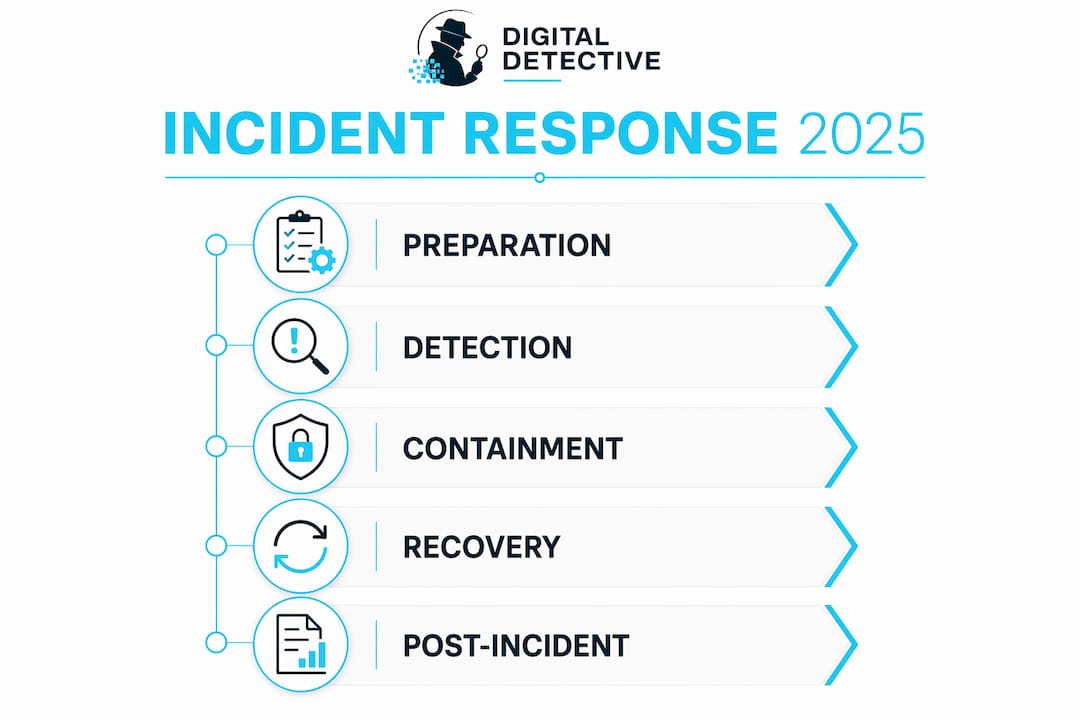
The 2025 incident response lifecycle follows four consolidated phases: Preparation; Detection and Analysis; Containment, Eradication and Recovery; and Post-Incident Activity. NIST’s consolidation differs from the SANS Institute’s six-phase model (Preparation, Identification, Containment, Eradication, Recovery, Lessons Learned), but the practical objectives overlap substantially. The critical distinction in the NIST model is that these phases form an iterative cycle, not a linear sequence. Each completed cycle feeds intelligence back into preparation, making the programme progressively more capable.

| Phase | NIST SP 800-61 Rev 3 | SANS model equivalent |
|---|---|---|
| Preparation | Preparation | Preparation |
| Detection and analysis | Detection and analysis | Identification |
| Containment, eradication and recovery | Single consolidated phase | Three separate phases |
| Post-incident activity | Post-incident activity | Lessons learned |
Preparation is where most programmes fail before an incident ever occurs. This phase covers documented playbooks, defined roles within a Computer Security Incident Response Team (CSIRT), pre-authorised containment decisions, and tested communication trees. Organisations that skip tabletop exercises discover their gaps during live incidents, which is the worst possible time.
Detection and analysis is the phase most disrupted by automation over-reliance. Formal escalation decisions trigger response team activation and start regulatory notification clocks, which means a human must confirm an alert as a genuine incident before the process formally begins. Automated tools such as Microsoft Sentinel, Splunk, or CrowdStrike Falcon generate alerts; trained analysts convert those alerts into confirmed incidents. The distinction matters enormously for compliance.
Containment, eradication and recovery must follow a deliberate sequence. Premature recovery, where systems are restored before the threat is fully eradicated, is one of the most common and costly mistakes in cybersecurity incident response. Containment isolates affected systems, eradication removes the root cause, and recovery restores operations under monitored conditions.
Post-incident activity closes the loop. Skipping post-incident activities leads directly to repeated failures; after-action reviews, evidence retention, and metrics tracking are the mechanisms that convert experience into capability.
Pro Tip: Document the precise moment an alert becomes a confirmed incident. That timestamp is the legal and regulatory starting point for every notification obligation your organisation carries.
How does the 2025 incident response process handle regulatory timing?
Confirmed incident classification triggers multiple regulatory clocks simultaneously, including the GDPR 72-hour notification requirement to supervisory authorities and the SEC’s 96-hour material incident disclosure rule for public companies. This is not a documentation formality. Missing these windows carries direct regulatory penalties, and the clock starts at confirmation, not at discovery of the initial alert.
Organisations operating under multiple jurisdictions face overlapping obligations. A single ransomware event affecting a UK-based firm with US-listed securities and EU customer data can trigger the ICO, the SEC, and relevant EU data protection authorities at the same time. The incident response plan 2025 must account for this explicitly.
Best practices for meeting regulatory timelines within the response process include:
- Pre-define your incident classification thresholds. Ambiguity about what constitutes a “confirmed incident” delays notification and creates audit exposure.
- Assign a dedicated regulatory liaison within the CSIRT who tracks notification deadlines independently of the technical response.
- Maintain a decision log from the moment an alert is escalated. Every triage decision, containment action, and communication must be timestamped and attributed.
- Draft notification templates in advance for the most likely incident types: ransomware, data exfiltration, and credential compromise.
- Test your notification workflow in tabletop exercises, not just your technical response. Many teams discover their legal escalation path is broken only when it matters most.
The legal context of incident response extends beyond regulatory filings. Evidence preservation standards, chain of custody requirements, and the admissibility of forensic findings in litigation all depend on decisions made in the first hours of a confirmed incident. Sloppy documentation at the containment stage can undermine a prosecution or defence months later.
Pro Tip: Treat your incident decision log as a legal document from the moment you open it. Courts and regulators will read it exactly that way.
What emerging trends are shaping incident response in 2025?
The integration of artificial intelligence into detection and analysis has shifted the volume problem but not eliminated the judgement problem. AI-driven tools reduce mean time to detect (MTTD) by correlating signals across large datasets faster than any human team. The risk is alert fatigue at scale: when AI generates thousands of prioritised alerts, analysts still make the confirmation decisions that trigger regulatory clocks. The quality of human triage, not the speed of automated detection, determines whether an organisation meets its notification obligations.
Zero trust architecture has a direct impact on containment and eradication. In a zero trust environment, lateral movement by an attacker is constrained by default because no implicit trust exists between network segments. This means containment actions, such as isolating a compromised endpoint, cause less operational disruption than in traditional perimeter-based networks. Organisations that have invested in zero trust see measurably faster containment times.
Cloud-centric incident response requires a different evidence collection approach. Volatile data in cloud environments disappears faster than in on-premises infrastructure, and shared responsibility models mean that cloud providers such as AWS, Microsoft Azure, and Google Cloud control access to certain log sources. Incident response teams must understand exactly which logs they own, which the provider retains, and for how long.
Sector-specific considerations are becoming more prominent in 2025 incident management frameworks:
- Manufacturing and OT environments require cross-functional coordination that goes beyond IT. NIST SP 1800-41, developed with industry collaborators, emphasises restoring safe industrial operations rapidly. This means engineering and operations teams must be part of the CSIRT structure, not passive observers.
- Healthcare organisations face simultaneous obligations under the UK DSPT, GDPR, and sector-specific NHS guidance, making pre-planned regulatory response trees non-negotiable.
- Financial services firms regulated by the FCA must align their incident response plan with DORA (Digital Operational Resilience Act) requirements, which mandate ICT incident classification, reporting, and resilience testing.
- Critical national infrastructure operators must coordinate with CISA and, in the UK, the NCSC, whose guidance aligns with the updated NCIRP framework that closed its public comment period in February 2025.
The operational resilience focus in OT environments reflects a broader shift: incident response is no longer purely a security function. It is an operational continuity function with safety implications.
Pro Tip: If your organisation operates industrial control systems, run a joint tabletop exercise with your engineering team before your next security review. The gaps you find will not be technical. They will be procedural and communicative.
How can organisations continuously improve their incident response capabilities?
Continuous improvement in incident response requires treating post-incident activity as a feedback mechanism that updates preparation and readiness, not as a final administrative step. The organisations with the most mature programmes are those that close the loop systematically after every confirmed incident, regardless of severity.
The governance integration point is where many programmes stall. Traceable IR documentation aligned with CSF 2.0’s Govern function gives leadership confidence that the programme is auditable and strategically coherent. Without this alignment, incident response remains a technical silo rather than an organisational capability. The benefits of a mature IR programme extend directly to risk reduction, insurance positioning, and regulatory standing.
Practical steps for operationalising continuous improvement include:
- Track MTTD and MTTR (mean time to detect and mean time to respond) as primary metrics. These figures inform security investment decisions more reliably than incident counts alone.
- Conduct after-action reviews within 72 hours of incident closure while detail is fresh. Delayed reviews produce sanitised accounts rather than honest assessments.
- Maintain a living playbook library covering ransomware, insider threat, data exfiltration, and supply chain compromise. Each playbook should be reviewed after every relevant incident.
- Run tabletop exercises quarterly, not annually. Annual exercises test whether a plan exists; quarterly exercises test whether the team can execute it under pressure.
- Integrate IR metrics into board-level risk reporting. When leadership sees MTTD trends alongside financial exposure estimates, security investment decisions improve in quality and speed.
External coordination across sectors is increasingly a marker of IR maturity. The NCIRP update demonstrates that no organisation responds to significant incidents in isolation. Threat intelligence sharing through bodies such as the NCSC’s Cyber Security Information Sharing Partnership (CiSP) and sector-specific ISACs reduces detection time and improves containment decisions across the community.
Key takeaways
Effective incident response in 2025 requires integrating governance, regulatory timing, and continuous improvement into every phase of the NIST SP 800-61 Rev 3 lifecycle, not treating them as separate workstreams.
| Point | Details |
|---|---|
| NIST SP 800-61 Rev 3 is the 2025 standard | Published April 2025, it embeds IR across all six CSF 2.0 functions, replacing the 2012 framework. |
| Incident confirmation triggers regulatory clocks | GDPR’s 72-hour and SEC’s 96-hour notification windows begin at confirmed classification, not initial discovery. |
| Post-incident activity drives maturity | After-action reviews and metrics tracking convert each incident into preparation improvements for the next. |
| OT and manufacturing need cross-functional CSIRTs | NIST SP 1800-41 requires engineering and operations teams inside the response structure, not outside it. |
| Governance integration is non-negotiable | Traceable IR documentation aligned with CSF 2.0 Govern function makes programmes auditable and board-ready. |
From the forensics floor: why most IR programmes fail at the moment that matters most
The moment an alert becomes a confirmed incident is the single most consequential decision point in any response process. At Computerforensicslab, we see the consequences of getting this wrong more often than we should. Evidence that was never properly preserved. Decision logs that were never started. Containment actions taken before anyone documented what they were containing or why.
The technical phases of incident response are well understood. What fails in practice is the governance layer: who has the authority to confirm an incident, who starts the regulatory clock, and who owns the decision log. Organisations invest heavily in detection tooling and almost nothing in the human protocols that convert detections into defensible, documented responses.
The other pattern we observe consistently is the absence of tested playbooks for the incidents that actually occur. Most organisations have a ransomware playbook. Far fewer have a tested playbook for insider data exfiltration or supply chain compromise, which are the incident types that generate the most complex forensic and legal challenges.
The step-by-step investigative process matters as much as the technology supporting it. Organisations that treat incident response as a purely technical exercise discover its legal and reputational dimensions at the worst possible time. Build the governance layer first. The tools will follow.
— Computer
How Computerforensicslab supports your incident response programme
When an incident moves beyond internal containment capacity, professional digital forensics support becomes the difference between a defensible response and a compromised one. Computerforensicslab provides evidence preservation, malware analysis, and post-incident forensic investigation services that maintain chain of custody and produce expert witness reports suitable for litigation and regulatory proceedings. Our digital forensics services are designed to integrate directly with your existing CSIRT structure, providing specialist capability at the phases where internal teams are most stretched. For organisations seeking to strengthen their malware investigation capability, our forensic analysts work alongside legal and security teams to produce findings that hold up under scrutiny.
FAQ
What is the incident response process in 2025?
The incident response process in 2025 is a structured, iterative lifecycle defined by NIST SP 800-61 Revision 3, covering Preparation; Detection and Analysis; Containment, Eradication and Recovery; and Post-Incident Activity. It is integrated across all six functions of the NIST Cybersecurity Framework 2.0, with continuous improvement and governance as core requirements.
When does the GDPR 72-hour notification clock start?
The GDPR 72-hour notification clock starts at the point of confirmed incident classification, not at initial alert discovery. This makes the formal escalation decision, and its documentation, a critical compliance control.
What is the difference between NIST and SANS incident response frameworks?
NIST SP 800-61 Rev 3 consolidates containment, eradication, and recovery into a single phase, while the SANS model treats these as three separate phases. Both frameworks share the same core objectives; the NIST model is more commonly used in regulated industries and government contexts.
How does zero trust architecture affect incident containment?
Zero trust architecture limits lateral movement by default, which means containment actions cause less operational disruption than in traditional perimeter-based networks. Organisations with mature zero trust implementations typically achieve faster containment times during active incidents.
Why do post-incident reviews matter for IR maturity?
Post-incident reviews convert each incident into preparation improvements for the next, making them the primary driver of IR programme maturity. Skipping them results in repeated failures because the root causes of process gaps are never addressed.