
TL;DR:
- Cybersecurity audits help UK organizations reduce risk, demonstrate regulatory compliance, and support insurance negotiations.
- They identify vulnerabilities, provide documented evidence, and establish a measurable security baseline essential for compliance and trust.
Cybersecurity audits reduce organisational risk, demonstrate regulatory due diligence to the ICO and NCSC, and generate documented evidence that supports insurance negotiations, contract bids, and incident response. For UK organisations operating under UK GDPR and the NIS Regulations, a structured audit is not a discretionary activity. It is the mechanism by which you establish whether your controls actually work, not merely whether they exist on paper. Industry data cited by Valorem Reply references Ponemon research that audited organisations experience fewer security incidents, and the same source cites an illustrative average breach cost. Against that exposure, a structured audit is one of the most cost-effective risk management tools available.
- Audits identify vulnerabilities and misconfigurations before attackers do.
- They produce documented evidence of due diligence for the ICO, insurers, and procurement teams.
- Regular audits against ISO 27001 controls establish a measurable security baseline.
- NCSC guidance and UK GDPR both expect organisations to demonstrate active, evidenced risk management.
- Computerforensicslab delivers forensic-grade cybersecurity audits for UK organisations, combining technical depth with legally admissible evidence standards.
Key figure: Industry commentary referencing Ponemon research indicates that organisations running regular security audits experience substantially fewer incidents than those that do not, making the investment case straightforward for most UK decision-makers.
Pro Tip: If budget is constrained, commission a focused audit of your three most business-critical systems first. A phased approach delivers earlier remediation wins and builds executive confidence before you extend scope.
Table of Contents
- What exactly is a cybersecurity audit, and how does it differ from related activities?
- The critical benefits of regular cybersecurity audits for UK organisations
- What types of cybersecurity audit should you commission?
- What the cybersecurity audit process actually involves
- Which organisations need audits, and how often?
- How to prepare for an audit and what to ask prospective auditors
- How to select the right cybersecurity auditor in the UK
- What Computerforensicslab finds in practice: a forensic-grade audit example
- Key takeaways
- Why audits sit at the heart of forensic readiness
- Computerforensicslab: forensic-grade cybersecurity audits for UK organisations
- Useful sources for UK decision-makers
What exactly is a cybersecurity audit, and how does it differ from related activities?
A cybersecurity audit is a systematic, evidence-based evaluation of how an organisation protects its information assets. It measures controls, processes, and configurations against defined standards such as ISO 27001, NCSC Cyber Essentials, or the requirements of UK GDPR, and translates technical findings into business risk language that decision-makers can act on. The output is not an opinion; it is documented evidence with risk ratings and a remediation roadmap.
Decision-makers frequently conflate audits with assessments and penetration tests. The distinctions matter because each activity answers a different question and produces a different deliverable.
- Cybersecurity audit: Systematic, evidence-based, point-in-time review of controls against a defined standard. Produces a findings report, risk ratings, and a remediation plan. Suitable for regulatory compliance and governance.
- Security assessment: Broader, less formal review of security posture. Useful for gap analysis before a full audit or after a significant change.
- Penetration test: Simulated attack against specific systems to identify exploitable vulnerabilities. Technical in focus; does not evaluate governance, policy, or process controls.
- Continuous monitoring: Ongoing, automated visibility into system state and threat indicators. Complements audits but cannot replace the structured evidence-gathering and control verification an audit provides.
Point-in-time audits are valuable precisely because they force a structured review, but they do have a limitation: the security environment changes between audits. Continuous monitoring fills that gap by providing real-time visibility, which is why mature programmes combine both.
Typical audit scope includes verification against ISO 27001 controls, cloud configuration reviews, identity and access management checks, network architecture, data handling policies, and supplier security assessments. The scope is agreed before fieldwork begins and documented in a scope statement that forms part of the final deliverable.
| Activity | Primary purpose | Typical scope | Main deliverable | Frequency |
|---|---|---|---|---|
| Cybersecurity audit | Compliance and control assurance | Policies, controls, configurations, processes | Findings report + remediation plan | Annual minimum |
| Security assessment | Posture gap analysis | Broad, risk-based | Gap analysis report | As needed |
| Penetration test | Exploit identification | Defined systems or applications | Technical vulnerability report | 6–12 months |
| Continuous monitoring | Real-time threat visibility | Network, endpoints, logs | Alerts and dashboards | Ongoing |
The critical benefits of regular cybersecurity audits for UK organisations
The business case for regular audits rests on four pillars: risk reduction, regulatory compliance, commercial trust, and cost avoidance. Each is concrete and measurable.
Risk identification and mitigation is the most immediate benefit. Audits surface vulnerabilities, misconfigurations, and weak access controls before threat actors find them. They also reveal security debt, the accumulation of legacy, redundant, or misconfigured controls that inflate maintenance overhead without adding protection. Decommissioning those controls simultaneously improves security and reduces cost.

Regulatory compliance is non-negotiable for most UK organisations. UK GDPR requires organisations to implement appropriate technical and organisational measures and to demonstrate those measures are effective. The NIS Regulations impose equivalent obligations on operators of essential services and relevant digital service providers. Audit documentation supports both obligations by providing the ICO with evidence of due diligence, which can materially reduce penalties in the event of a breach. For legal sector organisations, the Solicitors Regulation Authority also expects demonstrable cyber risk management, as detailed in Computerforensicslab’s cybersecurity guide for legal professionals.
Commercial trust and contracting advantage is an increasingly significant driver. Enterprise procurement teams and public sector buyers routinely require evidence of security assurance as a condition of contract. A recent, independently verified audit report is a credible answer to that requirement. Cyber insurers are equally attentive: well-documented audit reports can materially improve policy terms and premiums by demonstrating risk management maturity.
Operational efficiency and cost avoidance close the argument. Organisations that identify and remediate vulnerabilities proactively spend less on incident response, regulatory investigation, and reputational recovery. The US$4.88m average breach cost figure cited in industry commentary is a useful order-of-magnitude reference, though actual costs vary significantly by sector and organisation size.
Statistic callout: Industry sources referencing Ponemon research indicate that organisations running regular security audits experience materially fewer incidents, translating directly into lower breach response costs and reduced regulatory exposure.
Pro Tip: Request that your auditor maps findings to UK GDPR Article 32 and the relevant NIS Regulations obligations. That mapping converts a technical report into a compliance evidence pack you can present directly to the ICO or a regulator.
What types of cybersecurity audit should you commission?
Choosing the right audit type depends on your primary objective: compliance assurance, technical vulnerability discovery, cloud security, or a combination. The following types are the most commonly commissioned by UK organisations.
| Audit type | Purpose | Who commissions it | Frequency | Main deliverable |
|---|---|---|---|---|
| Compliance audit | Map controls to regulatory requirements (UK GDPR, NIS, ISO 27001) | Legal, financial, health, CNI sectors | Annual | Compliance gap report |
| Internal audit | Self-assessment of controls and processes | Any organisation with an internal audit function | Quarterly or annual | Internal findings report |
| External/third-party audit | Independent verification; removes conflict of interest | Any organisation seeking assurance or certification | Annual | Independent findings report |
| Penetration test | Simulated attack to find exploitable vulnerabilities | Technical teams, regulated sectors | 6–12 months | Technical vulnerability report |
| Cloud security audit | Review of cloud configuration, access controls, and data residency | Organisations with significant cloud estate | Annual or after major change | Cloud configuration report |
| Risk assessment audit | Holistic threat and likelihood analysis | Boards, risk committees | Annual | Risk register update |
Independent third-party audits remove conflicts of interest and frequently reveal blind spots that internal teams miss because of operational familiarity. That is not a criticism of internal teams; it is a structural reality. An internal auditor who built a system is less likely to question its design than an external reviewer who has no prior relationship with it.
For most UK organisations, the practical answer is a layered approach:
- An annual compliance audit against ISO 27001 or the relevant regulatory framework.
- Penetration tests every six to twelve months, focused on internet-facing systems and critical applications.
- Continuous monitoring for high-change environments or organisations with elevated threat profiles.
- A cloud security audit whenever significant cloud infrastructure changes occur or annually as a minimum.
What the cybersecurity audit process actually involves
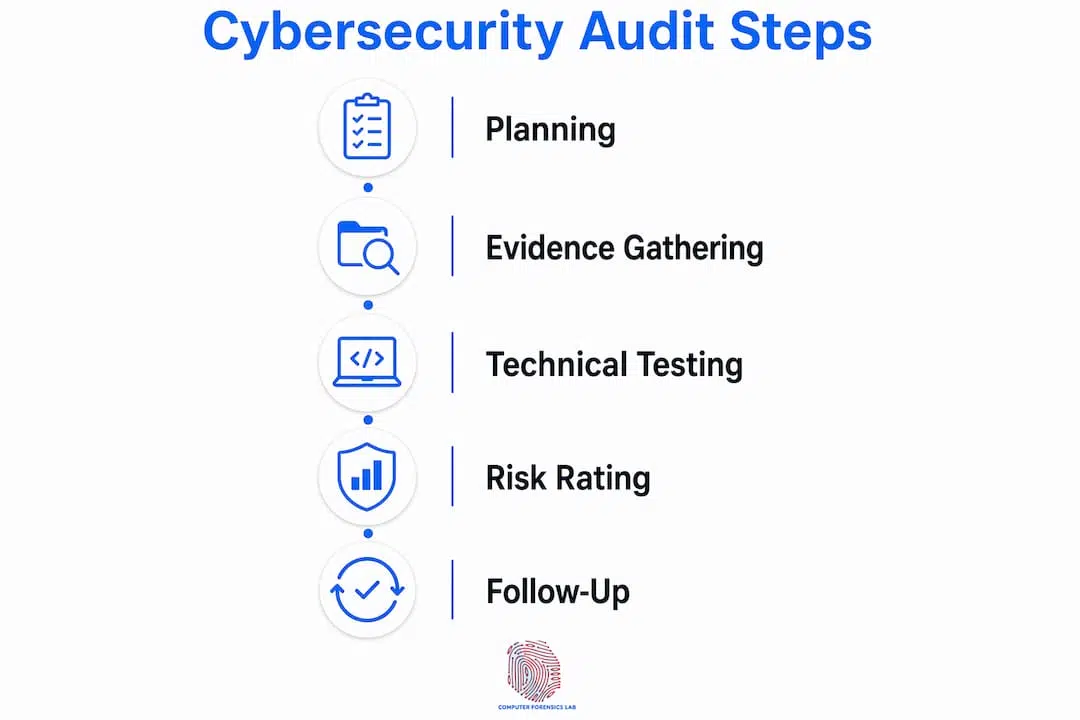
Understanding the audit process helps you allocate time, prepare documentation, and set realistic expectations for your team. A well-run audit follows five stages.
Stage 1: Planning and scoping. The auditor works with you to define the systems, processes, and standards in scope. A written scope statement is produced and agreed before fieldwork begins. This document also records the methodology, the frameworks applied (ISO 27001, NCSC, NIST), and the evidence-handling approach.
Stage 2: Evidence gathering and interviews. The auditor collects policy documents, configuration records, access logs, and incident records, and conducts structured interviews with key personnel. This stage establishes what controls exist on paper and how they are applied in practice.
Stage 3: Technical testing. Depending on scope, this includes network configuration reviews, vulnerability scanning, identity and access management checks, cloud configuration analysis, and review of data handling procedures. For practical scope examples, auditors commonly verify ISO 27001 controls, review cloud storage permissions, and assess supplier security posture.

Stage 4: Findings, risk ratings, and remediation plan. Each finding is assigned a risk rating (critical, high, medium, low) and mapped to a recommended remediation action with a suggested timeline. The report distinguishes between immediate actions and longer-term programme improvements.
Stage 5: Follow-up verification. A credible audit engagement includes a follow-up review to confirm that critical and high-risk findings have been addressed. This closes the loop and provides updated evidence for regulators and insurers.
A phased audit approach, prioritising the highest-risk areas first, reduces disruption and delivers earlier remediation wins. For organisations new to formal audits, starting with the most business-critical systems is both practical and persuasive for board-level stakeholders.
Typical timelines and cost shape for UK organisations:
- Focused audit (single system or process): two to four weeks elapsed time.
- Mid-scope audit (department or business unit): four to eight weeks.
- Full organisational audit: eight to sixteen weeks, depending on complexity.
Cost varies considerably by scope, sector, and auditor credentials. Small organisations typically invest in the low thousands for a focused engagement; enterprise-scale programmes with multiple frameworks and technical testing run to significantly higher figures. Obtaining two or three scoped proposals from credentialled providers is the most reliable way to establish a realistic budget.
Which organisations need audits, and how often?
Every organisation that holds personal data, processes financial transactions, or operates systems that others depend on has a legitimate need for regular security audits. The question is not whether to audit, but at what frequency and depth.
Regulated sectors with the highest priority:
- Legal services: Law firms hold highly sensitive client data and are subject to SRA cyber risk expectations. Computerforensicslab’s cybersecurity guidance for solicitors addresses the specific obligations facing UK law firms.
- Financial services: FCA-regulated firms face specific operational resilience requirements that audits directly support.
- Health and social care: NHS and private health organisations handle special category data under UK GDPR, with ICO enforcement a real risk.
- Critical national infrastructure suppliers: NIS Regulations impose mandatory security obligations on operators of essential services.
- Professional services and B2B suppliers: Supply chain security requirements from enterprise clients increasingly mandate audit evidence.
Frequency guidance:
- Annual comprehensive audit as a baseline for any organisation holding personal data or operating regulated systems.
- Quarterly focused checks on critical systems in high-change environments or following significant infrastructure changes.
- Continuous monitoring as a complement to, not a replacement for, formal audits.
- An immediate audit following a security incident, significant breach, or material change in IT architecture.
For smaller organisations without dedicated security teams, a targeted, lower-cost audit focused on the highest-risk assets is more appropriate than a full programme. The NCSC’s Cyber Essentials scheme provides a useful baseline framework for this audience, and an audit against those five controls is a proportionate starting point.
Pro Tip: Build your audit schedule around your regulatory renewal cycle. If your organisation renews professional indemnity or cyber insurance annually, commission the audit two to three months before renewal so the report is available for insurer review.
How to prepare for an audit and what to ask prospective auditors
Preparation reduces elapsed time, lowers cost, and produces a more useful report. The following steps apply regardless of audit type or scope.
Pre-audit preparation checklist:
- Define the audit objectives and scope in writing before approaching providers.
- Gather existing documentation: information security policy, network diagrams, asset register, previous audit reports, incident logs, and data processing records.
- Identify the key stakeholders who will need to participate in interviews (IT, legal, HR, operations).
- Prioritise business-critical assets and systems so the auditor can weight their effort accordingly.
- Confirm data handling and confidentiality requirements with your legal team before sharing documentation with an external provider.
Questions to ask prospective auditors:
- Which frameworks do you apply (ISO 27001, NCSC Cyber Essentials, NIST, or a combination)?
- What certifications do your lead auditors hold (CISSP, CISM, or equivalent)?
- How do you handle evidence and maintain confidentiality of findings?
- What is your methodology for technical testing, and what tools do you use?
- Can you provide a sample redacted report and at least two references from comparable organisations?
- How do you support remediation after the report is delivered?
- What is your approach to follow-up verification of critical findings?
Red flags in bids:
- Vague scope with no written methodology statement.
- No evidence of relevant certifications (CISSP, CISM) for the lead auditor.
- Unrealistically short timelines that suggest superficial review rather than genuine evidence gathering.
- No mention of confidentiality or data handling procedures.
- Reluctance to provide references or sample deliverables.
Pro Tip: Ask each bidder to describe the last finding they escalated to a client’s board. A credible auditor will have a clear, specific answer. A provider who has never escalated a critical finding has either been very lucky or has not been looking hard enough.
How to select the right cybersecurity auditor in the UK
Selecting an auditor is a procurement decision with significant downstream consequences. A weak audit produces false assurance; a strong one produces evidence you can act on, present to regulators, and use in commercial negotiations.
Evaluation criteria:
- Demonstrable experience with ISO 27001 and UK regulatory frameworks (UK GDPR, NIS Regulations, FCA operational resilience).
- Lead auditor certifications: CISSP (Certified Information Systems Security Professional) and CISM (Certified Information Security Manager) are the recognised benchmarks.
- Forensic capability where the audit may need to support legal proceedings or regulatory investigation. This is particularly relevant for organisations in regulated sectors or those that have experienced prior incidents.
- Genuine independence: the auditor should have no prior commercial relationship with the systems or vendors being reviewed.
- Professional indemnity and cyber insurance held by the auditor.
Trust signals to request:
- A written methodology and scope statement before engagement.
- A sample redacted report from a comparable engagement.
- Case studies or anonymised examples of findings and remediation outcomes.
- Evidence of independence, including any conflict-of-interest declaration.
“Independent external reviews frequently reveal blind spots internal teams miss because of conflict of interest or operational familiarity.” This is not a theoretical concern. Organisations that rely solely on internal review consistently underestimate their exposure in areas where internal teams have built or maintained the systems under review.
Contract checklist:
- Defined scope, deliverables, and acceptance criteria.
- Confidentiality and data handling obligations.
- Remediation support terms and follow-up verification scope.
- Timescales and milestone sign-off points.
- Escalation procedure for critical findings identified during fieldwork.
Pro Tip: For organisations in legal or financial services, prioritise auditors with forensic investigation capability alongside their audit credentials. If an audit uncovers evidence of a breach or misconduct, you need a provider who can preserve and present that evidence to the required legal standard, not one who will hand you a report and step back.
What Computerforensicslab finds in practice: a forensic-grade audit example
A mid-sized professional services firm engaged Computerforensicslab for a cybersecurity audit following a failed cyber insurance renewal. The insurer had requested evidence of active security controls and the firm had none beyond a basic firewall and an outdated acceptable use policy.
The audit scope covered identity and access management, cloud storage configuration, endpoint controls, and data handling procedures. Within the evidence-gathering stage, the audit identified three critical findings: a cloud storage bucket containing client documents was publicly accessible due to a misconfigured permission setting; privileged administrator accounts lacked multi-factor authentication; and a former employee’s credentials remained active in the firm’s primary case management system six months after their departure.
Computerforensicslab’s forensic audit approach ensured that evidence of the misconfiguration was preserved in a forensically sound manner, maintaining chain of custody in the event that the firm needed to demonstrate to the ICO that the exposure had not resulted in unauthorised access. The final report included a prioritised remediation roadmap, a revised access management policy, and a recommended continuous monitoring configuration.
The firm’s cyber insurance renewal proceeded successfully, with improved terms, three months after the audit was completed. The audit also identified legacy security controls that were consuming IT resource without contributing to protection, and decommissioning those controls reduced the firm’s annual security overhead.
The lesson from this engagement is consistent with what Computerforensicslab observes across its audit portfolio: the most significant findings are rarely the ones organisations expect. Misconfigured cloud storage, stale credentials, and unmonitored third-party access recur across sectors and organisation sizes. A structured audit with forensic-grade evidence handling is the only reliable mechanism for surfacing them.
Key takeaways
Cybersecurity audits are the primary mechanism by which UK organisations establish evidenced control assurance, meet regulatory obligations, and reduce the financial and reputational cost of security incidents.
| Point | Details |
|---|---|
| Audits reduce incident frequency | Industry research indicates audited organisations experience materially fewer security incidents, directly lowering breach response costs. |
| Regulatory evidence is mandatory | UK GDPR and NIS Regulations require demonstrable, evidenced security controls; audit documentation satisfies ICO due diligence expectations. |
| Insurance and procurement value | Well-documented audit reports can improve cyber insurance terms and satisfy enterprise procurement security requirements. |
| Phased approach works best | Prioritising highest-risk systems first delivers earlier remediation wins and builds board confidence before extending scope. |
| Computerforensicslab delivers forensic-grade audits | Computerforensicslab combines cybersecurity audit capability with forensic evidence standards, supporting both regulatory compliance and legal proceedings for UK organisations. |
Why audits sit at the heart of forensic readiness
The conventional framing of cybersecurity audits as a compliance exercise misses the more important point. An audit is also a forensic readiness exercise. When an incident occurs, the organisations that recover fastest and face the least regulatory scrutiny are those that can demonstrate, with documented evidence, that they had appropriate controls in place, that those controls were tested, and that identified weaknesses were addressed. That documentation does not exist unless someone created it through a structured audit process.
Computerforensicslab’s position on this is direct: the gap between a compliance audit and a forensic investigation is smaller than most decision-makers realise. The same evidence-handling discipline, the same chain of custody standards, and the same rigour in documenting findings apply to both. Organisations that treat their audit programme as a forensic asset, rather than a regulatory obligation, are materially better positioned when an incident occurs and the ICO or a court asks what they knew and when.
The cross-discipline value is practical. An auditor who also understands digital forensics will identify not just whether a control is in place, but whether the logs and artefacts that control generates would be admissible and useful in a legal proceeding. That is a different and more demanding standard than a compliance tick-box, and it is the standard Computerforensicslab applies.
Computerforensicslab: forensic-grade cybersecurity audits for UK organisations
For UK organisations that need audit findings they can act on, present to regulators, and rely on in legal proceedings, Computerforensicslab provides a materially different service from a standard compliance consultancy. The firm’s cybersecurity investigation and audit services combine ISO 27001-aligned control assessment with forensic evidence standards, meaning every finding is documented to chain-of-custody requirements from the outset.
Services include cybersecurity audits, forensic audits, penetration testing, data breach investigation, and post-audit remediation support. Engagements are scoped in writing, conducted under strict confidentiality obligations, and delivered with a prioritised remediation roadmap. Where audit findings indicate a prior or ongoing incident, Computerforensicslab’s digital forensics services provide the investigative capability to establish what occurred, preserve evidence, and support regulatory or legal response.
To commission an audit or request a scoped proposal, contact Computerforensicslab directly through the website.
Useful sources for UK decision-makers
The following primary sources and authoritative guides are recommended reading for decision-makers commissioning or overseeing cybersecurity audits.
- NCSC Cyber Essentials — The UK government’s baseline security framework; the starting point for any organisation new to formal security assurance.
- ICO guidance on security under UK GDPR — The ICO’s expectations for technical and organisational security measures, including audit and documentation requirements.
- ISACA: Six benefits of a cybersecurity audit — Concise practitioner summary of the compliance and governance value of regular audits.
- Valorem Reply: Cybersecurity audits guide — Detailed industry guide covering audit types, costs, and checklists; useful for scoping decisions.
- Secureframe: The critical role of cybersecurity audits — Practical guidance on audit process, continuous monitoring, and insurance implications.
- SailPoint: Benefits of a cybersecurity audit — Clear overview of audit scope, types, and organisational benefits including identity and access management focus.
- Rippling: How to perform a cybersecurity audit — Step-by-step process guide with practical advice on phased implementation.
- UK Government: Cyber Security Breaches Survey 2025 — Annual DSIT survey providing UK-specific data on breach prevalence, impact, and organisational response.
- ISO 27001 standard overview (BSI) — The international standard for information security management; the primary benchmark for UK audit programmes.
- Computerforensicslab: Forensic audits for legal and corporate clients — Computerforensicslab’s forensic audit service, combining cybersecurity assurance with legally admissible evidence standards.
This article provides general information about cybersecurity audits and does not constitute legal or regulatory advice. Organisations should confirm their specific obligations under UK GDPR, the NIS Regulations, and any sector-specific requirements with a qualified legal or compliance professional.