A computer forensic company collects, preserves and analyses digital evidence so that it can be relied upon in legal or corporate proceedings. Its core purpose is to produce findings that survive scrutiny in court or before a tribunal, supported by defensible methodology and clear reporting. Solicitors, corporate legal teams and private individuals typically instruct such firms when data on a computer, phone or cloud account may determine the outcome of a dispute.
TL;DR:
- Digital evidence collection must prioritize imaging with write-blockers to prevent data alteration and preserve chain of custody.
- Forensic analysis includes recovering deleted files, verifying document integrity, and reconstructing activity timelines from copies of devices.
- Choosing a provider requires confirming compliance with regulatory standards, accreditation, documented chain of custody procedures, and relevant court experience.
- Rapidly instructing a forensic firm is crucial to prevent data being overwritten, with initial case summaries aiding quick engagement.
- Trusted providers like Computer Forensics Lab adhere to strict quality standards, post legal and regulatory guidelines, and offer tailored services for legal and corporate investigations.
Table of Contents
- What services a professional computer forensic company provides
- When and why you should instruct a computer forensic company
- How a digital forensic investigation normally works
- How to choose a reputable computer forensic company
- Why Computer Forensics Lab is a suitable option
- Common mistakes clients make and how to avoid them
- How to instruct Computer Forensics Lab and next steps
- Authoritative guidance and standards to consult next
- Sources
- FAQ
What services a professional computer forensic company provides
A digital forensics provider offers a defined set of technical services, each aimed at extracting and validating evidence without altering the underlying data. Forensic imaging, or duplication, creates an exact working copy of a device using write-blocking hardware, with hash values calculated before and after to confirm the copy matches the original. This is the foundation of every subsequent step, because analysis is always performed on the copy rather than the source device, as explained in guidance on chain of custody.
Beyond imaging, providers typically deliver:
- Deleted file and metadata recovery, including authentication of documents and photographs to determine whether they have been altered.
- Mobile phone extraction and cloud forensics, covering messaging apps, social media accounts and cloud storage linked to a device.
- Malware analysis and network forensics, used to establish how a breach occurred and what data was affected.
- Data recovery from damaged, corrupted or reformatted media.
- Litigation support, including expert witness reports and assistance with electronic disclosure obligations, detailed further in Computer Forensics in Legal Disputes.
Each service can be commissioned individually or combined, depending on whether the matter is a single-device dispute or a wider corporate investigation.
When and why you should instruct a computer forensic company
Digital evidence features in a broad range of disputes, and the decision to instruct a specialist usually turns on whether the data needs to withstand challenge later. Common scenarios include:
- Criminal defence and prosecution, where devices may contain material central to the charge.
- Corporate fraud and employee misconduct, including unauthorised data access or breach of contract.
- Intellectual property theft, where former employees may have copied confidential files before leaving.
- Data breaches and regulatory enquiries, requiring a clear account of what happened and when.
- Family law matters, where financial or communication records are disputed.
Solicitors, corporate counsel, company directors, insurers and private clients are the parties who typically make the initial instruction. Handling devices informally, such as asking an internal IT team to search a laptop without imaging it first, risks altering timestamps and metadata, which can undermine the evidence’s admissibility before it is ever examined properly.
How a digital forensic investigation normally works
A digital forensic investigation follows a broadly consistent sequence, regardless of the size of the matter. The stages typically run as follows:
- Intake, where each device or data source is logged, assigned a unique identifier and placed into secure storage pending examination.
- Forensic imaging, performed using write-blockers to prevent any change to the original media, with cryptographic hash values recorded to verify the copy.
- Analysis, involving file carving to recover deleted material, timeline reconstruction to establish sequences of activity, and metadata checks to corroborate findings against other evidence.
- Validation and peer review, where findings are checked internally against quality assurance procedures before release.
- Reporting, producing a written account suitable for legal proceedings, with the examiner prepared to give expert testimony if required.
Thorough documentation from intake to release underpins admissibility: every transfer of custody should be dated, timed and signed, a point the National Institute of Justice’s digital evidence manual treats as central to withstanding challenge in court. Remote or offsite examination is possible using a verified working copy and secure transfer methods, but only when the provider follows validated processes, as set out in NIST guidance on offsite examination.
Timescales vary with the volume of data and the complexity of the analysis required. A single device examination may take some time, while a corporate investigation spanning multiple accounts and cloud sources can take longer, particularly where expert witness preparation is also required. More detail on this sequence appears in Digital forensics steps: a guide for investigators.
How to choose a reputable computer forensic company
Selecting a provider is a matter of verifying process, not simply comparing price. A useful checklist includes:
- Regulatory compliance: ask whether the firm follows the Forensic Science Regulator’s statutory Code of Practice, which sets mandatory requirements for practitioners undertaking forensic science activities in England and Wales.
- Accreditation: check for ISO/IEC 17025 accreditation covering laboratory work and ISO/IEC 17020 where scene-based activities are involved.
- Method validation: ask how tools and techniques are tested before use, and request evidence of quality assurance records.
- Chain of custody procedures: confirm how evidence is logged, stored and transferred, and whether documentation is available for every step, following practices described in best-practice guidance on digital evidence collection.
- Expert testimony experience: ask whether the examiner has produced court-ready reports and given evidence previously.
- Confidentiality and insurance: confirm data security measures and professional indemnity cover.
Red flags include vague descriptions of methodology, an inability to demonstrate a documented chain of custody, and deliverables that are not clearly specified before work begins.
Pro Tip: Ask a prospective provider to name the specific accreditation covering the exact activity you need, rather than accepting a general assurance of being “accredited.”
Why Computer Forensics Lab is a suitable option
Computer Forensics Lab, based in London, provides services relevant to the scenarios above, including Digital Forensics Investigations, Mobile Phone Forensics and Expert Witness Provision and Presentation, supporting solicitors, corporate clients and private individuals.
- The company states that its investigations are conducted independently and impartially, with adherence to legal and regulatory compliance including chain of custody procedures.
- It reports experience relevant to high-profile cases and has featured in a media project, indicating some public-facing recognition.
- Its practice is described as aligning with expectations under the Forensic Science Regulator’s code, alongside reference to relevant quality standards.
Readers researching a specific instruction can review the specialist services page for a fuller list of offerings.
Common mistakes clients make and how to avoid them
The most frequent error is delay: waiting days before securing a device allows data to be overwritten or altered, often by well-meaning but untrained staff. Every transfer should be documented, and no one should run ordinary software on a device before imaging, since this can change metadata. Clients should also budget realistically for urgent work and agree timelines in writing before instruction begins.
— Computer
How to instruct Computer Forensics Lab and next steps
Instructing a computer forensic company does not need to be complicated, provided you arrive prepared. Before making contact, put together a short case summary, a list of the devices or accounts involved, and any details already known about how the data has been handled or stored.
On receipt of that information, Computer Forensics Lab will typically carry out an initial triage, discuss the proposed scope of work, and provide an estimate before any forensic imaging begins. This applies equally to a single-device dispute and a multi-source corporate investigation, whether the work involves Cloud Forensics or mobile extraction.
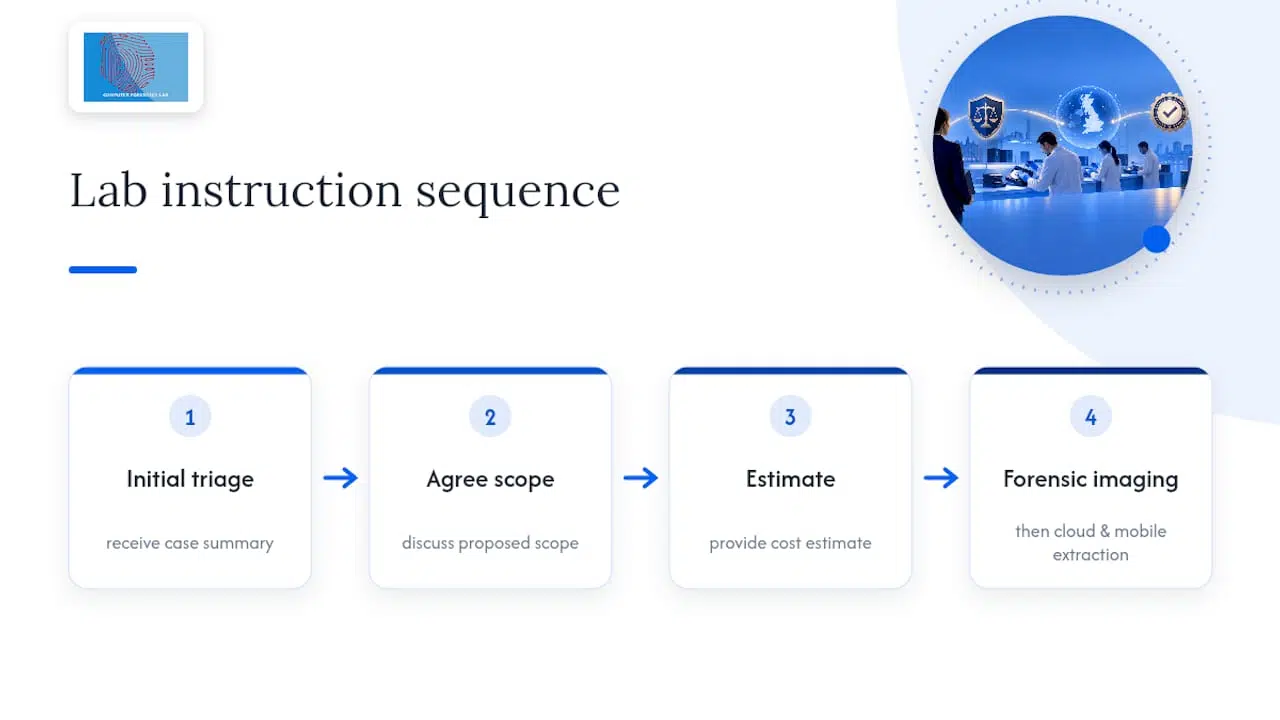
For solicitors and corporate clients who need to move quickly, particularly where devices are at risk of being altered or wiped, early contact matters more than a fully finished brief. Full details of the core services available can be reviewed on the main services page, with specialist and litigation-focused offerings set out on the specialist computer forensics services page.
Authoritative guidance and standards to consult next
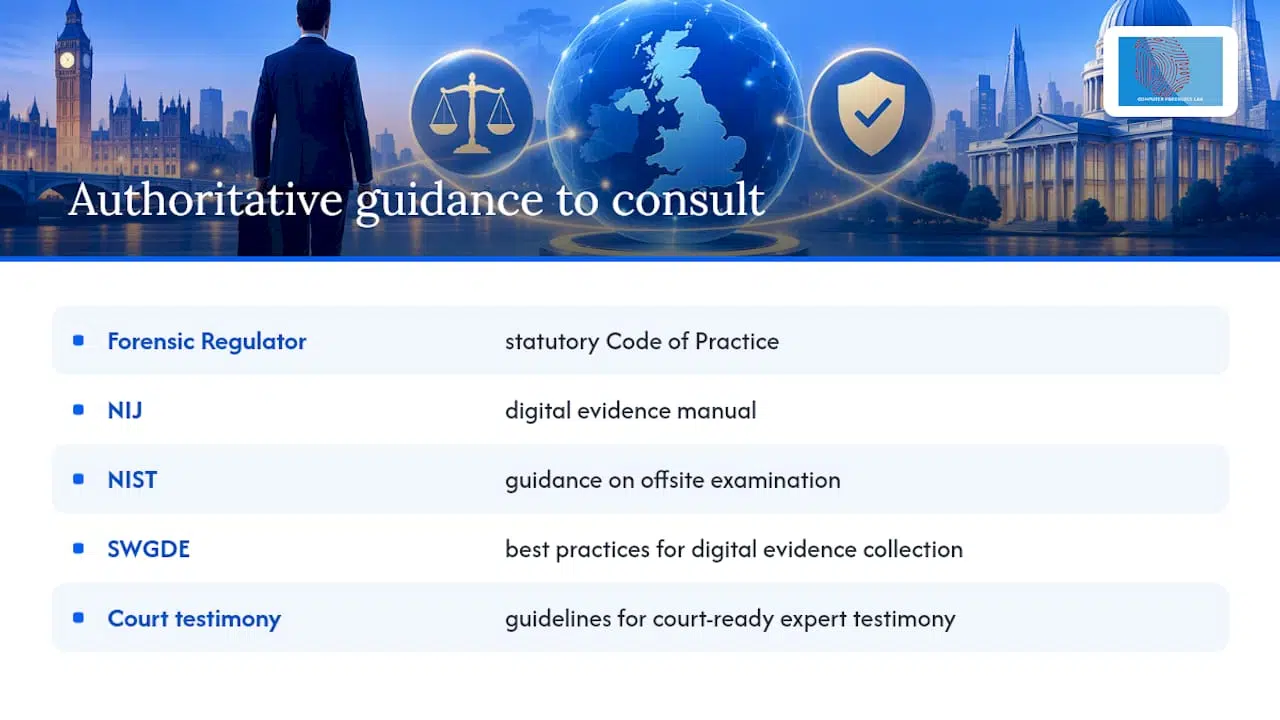
For further reading, consult the Forensic Science Regulator’s statutory Code of Practice, the NIJ’s digital evidence manual, NIST’s guidance on offsite examination, and SWGDE’s best practices for digital evidence collection, alongside guidelines for court-ready expert testimony.
Sources
- Forensic Science Activities: statutory code of practice — version 2
- National Institute of Justice: Digital evidence policies and procedures manual
- SWGDE: Best practices for digital evidence collection
- NIST guidance on non-routine offsite examination of forensic digital/multimedia evidence
FAQ
What companies specialise in computer forensics?
Specialist providers range from independent digital forensics firms to larger consultancies, all offering services such as forensic imaging, data recovery and expert witness reporting. Computer Forensics Lab is one such firm, focused on legal, corporate and private instructions in the UK.
What does computer forensics do?
Computer forensics identifies, preserves, analyses and reports on digital evidence from computers, phones and cloud accounts so that findings can be relied upon in legal or corporate proceedings. This includes recovering deleted files, verifying document authenticity and reconstructing timelines of activity.
What are the best cyber forensics companies?
There is no single ranked list of the best providers, since suitability depends on the nature of the matter, the accreditation required and the jurisdiction involved. A sound approach is to check a firm’s compliance with the Forensic Science Regulator’s code and relevant ISO accreditation before instructing them.
What is forensics in a Big Four firm?
Within large accountancy and advisory firms, forensic teams typically focus on financial fraud investigation, dispute analysis and regulatory support, often working alongside dedicated digital forensics specialists for the technical evidence element. This differs from a standalone digital forensics provider, which concentrates specifically on data acquisition, analysis and expert reporting.