
A security breach strikes fast and leaves questions behind. For digital forensics professionals at London law firms, the ability to respond methodically can mean the difference between swift justice and missed opportunities. Established frameworks from NIST and CISA highlight the value of structured response, clear team roles, and cross-department collaboration. By building a strong foundation, you set the stage for rapid detection, secure evidence handling, and confident cybercrime investigations.
Table of Contents
- Step 1: Establish An Incident Response Framework
- Step 2: Identify And Prioritise Security Incidents
- Step 3: Contain The Compromised Systems And Evidence
- Step 4: Analyse Digital Artefacts And Root Causes
- Step 5: Restore Systems And Verify Remediation
Quick Summary
| Key Point | Explanation |
|---|---|
| 1. Develop an Incident Response Framework | Create guidelines to efficiently manage and recover from cybersecurity incidents by defining roles and protocols. |
| 2. Identify and Prioritise Security Incidents | Establish monitoring systems to detect threats and rank them based on their potential organisational impact. |
| 3. Contain Compromised Systems | Implement isolation protocols for affected systems to limit damage and preserve evidence. |
| 4. Analyse Digital Artefacts | Deconstruct forensic evidence to understand the breach’s origins and identify vulnerabilities. |
| 5. Restore Systems Securely | Methodically restore infrastructure using clean backups while ensuring thorough verification to prevent reinfection. |
Step 1: Establish an Incident Response Framework
Creating a robust incident response framework is critical for organisations seeking to proactively manage cybersecurity threats. This step involves developing comprehensive guidelines and structures that enable your team to detect, respond to, and recover from potential security incidents efficiently.
To build an effective framework, start by outlining clear organisational policies and procedures. Reference the comprehensive NIST incident response recommendations to ensure you’re following industry best practices. Your framework should encompass several key components:
- Defining roles and responsibilities
- Establishing communication protocols
- Creating incident classification systems
- Developing response and escalation procedures
- Setting documentation and reporting standards
The framework must also include strategies for coordinating across different departments. Consider involving stakeholders from IT, legal, communications, and executive leadership to create a holistic approach. The CISA guidelines for incident management emphasise the importance of cross-sector collaboration in developing comprehensive response strategies.
Here is a summary of the stakeholders commonly involved in building an incident response framework:
| Stakeholder Group | Primary Role | Business Impact |
|---|---|---|
| IT Department | Technical response and recovery | Reduces downtime, restores systems |
| Legal | Compliance and liability review | Mitigates legal risks |
| Communications | Internal and external updates | Protects reputation, guides messaging |
| Executive Leadership | Strategic oversight and resources | Ensures support, aligns priorities |
By systematically building this framework, you’ll create a structured approach that reduces response times and minimises potential damage during cybersecurity events.
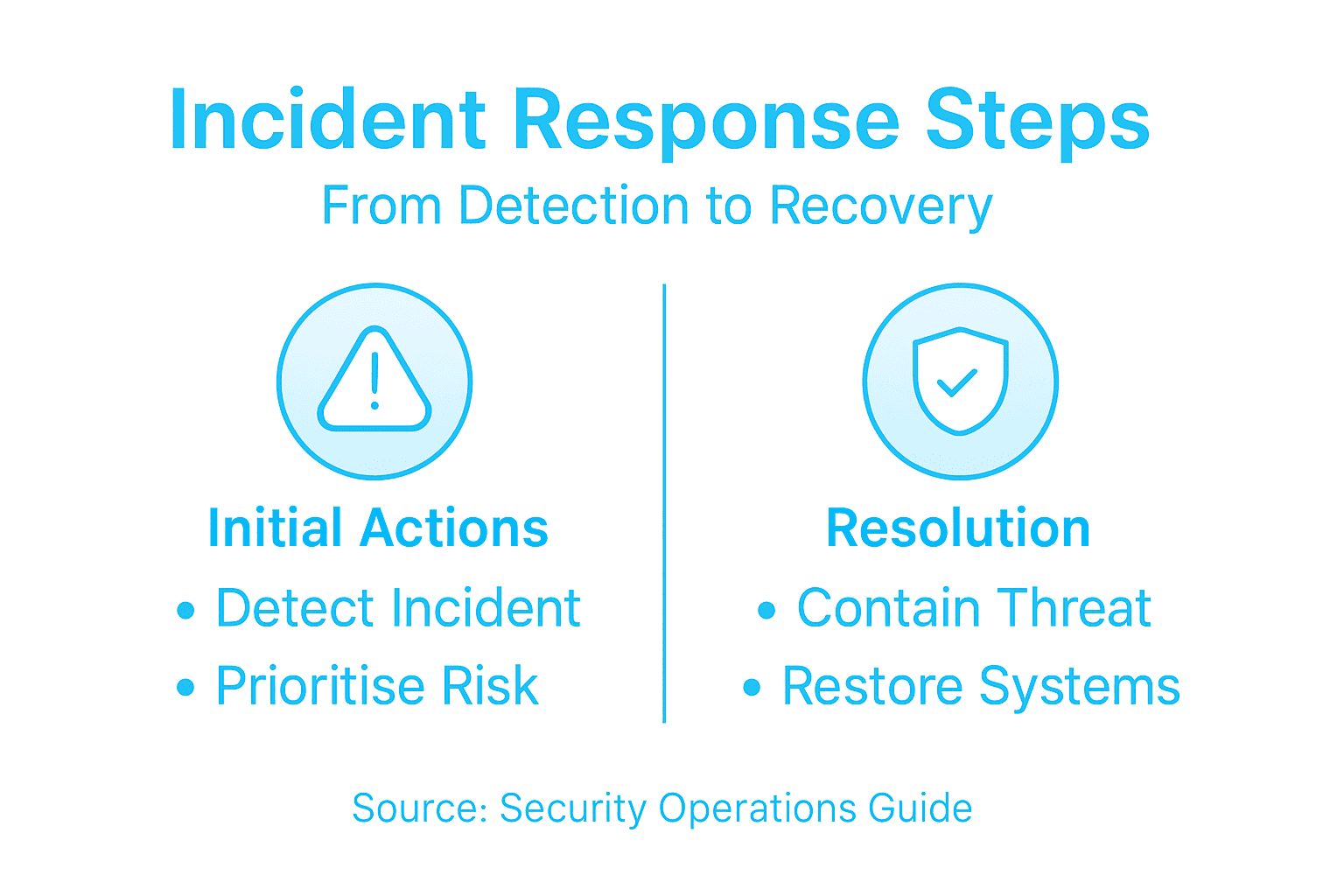
Expert recommendation: Always review and update your incident response framework at least annually to ensure it remains aligned with evolving technological and threat landscapes.
Step 2: Identify and Prioritise Security Incidents
Effective incident identification and prioritisation form the cornerstone of a proactive cybersecurity strategy. This crucial step involves systematically detecting potential security threats and ranking them based on their potential organisational impact.
Begin by establishing comprehensive monitoring systems that can detect anomalies across your digital infrastructure. The CISA guidelines for incident detection recommend developing robust situational awareness mechanisms that enable rapid threat identification. Your prioritisation approach should consider several critical factors:
- Potential operational disruption
- Sensitivity of compromised data
- Immediate and long-term financial risks
- Potential legal and regulatory implications
- Scale and speed of potential data breach
Prioritise incidents based on their potential to cause significant organisational harm, not just their technical complexity.
To effectively categorise incidents, create a standardised severity ranking system that assigns numerical or colour-coded threat levels. This allows your response team to quickly understand the urgency and required resources for each detected security event.
The following table outlines typical severity levels used in incident prioritisation systems:
| Severity Level | Characteristics | Response Urgency |
|---|---|---|
| Low | Minor impact, no disruption | Routine investigation |
| Medium | Limited disruption, some risk | Prioritised within 24 hours |
| High | Significant disruption, sensitive data | Immediate action required |
| Critical | Major threat, legal/regulatory risk | Response within minutes |
Expert recommendation: Conduct regular tabletop exercises to test and refine your incident identification and prioritisation processes, ensuring your team remains adaptable and prepared.
Step 3: Contain the Compromised Systems and Evidence
Containing compromised systems and preserving digital evidence represents a critical phase in your incident response strategy. Your primary objectives are to limit potential damage and secure forensically sound evidence that can support future investigations.
Start by implementing immediate isolation protocols for affected systems. The United Nations digital evidence handling guidelines recommend carefully preventing further system modifications while maintaining potential evidence integrity. Key containment strategies include:
- Disconnecting compromised devices from network infrastructure
- Creating forensic disk images before any potential alterations
- Documenting system state and configuration at time of incident
- Preserving network logs and connection records
- Implementing read-only access for forensic examination
Critical evidence can be irretrievably lost if improper containment procedures are followed.
Coordinate closely with your incident response team to balance system recovery needs with evidence preservation requirements. Cornell University’s information security experts emphasise the importance of avoiding unnecessary system shutdowns that might compromise forensic data.

Expert recommendation: Create a dedicated forensic workstation with write-blockers and specialised software to ensure evidence remains unaltered during your investigation.
Step 4: Analyse Digital Artefacts and Root Causes
Analysing digital artefacts represents the investigative core of incident response, where you systematically deconstruct the forensic evidence to understand precisely what occurred during a cybersecurity breach. Your goal is to develop a comprehensive narrative that reveals the incident’s origins, mechanisms, and potential vulnerabilities.
Begin by employing systematic digital forensic methodologies to examine recovered digital evidence. This involves meticulously reconstructing system events, tracking potential attack vectors, and identifying the precise sequence of compromising actions. Key analysis strategies include:
- Examining system and application logs
- Analysing network traffic patterns
- Reviewing user account activities
- Investigating malware characteristics
- Correlating timestamp information across multiple sources
Forensic analysis is less about finding isolated pieces of evidence and more about constructing a coherent narrative of the security incident.
Utilise advanced analytical techniques to uncover the root cause and attack methodology. This might involve deep dive analysis of log files, memory dumps, and network captures to understand the specific techniques used by threat actors.
Expert recommendation: Develop a structured timeline of events and maintain detailed documentation throughout your analysis to support potential legal proceedings.
Step 5: Restore Systems and Verify Remediation
Restoring systems after a cybersecurity incident requires a strategic and methodical approach to ensure complete recovery and prevent potential reinfection. Your primary goal is to return your infrastructure to a secure, fully functional state while maintaining the integrity of your digital environment.
Begin by implementing systematic vulnerability management strategies that prioritise critical system restoration. This involves carefully reconstructing systems using clean, validated backup images and applying the latest security patches. Key restoration steps include:
- Replacing compromised system components
- Applying comprehensive security updates
- Resetting all user credentials
- Reconfiguring network access controls
- Validating system integrity through multiple verification passes
Restoration is not just about returning to normal operations, but about creating a more resilient infrastructure than before the incident.
Conduct thorough post-restoration verification to confirm that all systems are functioning securely. This includes running comprehensive vulnerability scans, penetration testing, and ensuring that no residual malware or backdoors remain in your network infrastructure.
Expert recommendation: Create a detailed restoration log documenting every action taken, which will serve as a critical reference for future incident response planning and potential legal documentation.
Strengthen Your Incident Response with Expert Digital Forensics Support
Facing complexities in establishing a comprehensive incident response framework or struggling with identifying and containing security incidents can leave your organisation vulnerable. The article “Incident Response Step by Step for Effective Investigations” highlights crucial pain points such as the need for timely detection, evidence preservation, and thorough system restoration — all essential to minimising damage and ensuring effective investigations.
At Computer Forensics Lab, we specialise in helping businesses and legal professionals navigate these exact challenges. Our expert team provides advanced digital forensic services including evidence collection, malware analysis, and restoration verification that align perfectly with the detailed incident response steps discussed. With proven experience supporting cybersecurity investigations and legal cases, we help you reduce downtime and strengthen your security posture.
Take proactive action now to safeguard your organisation. Explore how our services can enhance your incident response efforts by visiting Computer Forensics Lab and request a consultation tailored to your needs. Do not let security incidents escalate without expert guidance — connect with us today and build a resilient defence.
Frequently Asked Questions
What is the first step in establishing an incident response framework?
To create an effective incident response framework, outline clear organisational policies and procedures. Begin by referencing industry best practices, such as those from NIST, and involve stakeholders from various departments within your organisation.
How can I prioritise security incidents effectively?
Prioritise security incidents by establishing a severity ranking system that considers factors like operational disruption and data sensitivity. Implement a colour-coded or numerical scale to help your team quickly assess which incidents require immediate attention.
What should I do to contain compromised systems during an incident?
When containing compromised systems, immediately isolate affected devices from your network to prevent further damage. Ensure to document the system state and preserve digital evidence for later analysis and investigation.
How do I analyse digital artefacts after a security incident?
Analyse digital artefacts by examining logs, network traffic patterns, and user activities to reconstruct the sequence of events during the incident. Employ systematic forensic methodologies to uncover vulnerabilities and understand how the breach occurred.
What are the key steps to restore systems after an incident?
Restore systems by applying validated backup images and security updates to ensure integrity. Complete a thorough post-restoration verification process, including vulnerability scans, to validate that all systems are secure before resuming regular operations.
How often should I review my incident response framework?
Review your incident response framework at least annually to ensure it aligns with evolving threats and technological changes. Regular updates can help maintain your team’s readiness and improve response times during actual incidents.
Recommended
- What Does Incident Response Mean in A Legal Context?
- Step by Step Digital Evidence Collection Guide
- How Can An IT Forensic Specialist Help You? Step-by-Step
- 7 Top Digital Forensics Techniques Every Legal Team Must Know
- How to Report Insurance Fraud: A Step-by-Step Guide – Unparalleled Global Benefits