
TL;DR:
- A digital witness report is a formal forensic document that establishes the authenticity and chain of custody for digital evidence used in court. It relies on cryptographic hashes, qualified timestamps, and detailed documentation to ensure admissibility and defend against legal challenges. Proper structure, contemporaneous recording, and a robust chain of custody are essential for the report’s credibility and acceptance in legal proceedings.
A digital witness report is a formal document that captures, authenticates, and presents digital evidence for use in legal proceedings, establishing its provenance, integrity, and chain of custody. In practice, these reports are the bridge between raw electronic data and court-admissible testimony. Without them, even compelling digital evidence can be dismissed on procedural grounds. Understanding digital witness reports explained in full means grasping how forensic methodology, legal standards, and expert analysis combine to produce documentation that courts can trust. Tools like SHA-256 hashing, qualified timestamps under the eIDAS regulation, and frameworks such as ISO/IEC 27037 are the technical foundations that make these reports defensible.
What makes digital witness reports legally admissible?
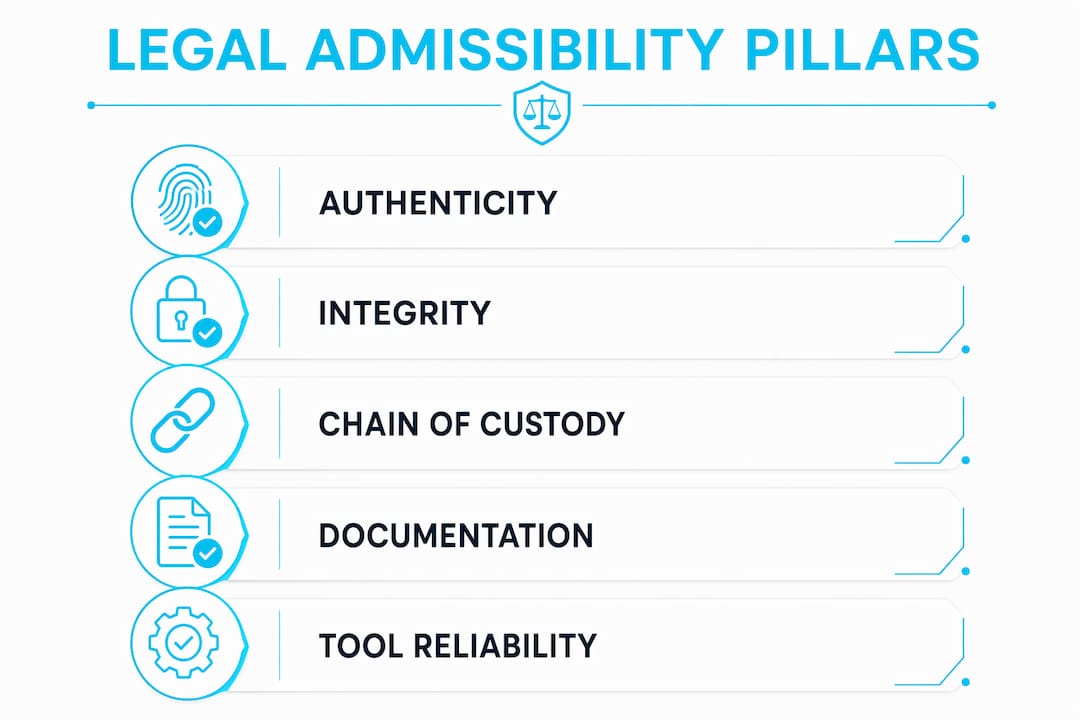
Legal admissibility for digital evidence rests on three pillars: authenticity, integrity, and a documented chain of custody aligned with ISO/IEC 27037:2012. Each pillar must be demonstrable through technical artefacts, not assertions. A report that simply states “this data was retrieved from the defendant’s device” carries no weight without cryptographic proof and procedural records to support it.
Authenticity means the evidence is what it purports to be. Integrity means it has not been altered since capture. Both are demonstrated through cryptographic hashes, typically SHA-256, and qualified electronic timestamps issued by Qualified Trust Service Providers under eIDAS, which provide legally recognised proof of data existence at a precise moment across EU jurisdictions. This combination legally binds data content to its capture time, ensuring non-repudiation.
The key admissibility elements a digital witness report must satisfy include:
- Cryptographic hash values recorded at the point of acquisition and verified at every subsequent stage
- Qualified timestamps that prove when data was captured and that it has not changed since
- Chain of custody records documenting every person who handled the evidence, when, and why
- Compliance with ISO/IEC 27037, the international standard governing the identification, collection, acquisition, and preservation of digital evidence
- Tool and methodology disclosure, including software names, versions, and configuration settings used during acquisition
“Reports that clearly separate observed facts from interpretations, state unknowns, and avoid advocacy signal higher judicial trust.” — Capital Expert Services
Missing any of these elements weakens the evidentiary chain. Opposing counsel routinely exploits gaps such as an absent hash value or an undocumented transfer to challenge the entire report. A single procedural omission can render months of forensic work inadmissible.
How is digital evidence acquired and documented?
Forensic acquisition is the practical difference between a simple file copy and court-credible digital evidence. A screenshot saved to a desktop proves nothing in court. A forensically acquired image, captured with write-blockers, hashed with SHA-256, and sealed with a qualified timestamp, is a different category of evidence entirely.

The acquisition process for physical devices uses write-blockers to prevent any data being written to the source medium during imaging. For web and cloud evidence, the process involves capturing the live state of data alongside environment metadata. Per ISO/IEC 27037 workflows, environment metadata such as browser version, installed extensions, user-agent string, and timezone must be recorded to allow independent reconstruction and validation of the evidence.
Documenting acquisition correctly requires the following steps, recorded contemporaneously:
- Record the analyst’s full name and role before any action is taken
- Note the date, start time, and end time of every acquisition session
- Document the forensic tool name and exact version number used
- Record all configuration parameters, including search terms and filter settings
- Generate and record the SHA-256 hash of the acquired data immediately after capture
- Apply a qualified timestamp and record the issuing trust service provider
- Log any anomalies, interruptions, or deviations from standard procedure
Consistent contemporaneous records including tool versions, evidence hashes, search terms, and analyst identity underpin reproducibility and withstand cross-examination. Documentation drift, where tool versions or analyst identification are not consistently recorded per action, severely weakens reproducibility and can invalidate evidence entirely.
Pro Tip: Never rely on memory or end-of-day summaries for forensic logs. Record every parameter at the moment of each action. Courts have rejected evidence where documentation was demonstrably written retrospectively.
What structure does an effective digital witness report follow?
An effective digital witness report follows a defined structure that allows judges, opposing counsel, and independent experts to navigate its contents without ambiguity. The standard sections in a compliant report are:
- Introduction: The analyst’s qualifications, instructions received, and the scope of the examination
- Methodology: The forensic tools, acquisition methods, and standards applied, with version numbers and configuration details
- Findings: A factual account of what the examination revealed, with technical artefacts such as hash values and timestamps integrated into the narrative
- Conclusions: The analyst’s expert interpretation of the findings, clearly distinguished from the factual record
- Limitations: A transparent account of what could not be determined and why
- Appendices: Raw logs, hash certificates, timestamp records, and supporting technical data
- Statement of truth: A signed declaration confirming the report is accurate and the analyst understands their duty to the court
The duty to the court is the governing principle of expert witness reporting. Independence and clear limitation disclosure increase judicial confidence, while overreach or advocacy can lead to outright report rejection. An analyst who overstates certainty, or who appears to advocate for the instructing party, damages their credibility and the case.
| Report section | Primary purpose |
|---|---|
| Methodology | Demonstrates forensic rigour and reproducibility |
| Findings | Establishes the factual evidentiary record |
| Conclusions | Provides expert interpretation, clearly separated from facts |
| Limitations | Signals independence and intellectual honesty |
| Statement of truth | Confirms duty to the court and personal accountability |
Expert reports and digital evidence packages are inseparable. A well-constructed report restates cryptographic hashes, timestamps, and logs within its narrative, allowing a judge to verify integrity without repeating the technical work. The report is not a summary of the evidence. It is the evidence, contextualised and explained.
For guidance on structuring these documents, Computerforensicslab provides detailed resources on creating expert witness reports that meet current judicial expectations.
How does the digital chain of custody support report credibility?
The digital chain of custody is the documented sequence of control, transfer, and analysis that evidence passes through from the moment of capture to its presentation in court. Four technical pillars define a defensible chain: identification, preservation, transfer, and presentation. Each stage produces measurable artefacts that independent experts can verify.
The table below summarises each pillar, the artefact it must produce, and the consequence of failure:
| Chain of custody pillar | Required artefact | Consequence of failure |
|---|---|---|
| Identification | Authenticated operator identity and device details | Evidence origin cannot be established |
| Preservation | SHA-256 hash and eIDAS qualified timestamp | Integrity cannot be proven; tampering alleged |
| Transfer | Signed custody logs with dates and recipient details | Continuity of possession breaks down |
| Presentation | Expert witness report with embedded technical proofs | Court cannot assess reliability of evidence |
Missing artefacts at any stage weakens evidence credibility greatly and invites attack from opposing counsel. Opposing experts routinely exploit gaps such as a missing hash or an unsigned transfer log to challenge the authenticity and integrity of the entire evidence package. The chain is only as strong as its weakest documented link.
The chain of custody’s measurable artefacts allow independent experts to reconstruct and verify evidence integrity, converting technical data into an evidentiary narrative the court can follow. This is why preserving chain of custody from the first moment of acquisition is not a procedural formality. It is the mechanism by which digital evidence earns its legal standing.
Pro Tip: Treat every handover of digital evidence as a formal transaction. Both parties should sign and date a custody log at the point of transfer, even within the same organisation. Courts have challenged evidence where internal transfers were undocumented.
Cross-examiners focus specifically on forensic tool versions and parameters because known software bugs can undermine findings if not documented and addressed. Failing to record the exact tool version or search parameters creates challenges to reproducibility that are difficult to rebut after the fact.
Key takeaways
A digital witness report is only as credible as the forensic methodology, documentation rigour, and chain of custody that underpin it.
| Point | Details |
|---|---|
| Admissibility requires three pillars | Authenticity, integrity, and documented chain of custody must all be demonstrable through technical artefacts. |
| SHA-256 and eIDAS timestamps are non-negotiable | Cryptographic hashes and qualified timestamps legally bind data to its capture time and prove it has not been altered. |
| Documentation must be contemporaneous | Tool versions, analyst identity, and session parameters recorded at the time of each action are what withstand cross-examination. |
| Report structure signals judicial credibility | Separating facts from conclusions, disclosing limitations, and signing a statement of truth are markers of an independent, court-ready report. |
| Chain of custody gaps invite legal challenge | A missing hash, unsigned transfer log, or absent timestamp at any stage gives opposing counsel grounds to challenge the entire evidence package. |
What working on digital witness reports has taught me
The most common failure I see in digital witness reports is not technical. It is the assumption that thorough forensic work speaks for itself. It does not. A court does not assess the quality of your acquisition methodology in isolation. It assesses whether your documentation allows someone else to independently verify every step you took. If it cannot, the work is legally invisible.
The second failure is conflating findings with conclusions. Analysts who write “the data proves the defendant sent this message” are making a legal determination, not a forensic one. The correct formulation is “the forensic examination identified a message originating from device X at time Y, bearing the following hash value.” The interpretation belongs to the court, not the report. Reports that blur this line are routinely challenged, and rightly so.
The legal document drafting workflow that governs expert reports is more structured than many analysts initially appreciate. Understanding it early prevents the kind of structural errors that require a report to be substantially rewritten before it can be filed.
My practical recommendation is to treat the statement of truth as the governing discipline for the entire report. If you cannot sign that statement against a particular sentence, that sentence should not be in the report. This single test eliminates overstatement, speculation, and advocacy more reliably than any editorial review process.
— Computer
How Computerforensicslab supports digital evidence and reporting
Computerforensicslab provides professional digital forensics services for legal professionals and law enforcement across the UK, covering the full spectrum from forensic acquisition to expert witness report production. Every acquisition follows ISO/IEC 27037 protocols and incorporates SHA-256 hashing and eIDAS-compliant qualified timestamps to meet current admissibility standards. The team produces expert witness reports that clearly distinguish findings from conclusions, disclose limitations transparently, and satisfy the duty to the court. Whether you are building a case involving mobile devices, cloud data, or web-based evidence, Computerforensicslab delivers forensic packages that hold up under cross-examination. Contact the team to discuss your case requirements.
FAQ
What is a digital witness report?
A digital witness report is a formal document produced by a forensic expert that captures, authenticates, and presents digital evidence for use in legal proceedings. It combines cryptographic proofs, chain of custody records, and expert analysis into a single court-ready package.
How does SHA-256 hashing prove evidence integrity?
SHA-256 generates a unique fixed-length fingerprint of a data set at the moment of acquisition. Any subsequent alteration to the data, however minor, produces a different hash value, making tampering immediately detectable.
What is the difference between findings and conclusions in a report?
Findings are factual observations from the forensic examination, such as file metadata or message timestamps. Conclusions are the analyst’s expert interpretation of what those findings mean, and the two must be clearly separated in any compliant report.
Why does documentation drift invalidate digital evidence?
Documentation drift occurs when tool versions, analyst identifiers, or session parameters are not recorded at the time of each action. Courts require contemporaneous records to verify reproducibility, and retrospective documentation is routinely challenged as unreliable.
What standard governs digital evidence acquisition?
ISO/IEC 27037 is the internationally recognised standard for the identification, collection, acquisition, and preservation of digital evidence. Compliance with this framework is a baseline requirement for evidence to be considered forensically sound in most jurisdictions.