
TL;DR:
- Procedural errors and chain of custody gaps cause 35% of UK digital case failures.
- Expert reports must follow strict legal standards with transparency, validation, and clear methodology.
- Proper evidence preservation, structured reporting, and honest acknowledgment of limitations are essential for admissibility.
Procedural errors are quietly sabotaging digital forensic cases across the UK. 35% of UK cybercrime case failures stem from chain of custody gaps and procedural oversights, not weak evidence. For legal professionals, that figure is a stark reminder that even the most compelling digital evidence can be rendered inadmissible if the expert witness report is not prepared correctly. This article walks you through the complete process: from understanding your legal obligations and preserving evidence properly, to structuring a court-ready report and passing final compliance checks before submission.
Table of Contents
- Understanding expert witness report requirements in the UK
- Preparation: collecting, preserving, and analysing digital evidence
- Structuring your expert witness report for maximum impact
- Common pitfalls and how to avoid them in digital forensic reports
- Final checks and ensuring compliance before submission
- A fresh perspective on expert evidence in digital forensics
- Expert digital forensic services for your next case
- Frequently asked questions
Key Takeaways
| Point | Details |
|---|---|
| Follow legal standards | Every report must comply with UK procedure rules and declare expert independence to be admissible. |
| Preserve digital evidence | Use best-practice tools and document each step to ensure evidence is accepted in court. |
| Clarify and review | Organise findings logically, use plain language, and thoroughly check for compliance before submission. |
| Disclose limitations | Openly stating uncertainties or caveats builds judicial credibility and can strengthen your report’s impact. |
Understanding expert witness report requirements in the UK
To accurately prepare an expert witness report, you must first recognise the regulatory and legal standards underpinning their structure and content. Digital forensic evidence attracts particularly close judicial scrutiny, and courts are increasingly alert to reports that fall short of procedural expectations.
In criminal proceedings, reports must follow CPR Part 19, which requires a declaration of compliance, a statement of qualifications, a list of materials relied upon, a clear methodology, and reasoned opinions. The expert’s overriding duty is to the court, not to the instructing party. That principle is not merely aspirational; courts will dismiss evidence where an expert is perceived to have advocated for a client rather than assisted the tribunal.
Digital forensic cases amplify these demands considerably. Unlike a medical or engineering report, a digital forensic report must account for the integrity of electronic data, the reliability of specialist tools, and the possibility that evidence has been altered. Judges and opposing counsel are increasingly sophisticated in challenging these reports, making transparency and rigour non-negotiable.
Understanding the expert roles in digital forensics helps clarify what courts expect at each stage. The table below summarises the core components required across criminal and civil proceedings.
| Report component | Criminal (CPR Part 19) | Civil (CPR Part 35) |
|---|---|---|
| Declaration of compliance | Required | Required |
| Statement of qualifications | Required | Required |
| Materials relied upon | Required | Required |
| Methodology and tools | Required | Required |
| Reasoned opinion | Required | Required |
| Limitations and caveats | Strongly advised | Strongly advised |
The Practice Direction for expert evidence reinforces these requirements and provides further guidance on format and content. Key obligations include:
- Maintaining independence throughout the instruction
- Clearly distinguishing fact from opinion
- Disclosing any limitations in the evidence or methodology
- Providing a signed statement of truth
“The expert’s duty is to the court and overrides any obligation to the person from whom the expert has received instructions or by whom the expert is paid.” This principle, embedded in the procedural rules, is the cornerstone of credible expert evidence.
Preparation: collecting, preserving, and analysing digital evidence
Understanding these core requirements, your next challenge is to ensure your evidence collection and handling will withstand legal scrutiny. Rigorous preservation is not optional; write-blockers and hash verification prevent the procedural errors responsible for a 35% failure rate in digital cases.
Hash verification deserves particular attention. A cryptographic hash, such as an MD5 or SHA-256 value, acts as a digital fingerprint for a piece of evidence. If the hash of a forensic copy matches the original at the point of collection and again at analysis, you can demonstrate that the data has not been altered. This single step can make or break admissibility.

Knowing how to preserve chain of custody from the first moment of evidence handling is essential. Every transfer, storage event, and access must be logged. Gaps in that log are precisely what opposing counsel will target.
A structured report for digital evidence should incorporate an executive summary, methodology (including tools such as Autopsy or X-Ways), chain of custody records, hash verification results, detailed findings with screenshots and timelines, neutral language, disclosed limitations, and a thorough compliance review.
The following steps outline the correct sequence for evidence handling:
- Photograph and document the scene before touching any device
- Use a write-blocker before imaging any storage media
- Create a forensic image and verify with hash values immediately
- Store originals securely with access logs maintained
- Conduct all analysis on the forensic copy, never the original
- Document every tool used, including version numbers and settings
- Record findings contemporaneously, not retrospectively
| Evidence type | Recommended tool | Key preservation step |
|---|---|---|
| Hard drives and SSDs | X-Ways, FTK Imager | Write-blocker, hash verification |
| Mobile devices | Cellebrite, Oxygen Forensic | Isolate from network, Faraday bag |
| Cloud and email data | Nuix, Autopsy | Authenticated export with metadata |
| Volatile memory (RAM) | Volatility | Capture before powering down |
Pro Tip: Always record the exact time and date of evidence acquisition using a synchronised clock. Courts have challenged reports where timestamps were inconsistent or unverifiable, and this simple discipline closes that vulnerability immediately. You can find additional chain of custody tips to reinforce your process.
Structuring your expert witness report for maximum impact
With evidence meticulously preserved, you are ready to translate your findings into a report that holds up in court. Structure is not just about presentation; it signals to the judge that your analysis is disciplined and your conclusions are trustworthy.
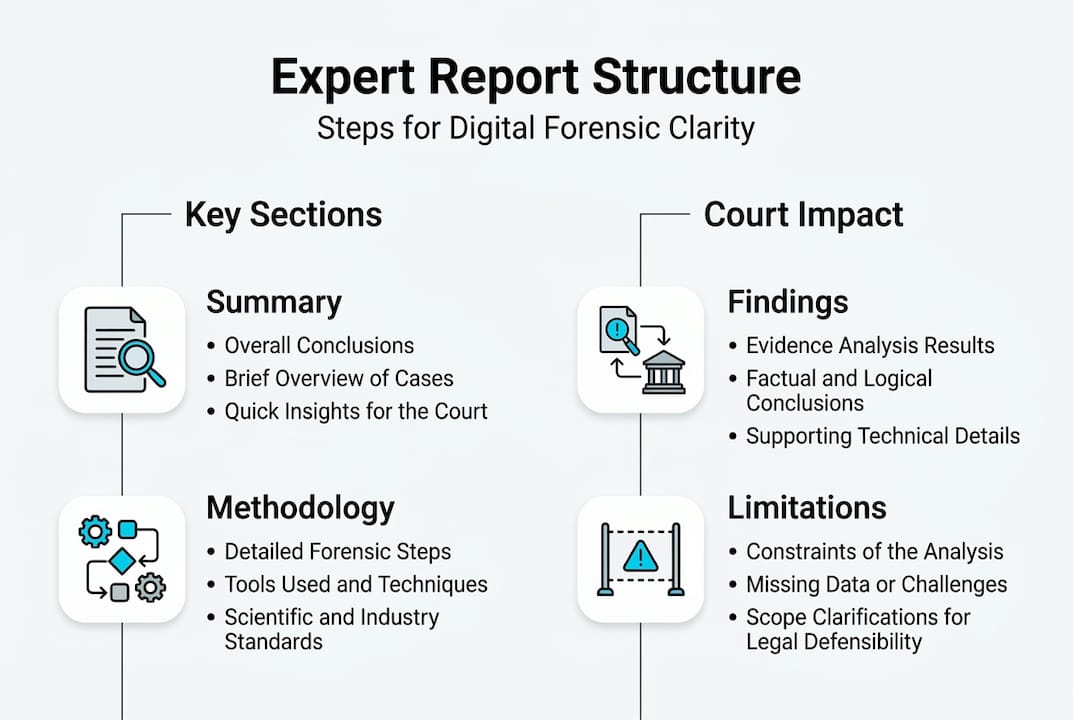
Gathering and preserving evidence with a clear chain of custody, analysing using validated tools, drafting objectively, reviewing for accuracy, and including a declaration of independence are the five mechanical pillars of a sound report. Each must be present and verifiable.
The report layout should follow this sequence:
- Cover page: Case reference, instructing party, date, and expert’s name
- Executive summary: A concise overview of findings written for a non-technical reader
- Qualifications and experience: Relevant credentials and prior court experience
- Instructions received: Verbatim or summarised instructions from the instructing party
- Methodology: Tools used, processes followed, and why they were selected
- Findings: Detailed, evidence-backed analysis with supporting visuals
- Limitations: Honest disclosure of what the analysis could not determine
- Opinion: Clear, reasoned conclusions directly responsive to the questions asked
- Declaration: Signed statement of truth and compliance with procedural rules
Using plain language and logical structure to aid non-technical judges, and acknowledging limitations transparently, are not signs of weakness. They are the hallmarks of a credible expert.
Practical tips for each section:
- Executive summary: Write it last, keep it under one page, and avoid technical jargon entirely
- Methodology: Cite published standards or tool documentation to validate your approach
- Findings: Use annotated screenshots and timelines to anchor abstract data in concrete reality
- Limitations: Be specific. Vague disclaimers are less convincing than precise acknowledgements
Pro Tip: Read your findings section aloud as if explaining to a jury member with no technical background. If you stumble or need to pause to explain a term, rewrite that passage. Clarity is a professional obligation, not a stylistic preference. Review further report preparation methods to refine your approach.
Common pitfalls and how to avoid them in digital forensic reports
Even with a well-structured report, certain recurring mistakes can quickly erode your credibility or lead to court challenges. Awareness of these failure modes is half the battle.
Nearly one third of digital forensic reports are challenged on accuracy grounds. That is a remarkable proportion, and it reflects how frequently experts underestimate the scrutiny their work will face.
The most common pitfalls include:
- Chain of custody gaps: Any undocumented transfer or access creates a vulnerability that opposing counsel will exploit
- Advocacy language: Phrases such as “clearly shows” or “proves beyond doubt” signal bias and invite challenge
- Undisclosed tool limitations: Every forensic tool has known limitations. Failing to mention them suggests either ignorance or concealment
- Scope creep: Offering opinions outside your area of expertise is a procedural violation and a credibility risk
- Failure to address alternative hypotheses: Courts expect experts to consider and rebut competing explanations, not simply assert their own
Staying within expertise, disclosing limitations and alternative hypotheses, preparing for written questions and joint statements, and avoiding advocacy are all requirements reinforced by the latest practice directions. In digital cases specifically, experts must address volatile data handling, tool limitations, and the possibility of tampering.
Pro Tip: Before finalising your report, ask yourself whether an equally qualified expert reviewing your work would reach the same conclusions from the same evidence. If the answer is uncertain, revisit your reasoning. Understanding the full expert witness role helps you maintain the objectivity courts demand.
New EWI guidance on written questions also reminds experts to respond promptly and precisely when questioned by opposing parties, treating that process as an extension of their duty to the court rather than an adversarial exchange.
Key statistic: Nearly one third of digital forensic reports face accuracy challenges in UK proceedings. Rigorous methodology and transparent disclosure are your strongest defences.
Final checks and ensuring compliance before submission
Once you believe your report is ready, a final set of checks will help safeguard its admissibility and impact in court. This stage is where many experts cut corners, and where courts notice.
Courts prioritise reliability over theoretical positions. Pre-specified models and tests carry more weight than post-hoc justifications. Experts must address opposing hypotheses, and in some cases a single joint expert is preferred to reduce costs and disputes.
Your pre-submission checklist should cover:
- Confirm every factual claim is supported by documented evidence
- Verify that all tools used are named, versioned, and validated
- Check that the chain of custody log is complete and attached
- Ensure the declaration of independence is signed and compliant with the relevant procedural rules
- Review all language for neutrality, removing any advocacy or emotive phrasing
- Confirm that limitations are clearly stated and not buried in technical appendices
- Have a peer or colleague review the report for clarity and completeness
- Deliver the report securely, retaining a timestamped copy for your records
The table below summarises key compliance areas and what to check for each.
| Compliance area | What to verify |
|---|---|
| Procedural rules | CPR Part 19 or 35 compliance, declaration present |
| Chain of custody | Complete log from acquisition to submission |
| Methodology | Tools validated, version numbers recorded |
| Neutrality | No advocacy language, limitations disclosed |
| Peer review | Independent review completed and documented |
| Secure delivery | Encrypted transmission, receipt confirmed |
Reviewing your evidence collection steps against this checklist before submission gives you a defensible record of due diligence. Courts respond well to experts who can demonstrate that their process was systematic from start to finish.
A fresh perspective on expert evidence in digital forensics
Here is something that surprises many practitioners: the experts who perform best under cross-examination are rarely the most technically brilliant. They are the ones who are most honest about what they do not know.
In our experience working on complex litigation and criminal cases, we have seen technically impeccable reports unravel because the expert refused to concede any uncertainty. Conversely, reports that openly acknowledged tool limitations or data gaps often emerged from challenge with their credibility intact. Judges are not looking for omniscience. They are looking for reliability.
Preparation for cross-examination and written questions deserves as much attention as the technical analysis itself. An expert who understands the digital forensic examiner role in its full legal context will anticipate the questions, prepare honest answers, and resist the pressure to overstate conclusions. That discipline, more than any technical skill, is what separates adequate reports from genuinely authoritative ones. Objectivity and clear communication are not soft skills. They are the foundation of expert credibility.
Expert digital forensic services for your next case
For cases where confidence and technical expertise matter, trusted support can make all the difference. At Computer Forensics Lab, we work directly with solicitors, barristers, and legal teams across the UK to produce watertight digital forensic reports that meet the strictest procedural standards. Our London-based team has extensive experience in criminal and civil proceedings, including high-profile cases featured on Discovery+.
Whether you need support with evidence acquisition, chain of custody management, or a court-ready expert witness report, our digital forensics services are designed to strengthen your litigation position. Speak to our digital evidence specialists today to discuss your case requirements.
Frequently asked questions
What should be included in a digital forensic expert witness report?
Your report should contain an executive summary, methodology, detailed findings with evidence visuals, limitations, and a signed declaration of independence. A structured digital forensic report also incorporates chain of custody records and hash verification results to support admissibility.
How can I avoid common mistakes in digital forensic expert reports?
Follow strict chain of custody protocols, use validated tools, and disclose all limitations clearly. Rigorous preservation methods such as write-blockers and hash verification are proven to reduce the procedural errors that cause case failures.
Why is chain of custody important for UK digital forensic cases?
A complete chain of custody ensures your findings are legally admissible and defends against tampering allegations. Procedural gaps in custody records are among the leading causes of digital evidence being challenged or excluded.
What if my report is challenged in court?
Be prepared to explain your methods, justify your conclusions, and address limitations or alternative hypotheses openly. Gathering evidence with a clear chain of custody, using validated tools, and drafting objectively gives you a solid foundation to defend your findings under scrutiny.