

TL;DR:
- Digital evidence is essential in over 90% of UK legal cases and must follow a strict forensic workflow.
- Proper documentation and chain of custody are critical; procedural errors can lead to evidence exclusion.
- Modern investigations face challenges like volatile data and cloud complexities, requiring specialized techniques.
Digital evidence now sits at the heart of nearly every UK legal dispute, criminal prosecution, and corporate investigation. Yet many legal professionals, businesses, and private clients still assume that digital investigations are largely improvised, a matter of plugging in a device and seeing what turns up. That assumption is wrong, and it costs cases. The digital forensic process follows a strict, court-tested workflow with defined stages, compliance obligations, and documentation requirements. Get any stage wrong and evidence may be excluded entirely. This guide breaks down each step so you know exactly what to expect and what to demand from any investigation.
Table of Contents
- Why digital investigation workflow matters in the UK
- The digital investigation workflow: step-by-step breakdown
- Maintaining chain of custody and evidence reliability
- Complex cases: handling volatile data and modern challenges
- Legal frameworks and approved tools for UK investigations
- Why workflow discipline is the real difference in digital investigations
- How to get expert support for your digital investigation
- Frequently asked questions
Key Takeaways
| Point | Details |
|---|---|
| Strict workflow is vital | A structured digital investigation workflow decides whether evidence is accepted or rejected in UK courts. |
| Chain of custody prevents loss | Meticulous documentation for every evidence transfer safeguards admissibility and case success. |
| Quick action on volatile data | Time-critical collection of RAM and network data is essential—delays risk irretrievable loss. |
| Legal rules and tools | You must use UK-approved processes and validated forensic tools such as EnCase and FTK. |
| Expert involvement boosts outcomes | Handled by experts, digital evidence contributes to higher conviction rates and lessens investigation risks. |
Why digital investigation workflow matters in the UK
Digital evidence is no longer a supplementary element in UK legal proceedings. It is the backbone. Over 90% of UK legal cases now involve some form of digital evidence, whether that is emails, device logs, social media activity, or cloud-stored files. That figure alone should shift how legal teams and corporate clients approach any investigation from the very first moment.
The critical point is this: digital evidence does not speak for itself. It only becomes admissible and persuasive when it has been collected, handled, and documented according to a recognised forensic workflow. Courts do not simply accept a screenshot or a downloaded file. They scrutinise how it was obtained, who handled it, and whether the process followed accepted standards. The chain of custody importance cannot be overstated in this context. A single undocumented transfer can render months of investigation worthless.
“Forensic workflow isn’t a bureaucratic formality. It is the legal mechanism that transforms raw data into court-admissible evidence.”
The scale of the challenge is significant. Investigation timelines range from 2 to 12 weeks, depending on case complexity, and device backlogs exceeding 20,000 units have been recorded within UK law enforcement. These delays directly affect justice outcomes. Expert involvement, however, makes a measurable difference: cases with qualified forensic specialists see conviction rates improve by approximately 20%.
Key reasons why structured workflow matters:
- Evidence obtained outside proper process is routinely challenged and excluded
- Procedural errors account for a significant proportion of failed cybercrime prosecutions
- Courts in 2026 are increasingly forensic in their scrutiny of how digital evidence was gathered
- Businesses face regulatory exposure if internal investigations do not follow recognised standards
- Expert-led investigations provide defensible, documented findings that withstand cross-examination
For legal professionals and corporate clients alike, understanding the workflow is not optional background knowledge. It is a prerequisite for running any investigation that will hold up.
The digital investigation workflow: step-by-step breakdown
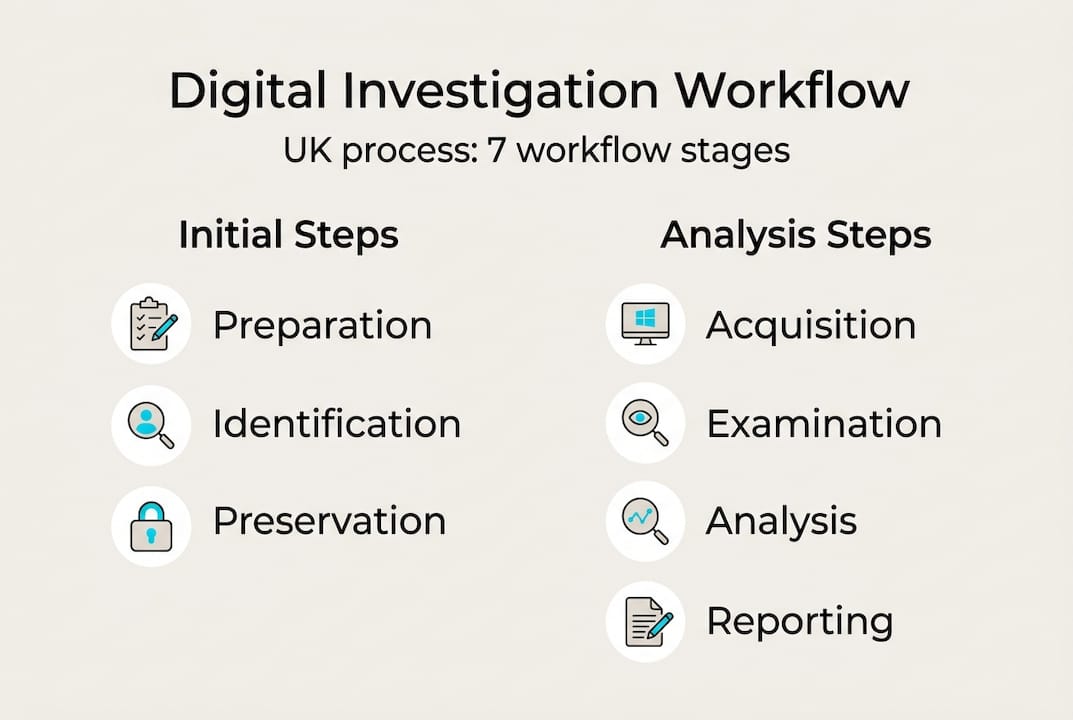
The structured forensic workflow used in UK investigations follows seven core stages. Each carries specific obligations, and skipping or shortcutting any one of them introduces legal risk.
- Preparation — Define the scope, secure legal authority (warrants or consent), and assemble the right tools and personnel before touching any device.
- Identification — Locate all potential sources of evidence: devices, accounts, cloud storage, network logs, and any connected systems.
- Preservation and collection — Prevent alteration or deletion. This means isolating devices, disabling remote wipe functions, and applying write-blockers immediately.
- Acquisition — Create forensically sound copies (images) of all relevant data using validated tools. Original media must remain untouched.
- Examination — Process the acquired data to surface relevant files, deleted content, metadata, and system artefacts.
- Analysis — Interpret the examined data in the context of the investigation, drawing connections and building the evidential narrative.
- Reporting — Produce a clear, technically accurate report suitable for court or corporate proceedings, including an expert witness statement where required.
The table below shows how requirements differ across case types:
| Stage | Legal/criminal case | Corporate investigation | Private client matter |
|---|---|---|---|
| Preparation | Warrant or court order required | Internal policy and HR sign-off | Written consent from device owner |
| Acquisition | Forensic image with hash verification | Forensic image or targeted extraction | Targeted extraction with documentation |
| Reporting | Expert witness report for court | Internal report with legal privilege | Summary report with chain of custody |
Pro Tip: Most workflow failures happen not at the analysis stage but at preservation. Volatile data, including RAM contents and active network connections, begins disappearing the moment a device is powered down. Capture it first, before anything else.
Using validated forensic tools and maintaining a complete digital forensics chain of custody record at every stage is what separates evidence that holds up from evidence that gets thrown out.

Maintaining chain of custody and evidence reliability
Chain of custody is the documented record of every person who handled a piece of evidence, every action taken, and the precise timestamp of each event. It sounds straightforward. In practice, it is where many investigations unravel.
Procedural errors cause 35% of cybercrime case failures in the UK, and the majority of those errors trace back to chain of custody gaps. With 80% of UK crimes now involving digital evidence, the stakes for getting this right are higher than ever.
| What to record | Risk if omitted |
|---|---|
| Full name of every person handling evidence | Defence can argue unauthorised access |
| Date, time, and location of each transfer | Timeline integrity collapses |
| Purpose of each action taken | Tampering allegations become harder to refute |
| Hash values before and after acquisition | Data integrity cannot be verified |
| Storage conditions and access controls | Evidence may be deemed compromised |
Must-do steps for evidence reliability:
- Apply write-blockers before connecting any storage device to a forensic workstation
- Generate and record cryptographic hash values (MD5 or SHA-256) immediately after acquisition
- Store evidence in tamper-evident packaging with unique reference numbers
- Limit access to the smallest possible number of authorised personnel
- Log every access event, even when no action is taken
Pro Tip: Treat the chain of custody log as if a hostile barrister will read every line. Because eventually, one will. Gaps that seem minor during collection become major vulnerabilities in cross-examination.
For detailed guidance on preserving chain of custody and safeguarding digital evidence throughout an investigation, rigorous documentation from the first moment of contact is non-negotiable.
Complex cases: handling volatile data and modern challenges
Not all digital evidence sits patiently on a hard drive waiting to be collected. Some of the most valuable evidence is also the most fragile, and modern investigations increasingly involve data types that demand immediate, specialist action.
Volatile data includes anything stored in RAM, active network connections, running processes, and encryption keys held in memory. Up to 60% of volatile data is lost if the device is powered down before capture. This is not a theoretical risk. It is a routine cause of evidential gaps in cybercrime cases.
Techniques for capturing volatile, cloud, and encrypted data:
- Use live forensics tools to image RAM before any device shutdown
- Capture network traffic in real time using packet capture software
- Preserve cloud evidence through legal preservation requests to platform providers before data retention periods expire
- Use specialist decryption tools where lawful authority exists, or document encryption as an evidential obstacle
- For social media, capture content with court-recognised tools that preserve metadata and timestamps
The scale of the threat environment makes these skills urgent. 7.78 million cyber crimes are recorded in the UK annually, and 50% of UK businesses have experienced a cyber attack. Investigations cannot afford to treat volatile data as secondary.
“Digital forensics must evolve faster than the technology it investigates. Static methodologies fail against dynamic threats.”
Cloud platforms present particular complexity. Data may be distributed across multiple jurisdictions, subject to different legal frameworks, and held by third parties with their own retention and disclosure policies. A well-structured cloud forensics workflow is essential for any investigation touching cloud infrastructure.
Legal frameworks and approved tools for UK investigations
Every stage of a UK digital investigation must operate within a defined legal framework. Ignoring these requirements does not just create procedural problems. It can expose investigators, legal teams, and their clients to liability.
The primary statutes governing digital evidence in the UK are:
- Police and Criminal Evidence Act 1984 (PACE) — Sets the rules for how evidence must be obtained, handled, and disclosed in criminal proceedings
- Criminal Procedure and Investigations Act 1996 (CPIA) — Governs disclosure obligations and the handling of unused material
- Data Protection Act 2018 (DPA 2018) — Regulates how personal data may be processed during investigations, including restrictions on retention and access
- Investigatory Powers Act 2016 — Controls the interception of communications and the use of surveillance powers
Warrants or explicit consent are required before accessing most devices or accounts. Proceeding without proper authorisation makes any evidence obtained inadmissible and may constitute a criminal offence.
On the tools side, forensic integrity depends on using validated software. Write-blockers, EnCase, FTK, and Cellebrite are the industry standards in UK investigations, with NIST validated tools providing independent verification of forensic reliability. Using unvalidated or consumer-grade software introduces challenges that defence teams will exploit.
For a full overview of digital forensics compliance requirements and the forensics tools used by UK legal teams, understanding the intersection of law and technology is what separates a defensible investigation from a compromised one.
Why workflow discipline is the real difference in digital investigations
After working across criminal, civil, and corporate investigations, one pattern becomes clear. The cases that fail rarely fail because the technology was inadequate. They fail because someone skipped a step that seemed unimportant at the time.
A missed timestamp. An undocumented device transfer. A forensic image taken without a hash value. These are not exotic mistakes. They are common ones, and UK courts are increasingly willing to exclude evidence on exactly these grounds. The best forensic software in the world cannot repair a chain of custody broken by poor process.
Backlogs and errors are almost always human in origin. The discipline of following a structured workflow, every time, without exception, is what builds the kind of evidential record that survives adversarial scrutiny. It is also what allows expert witnesses to give confident, unshakeable testimony. Adopting rigorous habits around protecting evidence from the very first moment of collection is the single most effective thing any investigation team can do. Workflow is not the boring part of digital forensics. It is the part that wins cases.
How to get expert support for your digital investigation
If you are managing a litigation matter, responding to a data breach, or investigating employee misconduct, the quality of your digital investigation will depend entirely on the rigour of the process behind it. Our team at Computer Forensics Lab provides UK digital forensics services covering every stage of the workflow, from initial preservation through to expert witness reporting. We help legal professionals, businesses, and private clients trace digital evidence across devices, cloud platforms, and social media while maintaining full chain of custody. Contact Computer Forensics Lab today to discuss your case with a specialist.
Frequently asked questions
What is the digital investigation workflow used for in the UK?
It provides a step-by-step process for collecting, analysing, and reporting digital evidence so it stands up in legal or security proceedings. A structured forensic process is essential for evidence to be accepted by UK courts.
What are the main stages of a digital investigation workflow?
The core stages are Preparation, Identification, Preservation and Collection, Acquisition, Examination, Analysis, and Reporting. These seven core steps follow ACPO guidance and apply across criminal, civil, and corporate investigations.

Why is chain of custody so important for digital evidence?
It documents every evidence transfer so gaps cannot be challenged in court. Missing timestamps or handlers may result in evidence being excluded entirely.
Which laws and tools apply to digital investigations in the UK?
PACE 1984, CPIA 1996, and DPA 2018 are the primary statutes. Approved forensic tools such as EnCase, FTK, and Cellebrite are standard in UK investigations.
What special challenges affect modern digital investigations?
Volatile data must be secured immediately, as 60% is lost if delayed. Cloud platforms and encryption require specialist approaches and legal authority before access is possible.