

TL;DR:
- Deleted data often remains physically intact on storage media until overwritten, making timely recovery critical in legal cases. The recoverability significantly depends on factors like storage type, elapsed time, and encryption, with SSDs posing particular challenges due to TRIM and garbage collection. Proper forensic procedures, immediate device seizure, and expert involvement are essential to preserve evidence integrity and ensure admissibility in court.
Deleted data is not the same as destroyed data. That distinction is one the most costly misconceptions in UK litigation and corporate investigation today. Understanding why recover deleted data matters is not merely a technical question — it is a strategic legal one. In practice, files removed from a device often remain physically intact on the storage media, waiting in forensic silence until overwritten. Whether you are advising on employment disputes, intellectual property theft, or a security breach, knowing when data is recoverable and acting on that knowledge quickly can be the difference between a winnable case and a collapsed one.
Table of Contents
- How deleted data persists and why it matters legally
- Challenges of recovering deleted data from modern storage devices
- Backup strategies versus deleted data recovery in corporate investigations
- Role of deleted data recovery in security incidents and forensic investigations
- Best practices for legal professionals when recovering deleted data
- Rethinking assumptions about deleted data recovery in legal cases
- Partner with expert forensic recovery services for legal success
- Frequently asked questions
Key Takeaways
| Point | Details |
|---|---|
| Deleted data often persists | Data marked as deleted remains until overwritten, offering a recovery window for forensic analysis. |
| SSD recovery urgency | Recoverability from SSDs decreases rapidly due to TRIM, so immediate device seizure is essential. |
| Backups complement recovery | Backups provide primary restoration means when available, with recovery supplementing missing or stale data. |
| Forensic protocols matter | Admissible evidence requires proper imaging, chain of custody, and validated recovery tools. |
| Misconceptions risk cases | Realistic understanding of recovery limits improves legal strategies and prevents over- or underestimating evidence availability. |
How deleted data persists and why it matters legally
When a user deletes a file, most operating systems do not erase its contents. Instead, the file system marks that storage space as available for reuse. The actual data sits undisturbed until new data physically overwrites it. This creates a forensic window — sometimes hours, sometimes weeks — during which most deleted data can be retrieved unless it has been overwritten, encrypted, or securely erased.
For legal professionals, this is not merely reassuring. It is operationally critical. Evidence that a client assumes is gone may be entirely accessible to a competent forensic examiner. Equally, evidence that opposing parties believe they have destroyed may be partially or fully recoverable, which changes the landscape of disclosure obligations under UK civil procedure rules.
Legal data recovery and evidence preservation depend on this principle: deleted does not mean gone. The key factors that determine recoverability include:
- Time elapsed since deletion — the longer a device remains in use, the greater the chance of overwriting
- Storage media type — traditional hard drives (HDDs) retain deleted data far longer than solid-state drives (SSDs)
- File system in use — NTFS, FAT32, and APFS each handle deletion differently
- Whether encryption is active — full-disk encryption can make recovery impossible without the correct key
- Whether secure-erase tools were used — deliberate wiping is a different scenario from routine deletion
Understanding the basics of data recovery for legal professionals helps set realistic expectations before instructing forensic experts. Misconceptions about permanent deletion often lead legal teams to advise clients incorrectly about disclosure risk or to dismiss potentially recoverable evidence without pursuing it.
Challenges of recovering deleted data from modern storage devices
Not all storage devices behave the same way forensically. The growing prevalence of SSDs in laptops, smartphones, and corporate workstations has fundamentally changed what is possible — and how urgently investigators must act.
On HDDs, deleted data persists until the operating system writes new data to that physical sector. An examiner working on an HDD seized a week after deletion may still recover complete files, including metadata showing creation dates, user activity, and modification history. That metadata alone can establish a timeline in employment tribunal proceedings or intellectual property claims.
SSDs operate differently. On SSDs, recoverability drops rapidly due to TRIM and active garbage collection, which erase blocks almost immediately after deletion. TRIM is a command built into modern operating systems that tells the SSD to proactively clear deleted blocks for performance reasons. The result is that forensic tools encounter genuinely empty space rather than intact data.
Additional complicating factors on SSDs include:
- Wear-levelling — data is distributed across cells to extend drive life, making reconstruction harder
- Garbage collection — runs independently of the operating system, erasing deleted blocks without user input
- Proprietary controller firmware — varies between manufacturers, limiting what generic recovery tools can access
- Encryption at the hardware level — many modern SSDs encrypt data natively, tying recovery to cryptographic keys
Pro Tip: If an SSD device becomes relevant to a legal matter, instruct that it be powered off immediately and imaged at the earliest opportunity. Every minute it remains powered on increases the risk of TRIM completing and permanently destroying recoverable data.
For expert guidance on deleted data recovery from SSD devices, early forensic involvement is not a preference — it is a necessity.
Backup strategies versus deleted data recovery in corporate investigations
For corporate clients, the relationship between backup restoration and forensic data recovery is often misunderstood. They are not interchangeable. They serve different purposes, and in investigations they frequently need to work together.
Most complete restoration comes from recent backups; forensic deleted-data recovery serves as a complementary option when backups are compromised, tampered with, or simply do not exist. In many corporate investigations, backups are the first thing a sophisticated insider will alter or destroy. That is precisely when forensic recovery from live or seized devices becomes the only viable option.

| Method | Best used when | Limitations |
|---|---|---|
| Backup restoration | Recent, verified backups exist | Backups may be outdated, missing, or tampered with |
| Forensic data recovery | Backups unavailable or unreliable | Success depends on storage type and elapsed time |
| Combined approach | Complex investigations with multiple evidence sources | Requires specialist coordination |
Key considerations for corporate investigations using both methods:
- Verify backup integrity before relying on restored data as evidence
- Determine whether backup logs themselves show signs of tampering or unusual deletion
- Use forensic data recovery steps alongside backup validation to corroborate findings
- Treat recovered data and backup data as separate evidence streams requiring independent verification
- Document the source of every piece of evidence in your chain of custody records
The impact of lost data on business in an investigation context extends beyond operational disruption. Unrecovered evidence can expose a company to adverse inferences in litigation, regulatory penalties, or weakened defence positions. Effective data recovery for legal cases combines forensic methodology with a clear understanding of how corporate data environments are structured.
Role of deleted data recovery in security incidents and forensic investigations
Security breaches and insider threat investigations share a common pattern: evidence is deleted. Logs are cleared. Files are moved and then removed. Understanding why file recovery is necessary in this context goes beyond simple data restoration — it is about reconstructing intent.
“Deliberate deletion often aims to conceal evidence, but recovery can reveal artefacts or logs left behind, crucial for proving intent in both civil and criminal matters.”
A forensic examiner investigating a data breach does not simply look for deleted files. They examine the residue of activity: partial file entries in the master file table, shellbags recording folder access, prefetch files showing application execution, and event logs that may have been partially wiped. These are the artefacts that establish what happened, when, and by whom.
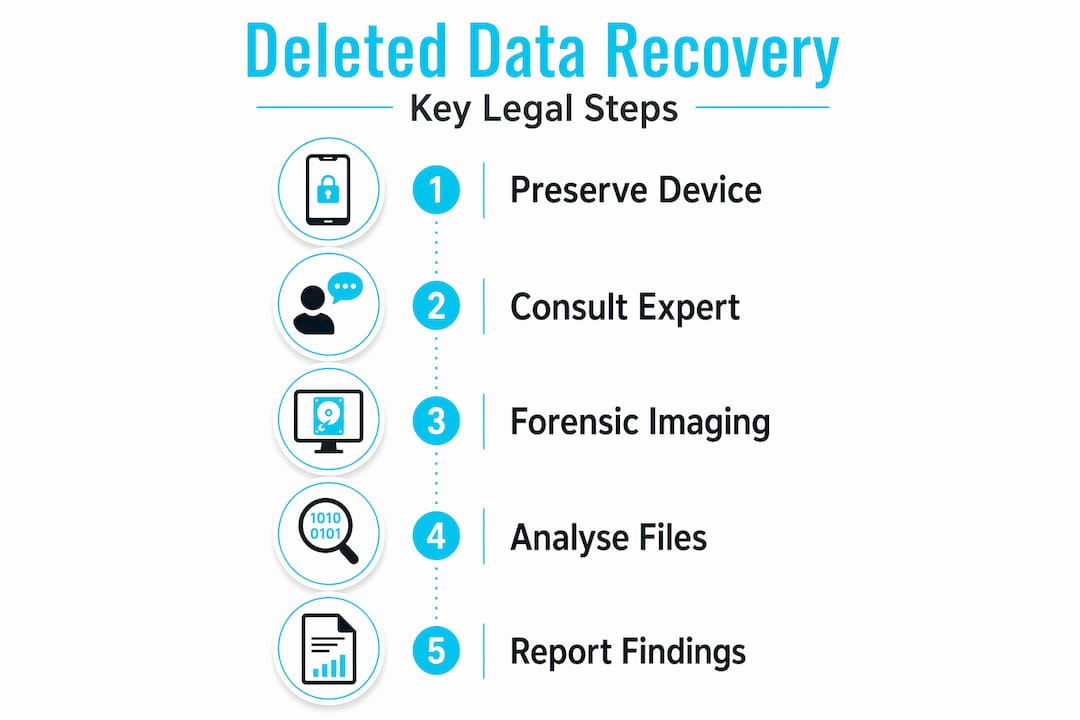
A typical forensic investigation into deleted data for a security incident follows these phases:
- Device seizure and write-blocking — preventing any further writes to the evidence media
- Forensic imaging — creating a verified bit-for-bit copy using cryptographic hashing
- File system analysis — examining the master file table, directory entries, and unallocated space
- Artefact recovery — extracting deleted files, fragments, metadata, and log entries
- Timeline reconstruction — correlating recovered data with system timestamps and user activity
- Cryptographic verification — confirming image integrity matches the original hash
- Expert witness reporting — documenting findings in a form admissible before UK courts
Pro Tip: When briefing a forensic expert for a security incident investigation, ask specifically what artefact classes they will examine beyond deleted files. Log analysis, browser history, and registry entries often yield more probative evidence than file recovery alone.
Knowing these top data recovery techniques for legal investigations allows legal professionals to ask better questions and set realistic expectations for what forensic examination can and cannot establish.

Best practices for legal professionals when recovering deleted data
When deleted data recovery becomes necessary in a matter you are handling, the decisions made in the first few hours are often the ones that determine admissibility and outcome. The benefits of data restoration are only realised if the recovery process is conducted in a forensically sound manner from the outset.
Forensic imaging before analysis, chain of custody maintenance, and validated tool usage ensure that recovered data is admissible in court. Every step of that process must be documented.
Critical actions legal teams must take upon identifying a relevant device:
- Secure the device immediately — prevent further use by the subject or any third party
- Do not attempt recovery in-house — unqualified attempts can overwrite the very data you need
- Instruct a certified forensic examiner — ensure they use write-blocking hardware and validated software
- Maintain a chain of custody log from the moment the device is identified as relevant
- Engage forensic data recovery services with experience in producing court-admissible reports
| Common cause of recovery failure | How to avoid it |
|---|---|
| Continued device use after deletion | Power off and seize immediately |
| In-house recovery attempts | Instruct qualified forensic examiners only |
| Delayed forensic action on SSDs | Treat SSD seizure as time-critical |
| Failure to document handling | Maintain a chain of custody from first contact |
| Using unvalidated recovery tools | Require examiners to document tool validation |
Pro Tip: Before instructing a forensic expert, confirm they can produce an expert witness report meeting UK court standards. Technical competence and legal presentation are both essential — a recovery without a defensible report is of limited value in proceedings.
Data recovery best practices in legal contexts also intersect with financial investigation. Where forensic accounting and data recovery overlap, as in fraud or asset-tracing matters, coordinating digital and financial forensics from the outset produces a far more coherent evidential picture.
Rethinking assumptions about deleted data recovery in legal cases
Here is the uncomfortable truth: the binary thinking that data is either recoverable or gone is actively damaging legal cases in the UK right now. That belief harms legal strategies; a nuanced appreciation of context is what produces results.
We see two failure modes regularly. The first is overconfidence — a legal team assumes that because a device uses an HDD, full recovery is guaranteed, and so delays instructing a forensic expert while attending to other case preparation. Meanwhile, the device remains in use, data gets overwritten, and the window closes. The second is premature abandonment — a team learns the device is an SSD, concludes recovery is impossible, and never pursues it. In doing so, they miss the metadata, partial file entries, and system logs that survive even after TRIM has run.
Partial recovery is not a consolation prize. A fragmented document recovery that shows a file existed and was deleted at a specific time can prove spoliation. System artefacts showing a user accessed particular folders before departing a company can establish misappropriation without a single complete file being recovered.
Common misconceptions and what to correct:
- “Emptying the recycle bin permanently deletes data” — it does not; it simply removes the file system reference
- “SSDs make forensic investigation pointless” — timing and artefact recovery often yield probative evidence regardless
- “Cloud storage means device recovery is unnecessary” — cloud and local copies can diverge; both warrant examination
- “Formatting a drive destroys all evidence” — formatting typically removes file system metadata, not the underlying data
- “Full recovery is required for evidence to be admissible” — partial recovery with proper methodology is entirely admissible
Legal professionals who understand forensic data recovery methodology are better placed to advise clients on preservation obligations, challenge opposing evidence, and assess the true strength of a disclosure position.
Partner with expert forensic recovery services for legal success
When deleted data recovery is relevant to your case, the quality of the forensic provider you instruct is not a secondary consideration. Computer Forensics Lab offers certified digital forensics services specifically designed to meet the standards required by UK courts, regulatory bodies, and corporate investigations.
Our work covers forensic imaging of HDDs and SSDs, specialist forensic data recovery from encrypted and damaged devices, full chain of custody documentation, and expert witness reporting. Whether the matter involves employee misconduct, intellectual property theft, or a security breach, we bring the methodological rigour that makes recovered evidence stand up under cross-examination. You can also explore our data recovery fundamentals guidance to understand the process before engaging. This professional support ensures your legal strategies rest on strong, admissible digital evidence.
Frequently asked questions
Can deleted data always be recovered for use in legal cases?
No, recovery depends on factors such as storage media type, time elapsed, and whether data has been overwritten or securely erased. Recovery is possible 70 to 90% of the time for non-overwritten data, but drops to zero after TRIM on SSDs or without encryption keys.
Why is immediate action important after data deletion in legal investigations?
Because continued device use can overwrite deleted data, promptly securing and imaging devices preserves the best chance of recovery. Every second a device remains active after deletion is a risk, as delays allow critical data to be overwritten.
How does SSD technology affect deleted data recoverability?
SSDs use TRIM commands to erase deleted data almost immediately, making recovery extremely difficult compared to traditional hard drives. TRIM alerts the SSD to erase blocks right after deletion, rendering traditional recovery methods far less effective.
What role does chain of custody play in deleted data recovery for legal cases?
It ensures recovered data is admissible in court by documenting evidence handling from seizure through to presentation. Unbroken documentation during recovery is required to maintain admissibility and resist challenges to evidence integrity.