

TL;DR:
- Detecting malware early is essential to preserve digital evidence, ensure legal compliance, and maintain business continuity.
- Implementing foundational controls like patch management, antivirus, firewalls, and log retention creates a reliable detection baseline aligned with UK standards.
- Effective malware detection hinges on documented objectives, contextual analysis, and threat intelligence integration to support forensic investigations and legal defensibility.
A routine audit flags an unfamiliar process running on a senior partner’s laptop. Nobody knows what it is. That single moment of uncertainty can unravel an entire digital investigation, compromise privileged evidence, and expose your organisation to regulatory penalties under UK data protection law. Undetected malware does not simply sit quietly; it exfiltrates files, corrupts logs, and destroys the very audit trails that legal proceedings depend upon. This guide gives UK legal professionals and corporate security teams a structured, evidence-driven framework for detecting malware early, verifying results with confidence, and building processes that hold up to forensic scrutiny.
Table of Contents
- Why malware detection matters for UK legal investigations
- Prevention and foundational controls: Building your detection baseline
- Step-by-step malware detection: Monitoring, logging, and threat intelligence
- Troubleshooting, common pitfalls, and verifying detection accuracy
- A fresh perspective: Defensible detection means documented objectives, not ad-hoc searches
- Connect with expert digital forensics solutions for malware detection
- Frequently asked questions
Key Takeaways
| Point | Details |
|---|---|
| Phishing is top threat | Phishing and social engineering account for the majority of malware entry points in UK organisations. |
| Baseline controls are vital | Antivirus, patching, firewalls, and restricted ports build a strong foundation for malware detection. |
| Contextual enrichment reduces errors | Combining asset inventories and threat intelligence helps avoid false positives and improves detection accuracy. |
| Monitoring supports legal defensibility | Well-documented monitoring and logging make detection procedures credible for legal investigation and response. |
| Signature-only approaches are outdated | Modern detection requires broad monitoring and integration of threat intelligence, not just static signatures. |
Why malware detection matters for UK legal investigations
When malware goes undetected inside a law firm or corporate environment, the consequences extend far beyond a technical inconvenience. Evidence stored on compromised devices may be tampered with, deleted, or rendered inadmissible. In a litigation context, this is catastrophic. Courts expect that digital evidence has been collected and preserved with a demonstrable chain of custody. A device running undiscovered malware fundamentally undermines that expectation.
Beyond evidence integrity, there is also the question of business continuity. Ransomware variants routinely encrypt case files, client databases, and communication records. A single successful attack can halt legal proceedings, trigger regulatory notifications under the UK GDPR, and generate significant reputational damage. The stakes are therefore not purely technical; they are legal, financial, and professional.
Understanding how malware enters your environment is just as important as knowing what it does once inside. The ENISA Threat Landscape 2025 confirms that phishing and social engineering account for the majority of initial access events, making them the single greatest threat vector for organisations of all sizes. That finding has direct implications for where legal and corporate teams should focus their detection resources first.
Common malware entry vectors
| Attack vector | Approximate share of incidents | Example method |
|---|---|---|
| Phishing and social engineering | 60% | Credential-harvesting emails to staff |
| Exploitation of vulnerabilities | 21.3% | Unpatched software on endpoints |
| Supply chain compromise | ~8% | Malicious third-party software updates |
| Physical media (USB, removable drives) | ~5% | Infected devices brought on-site |
| Insider threat or misuse | ~5.7% | Intentional or accidental data transfer |
The table makes clear that the majority of incidents do not rely on sophisticated zero-day exploits. They exploit human behaviour and unpatched systems, both of which are addressable through disciplined controls. For a deeper look at malware analysis tips relevant to legal and cybersecurity professionals, the technical context there is invaluable for building your initial threat picture.
With this understanding of why malware can be so disruptive, it is critical to prepare proper detection controls before an incident occurs.
Prevention and foundational controls: Building your detection baseline
Detection does not begin the moment you suspect an infection. It begins weeks or months earlier, when you establish the controls that generate the signals you will later rely upon. Without a solid baseline, you cannot distinguish normal behaviour from malicious activity, and your detection programme will produce little more than noise.


The NCSC Cyber Essentials requirements provide the clearest starting point for UK organisations. Cyber Essentials is not merely a certification exercise; it is a practical foundation for malware prevention and early detection. The five technical controls it mandates are directly relevant to reducing your attack surface and generating the telemetry detection depends upon.
Foundational baseline controls
- Install and maintain antivirus software on all endpoints, including mobile devices used for case work
- Patch all software and operating systems within 14 days of a critical update being released, or sooner for actively exploited vulnerabilities
- Configure and maintain boundary firewalls to restrict inbound and outbound connections to only those required
- Restrict USB and removable media access through group policy or device management platforms
- Enforce least-privilege access controls so that malware executing under a standard user account cannot reach sensitive case files or system processes
- Enable centralised logging on all endpoints and servers so that events are captured before a potential attacker can delete them locally
Pro Tip: Maintain an up-to-date asset inventory as the very first step. Without knowing what devices and software exist on your network, you cannot meaningfully interpret monitoring alerts. Asset inventories also reduce false positives significantly, because analysts can cross-reference alerts against known, approved assets rather than treating every unknown process as a confirmed threat.
UK compliance baseline summary
| Control area | Cyber Essentials requirement | Detection benefit |
|---|---|---|
| Antivirus and anti-malware | Mandatory on all devices | Catches known malware signatures at point of execution |
| Patch management | Critical patches within 14 days | Closes the vulnerabilities most commonly exploited post-phishing |
| Firewall configuration | Required at boundaries and on devices | Limits command-and-control communication channels |
| Access control | Least privilege enforced | Reduces lateral movement potential if malware executes |
| Removable media | Restricted by policy | Eliminates a documented but underestimated entry vector |
Once you have these controls in place and generating consistent data, review your incident response procedures to ensure your team knows what to do when the baseline throws an alert. It is equally worth familiarising yourself with the early warning signs of data breaches so that detection translates quickly into action.

Step-by-step malware detection: Monitoring, logging, and threat intelligence
With your baseline established, the next layer is active detection through structured monitoring. The NIST SP 800-61 Rev.3 framework, which guides incident handling globally, emphasises integrating threat intelligence and monitoring across all common attack vectors, including email, web traffic, file sharing platforms, and endpoints, to reduce the time between compromise and discovery. Shorter detection windows mean less evidence corruption and stronger forensic outcomes.
The ENISA technical implementation guidance on cybersecurity risk management ties effective malware detection directly to documented logging and monitoring objectives. In other words, what you decide to monitor, and why you monitor it, matters as much as the tools you deploy.
Sequenced detection steps
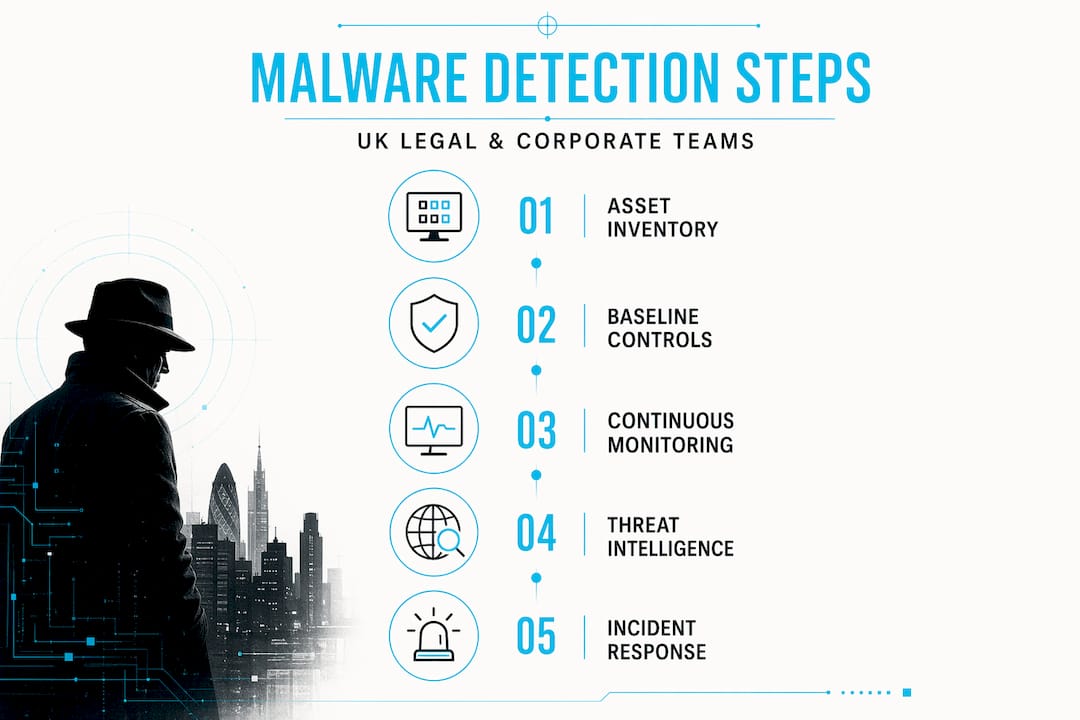
- Build and maintain a current asset inventory. Document every device, application, user account, and network segment. This is the reference point against which all anomalies are measured.
- Integrate a threat intelligence feed. Subscribe to a reputable feed (NCSC’s early warning service, for example) that provides indicators of compromise (IOCs) relevant to the UK threat landscape. Automatically push these IOCs into your monitoring platform.
- Monitor email gateways and web proxies. Given that phishing accounts for the dominant share of attacks, email remains the highest-priority monitoring surface. Log all attachment types, sender domains, and URLs accessed through corporate infrastructure.
- Enable endpoint detection and response (EDR) tools. EDR goes beyond traditional antivirus by recording process execution chains, registry modifications, and network connections made by individual processes. This telemetry is forensically rich and directly usable as digital evidence.
- Aggregate logs in a centralised SIEM platform. A Security Information and Event Management (SIEM) system correlates events across your estate. Standalone logs from individual devices are far harder to analyse under time pressure during an investigation.
- Define alert thresholds and escalation paths. Not every alert requires a full forensic investigation. Document which alert categories trigger internal review, which require external forensic support, and who holds decision-making authority at each stage.
- Conduct regular threat-hunting exercises. Proactive hunting means searching for anomalies that automated tools have not flagged. This is particularly valuable in legal environments where targeted, low-noise attacks may deliberately avoid triggering standard signatures.
Pro Tip: Combine your asset inventory with contextual enrichment when reviewing alerts. If an alert fires on a device labelled as a guest laptop with no case data, its priority differs entirely from the same alert on a server holding privileged client communications. Context turns raw signals into actionable intelligence and dramatically reduces the analyst hours spent on false positives.
Critical warning: Not every anomaly is an attack. Unusual process behaviour can result from legitimate software updates, misconfigured applications, or user error. Treat anomalies as hypotheses to be tested rather than confirmed incidents. Premature containment actions on a false positive can themselves disrupt operational continuity and, in a legal context, raise questions about evidence handling.
For a clear overview of what incident response meaning entails in the legal context, and a practical incident response step by step guide, these resources are directly applicable once your monitoring starts generating alerts.
Troubleshooting, common pitfalls, and verifying detection accuracy
Even well-designed detection programmes produce unreliable outputs when certain foundational errors persist. The most common mistakes we encounter in UK legal and corporate environments are not technical failures; they are process failures that create either too many false positives or, more dangerously, missed detections entirely.
Common detection pitfalls
- Relying solely on signature-based detection. Signature matching identifies known malware based on previously catalogued code patterns. Novel variants, modified payloads, and fileless malware techniques all bypass signature detection routinely. Relying on this alone means you are always detecting yesterday’s threats.
- Failing to baseline normal behaviour. Without knowing what normal network traffic, process execution, and authentication patterns look like for your specific environment, anomaly detection generates overwhelming noise. Baselines must be built per environment, not imported from generic templates.
- Ignoring authentication anomalies. Credential-based attacks, including password spraying and pass-the-hash techniques, often precede malware deployment. Monitoring only for file-based malware misses the early stages of many sophisticated attacks.
- Incomplete log retention. Many organisations retain logs for 30 days or fewer. Legal investigations frequently cover periods stretching back months. Inadequate retention creates evidentiary gaps that cannot be recovered after the fact.
- No documented detection objectives. If your monitoring programme has no written objectives, it cannot be defended in a legal or regulatory review. Documented objectives also help analysts prioritise correctly under pressure.
Pro Tip: When building your logging framework, document the objective behind each log source before you configure it. Ask: what specific threat or compliance requirement does this log address? This practice, recommended by forensic investigators and incident responders alike, makes your detection defensible in court because you can demonstrate that your monitoring was purposeful and methodical rather than ad-hoc.
The NIST SP 800-61 Rev.3 guidance is explicit on this point: detection signals can be ambiguous, and anomalies may be entirely benign. Pairing contextual enrichment, including asset inventories and cyber threat intelligence (CTI), with your monitoring tools improves accuracy and reduces the risk of misclassifying incidents in either direction. Understanding the cyber incident response role within legal proceedings will help your team understand why accuracy at this stage has direct consequences for case outcomes.
A fresh perspective: Defensible detection means documented objectives, not ad-hoc searches
Here is an uncomfortable reality that many cybersecurity vendors do not want to discuss: the majority of malware detection tooling sold to UK organisations is built around indicators of compromise and known-bad signatures. This creates a false sense of security, because indicators of compromise are retrospective by design. They tell you about threats that were already discovered, analysed, and catalogued by someone else, often weeks or months after the attack campaign began.
The ENISA technical implementation guidance is direct on this: signature and IOC-heavy approaches alone are insufficient when attacker tradecraft evolves rapidly. Both NIST and ENISA push practitioners toward monitoring objectives that cover configuration deviations, authentication attack patterns, and endpoint health indicators. These are behaviours, not signatures. They catch novel threats because they focus on what attackers do, not simply which tools they deploy.
For legal and corporate teams specifically, this distinction has a second, less-discussed consequence. A detection programme built around IOC checklists looks superficially rigorous but falls apart under cross-examination in a legal or regulatory context. Why? Because it cannot demonstrate why it was configured to look for specific signals, only that it looked for them. A detection programme built around documented monitoring objectives, tied to specific threat categories, compliance requirements, and operational risks, can answer that question clearly and convincingly.
The NCSC Response Prep Guide reinforces this principle: detection processes should be designed to support incident response and forensic investigation, not to operate independently of them. When your monitoring objectives are documented and aligned with your response plan, detection findings become evidence-ready artefacts rather than informal observations. That alignment is precisely what distinguishes an organisation that can manage an investigation calmly from one that scrambles to reconstruct what happened after the fact.
We have seen organisations invest substantially in detection tooling, only to have the resulting evidence challenged in proceedings because no one could demonstrate that the monitoring programme followed a coherent, documented methodology. The incident response benefits extend well beyond the immediate technical response; they protect the organisation’s legal standing throughout the aftermath of any serious incident.
Connect with expert digital forensics solutions for malware detection
When a detection alert escalates beyond what internal teams can confidently investigate, specialist forensic expertise is what preserves both the evidence and your organisation’s legal position. Computer Forensics Lab provides London-based digital forensics services specifically designed for legal professionals, corporate clients, and law enforcement in the UK. Our team supports malware investigations from initial triage through to expert witness reporting, maintaining chain of custody throughout. Explore our detailed malware analysis guidance to understand how forensic-grade analysis differs from standard IT investigations. Whether you need rapid incident response, forensic examination of compromised devices, or court-ready evidence reports, our expertise is built for the precision that legal proceedings demand.
Frequently asked questions
What is the most common entry point for malware in UK organisations?
Phishing and social engineering are the most prevalent entry vectors, accounting for 60% of initial access events according to ENISA’s 2025 threat landscape data, making email security the highest-priority control for most UK organisations.
How should legal teams verify malware detection results are reliable?
Teams should ensure their detection process combines contextual enrichment, such as asset inventories and threat intelligence, with active monitoring; detection signals alone can be ambiguous, and pairing context with technical signals significantly reduces false positives and misclassifications.
What are the key baseline controls required for malware detection in the UK?
Organisations must install antivirus software, apply critical patches promptly, configure firewalls, and restrict removable media access; these are the foundational requirements under the NCSC Cyber Essentials scheme and represent the minimum detection baseline for UK environments.
Why is signature-only malware detection insufficient for legal investigations?
Signature-based tools only identify previously catalogued threats; when attacker techniques evolve, these tools miss entirely novel variants, and both NIST and ENISA recommend behaviour-based monitoring and threat intelligence integration to address the gaps.
How can detection processes support legal forensic investigation?
Documented monitoring and logging objectives, aligned with a formal incident response plan, produce detection outputs that are defensible in legal proceedings; the NCSC response preparation guidance specifically ties detection design to forensic investigation readiness.