
TL;DR:
- Selecting the right CSI course is crucial for ensuring skills meet legal and operational standards in various professional fields. Top UK providers emphasize practical, scenario-based training, accreditation, and sector-specific content to build operational competence and legal credibility. Prioritizing hands-on experience and advanced modules ensures investigators stay current with technological developments and complex investigation requirements.
Selecting the right crime scene investigation (CSI) course is harder than it looks. Police forces, legal teams, and corporate security departments in the UK face a market crowded with options ranging from six-week intensive programmes to online self-paced modules and postgraduate degrees. The wrong choice wastes time, budget, and professional credibility. The right one equips you with skills that hold up under scrutiny in court, at a major incident, or during a high-stakes internal investigation. This guide cuts through the noise by setting out clear evaluation criteria, profiling the leading UK providers, and comparing them directly so you can make a confident, informed decision.
Table of Contents
- How to evaluate crime scene investigation courses
- Leading crime scene investigation course providers in the UK
- Course comparison: who is each provider best for?
- Advanced and specialist topics: what to look for in modern CSI training
- Professional insight: why course selection should prioritise real-world simulation
- Take the next step: combining CSI skills with digital forensics
- Frequently asked questions
Key Takeaways
| Point | Details |
|---|---|
| Practical training matters most | Hands-on simulation and real-world scenarios should be your top selection factor for CSI training. |
| Choose courses fit for your sector | Match course type and focus with your role, whether in law enforcement, legal practice, or corporate security. |
| Accreditation adds credibility | CSI courses accredited by recognised bodies stand out for professional use and court recognition. |
| Specialist modules boost employability | Advanced topics such as scene reconstruction and digital forensics are increasingly important for career progression. |
How to evaluate crime scene investigation courses
Before you shortlist a single provider, you need a framework that reflects the realities of your role. A corporate security manager has fundamentally different requirements from a detective constable or a solicitor building an evidence portfolio for litigation. Understanding what separates a genuinely rigorous course from a polished marketing brochure is the first skill you should develop.


What defines a high-quality CSI course?
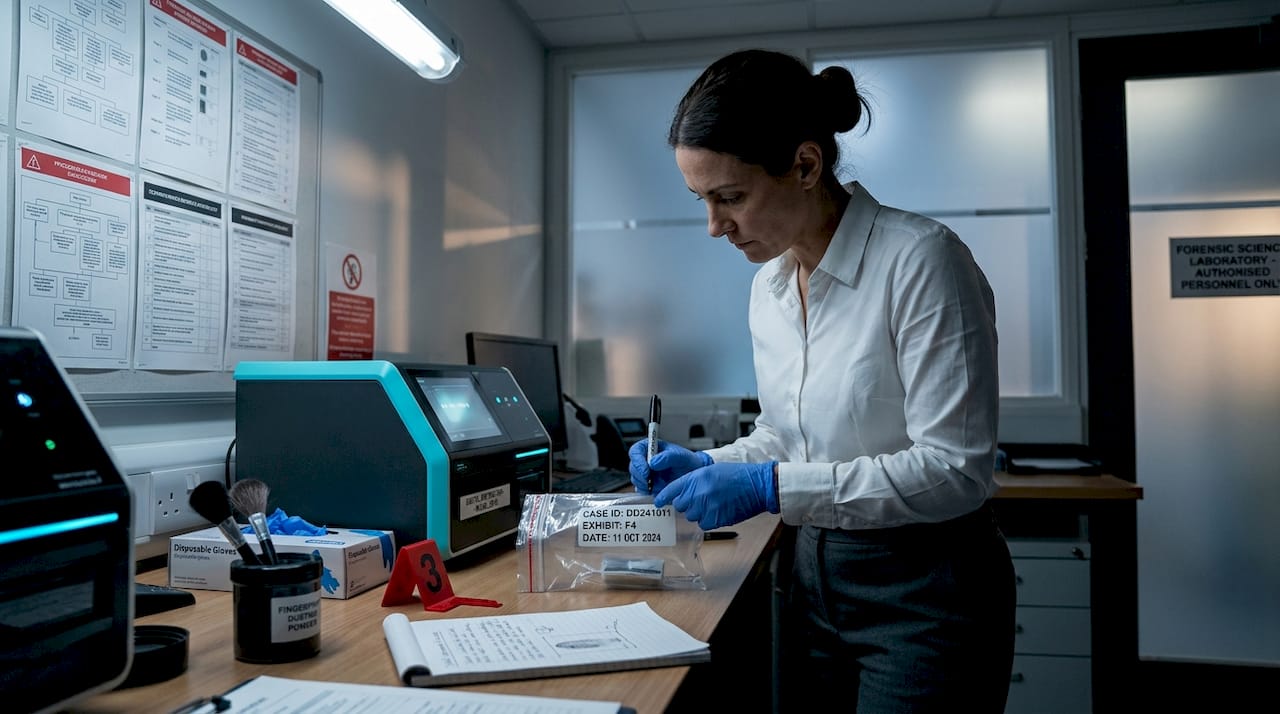
The strongest courses share several non-negotiable characteristics. Core CSI mechanics include scene security (cordons, logs, common approach paths), risk assessment, evidence preservation (packaging, labelling, chain of custody), forensic techniques such as fingerprinting, DNA collection, photography, and bloodstain pattern analysis, thorough documentation, and court presentation, all underpinned by standard operating procedures (SOPs) and multi-agency collaboration. A course that skips or superficially covers any of these areas will leave gaps that become visible the moment theory meets reality.
Beyond content, look for:
- Accreditation from a recognised body such as the Chartered Society of Forensic Sciences or a university quality framework
- Expert instructors who have active or recent operational experience, not solely academic backgrounds
- Practical scenario training using mock scenes, simulated evidence, or virtual reality environments
- Career-relevant assessment that mirrors the demands of your specific sector, whether that is criminal law, corporate governance, or law enforcement
- Chain of custody discipline embedded throughout, since understanding the role of forensics in legal cases depends entirely on maintaining integrity from scene to courtroom
Matching course content to your sector matters enormously. Law enforcement officers need immediate operational readiness. Legal professionals benefit from courses that address evidence admissibility and courtroom presentation. Corporate security teams prioritise governance, case management, and internal investigation protocols. Solid investigation principles for public safety apply across all three, but the weighting changes significantly.
The depth of practical training also determines your ability to gather forensic evidence in a legally defensible manner, which is why hands-on elements are never optional extras.
Pro Tip: Prioritise courses that include realistic scenario training under time pressure. Courtroom scrutiny and live incident scenes do not allow for hesitation, so your training environment should replicate that stress deliberately.
Leading crime scene investigation course providers in the UK
With your framework in place, here is an overview of the main providers currently respected across law enforcement, academia, and the corporate sector.
Forensic Training Partnership and Cranfield Forensic Institute
The FTP Initial CSI Course is widely regarded as the gold standard for operational CSI training in the UK. Running over six weeks in partnership with Cranfield Forensic Institute, it is designed specifically for UK police forces and aspiring crime scene investigators. The curriculum covers evidence collection, fingerprint development techniques, forensic photography, scene documentation, and the assessment of volume crime scenes.
What sets this programme apart is the parity it creates between trainees and serving police recruits. Students work through mock crime scenes under conditions that genuinely replicate operational pressure. This is not classroom demonstration; it is immersive, hands-on learning where evidence integrity and procedural compliance are assessed in real time.
“The hands-on practical element is prioritised over theoretical instruction, placing trainees in the same learning environment as police recruits and ensuring that skills are tested under realistic operational conditions.”
Brunel University London
Brunel’s MSc in Crime Science, Investigation and Intelligence targets law enforcement professionals and legal practitioners who want a management-level understanding of the investigative process. Crucially, no prior forensic experience is required for entry, making it accessible to solicitors, barristers, and intelligence analysts who are expanding their expertise rather than starting careers in CSI. The programme incorporates virtual reality crime rooms, which allow students to practise scene assessment and evidence decision-making in a safe, repeatable environment.
University of Bradford
Bradford’s MSc in Forensic Archaeology and Crime Scene Investigation is accredited by the Chartered Society of Forensic Sciences, which signals adherence to recognised professional standards. The programme is particularly strong for those targeting law enforcement or specialist investigative roles, with a curriculum that takes students from initial scene assessment through to evidence presentation in court. The accreditation also carries weight with employers in the public sector.
CorpSecurity CSI certified security investigator
For corporate security professionals, CorpSecurity’s online programme offers a self-paced format spanning two to three months. The content focuses on investigation governance, case management, and specialist corporate investigation scenarios such as fraud, misconduct, and intellectual property disputes. Importantly, this course requires a minimum of five years’ prior investigation experience, so it is best positioned as a credentials enhancement tool rather than an entry-level pathway.
The step-by-step forensic analysis skills developed through all of these providers ultimately determine how effectively evidence is handled long before it reaches any legal proceeding. Choosing a provider that builds this discipline rigorously is not merely preferable. It is professionally essential.
Consider also whether your employer or sector has formal partnerships with specific providers. Some UK constabularies have procurement agreements with FTP, while certain legal chambers have relationships with university programmes that offer continuing professional development credits. Law enforcement background checks may also influence eligibility for certain police-facing courses, so confirm requirements early.
Course comparison: who is each provider best for?
Once you understand what each provider offers, a direct side-by-side comparison makes the strategic choice far clearer.
| Provider | Delivery | Duration | Entry requirement | Best suited for | Practical intensity | Accreditation |
|---|---|---|---|---|---|---|
| FTP/Cranfield | In-person | 6 weeks | Police or aspiring CSI | Law enforcement | Very high | Police-endorsed |
| Brunel University | Blended/VR | 1 year (MSc) | No forensic background needed | Legal professionals, intelligence | Medium-high | University validated |
| University of Bradford | Campus-based | 1 year (MSc) | Relevant undergraduate degree | Law enforcement, court-facing roles | High | Chartered Society of Forensic Sciences |
| CorpSecurity | Online, self-paced | 2 to 3 months | 5 years’ investigation experience | Corporate security teams | Low to medium | Professional certification |
The FTP course sets what is widely acknowledged as the gold standard for UK CSI training, and its emphasis on practical, police-grade skills makes it the strongest choice for operational investigators. However, “gold standard” does not mean universally appropriate. A corporate security manager sitting through six weeks of police scene management procedures may acquire skills that do not translate directly to internal investigations governed by employment law rather than criminal statutes.
The Bradford MSc carries the prestige of Chartered Society accreditation, which is particularly useful if you intend to appear as an expert or provide evidence in court. Legal professionals who need to understand forensic methodology well enough to cross-examine expert witnesses, or to commission forensic reports effectively, will find Brunel’s programme more immediately applicable.
Pro Tip: Check whether the course you select is formally recognised by your employer, your professional regulator, or your sector. Completing an excellent course that carries no weight with your line manager or the courts is a missed opportunity.
Understanding the importance of documenting the forensic process is something every course should address, but the depth of coverage varies enormously. Ask providers specifically how documentation, chain of custody, and continuity of evidence are taught and assessed before committing.
Advanced and specialist topics: what to look for in modern CSI training
Basic curriculum covers the fundamentals. What distinguishes a truly forward-facing course is the depth and currency of its specialist and advanced content.
Modern CSI training is evolving rapidly in response to changing crime patterns, technological capability, and the increasing complexity of major incident management. The most respected programmes now incorporate advanced topics that reflect operational realities.
- Scene reconstruction — understanding how physical evidence is used to establish sequence of events and test competing hypotheses
- Digital forensics integration — recognising digital evidence at a scene (devices, storage media, network infrastructure) and ensuring it is preserved correctly before specialist examination
- Major incident management — managing multiple simultaneous scenes, coordinating multi-agency responses, and maintaining evidence integrity at scale
- Night photography and specialist lighting — critical for scenes that cannot wait for daylight or that require alternate light source examination
- Volume versus major crime scenes — the operational and procedural differences between high-frequency lower-complexity scenes and serious crime scenes requiring forensic strategy
- Contamination management — identifying and mitigating contamination risks, including from first responders, medical personnel, and other agencies
- Intelligence integration — using forensic findings to inform wider investigative intelligence products
Advanced MSc-level modules also increasingly incorporate virtual reality simulations, artificial intelligence-assisted scene analysis, and forensic strategy development for complex investigations. The role of AI and collaborative approaches in crime investigation is expanding, and providers who do not acknowledge this in their curriculum are already behind the curve.
The demand for professionals with advanced CSI skills is high, driven by the continuous evolution of forensic technology and investigation methods. Volume crime scenes are becoming more complex as offenders adapt, and major crime investigations now regularly span physical and digital domains simultaneously. Choosing a course with strong advanced modules is not about resume padding. It is about staying operationally relevant.
Understanding how to present forensic evidence in court is another advanced capability that separates competent investigators from genuinely authoritative ones. Whether you are a CSI, a legal professional, or a corporate investigator, the ability to translate technical findings into clear, credible, legally sound evidence is the ultimate measure of your training.
Professional insight: why course selection should prioritise real-world simulation
Here is a position that not every course provider will advertise honestly: the most prestigious qualification on paper can still leave you flat-footed when you are standing in front of a compromised scene, under time pressure, with multiple agencies waiting on your assessment.
Theory-based CSI learning is not worthless. It builds the conceptual architecture that helps you understand why procedures exist. But the gap between knowing what to do and executing it correctly under stress is where investigations fail. Evidence gets contaminated. Logs are not completed. Photography misses critical angles. These are not failures of intelligence. They are failures of practice under realistic conditions.
The FTP’s emphasis on hands-on practical training over theoretical instruction reflects an understanding that operational readiness is a physical and procedural habit, not a set of remembered principles. The professionals who perform best in court, and in the field, are those who have repeated correct procedures enough times that they are automatic.
For legal professionals and corporate investigators, the same principle applies. Understanding forensic analysis in legal evidence is not simply an academic exercise. It shapes how you commission expert reports, how you challenge opposing expert testimony, and how you build case strategy around physical evidence. Passive learning does not build that confidence. Scenario-based engagement does.
Our view, developed through working alongside law enforcement, legal teams, and corporate investigators across complex cases, is this: choose the course that makes you uncomfortable in training, because that discomfort is exactly what prepares you for the moments that matter most.
Take the next step: combining CSI skills with digital forensics
Physical crime scenes and digital evidence are now inseparable. Whether you are investigating a serious assault, a corporate fraud, or an intellectual property dispute, the evidence trail almost always crosses into digital territory. A suspect’s phone, a company server, or a social media account can hold information that corroborates or contradicts everything found at the physical scene.
The gap between physical CSI competence and digital investigation capability is where many investigations stall. Bridging it requires both strong foundational training and access to specialist digital forensics support. At Computer Forensics Lab, we work directly with law enforcement, legal professionals, and corporate security teams to fill that gap. Our digital forensics services cover everything from device examination and data recovery to court-ready expert witness reports, ensuring that digital evidence is handled with the same rigour you would expect from any physical crime scene. We also offer detailed insight into how digital footprints support or undermine physical investigation narratives, giving you a fuller picture of every case.
Frequently asked questions
Do I need a forensic science degree to enrol in a CSI course?
Not always. Brunel’s MSc programme is suitable for law enforcement and legal professionals with no prior forensic training, and the FTP course is designed for aspiring CSIs who may be entering the field for the first time.
What accreditation should I look for in UK CSI courses?
Look for accreditation from the Chartered Society of Forensic Sciences, which confirms the course meets recognised professional standards. The University of Bradford’s MSc carries this accreditation and is a benchmark for court-facing CSI education.
How long do most crime scene investigation courses take to complete?
Duration varies considerably. FTP’s Initial CSI Course runs for six intensive weeks, while CorpSecurity’s self-paced online programme typically takes two to three months for working professionals to complete.
Are there crime scene investigation courses specific to corporate investigations?
Yes. CorpSecurity’s CSI certified programme is specifically designed for corporate investigators with at least five years’ experience and focuses on governance, case management, and specialist internal investigation scenarios.
What practical skills will I learn in a typical UK CSI course?
Most quality UK CSI courses teach evidence collection, scene security and management, fingerprint development, forensic photography, and documentation. FTP’s curriculum also includes volume crime scene assessment, ensuring you are prepared for the full spectrum of operational demands.