
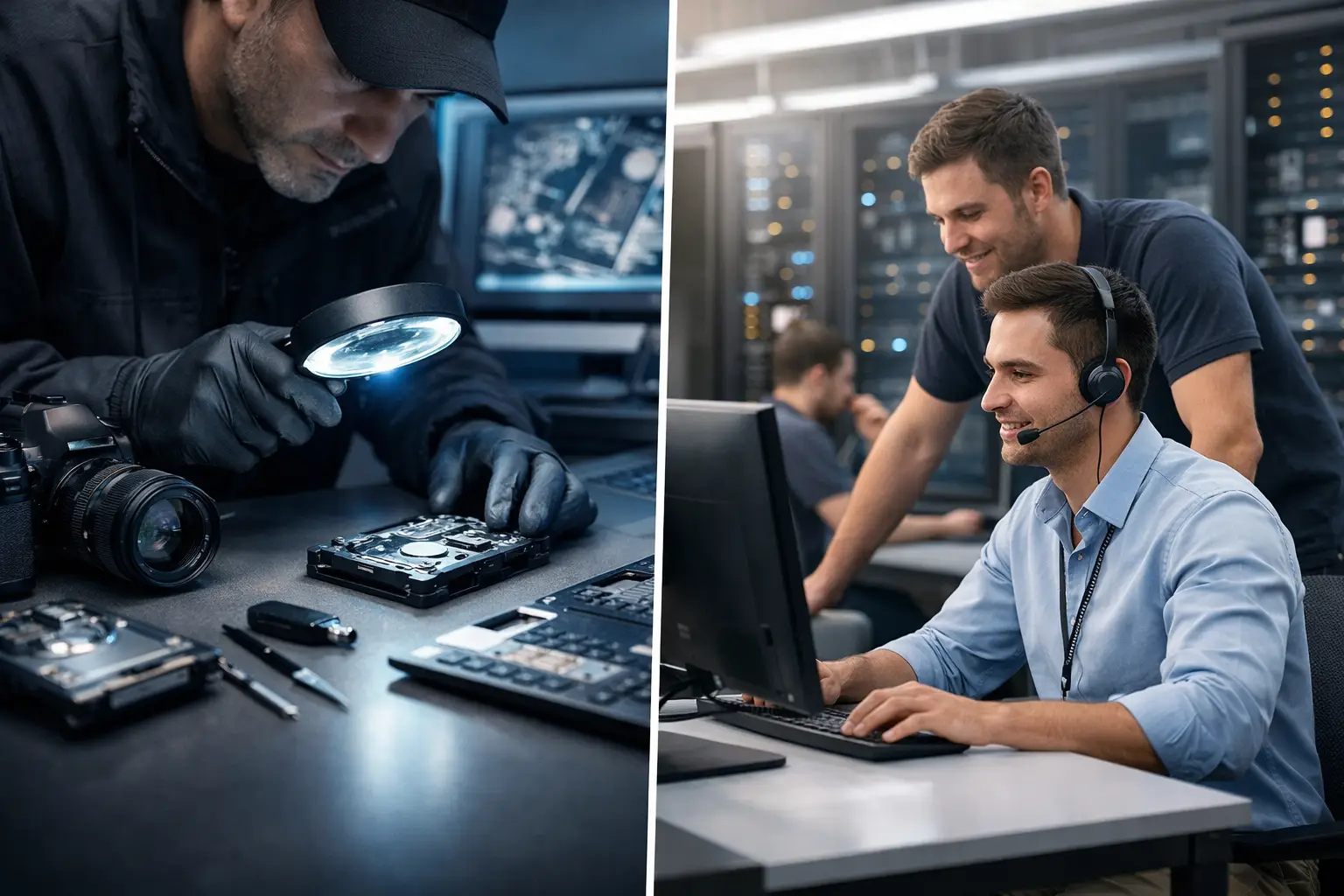
When a device may contain evidence, the difference between computer forensics vs IT support is not academic – it can decide whether crucial material is preserved properly or lost, altered, or rendered difficult to rely on later. That distinction matters in employment disputes, fraud investigations, suspected data theft, hacking incidents, matrimonial matters, and any case where digital activity may be challenged in court.
At first glance, both disciplines deal with computers, user accounts, deleted files, damaged systems, and urgent technical problems. That superficial overlap is where costly mistakes begin. An IT engineer may be highly capable at restoring access, rebuilding a machine, or resolving a network issue. A forensic examiner, by contrast, works to identify, preserve, analyse, and present digital evidence in a way that can withstand scrutiny.
Why computer forensics vs IT support matters
In a business setting, the instinct after an incident is often to call internal IT or an external support provider. That may be reasonable if the problem is purely operational: a server has failed, a user cannot log in, or a software deployment has gone wrong. But where there is suspicion of misconduct, unauthorised access, data exfiltration, deleted communications, or disputed device usage, routine support activity can unintentionally compromise evidence.
A support technician is usually measured on speed, restoration, and continuity. Their job is to get systems running again with minimal disruption. That can involve rebooting, patching, changing passwords, removing software, reimaging devices, synchronising cloud accounts, or overwriting data through normal troubleshooting. Those actions may solve the immediate issue while erasing artefacts that later become central to an investigation.
Computer forensics starts from a different premise. The first priority is not convenience but evidential integrity. That means preserving the original state as far as possible, documenting handling, maintaining chain of custody, and using defensible methods to recover and examine data. In legal and regulatory contexts, that difference is fundamental.
Different objectives, different outcomes
IT support exists to maintain or restore function. Computer forensics exists to establish facts.
That sounds simple, but it has practical consequences. If an employee is suspected of copying confidential files before departure, IT support may disable the account, reset credentials, and collect the laptop. A forensic examiner will ask different questions: was data transferred to USB media, uploaded to cloud storage, emailed externally, or accessed outside normal hours? What artefacts exist on the device, within logs, and across connected systems? What can be shown reliably, and what remains uncertain?
The same applies in personal matters. If a phone contains messages relevant to family proceedings or harassment allegations, ordinary repair or support work may help extract visible content but fail to preserve metadata, timestamps, deleted material, or application artefacts in a way that can be explained and defended. In litigation, that gap matters.
What IT support typically does
IT support is broad and commercially necessary. It covers user support, software issues, hardware failures, account administration, backups, patching, security tooling, network troubleshooting, and device replacement. In many organisations, it is the first line of response because it is available, practical, and familiar.
There is nothing improper about that role. In fact, good IT support is essential to reducing downtime and limiting operational harm. The issue arises when a live technical problem is also a potential evidential event.
For example, after a suspected compromise, support staff may isolate a machine, remove malware, reset user access, and restore data from backup. Those steps may be entirely sensible for business continuity. They may also destroy volatile data, alter log histories, and obscure how the intrusion occurred. If the matter later develops into disciplinary action, civil proceedings, an insurance dispute, or a criminal complaint, the organisation may discover that its best evidence has been weakened by well-meaning intervention.
What computer forensics actually involves
Computer forensics is a specialist evidential discipline. It is concerned with the acquisition, preservation, analysis, and presentation of digital material from computers, phones, tablets, storage devices, cloud-linked sources, and associated systems.
The work is methodical. Devices are identified and secured. Handling is recorded. Forensic copies may be created using validated tools and repeatable processes. Examiners then analyse user activity, file system artefacts, internet history, communications, application data, external device usage, deleted material, system events, and timeline evidence. Findings are documented clearly, with attention to limitations, alternative explanations, and provenance.
That process is designed for scrutiny. A solicitor, barrister, insurer, regulator, employer, or court may need to understand not only what was found, but how it was found, what was preserved, and whether the methodology was reliable.
Computer forensics vs IT support in legal settings
In legal work, the distinction becomes sharper. A court is not interested in whether someone “looked at the laptop” or “managed to get the files off”. It is concerned with reliability, relevance, continuity, and the weight that can properly be attached to digital evidence.
If a non-specialist accesses a device repeatedly, copies selected files manually, or allows syncing and background processes to continue unchecked, the evidential picture can become muddied. Opposing parties may challenge the handling, suggest contamination, or dispute whether material was altered. Even where the underlying allegation is strong, poor procedure can create avoidable arguments.
A forensic examiner is not simply a more technical version of IT support. The examiner’s role includes independence, documented process, and careful interpretation. That is especially important where the findings may feature in witness statements, expert reports, disclosure exercises, internal investigations, or contested hearings.
When IT support is enough, and when it is not
It would be wrong to suggest every technical issue needs a forensic response. If a member of staff cannot access their email, a printer queue has failed, or a machine needs replacing, IT support is the correct route. Likewise, many routine cybersecurity and infrastructure tasks sit properly with internal or managed IT teams.
The position changes when there is a real prospect of dispute, accusation, regulatory exposure, or evidential dependency. Warning signs include suspected insider misconduct, unexplained deletion of files, alleged policy breaches, intellectual property theft, fraudulent transactions, anonymous communications, suspicious USB usage, unauthorised remote access, and device activity that may need to be reconstructed later.
In those situations, speed still matters, but so does restraint. The wrong first step can close off lines of enquiry permanently.
The risk of treating evidence as a support issue
One of the most common errors is assuming that because a technician can access data, they can also preserve evidence. Those are not the same thing.
A support provider may be able to retrieve emails, export documents, or repair a corrupted profile. Yet if they do so without preserving the wider environment, recording their actions, and considering forensic artefacts, the resulting material may answer only part of the question. It may also leave important context behind, such as whether files were opened, copied, renamed, backdated, or transmitted.
Another risk is overconfidence in screenshots, ad hoc exports, or user-generated device histories. These can be useful leads, but they are not substitutes for structured examination. In contested matters, the absence of proper acquisition and interpretation can become the story.
Choosing the right specialist early
For solicitors, employers, and private clients, the practical question is not which discipline is better in the abstract. It is which one fits the risk profile of the matter.
If the issue concerns service restoration, standard troubleshooting, or systems administration, IT support is appropriate. If the issue may require evidence recovery, timeline reconstruction, attribution analysis, deleted data examination, expert reporting, or testimony, a forensic route should be considered from the outset.
There are also mixed cases. Following a ransomware event, for example, a business may need IT support to contain operational damage and forensic input to establish entry vector, user activity, affected data, and evidential preservation. Those functions can complement each other, but they should not be confused.
At Computer Forensics Lab, that distinction is central to casework. Clients do not come to a forensic examiner for generic technical assistance. They come because the facts matter, the handling matters, and the outcome may be tested by an opposing party, regulator, insurer, or court.
The real question behind computer forensics vs IT support
The real question is not who can get into the device fastest. It is who can uncover what happened without compromising the evidence.
When digital material may shape liability, credibility, or case strategy, evidential discipline is not an optional extra. It is part of protecting the truth. If there is any realistic chance that a technical incident will become a dispute, treat it that way from the start.