

TL;DR:
- A forensic report must comply with current UK standards, including structured formats, validated methodologies, and verbal probability scales. Failure to adhere risks evidence inadmissibility, reputational harm, and regulatory sanctions. Proper documentation of chain of custody and audit trails is essential for court acceptance and forensic credibility.
A single oversight in a forensic report can unravel months of legal preparation. If your chain of custody documentation has a gap, or if your expert’s opinion lacks the structured verbal scale required by current UK guidance, a judge may rule that evidence inadmissible before it even reaches the jury. Many legal professionals and businesses still rely on templates built around superseded standards, assuming that following a familiar format is enough. It is not. This checklist-based guide gives you a clear, practical framework for producing forensic reports that meet current statutory requirements and hold up under courtroom scrutiny.
Table of Contents
- Why forensic reporting standards matter in the UK
- The essentials of a compliant forensic report
- Forensic reporting checklist: step-by-step process
- Ensuring audit trails and evidence integrity
- A fresh perspective: why most checklists fall short
- Tap into expert forensic support for total compliance
- Frequently asked questions
Key Takeaways
| Point | Details |
|---|---|
| Compliance is critical | Only reports meeting the FSR Code and guidance are admissible in UK courts. |
| Structured reporting wins | Following a formal structure improves clarity, objectivity, and legal acceptance. |
| Audit trails safeguard evidence | Meticulous documentation of method and custody ensures court-ready credibility. |
| Generic templates are risky | Rely on checklists based on the latest statutory standards, not outdated models. |
Why forensic reporting standards matter in the UK
Digital evidence is now central to criminal prosecutions, civil disputes, employment tribunal cases, and corporate investigations alike. Yet the way that evidence is reported and presented carries as much legal weight as the evidence itself. A technically brilliant forensic analysis can fail entirely if the report does not meet the required standards for interpretation and communication.
UK forensic reporting must comply with the Forensic Science Regulator’s statutory Code of Practice (version 2, effective October 2025), which sets quality standards for reporting results, including interpretation and opinion development under section 31. This is not advisory guidance. It is a statutory obligation. Practitioners who do not comply expose themselves, their clients, and their cases to serious consequences.
For businesses involved in litigation, the risks extend beyond the courtroom. Flawed reports can result in:
- Inadmissible evidence, which may collapse a criminal prosecution or undermine a civil claim
- Reputational damage to the instructing firm or in-house legal team
- Adverse cost orders arising from proceedings derailed by non-compliant evidence
- Regulatory scrutiny of the forensic provider, which can trigger further investigation
The role of expert witnesses in UK proceedings is tightly governed. Courts expect experts to be objective, transparent about their methodology, and honest about the limitations of their findings. Compliance with the Forensic Science Regulator’s Code is not just a quality marker. It is the baseline.
“Compliance with forensic reporting standards is not a box-ticking exercise. It is the foundation upon which the credibility of your entire investigation rests.”
Understanding these risks sets the stage for clarifying what actually constitutes a compliant forensic report.
The essentials of a compliant forensic report
A compliant forensic report is not simply a document that describes what was found on a device. It must follow a structured format, use validated methodologies, and express findings with the appropriate degree of certainty. Getting this right means understanding what the Forensic Science Regulator expects at each stage.
The FSR-GUI-0004 guidance on interpretation and communication applies to all report types, supports the Code under section 31, uses verbal scales for expressing opinions, and is compatible with ISO 21043 but provides more specific requirements for England and Wales. In practice, this means your report must distinguish clearly between observed findings and interpreted opinions, using agreed verbal scales rather than vague terms like “probably” or “it seems likely.”
Every compliant report should include:
- Executive summary: a plain-language overview accessible to non-technical readers including judges and lay jurors
- Methodology section: listing every tool used, its validation status, and the version applied during examination
- Findings section: factual observations presented without interpretation, clearly distinguished from opinions
- Opinions section: reasoned interpretations expressed using FSR-approved verbal probability scales
- Limitations: an honest account of what could not be determined and why
The table below summarises the key components and their purpose:
| Report component | Purpose | Common failure |
|---|---|---|
| Executive summary | Clarity for non-specialists | Too technical or absent |
| Methodology | Reproducibility and validation | Unnamed or unvalidated tools |
| Findings | Factual observations only | Mixed with opinion |
| Opinions | Probability-scaled interpretation | Vague or absolute language |
| Limitations | Objectivity and transparency | Omitted entirely |
| Audit trail | Chain of custody evidence | Incomplete or inconsistent |
For reporting for legal case success, the separation between findings and opinion is particularly critical. Courts regularly see reports where an examiner states something is “confirmed” when the evidence only “supports” a particular conclusion. That distinction matters enormously in cross-examination.

Pro Tip: When reviewing a draft forensic report, read the opinions section in isolation first. If you cannot tell which verbal probability scale has been applied, or if absolute language like “proves” or “confirms” appears, send it back for revision before it reaches counsel.
With this framework explained, it is time to see how these pieces assemble into a practical step-by-step checklist.
Forensic reporting checklist: step-by-step process
The following checklist follows the lifecycle of a digital investigation from initial instructions through to evidence submission. It draws on validated tools and audit trails per the FSR Code, and prioritises structured formats covering executive summary, methods, findings, and opinions to ensure admissibility. Use it as a reference when commissioning, reviewing, or producing forensic reports.
- Receive and document instructions: Record the scope of the investigation in writing before any examination begins. Note the instructing party, legal context, and specific questions to be answered.
- Identify and secure evidence: Document every item received using unique identifiers. Photograph packaging, note condition, and record time and date of receipt.
- Create forensic images: Produce verified bit-for-bit copies of all storage media using write-blocking hardware. Record hash values immediately.
- Hash verification: Apply MD5 and SHA-256 hashing to verify that working copies are identical to originals. Log all hash values in the case record.
- Select validated tools: Use only forensically validated software, such as EnCase, FTK, or Cellebrite. Document the tool name, version, and validation basis.
- Conduct examination on the forensic copy: Never examine originals. Log every action taken during analysis, including search terms used, filters applied, and artefacts reviewed.
- Draft findings section: Record only what was observed. Avoid interpretive language at this stage.
- Draft opinions section: Apply FSR-GUI-0004 verbal scales. Distinguish clearly between what the evidence supports, what it is consistent with, and what it does not support.
- Write the methodology section: Document every step taken, every tool used, and every decision made during examination.
- Draft the executive summary: Write this last. Summarise key findings and opinions in plain language without oversimplifying.
- Internal review: Have a second qualified examiner review the report for accuracy, compliance, and clarity before submission.
- Final sign-off: The reporting expert signs the report, declares their expertise, and attaches their CV or relevant qualifications.
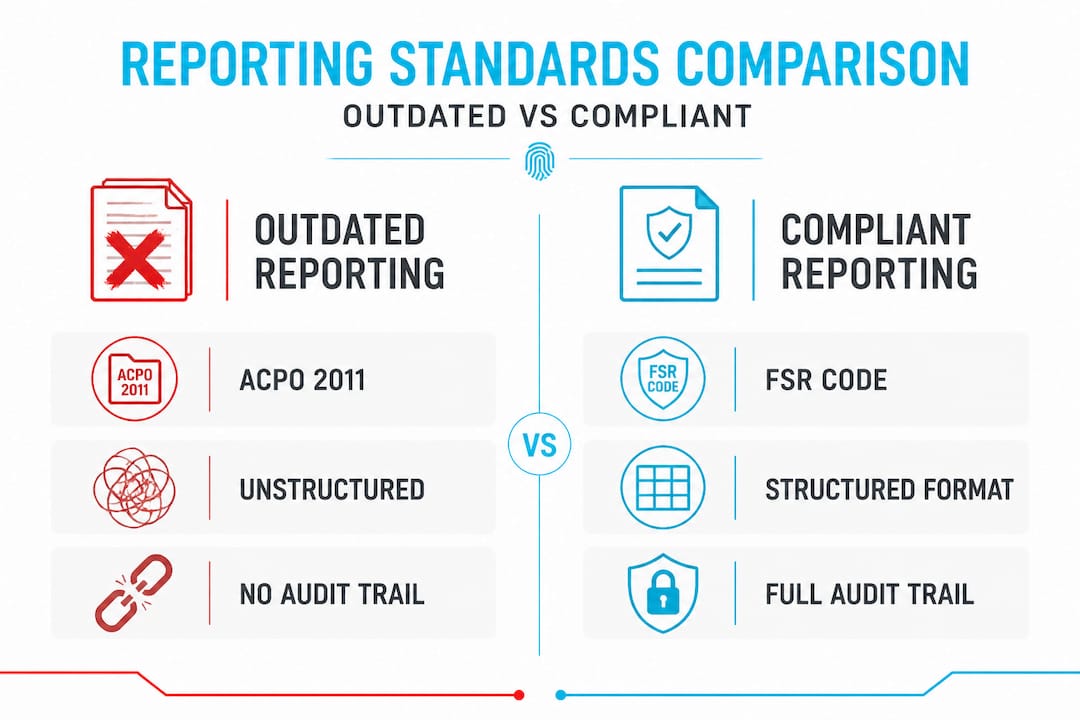
The comparison below shows how outdated and compliant reporting differ in practice, which is critical context for forensic methods for legal teams working across varied case types:
| Feature | Outdated reporting | Compliant reporting |
|---|---|---|
| Standards followed | ACPO 2011 guidelines | FSR Code v2 (Oct 2025) |
| Opinion language | “Proves”, “confirms” | FSR verbal probability scales |
| Tool documentation | Tool name only | Name, version, validation basis |
| Hash verification | Sometimes applied | Always applied and logged |
| Limitations | Rarely included | Required section |
| Chain of custody | Informal notes | Formal, time-stamped log |

Ensuring audit trails and evidence integrity
An audit trail is not just good practice. It is a legal necessity. Without a complete, time-stamped record of every action taken from the moment evidence was received to the moment it is presented in court, the entire forensic investigation is vulnerable to challenge.
Validated tools and hash verification underpin the integrity of any court-ready report. But the audit trail must go beyond technology. It must capture human decisions, access events, transfers of custody, and any departure from standard procedures, including the reason for that departure.
Key steps for maintaining a robust audit trail include:
- Logging access: Record every person who handles evidence, including date, time, and purpose of access
- Tracking transfers: Document every movement of evidence, whether physical or digital, with signatures from both parties
- Recording tool activity: Export and retain logs from forensic software showing exactly which operations were performed and when
- Noting anomalies: If something unexpected happens during examination, such as a device powering on unexpectedly, record it immediately and explain how it was managed
- Storing records securely: Audit trail records must be stored in a tamper-evident format and retained for the duration of the case plus any appeal period
Preserving chain of custody from the very first point of contact with evidence is essential. Defence counsel will scrutinise every gap, and even a brief undocumented period can give grounds for a successful challenge.
Common pitfalls that undermine chain of custody include:
- Delays in hashing: Waiting hours or days to record hash values creates a window where data integrity cannot be verified
- Shared login credentials: Using a team login on forensic systems makes it impossible to attribute specific actions to specific individuals
- Informal handovers: Passing evidence between colleagues without written records is a serious compliance failure
- Incomplete packaging records: Failing to photograph original packaging before opening it removes a layer of verification
Safeguarding digital evidence requires treating every piece of data as if it will be cross-examined. Because, in contested cases, it will be. For a thorough grounding in this area, the digital forensics chain of custody resources provide practitioners with a structured approach to documentation that courts consistently find reliable.
Pro Tip: Create a case log template before every investigation begins. Include fields for evidence receipt, hashing, access events, transfers, and any procedural departures. Completing it in real time takes minutes but saves hours of reconstruction under cross-examination.
A fresh perspective: why most checklists fall short
Here is something the industry does not say loudly enough. Most publicly available forensic checklists are built on standards that are no longer current. The ACPO Good Practice Guide, which was widely used as a benchmark, has been outdated since 2011 and has no statutory authority whatsoever in 2026. Yet it still circulates in template libraries, training materials, and even some law firm guidance documents.
The genuine differentiator between a checklist that works in court and one that does not is not its length. It is whether it reflects a deep understanding of interpretation standards and how courts actually evaluate expert opinion. We see this regularly in complex cases: a practitioner produces a technically meticulous examination but then writes opinions using language that does not align with FSR-GUI-0004. Cross-examination dismantles the report not on the forensics, but on the language.
What actually matters is this. First, the expert must understand the difference between a finding and an opinion, and that difference must be structural in the report, not just conceptual in the expert’s mind. Second, every opinion must be calibrated. The FSR’s verbal probability scales exist precisely because courts need consistency. When one expert says “highly likely” and another says “probable” to describe the same degree of certainty, the court cannot sensibly compare them. Third, templates breed over-reliance. We have reviewed reports where practitioners have filled in a template but failed to address the specific factual questions posed by the instructing solicitor. A checklist is a starting point, not a substitute for analytical rigour.
The legal case reporting strategies that succeed are always grounded in a clear understanding of what the court needs, not what the template provides. Legal professionals should ask their forensic provider directly: which version of the FSR Code are you working to, and how does your report format implement FSR-GUI-0004? If the answer is vague, treat that as a warning sign.
Tap into expert forensic support for total compliance
Meeting the standards described in this checklist demands more than familiarity with guidance documents. It requires ongoing practice, validated tools, and experience presenting evidence before UK courts. Computer Forensics Lab provides accredited digital forensics services built around the current FSR Code, with every report structured for legal admissibility and every opinion expressed in line with FSR-GUI-0004 verbal scales. Whether you are dealing with employee misconduct, data breach litigation, or a complex criminal matter, our London-based team manages evidence from first contact through to expert witness testimony. The breadth of digital forensics data we routinely examine spans computing devices, mobile phones, cloud platforms, and social media, ensuring no relevant evidence is overlooked.
Frequently asked questions
What is required for a UK-compliant forensic report in 2026?
A UK-compliant forensic report must follow the FSR’s statutory Code, use a structured format with executive summary, methods, findings, and opinions, include validated tools and audit trails, and apply FSR-GUI-0004 interpretation standards including verbal probability scales.
Are commercial or template-based checklists sufficient for UK legal cases?
No. Only checklists aligned with the current FSR Code and FSR-GUI-0004 standards are reliably compliant. ACPO guidelines and older commercial templates no longer carry statutory authority and are considered insufficient for modern UK proceedings.
What is the FSR-GUI-0004 and why does it matter?
FSR-GUI-0004 is the official guidance document governing the interpretation and communication of forensic results in England and Wales. It matters because it specifies the verbal probability scales that experts must use when expressing opinions, ensuring courts receive consistent and objective assessments rather than vague or absolute language.
How does chain of custody affect forensic report admissibility?
A well-documented chain of custody is the foundation of evidence integrity. Courts may reject digital evidence entirely if the chain of custody contains unexplained gaps, undocumented transfers, or periods where evidence accountability cannot be verified.