

TL;DR:
- A UK law firm was fined £60,000 after a cyber attack exposed sensitive data due to lack of multi-factor authentication and delayed breach reporting. Legal professionals face high risks because of the sensitive data they handle, making cybersecurity essential for regulatory compliance and reputation protection. Establishing clear policies, technical controls, ongoing staff training, and expert support are critical to managing these cyber threats effectively.
A UK law firm was fined £60,000 after a cyber attack exposed confidential personal data, partly because multi-factor authentication was absent on an administrator account and breach reporting was delayed. This was not a sprawling corporate giant with complex legacy infrastructure. It was a firm that, like many, likely believed its systems were adequate. For legal professionals in England, the stakes could not be higher: client confidentiality, regulatory duties, and professional reputation all hang in the balance. This guide gives you clear, actionable steps to improve your cybersecurity posture and meet your obligations under UK law.
Table of Contents
- Understanding the unique cyber risks in legal practice
- Putting the fundamentals in place: Policies, roles and ongoing vigilance
- Technical essentials: Authentication, hardening, and data backup
- Incident response and breach reporting: Getting it right under UK law
- Navigating compliance: Main UK cybersecurity legal and regulatory frameworks
- What most legal professionals miss, and why compliance alone is not enough
- Expert help for legal cybersecurity and digital investigations
- Frequently asked questions
Key Takeaways
| Point | Details |
|---|---|
| Law firms are high-value cyber targets | The nature of legal work and sensitive client data makes law firms a prime target for attackers. |
| Strong authentication is essential | Implementing multi-factor authentication and strong controls on all access points can prevent costly breaches. |
| Rapid breach reporting reduces penalties | Reporting breaches quickly to the ICO, even with incomplete details, is critical for compliance and mitigation. |
| Compliance alone is not enough | True resilience comes from ongoing risk assessment, tailored controls, and continuous staff vigilance. |
Understanding the unique cyber risks in legal practice
Having set the stakes with a real regulatory penalty, it is important to understand why legal sector cybersecurity is uniquely demanding. Law firms are not targeted randomly. They hold some of the most commercially and personally sensitive data available: financial records, litigation strategies, intellectual property, witness statements, and client disclosures. That combination makes legal practices exceptionally attractive targets.
Criminals actively seek legal sector data for downstream misuse, including money laundering. This is not a theoretical observation. The SRA’s sectoral risk assessment identifies legal professionals as recurring targets precisely because of the nature and volume of high-value data they handle. A conveyancing file alone can contain enough personal and financial information to enable identity fraud on a significant scale.
The shift to hybrid working and cloud-based case management has compounded these risks substantially. Solicitors accessing client files from home networks, uploading documents to third-party platforms, or using personal devices for urgent correspondence each represent new points of potential failure. Every additional access point is another door a criminal can try to open.
The consequences of a breach are threefold:
- Regulatory penalties from the ICO and, potentially, SRA disciplinary action
- Reputational harm that can permanently damage client relationships and referrals
- Operational disruption from ransomware, data loss, or system downtime at the worst possible moments
Practising cybersecurity best practices consistently is not optional in this environment. It is as fundamental to your professional obligations as client care letters.
“The legal sector is a high-value target. The data you hold on behalf of clients is precisely what sophisticated criminal networks seek to exploit. That reality should shape every decision about how you store, access, and protect information.”
Putting the fundamentals in place: Policies, roles and ongoing vigilance
With unique threats outlined, the next step is establishing strong organisational foundations to address them. Many firms invest in technical tools before they have the basic governance in place to use those tools effectively. That is the wrong order.
Effective cybersecurity starts with assigned responsibility, a maintained policy, regular asset reviews, trained staff, and a tested response plan. The Law Society is explicit on this point, and for good reason. Without a named individual responsible for cybersecurity, accountability disperses and nothing gets done properly.
Here is the foundational framework every firm should build:
-
Nominate a cyber lead. This person does not need to be a technical expert, but they must have authority to enforce policy, report to firm leadership, and coordinate with external specialists when necessary. In smaller firms, this is often a senior partner or practice manager.
-
Draft and document a cybersecurity policy. This should cover acceptable use of devices and networks, password management, remote working protocols, third-party access, and what staff must do when they suspect an incident. The policy means nothing if it lives in a drawer.
-
Review your assets regularly. Know what devices connect to your network, what software is installed, and who has access to what systems. You cannot protect what you cannot see.
-
Train staff at least annually. Phishing simulation exercises, scenario-based training, and regular updates on emerging threats are all effective. Human error remains the most common entry point for attackers.
-
Build and test your incident response plan. This connects directly to incident response in legal cases, where the quality of your documented response can affect both your legal position and your regulatory outcome. Running a tabletop exercise once a year is far better than discovering gaps during an actual attack.
Pro Tip: Do not wait until your renewal date to review your cybersecurity policy. Trigger a review whenever you onboard a new system, change your working arrangements, or add a new team member with elevated access rights.
Technical essentials: Authentication, hardening, and data backup
With firm-wide policies in place, let us break down the technical measures you need to make your systems genuinely robust. Technical controls are where good intentions either succeed or fail in practice.

The absence of MFA on even a rarely used administrator account enabled the breach that cost one UK firm £60,000. That is a sobering fact. The account did not need to be used regularly to be exploited. It simply needed to exist without adequate protection.
Authentication and access control
Every account with access to client data must use strong, multi-factor authentication. This applies especially to:
- Administrator and privileged accounts
- Remote access systems and VPNs
- Cloud-based case management and document platforms
- Email systems
The Law Society and ICO both stress the need for strong authentication, avoidance of unnecessary USB and external device entry points, maintained backups, and regular vulnerability scanning. These are not aspirational targets. They are the baseline your regulators expect.
Comparison: weak versus strong technical controls
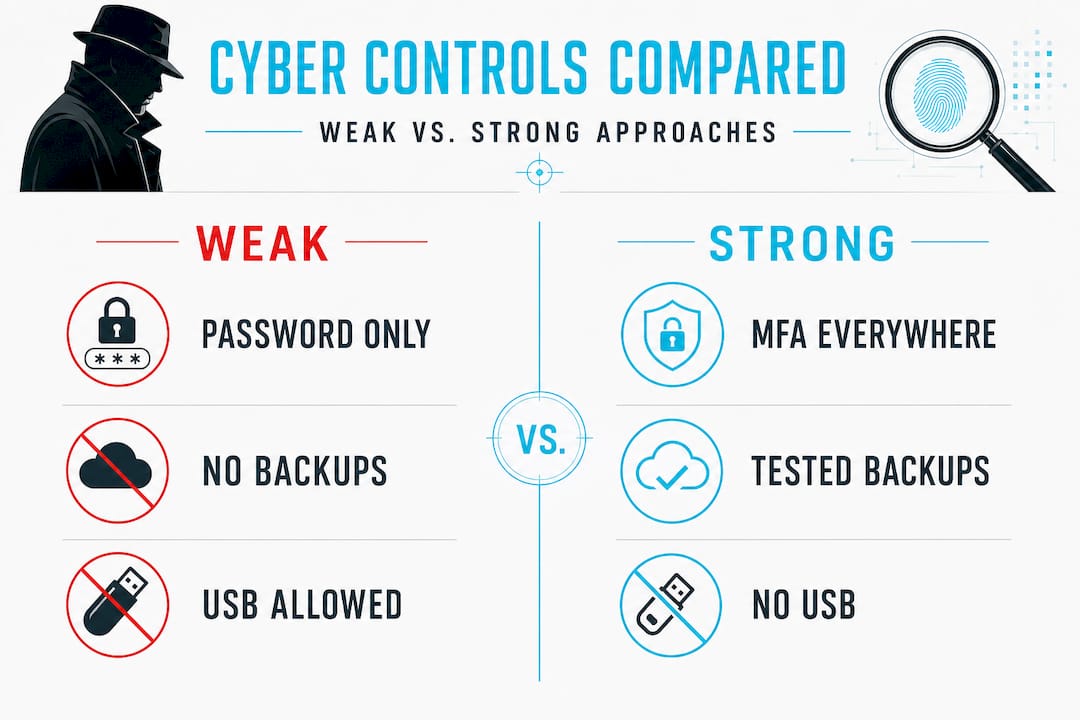

| Control area | Weak approach | Strong approach |
|---|---|---|
| Authentication | Password only | MFA on all accounts |
| Device access | USBs permitted freely | Removable media restricted or banned |
| Data backup | Occasional, untested | Daily, encrypted, stored separately |
| Software updates | Applied when convenient | Patched within 14 days of release |
| Legacy systems | Left running indefinitely | Reviewed and retired or isolated |
Pro Tip: Test your backups by actually restoring from them. A backup you have never verified is little more than an assumption. When you genuinely need it, you cannot afford to find out it was not working.
Good data recovery best practices assume that something will eventually go wrong. The question is whether your firm can recover quickly or whether it will spend weeks attempting to reconstruct case files from memory and email threads. Keeping backups logically and physically separated from your live systems prevents ransomware from encrypting both simultaneously.
For firms that have experienced an incident and need to recover digital evidence, forensic data recovery steps differ from ordinary IT recovery. The process must maintain the integrity of the data for potential regulatory or legal proceedings, which requires specialist handling from the outset.
Incident response and breach reporting: Getting it right under UK law
Having secured technical basics, it is vital to understand your legal duties when, despite best efforts, a breach occurs. Speed and accuracy during the first 72 hours are not just operationally important. They are a legal requirement.
Under Article 33(4) of UK GDPR, firms must report data breaches within 72 hours of becoming aware, even if all details are not yet confirmed. Phased updates are permitted. What is not acceptable is waiting until you have a complete picture before making any report at all.
Delayed or incomplete breach reporting can lead to heavy fines. In the case of the £60,000 fine referenced earlier, the delay in reporting was a significant aggravating factor in the ICO’s final assessment. Regulators expect you to act immediately, document what you know, and update them as more information becomes available.
The 72-hour incident window: Key actions
- Contain the breach. Isolate affected systems immediately to prevent further data loss or spread of malware.
- Assess the scope. Determine what data was affected, who it relates to, and what the likely harm is to those individuals.
- Notify the ICO via the online reporting portal, even if your investigation is incomplete.
- Document every decision. Regulators will want to see your reasoning, your timeline, and the steps you took. Evidence of identifying data breaches early and acting promptly demonstrates good faith.
- Notify affected individuals where required, particularly when there is a high risk of harm.
Breach response timeline at a glance
| Timeframe | Required action |
|---|---|
| Immediately | Contain and isolate affected systems |
| Within 24 hours | Internal escalation to cyber lead and senior management |
| Within 72 hours | Initial report to ICO (even if incomplete) |
| Ongoing | Updates to ICO, assessment of client notifications required |
“The ICO does not expect perfection during an incident. It expects prompt action, honest reporting, and a clear record of the decisions you made and why you made them.”
Navigating compliance: Main UK cybersecurity legal and regulatory frameworks
Legal breach reporting sits within a wider landscape of regulatory responsibilities that every legal professional must meet. Understanding the frameworks that apply to your firm prevents the common mistake of focusing on one obligation while inadvertently neglecting another.
The three core frameworks that govern UK law firms are UK GDPR, the Data Protection Act 2018, and the UK NIS Regulations 2018:
- UK GDPR sets out the principles for lawful data processing, security obligations, and breach response requirements. It applies to any firm handling personal data, which in practice means every legal organisation in England.
- The Data Protection Act 2018 supplements UK GDPR with domestic detail, including specific provisions for law enforcement processing and certain exemptions. It is not a replacement for GDPR obligations but operates alongside them.
- The NIS Regulations 2018 apply to digital service providers and operators of essential services. Some larger legal organisations or those providing digital infrastructure to essential sectors may fall within scope, making it worth seeking specialist legal advice on whether these regulations apply to your firm specifically.
Beyond these core frameworks, SRA obligations around client confidentiality and data security sit above and alongside statutory requirements. A regulatory breach with the ICO can trigger parallel scrutiny from the SRA, making it essential to treat data protection as a professional conduct matter, not merely a compliance exercise.
What most legal professionals miss, and why compliance alone is not enough
There is a pattern we observe repeatedly across legal practice: firms invest in a cybersecurity certification, tick the required boxes, and then treat the exercise as complete. The certificate arrives, it goes on the wall, and attention moves on. Months later, an unpatched system or a forgotten admin account becomes the entry point for an attacker.
The uncomfortable reality is that regulator guidance should be the starting point, mapped to practical solutions, rather than working backward from the certification criteria. The SRA’s own risk assessment makes this clear. Compliance frameworks tell you the minimum. They cannot tell you what your specific firm’s riskiest assets are, which staff members are most likely to fall for a phishing attempt, or whether your third-party case management provider has a weaker security posture than your internal systems.
The breaches that attract fines and reputational damage in the legal sector almost never involve sophisticated, novel attack methods. They involve missing MFA on an account someone forgot existed. They involve a USB drive plugged in by a well-intentioned team member. They involve a backup that was set up three years ago and never tested since. These are not failures of ambition. They are failures of ongoing attention.
Genuine resilience in legal practice comes from treating cybersecurity essentials for UK law as a continuous discipline rather than a project with a completion date. Risk management should be contextually tailored to your firm’s actual profile: the clients you serve, the matters you handle, the systems you use, and the people you employ. That kind of active, specific risk management is what separates firms that survive incidents from those that do not.
Expert help for legal cybersecurity and digital investigations
Recognising the limits of managing cybersecurity entirely in-house is not a sign of weakness. It is sound professional judgement. The complexity of UK GDPR obligations, combined with the forensic demands of evidence preservation during an incident, means that specialist support is often the difference between a contained problem and a regulatory crisis.
At Computer Forensics Lab, we work directly with solicitors, barristers, and legal teams to support digital forensic investigations that meet evidential standards, maintain chain of custody, and can withstand scrutiny in court or regulatory proceedings. Whether you are facing a suspected data breach, need to recover deleted or encrypted files, or require an expert witness report, our team provides rigorous, documented support.
We also assist firms in understanding digital forensic data solutions as part of a broader risk and compliance strategy. Explore our full range of digital forensics services to understand how specialist forensic support can protect your firm, your clients, and your professional standing.
Frequently asked questions
How soon must a legal professional report a data breach to the ICO?
You must report a notifiable personal data breach within 72 hours of becoming aware of it under UK GDPR, even if all the details are not yet known at the time of the initial report.
Is multi-factor authentication mandatory for law firms?
While not always explicitly mandated in statute, regulators expect strong access controls, and the absence of MFA on an administrator account directly contributed to a £60,000 ICO fine, making implementation effectively essential.
What are the biggest cybersecurity mistakes in legal practice?
The most common failures include poor authentication controls, unnecessary use of USB and legacy devices, untested backups, and the absence of a practised incident response plan when a breach actually occurs.
Which legal frameworks regulate law firm cybersecurity in the UK?
The UK GDPR, Data Protection Act 2018, and NIS Regulations form the core statutory framework, alongside SRA professional conduct obligations that apply to all practising solicitors in England and Wales.