
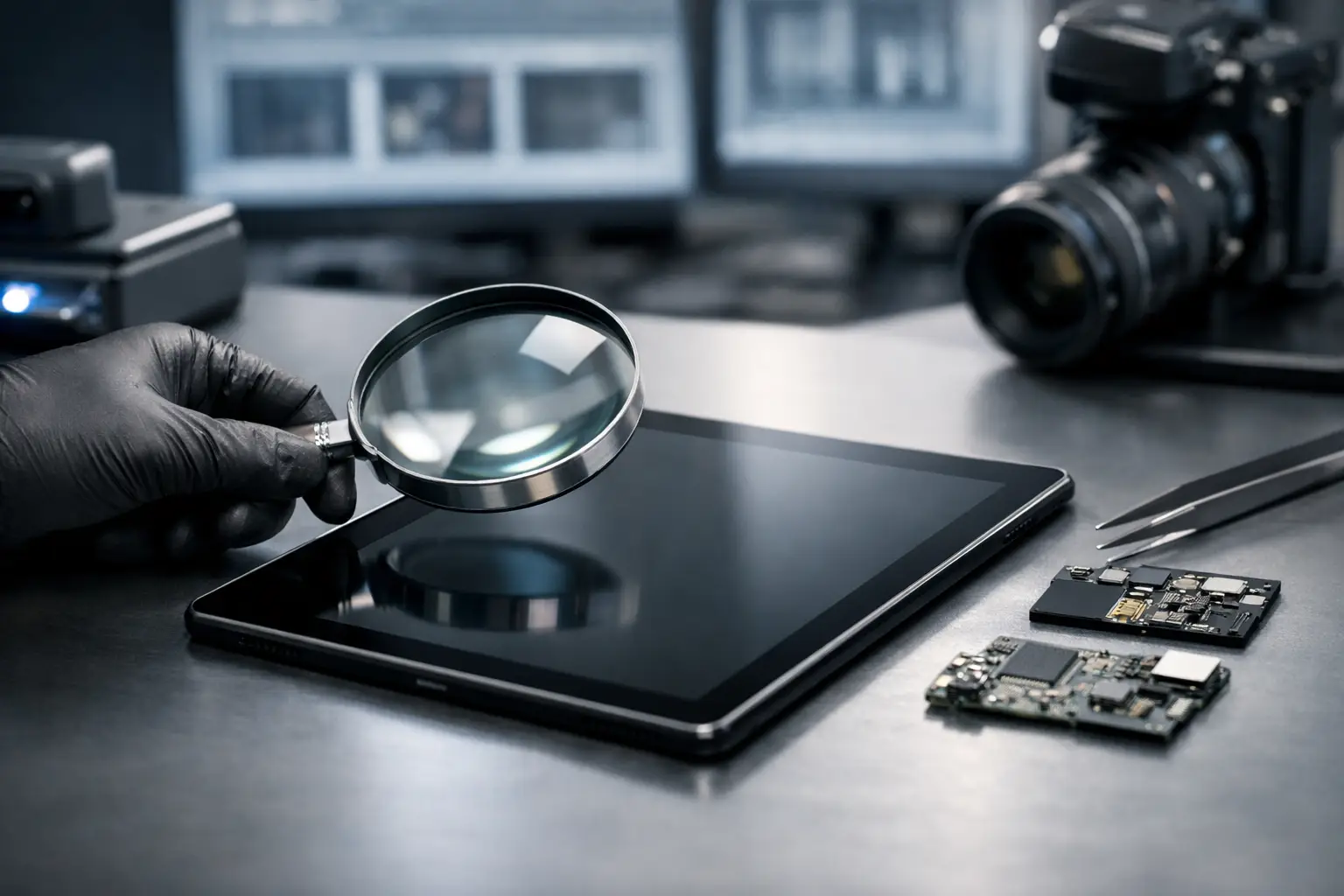
A tablet rarely arrives as a neat piece of evidence. It arrives in the middle of a dispute – after an alleged breach of trust, during a criminal investigation, or when one party insists the device will prove what really happened. That is why tablet forensic examination is not simply a technical task. It is an evidential process designed to preserve data properly, recover what can be recovered, and present findings in a form the court, legal team, or investigator can rely upon.
Tablets now sit in the same evidential category as mobile phones and laptops, but they bring their own complications. They may contain messaging data, photographs, email, browser history, location artefacts, app activity, cloud-linked content, and user account evidence. They may also be shared within a household or business, protected by modern encryption, or synchronised across multiple devices in ways that create both opportunity and risk. A proper forensic approach is therefore essential if the evidence is to carry weight.
What a tablet forensic examination is actually for
A tablet forensic examination is the controlled identification, extraction, preservation, analysis, and reporting of digital evidence from a tablet device. In practice, the purpose depends on the matter at hand. In criminal cases, the focus may be communications, intent, movements, contact between parties, or possession of unlawful material. In civil litigation, the issue may be disclosure, deleted messages, business records, image metadata, or evidence of account access. In employment and corporate investigations, the examination may centre on misuse of confidential information, unauthorised transfers, policy breaches, or communications relevant to misconduct.
The common thread is evidential integrity. It is not enough to locate interesting data. The handling of the device, the extraction method used, and the documentation of every step can all affect whether the findings are persuasive or vulnerable to challenge.
Why tablets need specialist forensic handling
Many people still assume a tablet is just a larger phone. That assumption causes problems. From a forensic perspective, tablets vary significantly by manufacturer, operating system, security model, app structure, and storage design. An iPad presents different access conditions from an Android tablet. Older devices may allow broader extraction. Newer ones may restrict access sharply unless the device is unlocked, partially unlocked, or supported by a lawful acquisition route.
There is also the issue of synchronisation. A tablet may show evidence that originated elsewhere, such as messages mirrored from a phone, documents opened from cloud storage, or photographs uploaded automatically from another device. This can be valuable, but it also means the examiner must distinguish between locally stored artefacts, synced data, and evidence that points to a wider digital estate.
In legal proceedings, that distinction matters. If a party claims a document was created on the tablet, the examiner may need to assess whether it was in fact authored there, merely viewed there, or downloaded from an online account. Those are very different evidential propositions.
The stages of a tablet forensic examination
The first stage is preservation. Before any analysis begins, the device should be secured in a way that reduces the risk of alteration, remote wiping, further synchronisation, or accidental access. Depending on the circumstances, this may include isolating the device from networks, recording its condition, noting visible notifications, and documenting any access credentials provided.
The second stage is acquisition. This involves obtaining data from the tablet using methods appropriate to the device, operating system, and legal authority available. In some cases, a logical extraction may retrieve user-accessible data such as messages, media, app content, and account information. In others, the examiner may be able to obtain a fuller file system extraction. Sometimes the practical limitation is straightforward – if the device is heavily encrypted and locked, the available data may be restricted unless lawful access credentials are obtained.
The third stage is analysis. This is where forensic expertise matters most. Raw extraction is not the same as evidence. Examiners assess timestamps, user activity, file metadata, deleted artefacts, application databases, geolocation records, browsing activity, and communication patterns. They also test assumptions. A message thread may appear complete but contain gaps. A screenshot may show content that no longer exists on the device. An app may retain logs even after a user believes material has been deleted.
The final stage is reporting. For legal use, findings must be set out clearly, impartially, and with sufficient methodological detail. A useful forensic report explains what was examined, how it was examined, what was found, and what limitations apply. It should not overstate the evidence.
What evidence can be recovered from a tablet
The answer depends on the device and the condition in which it is received, but tablets often contain a wider range of evidential material than clients expect. Messaging applications may reveal conversations, attachments, draft content, contact links, and communication timings. Email data can show exchanges, folder activity, and account configuration. Internet artefacts may include searches, visited sites, cached content, and session traces. Photographs and videos can provide embedded metadata relating to time, location, and device use.
Tablets may also contain notes, calendars, document revisions, application activity logs, and evidence of user authentication. In family and civil disputes, these artefacts can be highly significant. In corporate matters, business chat platforms, cloud storage applications, and remote access tools often become central.
Deleted data is another frequent area of interest, but this is where expectations need to be managed carefully. Deletion does not always mean recoverable. On modern encrypted devices, deleted content may be lost quickly or rendered inaccessible. Equally, some traces survive in thumbnails, app databases, synced records, or cloud-linked sources. The right answer is often not yes or no, but it depends on the device, timing, and user activity after deletion.
Tablet forensic examination in court-facing matters
For solicitors and counsel, the central question is rarely whether a tool can extract data. It is whether the evidence will withstand scrutiny. A tablet forensic examination intended for litigation or criminal proceedings should be conducted with chain of custody, repeatability, and proportionality in mind from the outset.
That means the examiner should be able to account for possession of the device, preserve an audit trail, identify the extraction method, and explain any limitations or interpretative issues. If another expert reviews the work, the process should be transparent enough to be understood and, where appropriate, reproduced. This is particularly important where there are allegations of fabrication, tampering, or selective disclosure.
It also means independence matters. A forensic examiner is not there to force the evidence into a client’s preferred narrative. The role is to identify and interpret digital artefacts fairly. That can strengthen a case, narrow the issues, or reveal that a point is weaker than first believed. In high-stakes matters, that clarity has value in itself.
Common problems and evidential risks
The greatest damage is often done before the examiner sees the tablet. A device may have been powered on repeatedly, browsed by a well-meaning colleague, connected to Wi-Fi, or subjected to improvised “recovery” attempts. Each of these actions can alter metadata, trigger synchronisation, or overwrite useful traces.
Another common issue is delay. The longer the gap between the event in question and forensic preservation, the greater the risk that key evidence will be lost through routine use, app updates, cloud changes, or user resets. Speed matters, but speed without proper process creates a different problem. Evidence gathered hastily and handled poorly can be harder to defend than evidence gathered carefully a little later.
There are legal and procedural risks as well. Privacy, privilege, proportionality, and scope must all be considered, particularly in civil, employment, and internal investigations. The objective is not to extract everything simply because it is technically possible. It is to examine what is necessary, lawful, and relevant.
When to instruct a specialist
If a tablet may become evidence, specialist instruction should come early. That is especially true where the issues involve deleted communications, disputed device use, allegations of misconduct, or the need for expert reporting. A general IT provider may be able to copy visible files. That is not the same as a forensic examination, and it will rarely satisfy the demands of litigation.
A specialist digital forensics provider such as Computer Forensics Lab approaches the device as evidence first and technology second. That distinction is what protects admissibility, preserves context, and gives legal teams confidence in the result.
A tablet can contain the timeline, the communication trail, or the contradiction that changes a case. The value lies not simply in getting data off the device, but in handling that evidence with the discipline required for it to speak clearly when it matters most.