

Digital evidence now features in over 80% of UK crimes, yet preservation failures and forensic backlogs threaten to collapse cases across England and Wales. Recent incidents, including the deletion of 96,174 body-worn video files by South Yorkshire Police, expose critical vulnerabilities in digital evidence handling. This comprehensive checklist empowers legal professionals and law enforcement to preserve digital evidence correctly, maintain chain of custody, and uphold justice through systematic, compliant procedures.
Table of Contents
- Understanding The Legal Framework For Digital Evidence Preservation
- Common Challenges And Failures In Preserving Digital Evidence
- Key Components Of An Effective Digital Evidence Preservation Checklist
- Applying The Checklist In Your Investigations: Best Practices And Tips
- Explore Expert Digital Forensics Services For UK Investigations
- Frequently Asked Questions
Key takeaways
| Point | Details |
|---|---|
| Digital evidence is critical | Involved in over 80% of UK crimes, yet preservation failures risk case collapses and lengthy delays |
| Legal compliance is mandatory | Seizure, retention, and processing must follow UK laws including Data Protection Act 2018 and CPIA 1996 |
| Backlogs create serious risks | Forensic backlogs exceed one year at some forces, jeopardising timely investigations |
| Structured checklists prevent errors | Consistent procedures support legally compliant handling and evidence integrity |
Understanding the legal framework for digital evidence preservation
The Digital Devices Seizure and Retention Policy establishes the foundation for lawful digital evidence handling across UK law enforcement. This policy applies throughout Immigration Enforcement and Home Office investigations, setting clear standards for seizing, retaining, and extracting data from digital devices.
Three key statutes govern digital evidence work. The Data Protection Act 2018 mandates lawful processing of personal data and protects data subject rights throughout investigations. The Criminal Procedure and Investigation Act 1996 establishes disclosure obligations, requiring investigators to pursue reasonable lines of enquiry and disclose material that might undermine the prosecution or assist the defence. The Police, Crime, Sentencing and Courts Act 2022 updated powers for obtaining devices from victims and witnesses, strengthening legal safeguards around consent and necessity.
You must issue Privacy Information Notices when handling digital data, informing data subjects about processing activities, legal bases, retention periods, and their rights. These notices demonstrate transparency and compliance with data protection requirements. Understanding these frameworks is essential because non-compliant evidence risks exclusion at trial, potentially destroying months of investigative work.
Your checklist must embed these legal requirements at every stage:
- Document the statutory power authorising each device seizure
- Record the legal basis for data processing under GDPR and DPA 2018
- Issue appropriate privacy notices to device owners
- Maintain disclosure schedules showing all material reviewed
- Respect data subject rights including access requests and deletion requirements where applicable
Compliance isn’t bureaucratic box-ticking. It protects evidence admissibility, safeguards individual rights, and maintains public confidence in digital investigations.
Common challenges and failures in preserving digital evidence
UK police forces face overwhelming digital forensics backlogs, with device analysis wait times exceeding 12 months at some constabularies. This crisis stems from exponential growth in digital devices per case, chronic understaffing, and inadequate technical infrastructure. The consequences extend far beyond delays, threatening justice itself.

The South Yorkshire Police incident reveals how catastrophic evidence loss occurs. In 2024, the force deleted 96,174 body-worn video files affecting 126 criminal cases, including serious offences. The Information Commissioner’s Office investigation found wholly inadequate technical and organisational safeguards. Staff lacked clear procedures, backup verification failed, and oversight mechanisms proved non-existent. This wasn’t malicious destruction but systemic failure born from poor documentation and insufficient controls.
Pro Tip: Always maintain verified backup copies of digital evidence in separate secure locations. The South Yorkshire incident resulted from assuming copies existed without verifying their integrity and accessibility.
Common preservation failures include:
- Inadequate chain of custody documentation allowing evidence tampering challenges
- Failure to create forensically sound images before analysis
- Poor environmental controls damaging storage media
- Inconsistent procedures across investigative teams
- Insufficient staff training on device handling and data protection
- Absence of audit trails tracking evidence access and modifications
The table below shows typical digital forensics backlogs across UK police forces in 2026:
| Force Type | Average Devices Awaiting Analysis | Typical Wait Time | Impact on Cases |
|---|---|---|---|
| Metropolitan/Large | 800-1,200 devices | 9-14 months | Critical delays in serious crime investigations |
| Regional/Medium | 300-600 devices | 6-12 months | Extended suspect bail periods, delayed charging decisions |
| Rural/Small | 100-250 devices | 4-8 months | Resource competition between cases, unsolved crimes |
These challenges don’t excuse poor practice. They demand rigorous checklists and procedures to prevent evidence loss. When staff face overwhelming workloads, detailed policies and safeguards become even more critical, not less.
Key components of an effective digital evidence preservation checklist
A comprehensive checklist transforms abstract legal requirements into concrete actions. Follow these five critical steps to preserve digital evidence properly.
- Secure the device during seizure
Document the seizure circumstances thoroughly. Record device location, condition, visible damage, and any passwords or PINs provided. Photograph the device and surrounding area. Package devices in anti-static bags with tamper-evident seals. For mobile devices, activate aeroplane mode immediately or use Faraday bags to prevent remote wiping. Never attempt to access the device without forensic training. Record the legal authority for seizure and issue Privacy Information Notices as required.
- Establish chain of custody documentation
Create detailed records tracking every person who handles evidence and every action taken. Your documentation must include dates, times, locations, purposes of access, and signatures. Use standardised forms to ensure consistency. Chain of custody breaks undermine evidence credibility at trial. Digital logs should be tamper-evident and backed up separately from the evidence itself.
- Create forensically sound copies
Generate bit-by-bit images using validated forensic tools before any analysis. These exact copies preserve all data including deleted files and system artifacts. Verify image integrity using hash values (MD5 and SHA-256). Work exclusively from copies, never the original device. Store original evidence securely and untouched except when creating verified copies. Document the imaging process meticulously including tool versions, settings, and verification results.
- Implement secure storage protocols
Store physical devices in climate-controlled evidence rooms with restricted access. Maintain access logs recording every entry. Digital evidence requires encrypted storage with role-based access controls. Separate storage locations for originals and working copies reduce loss risk. Environmental monitoring prevents damage from temperature, humidity, or electromagnetic interference. Regular integrity checks verify data hasn’t degraded or been altered.
- Conduct regular evidence reviews and audits
Schedule routine audits verifying evidence location, integrity, and documentation completeness. Automated alerts flag unauthorised access attempts or integrity violations. Review retention schedules ensuring evidence is kept appropriately but not indefinitely. Periodic reviews catch problems early, before they compromise investigations.
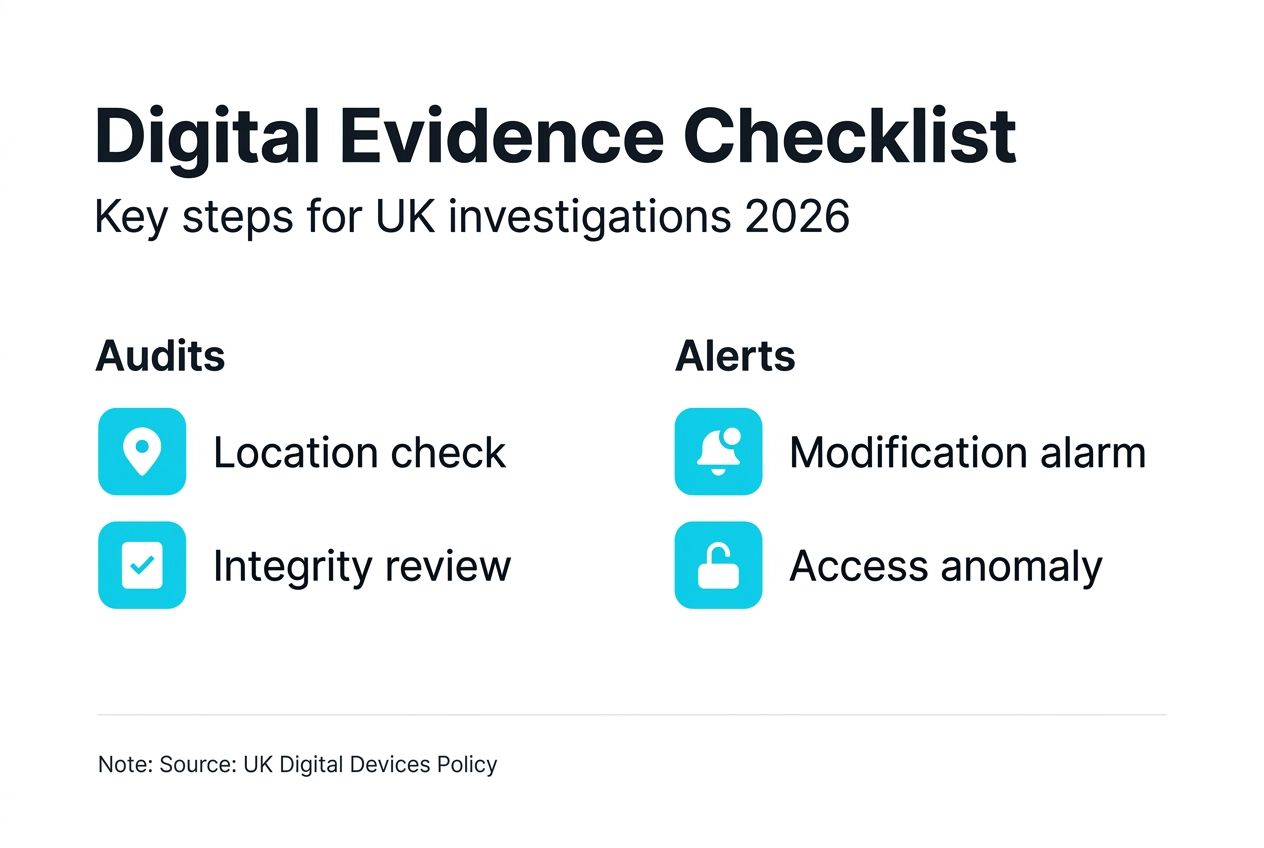

Pro Tip: Implement automated integrity monitoring with immediate alerts for any data modifications or access anomalies. Manual checks alone cannot prevent unnoticed evidence loss in complex digital investigations.
Applying the checklist in your investigations: best practices and tips
Integrating the checklist into daily operations requires strategic planning and cultural commitment. Make the checklist mandatory for all digital evidence handling, embedding steps into standard operating procedures and training programmes. New investigators must demonstrate competency before handling evidence independently.
Communication between investigating officers and digital forensics investigators determines success. Establish clear protocols for submitting devices, prioritising urgent cases, and communicating about realistic timelines. DFIs need context about the investigation to focus analysis effectively. Regular case reviews between investigators and forensic specialists prevent wasted effort and identify emerging evidence patterns.
Understanding forensic capacity constraints helps you plan realistically. With backlogs stretching beyond 12 months at some forces, early device submission becomes critical. Prioritisation systems should balance case seriousness, time sensitivity, and investigative value. Document prioritisation decisions to demonstrate proportionate resource allocation.
Legislation and technology evolve constantly. Schedule annual procedure reviews incorporating legal updates, new device types, and emerging forensic techniques. Consult with digital forensics specialists to understand capability developments and best practice evolution.
Practical implementation tips:
- Designate a digital evidence coordinator for each investigation ensuring checklist compliance
- Use standardised evidence bags, labels, and documentation forms reducing variability
- Photograph devices at seizure and before any handling to document condition
- Maintain separate logs for physical devices and extracted data
- Schedule regular training refreshers on evidence handling and data protection
- Create quick reference cards summarising critical checklist steps for field use
- Establish peer review systems where senior officers audit evidence handling documentation
- Build relationships with forensic laboratories understanding their procedures and capabilities
The checklist succeeds when it becomes habitual rather than burdensome. Invest time making procedures intuitive and efficient, then audit rigorously to maintain standards.
Explore expert digital forensics services for UK investigations
Navigating complex digital evidence preservation while managing backlogs and evolving threats demands specialist support. Computer Forensics Lab offers comprehensive digital forensics services tailored for UK legal professionals and law enforcement. Our London-based team handles device examination, data recovery, and chain of custody maintenance following strict forensic protocols.
We support investigators with mobile phone analysis, cloud data extraction, and deleted file recovery, ensuring no critical evidence is overlooked. Our expert witness reports meet court requirements and our analysts provide testimony when needed. Partnering with specialists reduces evidence loss risks and helps alleviate internal backlog pressures.
Explore our step-by-step evidence collection guide and digital forensics data analysis insights to strengthen your investigative capabilities.
Frequently asked questions
What is a digital evidence preservation checklist?
A digital evidence preservation checklist outlines systematic steps for lawfully collecting, handling, documenting, and storing digital evidence. It ensures compliance with UK legal standards including the Data Protection Act 2018 and CPIA 1996 whilst maintaining evidence integrity throughout investigations.
Why is preserving digital evidence so challenging in UK investigations?
Rapid technology advances outpace forensic capacity, creating skill and resource gaps. Staff shortages across police forces combine with inconsistent procedures to increase error risks. The sheer volume of devices per case generates backlogs exceeding 12 months, delaying justice and straining investigative teams.
What are the legal obligations when seizing digital devices?
You must comply with the Digital Devices Seizure and Retention policy, Data Protection Act 2018, and CPIA 1996. Issue Privacy Information Notices respecting data subject rights. Obtain proper authorisation under relevant legislation including the Police, Crime, Sentencing and Courts Act 2022 for victim and witness devices.
How can law enforcement prevent evidence loss like the South Yorkshire Police incident?
Implement strict technical controls limiting data deletion authority and requiring multi-person authorisation for critical actions. Maintain verified backup copies in separate secure locations with regular integrity checks. Provide comprehensive staff training on digital evidence policies and conduct routine audits detecting procedural failures before they cause irreversible loss.
Recommended
- Digital evidence checklist: essential steps for UK legal cases 2026
- Essential Digital Evidence Preservation Methods for 2025
- Digital Evidence Preservation: Safeguarding Legal Outcomes
- Digital Evidence Preservation | Computer Forensics Lab | Digital Forensics Services
- 10 Passaggi per una Checklist Sicurezza Informatica 2025 – Security Hub