
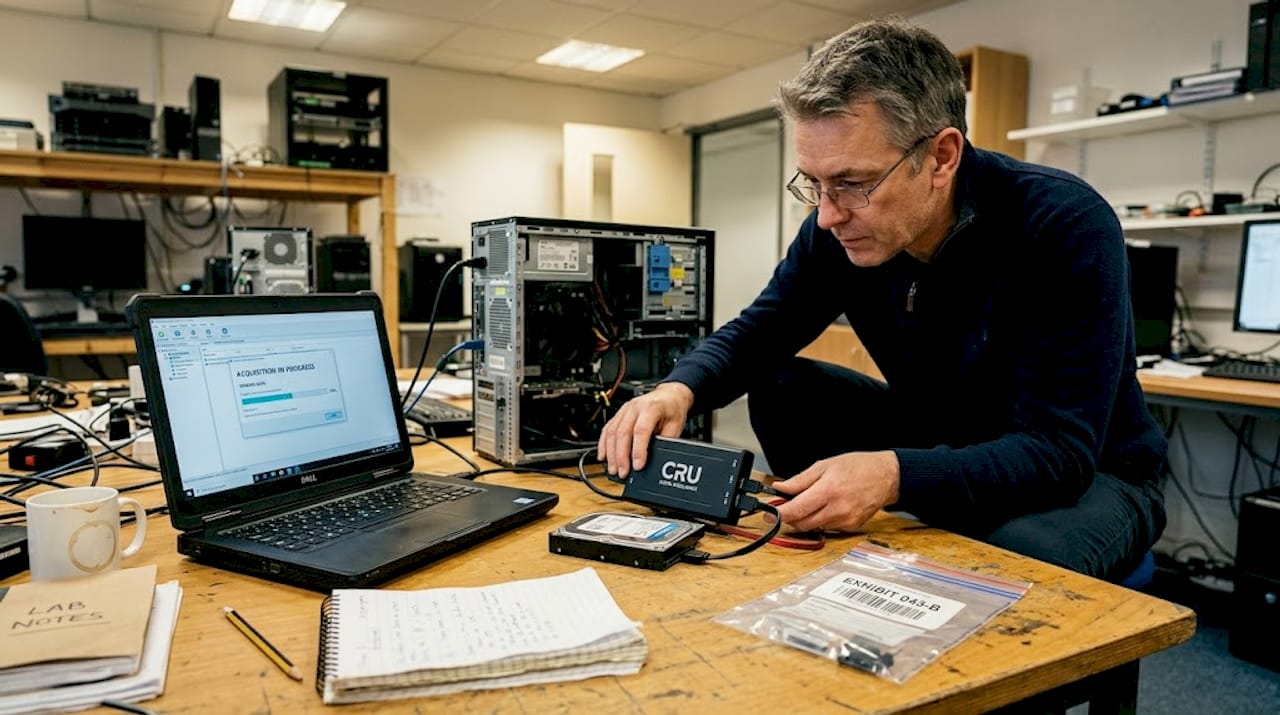
TL;DR:
- Forensic imaging creates an exact, bit-for-bit copy, capturing deleted data and system artifacts.
- Proper creation and maintenance of forensic images ensure evidence integrity and admissibility in UK courts.
- Continuous management and verification of digital evidence throughout investigations are crucial for courtroom success.
Many legal professionals assume that copying files from a device is sufficient to preserve digital evidence for court. It is not. A standard file copy misses deleted data, system artefacts, and critical metadata that can determine the outcome of a case. Forensic imaging is the accepted standard for capturing digital evidence in a form that courts and regulators in the UK will trust. This article explains exactly what a forensic image is, how it is created, why its integrity matters, and how it is applied across UK investigations and litigation to ensure evidence stands up to scrutiny.
Table of Contents
- Defining forensic images: what sets them apart
- How forensic images are created: a secure process
- Integrity and admissibility: safeguarding digital evidence
- Forensic imaging in UK investigations: best practices and legal standards
- What most legal teams overlook about forensic images
- Partner with experts for your digital evidence needs
- Frequently asked questions
Key Takeaways
| Point | Details |
|---|---|
| Exact evidence preservation | A forensic image is a complete, bit-for-bit copy that captures every detail of the original data source. |
| Integrity is essential | Hashes and careful processes are used to ensure the evidence remains unchanged and legally defensible. |
| Best practices matter | Using established procedures—including write-blocking and chain of custody—is vital for UK court admissibility. |
| Ongoing verification | Maintaining and verifying image integrity is an ongoing responsibility, especially as evidence is processed or examined. |
Defining forensic images: what sets them apart
When a forensic examiner talks about a “forensic image,” they mean something very specific. It is not a screenshot, not a folder copy, and not a cloud backup. A forensic image is an exact, bit-for-bit duplicate of every sector on a digital storage device, including areas that appear blank, sectors containing deleted files, unallocated space, and system partitions that a standard copy would never touch.
This distinction matters enormously in legal proceedings. When a solicitor or corporate investigator simply copies files from a suspect’s laptop, they capture only what the operating system presents as visible and accessible. Deleted files, file fragments, browser artefacts, and timestamps embedded in the file system are left behind entirely. A forensic image captures all of it, precisely as it exists at the moment of acquisition.
The table below illustrates the core differences between a forensic image and a standard file copy:
| Feature | Forensic image | Standard file copy |
|---|---|---|
| Deleted files | Captured | Not captured |
| File system metadata | Preserved | Often lost |
| Unallocated space | Included | Excluded |
| Cryptographic hash verification | Yes | No |
| Admissible in UK courts | Yes (when properly acquired) | Rarely |
| Write protection during acquisition | Required | Not standard |
Key characteristics that make forensic images uniquely suited to legal proceedings include:
- Completeness: Every bit of data is preserved, including areas the device owner believed were erased.
- Verifiability: Cryptographic hashes allow anyone to confirm the image is identical to the original at any point in time.
- Non-destructive working: Examiners work from the image, never the original device, eliminating any risk of accidental alteration.
- Legal defensibility: Investigators acquire forensic images using write-blocking and verify integrity with cryptographic hashes, meeting the evidentiary standards required in UK proceedings.
For legal professionals, understanding UK forensic compliance requirements is essential before instructing any digital forensics expert. The format of the image, the tools used, and the documentation produced all influence whether evidence will be accepted or challenged. A forensic image is not simply a technical artefact. It is a legal document in digital form, and it must be treated accordingly from the moment of acquisition.
In corporate investigations, forensic images serve an additional purpose. They allow organisations to preserve evidence of employee misconduct, data exfiltration, or intellectual property theft without disrupting live systems or alerting suspects. The image can be stored securely and examined at a later date, with the original device returned to service if necessary.
How forensic images are created: a secure process
Understanding the creation process helps legal professionals assess whether the evidence they are relying upon was properly acquired. A forensic image is only as reliable as the process used to create it. Shortcuts at any stage can undermine admissibility.
The standard acquisition process follows these steps:
- Preparation: The examiner documents the device, its condition, serial numbers, and any visible damage before anything is connected or powered on. This forms the foundation of the chain of custody record.
- Write-blocking: A hardware or software write-blocker is connected between the device and the imaging workstation. This prevents any data from being written back to the original device during acquisition, which is critical for preserving the original state.
- Imaging: Specialist software such as FTK Imager, Guymager, or EnCase is used to create the bit-for-bit copy. The tool reads every sector of the source device and writes it to the image file in a forensically accepted format such as E01 or DD.
- Hashing during acquisition: As the image is being created, the tool simultaneously computes a cryptographic hash of the source data. Common algorithms include MD5 and SHA-256.
- Verification: Once imaging is complete, the tool computes a hash of the resulting image file and compares it to the hash of the original. A match confirms the image is an exact duplicate. SWGDE guidance requires examiners to compute acquisition and verification hashes during and after imaging to ensure the container has not been compromised.
- Documentation: Every step, every tool used, every hash value, and every decision made is recorded in a contemporaneous log. This log becomes part of the chain of custody documentation.
Proper digital evidence handling at each of these stages is what separates evidence that survives cross-examination from evidence that collapses under it.


Pro Tip: Always request the acquisition log and hash verification report from your forensic provider before relying on digital evidence in proceedings. If an examiner cannot produce both, treat the evidence with caution regardless of what it appears to show.
The choice of imaging tool matters too. Not all tools handle every device type equally well. Solid-state drives with encryption, mobile devices, and cloud-connected systems each present specific challenges. An experienced forensic examiner will select the appropriate tool and method for the device in question, and will document that choice and the reasoning behind it.
Integrity and admissibility: safeguarding digital evidence
Creating a forensic image is only the beginning. Maintaining its integrity throughout the investigation is equally important, and this is where many cases encounter problems.
“Integrity is affected not only by initial hashing but also by subsequent operations such as lossy compression. Processed outputs are derivative evidence requiring their own integrity assurance.” SWGDE, Integrity and Digital Evidence
This point is frequently underestimated. Legal teams often focus on whether the initial image was correctly acquired, but the risks do not stop there. Every time data is extracted, exported, converted, or compressed from the forensic image, a new artefact is created. That artefact is what SWGDE refers to as “derivative evidence,” and it carries its own integrity requirements.
Consider a practical example. An examiner extracts a set of emails from a forensic image and exports them as a PDF for review. The PDF is derivative evidence. If the export process introduced any errors, or if the PDF was subsequently modified, the integrity of that specific exhibit is compromised, even though the original forensic image remains intact. Courts will scrutinise the entire chain, not just the starting point.
The factors that determine whether forensic evidence in UK courts will be admitted include:
- Acquisition integrity: Was the image created without modifying the original device?
- Hash verification: Do the acquisition and verification hashes match, and are they recorded?
- Chain of custody: Is there an unbroken, documented record of who handled the evidence and when?
- Derivative evidence management: Were all exports, copies, and processed outputs handled with the same rigour as the original image?
- Examiner competence: Is the examiner qualified, and can they explain and defend their methodology under cross-examination?
A single gap in any of these areas can provide opposing counsel with grounds to challenge admissibility. Securing digital evidence from the outset, and maintaining that security throughout the investigation, is not optional. It is the foundation upon which the entire case rests.
Forensic imaging in UK investigations: best practices and legal standards
In practice, UK legal and corporate investigations vary considerably in how well they apply forensic imaging standards. Some organisations have mature internal procedures. Others instruct forensic providers without fully understanding what to expect or what to verify.
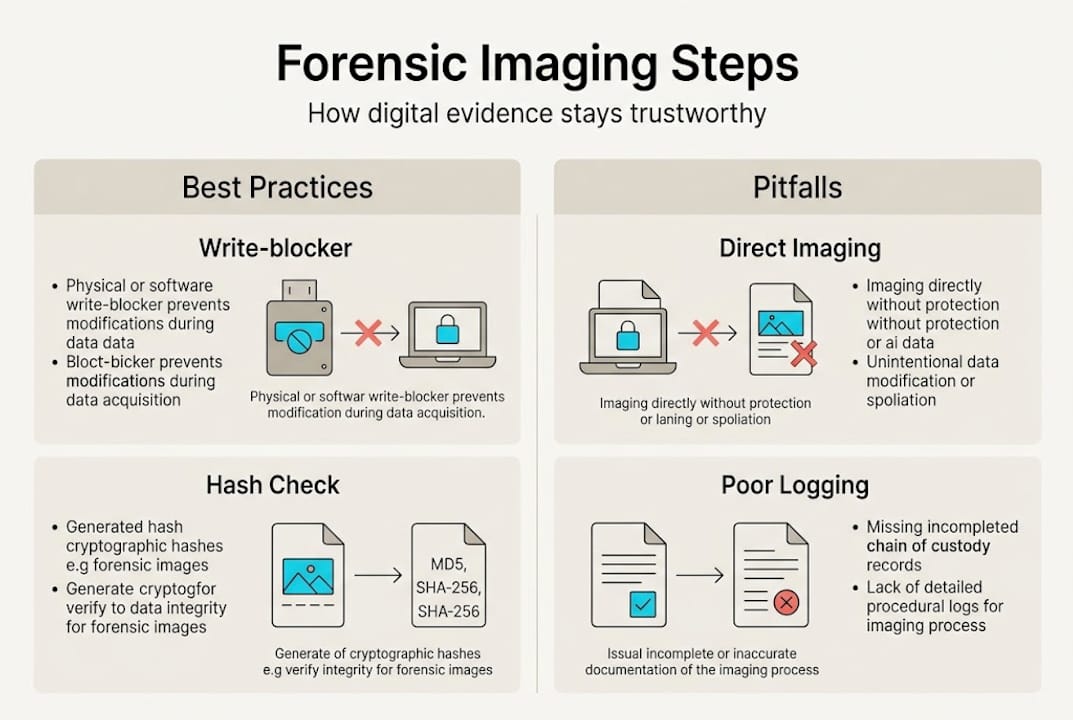

The table below contrasts best practices with common pitfalls seen in UK investigations:
| Best practice | Common pitfall |
|---|---|
| Use hardware write-blocker during acquisition | Imaging directly without write protection |
| Record dual hashes (MD5 and SHA-256) | Relying on a single hash or none at all |
| Document every step contemporaneously | Reconstructing logs after the fact |
| Work only from verified image copies | Analysing the original device directly |
| Treat all exports as derivative evidence | Failing to verify integrity of processed outputs |
| Instruct a qualified, independent examiner | Using internal IT staff without forensic training |
SWGDE best practices are explicit: examiners should work only on verified copies and always treat processed outputs as separate evidence requiring their own integrity documentation.
Pro Tip: In corporate investigations involving potential litigation, instruct your forensic provider before any internal IT team accesses the device in question. Even well-intentioned access by IT staff can alter timestamps and system logs, creating complications that are difficult to explain in court.
Real-world cases illustrate why these standards exist. In employment disputes involving alleged data theft, forensic images have revealed that employees accessed and copied confidential files in the days before resignation, information that would never have appeared in a standard file review. In fraud investigations, deleted financial records recovered from unallocated space have provided the decisive evidence. In both scenarios, the value of the evidence depended entirely on the integrity of the forensic image.
For legal professionals building a case, the UK digital evidence checklist provides a practical framework for ensuring that evidence is collected and managed to the required standard. Equally, the forensics evidence guide offers detailed guidance on how to instruct and work with forensic examiners effectively.
Key considerations for UK investigations include:
- Aligning acquisition methods with the specific device type, whether a laptop, mobile phone, server, or cloud account.
- Ensuring the forensic provider can produce an expert witness report that meets the requirements of Civil Procedure Rules Part 35.
- Confirming that the provider maintains professional indemnity insurance and can appear as an expert witness if required.
- Establishing clear protocols for sharing forensic images with opposing parties during disclosure, including appropriate protective orders.
What most legal teams overlook about forensic images
Here is the uncomfortable reality: most legal teams treat forensic imaging as a one-time event. The image is acquired, the hash is recorded, and the assumption is that integrity is secured indefinitely. That assumption is wrong.
In our experience, the greatest risks to digital evidence arise not during acquisition but during the analysis and review phases. Every time an examiner runs a tool against the image, every time a report is generated, every time a file is exported for counsel to review, there is an opportunity for error or undocumented change. The original image may be pristine, but the derivative evidence trail can become difficult to defend if it has not been managed with the same rigour.
Mastering the forensic process means understanding that integrity is not a state you achieve once. It is a discipline you maintain throughout the entire lifecycle of the evidence. Legal teams that grasp this principle are far better positioned to withstand challenges at trial. Those who do not often discover the gap at the worst possible moment.
Partner with experts for your digital evidence needs
When the integrity of digital evidence is central to your case, the expertise behind the forensic image matters as much as the image itself. Computer Forensics Lab provides legally defensible digital forensics services for solicitors, barristers, and corporate clients across the UK, from initial acquisition through to expert witness testimony. Our examiners follow SWGDE-aligned protocols, produce fully documented chain of custody records, and can support complex forensic investigations involving computers, mobile devices, cloud data, and corporate networks. If you are managing a case where digital evidence is in play, speak to our team before any device is accessed.
Frequently asked questions
What is the main difference between a forensic image and a standard copy?
A forensic image is an exact, bit-for-bit copy of all data, including deleted files and system information, while a standard copy only duplicates visible files. Forensic images are acquired using write-blocking to preserve all data in a legally defensible form.
Why are hashes like MD5 or SHA-256 important for forensic images?
Hashes uniquely fingerprint the evidence and prove that the image has not been altered from acquisition through to analysis. Cryptographic hashes are computed at imaging and again after acquisition to confirm integrity at each stage.
Can a forensic image be used more than once for different investigations?
Yes, provided its integrity is verified before each use and the chain of custody is maintained throughout. Integrity can be affected by later processing operations, so verification before each new use is essential.
Is a forensic image always admissible in UK courts?
No. Admissibility depends on proper collection, preservation, documentation, and the qualifications of the examiner producing the evidence. Even a technically sound image can be excluded if the chain of custody is incomplete or the examiner cannot defend their methodology.
What happens if a forensic image’s hash does not match?
A mismatch indicates possible tampering, corruption, or error during acquisition, and typically results in the evidence being excluded or heavily scrutinised. Hash verification is precisely why examiners confirm the container has not been compromised before any analysis begins.