
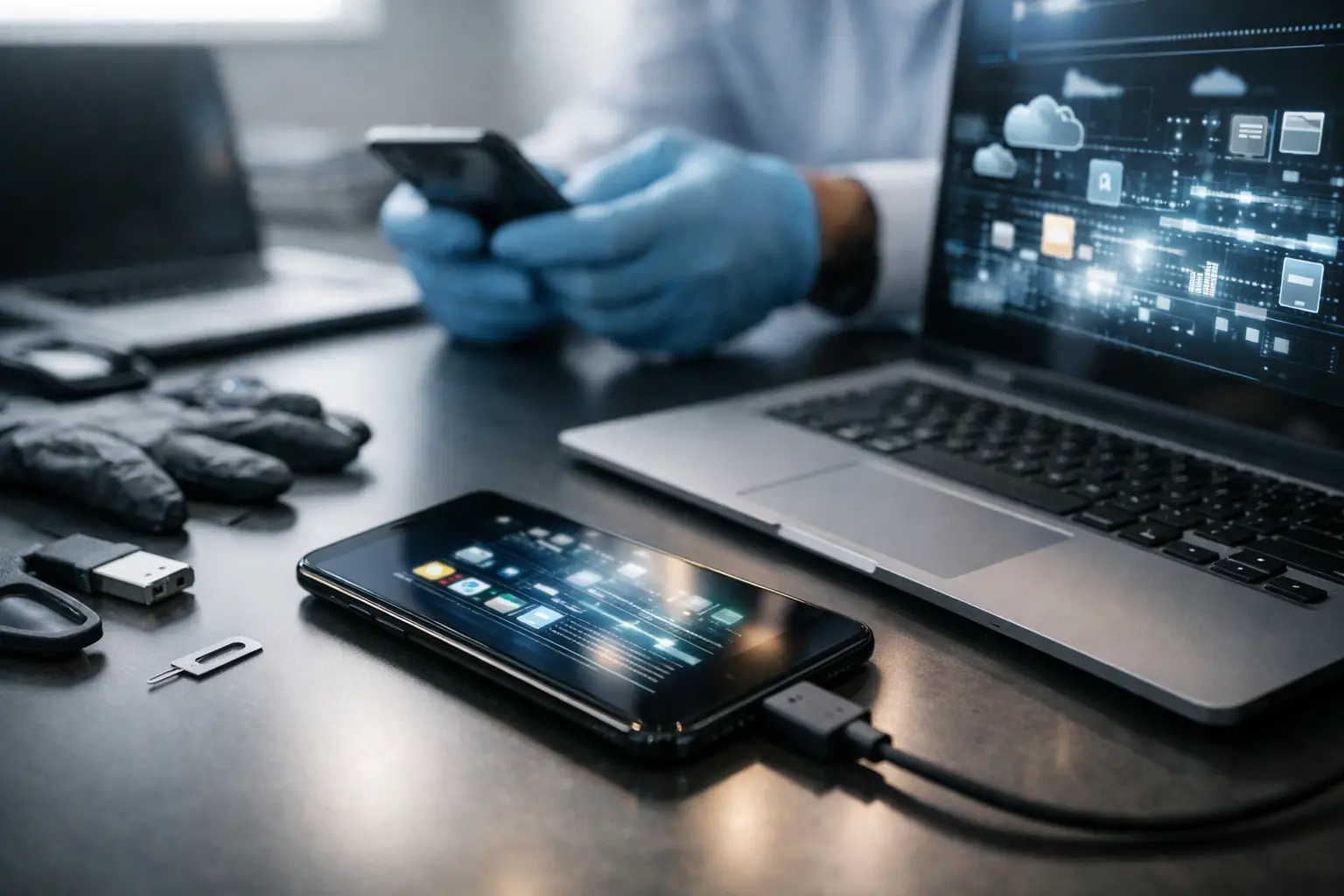
A handset arrives with more than messages and call logs. It may hold location records, deleted chats, app activity, photographs, cloud traces, browser artefacts and evidence of who did what, when and from where. In legal and investigative work, mobile phone data extraction is not simply about getting data off a device. It is about recovering relevant material in a way that preserves integrity, records method, and produces findings that can withstand scrutiny.
That distinction matters. A phone can be central to an employment dispute, a criminal allegation, a family matter, a fraud investigation or a cyber incident. Yet the same device can also mislead if handled carelessly. A well-meaning user opening apps, charging the handset incorrectly, or connecting it to consumer software may alter timestamps, trigger synchronisation, or overwrite recoverable material. Once that happens, evidential value may be weakened or lost entirely.
What mobile phone data extraction actually means
At its simplest, mobile phone data extraction is the forensic process of identifying, acquiring and preserving data from a mobile device for examination. In practice, the process is more exacting. The examiner must consider the device type, operating system, security controls, condition of the handset, potential cloud dependencies, and the legal basis for access.
Extraction methods vary. In some cases, a logical extraction may obtain active user data such as contacts, messages and application content exposed through the operating system. In others, a file system extraction may provide broader access to underlying directories and databases. More advanced matters may require a physical extraction or other specialist techniques aimed at capturing data at a lower level, subject to device support, encryption and lawful authority.
The method chosen is not a technical preference alone. It affects what may be recoverable, what cannot be reached, and how findings should be interpreted. A disciplined examiner will explain those limits clearly rather than overstating what the evidence shows.
Why forensic mobile phone data extraction matters in disputes
For solicitors and investigators, the issue is rarely whether a phone contains data. It is whether that data can be relied upon. Court-facing work requires more than screenshots, informal downloads or a witness scrolling through a handset in conference. It requires provenance.
That means documenting who held the device, when it was received, how it was secured, what tools and procedures were used, what data was extracted, and whether there were any restrictions or anomalies. Chain of custody is not administrative theatre. It is part of the evidential foundation. If there is a later challenge over contamination, access, tampering or selective disclosure, that record becomes critical.
There is also the issue of impartiality. In contentious matters, extraction should not be shaped around the answer one side hopes to find. The role of the forensic examiner is to preserve and analyse digital evidence independently, recording both inculpatory and exculpatory material where relevant. That is often the difference between a useful forensic report and an advocacy document that falls apart under cross-examination.
What data can often be recovered
A modern smartphone records far more activity than many users realise. Depending on the handset, operating system version, passcode status, application design and cloud integration, an examination may reveal SMS messages, instant messaging content, call histories, contacts, media files, notes, calendars, internet history, map usage, Wi-Fi connections and location-related artefacts.
In appropriate cases, deleted material may also be recoverable, though this depends heavily on the device and the timing of events. Some deleted records persist in databases, backups, caches or synced environments. Others are quickly overwritten or rendered inaccessible by encryption and system behaviour. Anyone promising guaranteed recovery of deleted phone evidence should be treated with caution.
Application data can be especially valuable. Messaging platforms, social media tools, banking apps, health data, ride-booking services and workplace communication platforms may all generate artefacts relevant to timelines, associations and user actions. Equally, cloud-linked evidence can matter as much as handset-resident data. A phone may be the access point, but not the only location where evidence sits.
The limits and risks of mobile phone data extraction
No competent examiner should present extraction as magic. Some devices are locked with strong encryption and cannot be accessed without the correct credentials or lawful powers. Some data exists only transiently. Some applications encrypt content end to end and store very little locally. Some phones are damaged to a degree that makes acquisition partial or impossible.
There are also legal and privacy constraints. A mobile phone can contain highly personal material unrelated to the dispute. In employment matters, internal investigations and family proceedings alike, relevance and proportionality matter. The scope of examination should be defined carefully, with attention to data protection obligations, privilege issues and the terms of any court order or consent.
This is where process protects everyone involved. A properly scoped forensic exercise can target relevant date ranges, users, applications or issues while preserving the wider device image should further questions arise later. It is a more defensible approach than broad, informal trawling through a person’s digital life.
How the forensic process should work
The sound approach begins before any extraction takes place. The device should be received, labelled and secured, with chain of custody commenced immediately. Examiners then assess the handset’s condition, network state and risks of remote access or alteration. In some matters, isolating the phone from networks is essential to prevent wiping, synchronisation or incoming data changes.
Acquisition follows, using forensic tools and methods appropriate to the device and the legal context. The examiner records the procedure, versioning of tools, relevant settings and any deviations caused by the handset’s condition or security. Hashing and verification may be used where applicable to confirm integrity of acquired data.
Analysis is separate from extraction. That distinction is often missed. Pulling data from a phone is one stage. Interpreting it accurately is another. Timestamps may be affected by time zone settings. A message in an app database may indicate storage, not necessarily that a user read it. A location artefact may suggest presence in an area, but not prove who held the device at that moment. Forensic reporting must address those nuances.
Mobile phone data extraction in legal and corporate cases
In criminal defence and prosecution work, phone evidence can support or undermine allegations through timeline reconstruction, communication analysis and location-related findings. In civil litigation, it may assist with breach of contract disputes, harassment claims, disclosure issues or questions of knowledge and intent. In matrimonial matters, it can become relevant to contact patterns, hidden communications or the authenticity of digital exhibits.
For corporate clients, the same principles apply in a different setting. A company investigating insider misconduct, data theft, collusion or policy breaches may need evidence from business-issued devices or, in some circumstances, from personally owned devices subject to lawful authority and workplace policies. The urgency is often high, but speed should not displace method. An internal investigation built on poorly acquired phone material can create more risk than clarity.
This is why legal teams often instruct specialist examiners rather than general IT providers. The task is not merely technical extraction. It is producing evidence that can be explained, defended and, if necessary, presented in court.
Choosing the right expert
Not every provider offering phone downloads is conducting forensic work. The difference shows up in documentation, tool validation, scope control, reporting quality and willingness to state limitations. If the case may proceed to court or formal disciplinary action, those points matter from the outset.
A credible expert should be able to explain what form of extraction is possible, what legal basis is required, what may be recoverable, where the limits lie, and how the chain of custody will be maintained. Reporting should be clear enough for lawyers and decision-makers, yet technically precise enough to withstand challenge. At Computer Forensics Lab, that standard is central to the work because the evidence is only as useful as the process behind it.
When a mobile phone may hold the key evidence, the first decision is often the most important one: do not treat it as an ordinary IT problem. Treat it as evidence from the start, and the chances of uncovering reliable, defensible answers are far stronger.