

Digital evidence now sits at the heart of almost every serious criminal investigation in the UK, yet it remains one of the most frequently excluded categories of evidence in court. Gaps in chain of custody documentation can render otherwise compelling material completely inadmissible, collapsing prosecutions and undermining justice. For legal professionals and law enforcement agencies, understanding precisely why chain of custody matters is not optional. This guide breaks down the legal obligations, practical mechanics, and emerging risks that every practitioner must grasp to keep digital evidence court-ready.
Table of Contents
- What chain of custody means for digital evidence
- Legal frameworks and real-world consequences in the UK
- How digital chain of custody is maintained: practical steps
- Edge cases and evolving risks: cloud, encryption, rapid response
- Audit trails, technology, and the future of chain of custody
- Expert support for digital chain of custody in the UK
- Frequently asked questions
Key Takeaways
| Point | Details |
|---|---|
| Court acceptance hinges on process | UK courts will not admit digital evidence unless chain of custody is flawlessly documented and upheld. |
| Legal compliance is non-negotiable | PACE 1984 and CPIA 1996 require strict adherence to digital evidence handling procedures. |
| Technical and human errors cause risk | Most evidence disputes in UK courts stem from avoidable chain of custody mishandling. |
| Technology boosts reliability | Audit trails, digital logs, and blockchain can strengthen the chain of custody and court confidence. |
What chain of custody means for digital evidence
Chain of custody is not simply a paper trail. In the digital context, it is a continuous, systematic record of every interaction with a piece of evidence from the moment it is seized to the moment it is presented in court. As chain of custody is defined, it is a chronological documentation process that tracks every interaction with digital evidence, ensuring its integrity, authenticity, and admissibility under UK law.
“Chain of custody is a systematic chronological documentation process tracking every interaction with digital evidence from seizure to court presentation, ensuring its integrity, authenticity, and admissibility under UK law.”
Digital evidence is uniquely vulnerable. Unlike a physical weapon or a signed document, a file can be altered without leaving an obvious physical mark. Metadata can be overwritten. Timestamps can shift. This is precisely why safeguarding evidence integrity requires a far more rigorous and technically informed approach than handling physical exhibits.
When a chain of custody is broken, courts are left with a fundamental question: can we be certain this evidence has not been tampered with? If the answer is uncertain, exclusion follows. The consequences extend beyond a single case. A broken chain can mean a guilty party walks free, a victim receives no justice, and the credibility of an entire investigation is called into question.
Key reasons chain of custody matters for digital evidence:
- It establishes that evidence has not been altered since seizure
- It identifies every person who accessed the evidence and when
- It supports the legal argument that evidence is authentic and reliable
- It protects investigators and legal teams from allegations of misconduct
- It is a prerequisite for admissibility under UK law
Legal frameworks and real-world consequences in the UK
Two pieces of legislation form the backbone of digital evidence handling in England and Wales. The Police and Criminal Evidence Act 1984 (PACE) governs the lawful seizure of evidence and sets standards for how it must be handled and stored. The Criminal Procedure and Investigations Act 1996 (CPIA) imposes disclosure obligations, requiring investigators to reveal all relevant material to the defence. Breaches of either statute can result in evidence being ruled inadmissible.
| Legislation | Key obligation | Consequence of breach |
|---|---|---|
| PACE 1984 | Lawful seizure and integrity maintenance | Evidence excluded; potential misconduct findings |
| CPIA 1996 | Full disclosure of relevant digital material | Case collapse; prosecution abuse of process arguments |
The scale of the challenge is significant. 89% of criminal investigations in the UK now involve digital evidence, making robust chain of custody procedures a daily operational necessity rather than an occasional concern. At the same time, over 20,000 devices currently await forensic analysis due to process backlogs, creating pressure that can lead to shortcuts and procedural errors.

Real-world consequences are stark. The Serious Fraud Office has faced scrutiny over software failures that affected digital evidence court impact, with cases collapsing because disclosure processes were compromised. Courts scrutinise chain of custody procedures rigorously, and even minor omissions in documentation can create reasonable doubt sufficient to exclude critical material.
Common court exclusion triggers include:
- Missing or incomplete custody logs
- Unverified transfers between handlers
- Failure to record dates, times, and locations of access
- Absence of forensic imaging records
- Broken or unsealed tamper-evident packaging
How digital chain of custody is maintained: practical steps
Maintaining an unbroken chain of custody requires discipline at every stage of the evidence lifecycle. The process is sequential and each step must be documented contemporaneously. Retrospective record-keeping is one of the most common and damaging mistakes practitioners make.
The core steps in order:
- Seizure — Record the exact time, location, and condition of the device. Photograph it in situ before touching it.
- Documentation — Complete a custody log immediately, noting the handler’s name, role, and purpose of access.
- Forensic imaging — Create a bit-for-bit copy of the original using write-blockers to prevent any data being written to the source device.
- Hash verification — Generate a hash value (typically SHA-256) for both the original and the copy. Matching hashes prove the copy is identical and unaltered.
- Tamper-evident packaging — Seal the original device in appropriate packaging and record the seal number.
- Secure storage — Store in a controlled environment with restricted access and a log of every entry.
- Transfer and disclosure — Document every transfer between parties, including dates, times, and the identity of both sender and recipient.
The mechanics of preserving chain of custody include contemporaneous records of handlers, dates, times, locations, and actions taken, alongside forensic imaging with write-blockers, hash values for integrity verification, and tamper-evident packaging throughout.
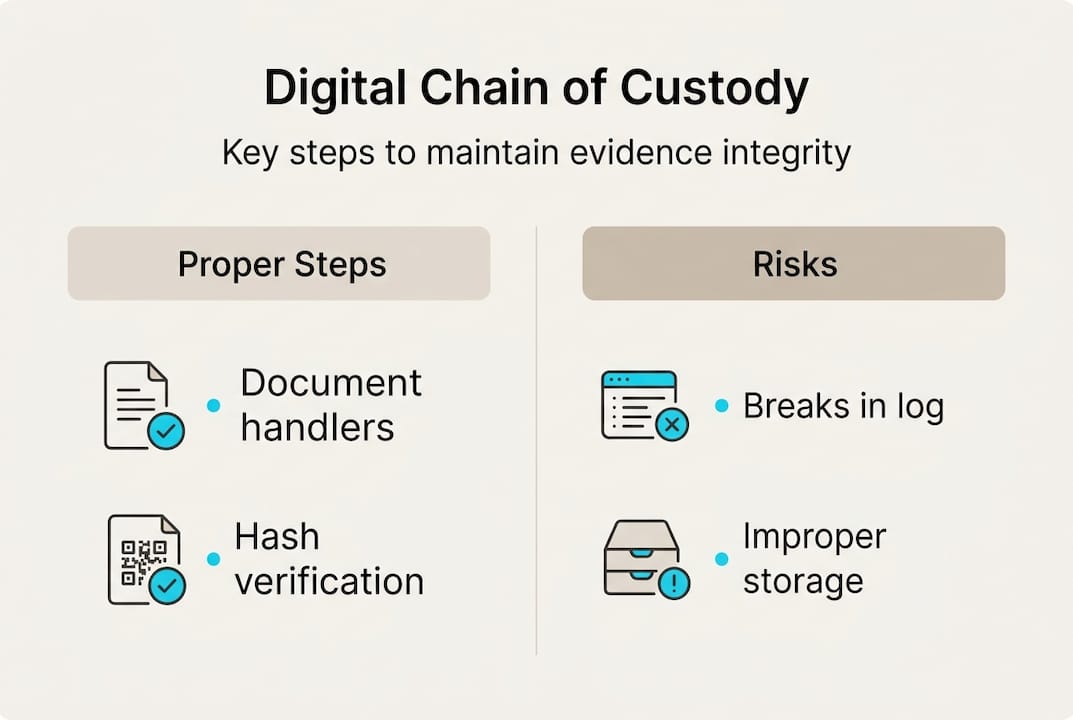

| Correct process | Incorrect process | Likely outcome |
|---|---|---|
| Contemporaneous documentation | Retrospective log completion | Credibility challenged in court |
| Hash values verified at each stage | No integrity checks performed | Evidence authenticity disputed |
| Write-blocker used during imaging | Direct access to original device | Data contamination alleged |
| Tamper-evident packaging sealed | Evidence stored in open containers | Tampering cannot be ruled out |
Pro Tip: Hash matching is your strongest single proof that evidence has not changed. Run hash checks at seizure, after imaging, and before any court submission. A mismatch at any stage is a red flag that demands immediate investigation.
For practical guidance on daily evidence handling, the chain of custody tips available from specialist forensic practitioners can help teams build consistent, defensible procedures. A well-structured digital forensics chain guide also provides a useful reference for teams building or auditing their own protocols.
Real-world pitfalls to avoid:
- Allowing non-certified personnel to handle original devices
- Failing to document the reason for accessing evidence
- Using personal or unvetted equipment for forensic work
- Transferring evidence via unencrypted channels
- Neglecting to update custody logs after routine storage checks
Edge cases and evolving risks: cloud, encryption, rapid response
Standard procedures work well for seized physical devices. But a growing proportion of critical evidence exists in environments where standard approaches simply do not apply. Cloud data, encrypted devices, and volatile memory each present distinct chain of custody challenges that demand specialist knowledge.
Cloud evidence introduces third-party access issues. Data held by a provider in another jurisdiction may require legal process to obtain, and the window for preservation can close quickly if accounts are deleted or overwritten. Encrypted devices present a different problem: delays in gaining access risk data loss, particularly if a device has a remote wipe capability or a time-limited decryption key.
Volatile memory, such as RAM, is perhaps the most time-sensitive challenge. The data it holds disappears the moment a device is powered down. Immediate imaging is not just best practice; it is the only way to preserve that evidence at all.
30% mishandling risk exists across digital evidence cases, and over half of all evidentiary disputes involve chain of custody errors. Over 72-hour delays in processing frequently result in exclusion.
Key edge case risks:
- Cloud data: third-party access, jurisdictional complications, rapid data deletion
- Encrypted devices: time pressure, specialist decryption requirements
- Volatile memory: immediate imaging window, no second chances
- AI-generated or AI-manipulated content: authentication challenges, deepfake risks
- Remote wipe capabilities: evidence destroyed before seizure is complete
Pro Tip: Develop a rapid response protocol specifically for volatile evidence. The protocol should designate a certified forensic specialist on call, define the maximum acceptable response time, and include a pre-approved imaging toolkit. Securing digital evidence in these scenarios is a race against time, and improvisation is the enemy of admissibility.
Audit trails, technology, and the future of chain of custody
Technology is reshaping how chain of custody is recorded and verified. The most significant development is the application of blockchain to evidence management. A blockchain-based audit trail creates an immutable, timestamped record of every interaction with a piece of evidence. Because the record cannot be altered retroactively without detection, it offers a level of tamper-proof assurance that traditional paper logs simply cannot match.
“Failure to maintain chain of custody renders digital evidence inadmissible; digital tools like blockchain offer enhanced audit trails.”
As chain of custody tracking systems evolve, UK legal teams have access to a growing range of tools that automate documentation, flag procedural gaps in real time, and generate court-ready reports at the click of a button.
Current and emerging solutions for UK legal teams:
- Blockchain audit systems — Immutable, timestamped records of every evidence interaction
- Automated custody management platforms — Digital logs that update in real time and alert handlers to missing entries
- Hash algorithm integration — Automated hash generation and comparison at each stage of the evidence lifecycle
- Encrypted evidence transfer portals — Secure, logged channels for moving evidence between parties
- AI-assisted anomaly detection — Systems that flag unusual access patterns or metadata inconsistencies
Futureproofing your evidentiary process means investing in these tools now, not after a case collapses. The courts are increasingly familiar with forensic technology, and a legal team that cannot demonstrate a robust, technology-supported chain of custody will find itself at a significant disadvantage.
Expert support for digital chain of custody in the UK
Chain of custody is not a bureaucratic formality. It is the foundation on which the admissibility of digital evidence rests, and getting it wrong has consequences that no legal team or law enforcement agency can afford. At Computer Forensics Lab, we work directly with legal professionals and investigators across the UK to ensure that digital forensics data is handled, preserved, and presented to the highest evidentiary standards. Our digital forensics services cover everything from initial seizure guidance and forensic imaging to expert witness reports and court-ready documentation. Whether you are managing a complex forensic investigation or building internal chain of custody policies, our specialists are available to support you at every stage. Speak to a digital forensics expert today for chain of custody support tailored to your case.
Frequently asked questions
Does chain of custody apply differently for digital versus physical evidence?
The principles are similar, but digital evidence handling requires additional technical controls such as hash values and write-blockers, plus faster response times due to volatility and the risk of remote deletion.
What are the main reasons digital evidence gets excluded in UK court?
Common causes include incomplete custody logs, broken packaging seals, unverified handler transfers, and over 72-hour processing delays, which courts treat as a significant indicator of procedural failure.
How can UK legal teams enhance chain of custody reliability?
Teams should maintain contemporaneous digital logs, ensure all handlers are certified, and adopt blockchain audit tools and hash algorithms to provide independently verifiable integrity records.
What legislation should I know regarding digital chain of custody in the UK?
PACE 1984 and CPIA 1996 set the legal framework for seizure, integrity maintenance, and disclosure obligations, with breaches potentially resulting in evidence exclusion or case collapse.