

A single digital forensics report can determine whether a cybercrime prosecution succeeds or collapses entirely. Yet one of the most persistent misconceptions in legal practice is that expert witnesses are simply hired to support whichever side instructs them. They are not. Expert witnesses in England owe an overriding duty to the court to provide objective, unbiased opinions within their expertise, overriding any obligation to the instructing party. Understanding this distinction is not just academic. It shapes how you instruct experts, how you challenge opposing evidence, and ultimately how you build a case that holds up under scrutiny.
Table of Contents
- What is an expert witness?
- Core duties: whose interests do expert witnesses serve?
- Expert witness roles in criminal and civil digital forensics cases
- Expert report standards and evidence transparency
- How to instruct and challenge an expert witness
- Need digital forensics expert witness support?
- Frequently asked questions
Key Takeaways
| Point | Details |
|---|---|
| Impartiality is vital | Expert witnesses must always prioritise the court’s interest over those of instructing parties. |
| Follow formal procedure | Written instructions and compliance with criminal or civil procedure rules are essential when engaging digital forensics experts. |
| Report transparency matters | A fully transparent, reproducible methodology in reports helps avoid disputes and strengthens your case. |
| Challenging evidence | Know how to scrutinise opposing expert reports for bias or methodological flaws using court guidelines. |
What is an expert witness?
An expert witness is a court-accepted professional whose specialist knowledge allows them to offer opinion evidence, not just factual testimony. In digital forensics, this means someone qualified to examine devices, recover data, analyse network logs, and interpret the findings in a way that assists the court. This is fundamentally different from a factual witness, who simply recounts what they observed.
Not every skilled technician qualifies. Courts in England assess whether a proposed expert has the relevant qualifications, practical experience, and methodological rigour to give reliable opinion evidence. A digital forensics expert witness must typically demonstrate formal training in forensic computing, a track record of casework, and familiarity with the legal standards governing evidence.
The key legal standards courts apply when assessing expert status include:
- Recognised academic or professional qualifications in the relevant field
- Demonstrable practical experience in digital forensic investigations
- Familiarity with court procedures and evidential requirements
- Ability to explain complex technical findings in plain language
- No undisclosed conflicts of interest with any party
“The primary duty to the court ensures impartiality that is crucial in digital forensics, where evidence is easily contested. Reports must detail methodologies transparently so findings can be tested under cross-examination.”
This transparency requirement is not optional. It is the foundation on which the credibility of any digital forensics opinion rests.
Core duties: whose interests do expert witnesses serve?
The answer is unambiguous. Expert witnesses serve the court, not the party that pays their fees. This is enshrined in the overriding duty to the court and applies regardless of whether the expert is instructed by the claimant, defendant, prosecution, or defence.

In practice, this impartiality shapes every stage of the expert’s involvement. Reports must present findings honestly, including findings that are unhelpful to the instructing party. Courtroom testimony must reflect genuine opinion, not a rehearsed position. When cross-examined, an expert who changes their view simply to avoid pressure is failing their duty.
When instructions conflict with objectivity, a credible expert follows these steps:
- Identifies the conflict and flags it immediately to the instructing solicitor in writing
- Clarifies the scope of their duty to the court and the limits of what they can properly opine on
- Declines to include any opinion in their report that they cannot honestly support
- If pressure continues, withdraws from the instruction rather than compromise their independence
Pro Tip: Never allow your expert to draft their report in close collaboration with instructing solicitors. The report must reflect the expert’s own independent analysis. Joint drafting, even with good intentions, creates a vulnerability that opposing counsel will exploit during cross-examination.
For solicitors engaging digital forensic experts, understanding this boundary protects both the integrity of the evidence and the firm’s own professional standing.
Expert witness roles in criminal and civil digital forensics cases
The procedural framework differs significantly depending on whether you are in criminal or civil proceedings, and this affects how digital forensics experts operate.
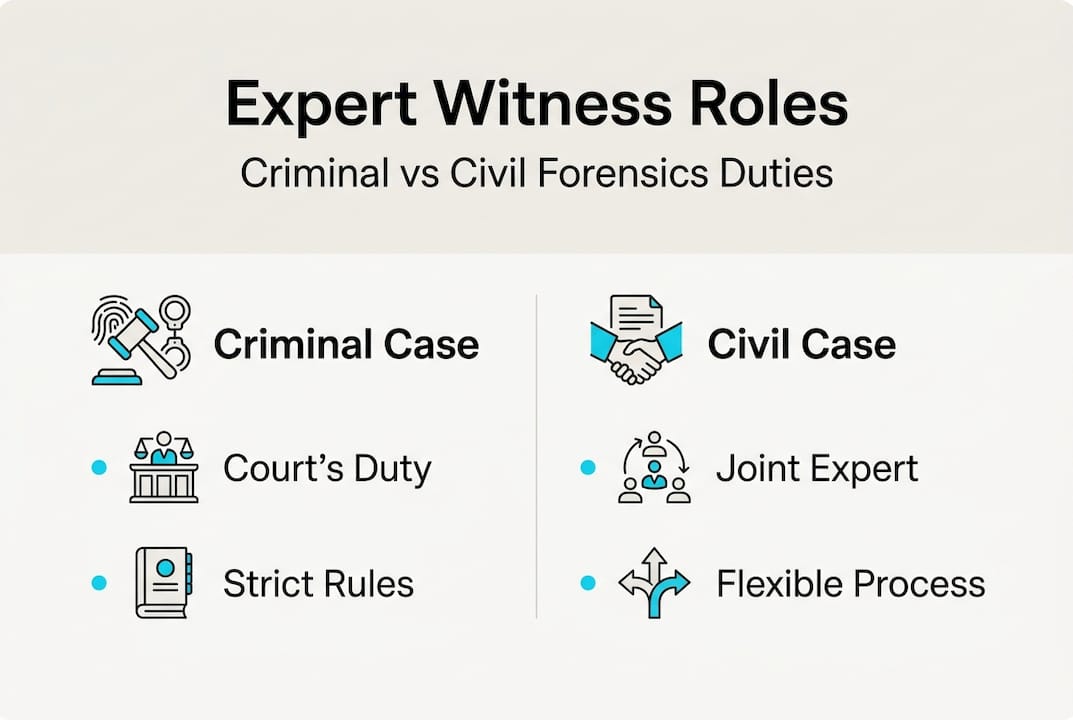

In criminal cases, experts must comply with Criminal Procedure Rules Part 19 and the accompanying Practice Directions. This includes a formal obligation to consider all reasonable hypotheses, not just those that support the prosecution or defence narrative. The standard is rigorous, and rightly so, given the consequences of a wrongful conviction.
In civil proceedings, including data breach litigation and commercial cybercrime disputes, the Civil Procedure Rules govern expert evidence. The emphasis shifts slightly towards proportionality and cost management, but the duty to the court remains identical.
Unique requirements in digital forensics across both contexts include:
- Strict chain of custody documentation from seizure to analysis
- Use of forensically sound tools and write-blockers to preserve original data
- Hypothesis testing to rule out alternative explanations for findings
- Multi-device analysis where evidence spans phones, computers, and cloud accounts
- Audit trails that allow another expert to replicate the process independently
| Factor | Criminal cases | Civil cases |
|---|---|---|
| Governing rules | Criminal Procedure Rules Part 19 | Civil Procedure Rules Part 35 |
| Standard of proof | Beyond reasonable doubt | Balance of probabilities |
| Hypothesis testing | Mandatory | Best practice |
| Single joint expert | Rare | Common |
| Disclosure obligations | Strict prosecution duties | Mutual disclosure |
| Typical issues | Cybercrime, fraud, CSAM | Data breaches, IP theft, misconduct |
For forensic testimony in cybercrime trials and digital evidence in criminal cases, the procedural demands are particularly exacting. A report that would pass scrutiny in civil proceedings may fall short of the criminal standard.
Expert report standards and evidence transparency
A compliant expert report is not simply a technical document. It is a legal instrument, and courts treat it as such. The methodology must be detailed transparently so that opposing parties can test the findings and, if necessary, instruct their own expert to challenge them.
In cybercrime and data breach cases, reports are frequently challenged on process grounds rather than on the conclusions themselves. Opposing counsel will scrutinise whether the correct forensic tools were used, whether the chain of custody was maintained, and whether the expert considered alternative interpretations of the data.
| Mandatory report element | Purpose |
|---|---|
| Expert’s qualifications and experience | Establishes admissibility |
| Statement of instructions received | Defines the scope of the opinion |
| Summary of facts relied upon | Separates fact from opinion |
| Methodology and tools used | Enables independent verification |
| Findings and analysis | The substantive opinion |
| Statement of truth | Confirms honesty and independence |
| Limitations and caveats | Demonstrates intellectual honesty |
| Appendices: logs, hash values, tool outputs | Supports repeatability |
Pro Tip: Always append supporting logs, hash values, and a methodology statement to your expert’s report. This allows opposing parties to test the findings independently and significantly reduces the risk of the report being excluded or undermined at trial.
When creating digital evidence reports, the goal is not to make findings look impressive. It is to make them unassailable. Solid forensic report writing anticipates every challenge and addresses it before the opposing expert has the chance to raise it.
How to instruct and challenge an expert witness
Instructing a digital forensics expert correctly from the outset saves significant time and cost later. Errors at the instruction stage, such as failing to define the evidential scope or omitting key devices from the examination, can result in reports that need to be redone or that leave gaps opposing counsel will exploit.
Follow these steps when instructing an expert:
- Define the evidential questions you need answered before approaching any expert
- Obtain court permission for expert evidence where required under the relevant procedural rules
- Provide written instructions that specify the devices, data, and issues in scope
- Agree on a timetable for the report that fits within court directions
- Consider whether a single joint expert is appropriate to manage costs
- Review the draft report for compliance with court rules before it is finalised
For cost management, single joint experts and hot-tubbing are both worth considering. Hot-tubbing, where experts from each side give evidence simultaneously and engage directly with each other, is particularly effective in technical disputes where the core disagreement is methodological rather than factual.
When challenging an opposing expert, focus on these indicators of a weak report:
- Methodology not described in sufficient detail to be replicated
- No statement of the limitations of the analysis
- Conclusions that go beyond the scope of the instructions
- Failure to consider alternative hypotheses
- Qualifications that do not match the specific technical issues in the case
- Evidence of close collaboration with the instructing party in drafting
Pro Tip: At the instruction stage, always clarify the evidential scope and any limitations in writing. An expert who later discovers that key evidence was outside their remit will need to qualify their conclusions, which weakens the report significantly.
Our computer expert witness services and approach to forensic analysis in court are built around these standards from the first instruction to the final cross-examination.
Need digital forensics expert witness support?
If you are handling a cybercrime prosecution, a data breach dispute, or any civil or criminal matter where digital evidence is central, securing the right expert early is critical. At Computer Forensics Lab, we provide impartial expert witness reports, court attendance, and independent analysis of digital evidence across a wide range of digital forensics services. Our experts are experienced in both criminal and civil proceedings, including complex multi-device cases and cross-jurisdictional matters. We maintain strict chain of custody, use forensically validated tools, and produce reports built to withstand cross-examination. Whether you need a primary expert or a review of an opposing report, explore how our digital forensic investigations can support your case.


Frequently asked questions
What is the main duty of an expert witness in England?
An expert witness’s primary duty is to provide independent, objective evidence to the court, not to advocate for the instructing party. This duty overrides any obligation to the solicitor or client who engaged them.
How are digital forensics experts involved in criminal cases?
They provide impartial technical opinions under Criminal Procedure Rules Part 19, ensuring all reasonable hypotheses are considered and that evidence is analysed to the standard required for criminal proceedings.
How can a law firm challenge an opposing expert’s report?
Focus on whether the methodology is transparent and replicable, whether the expert considered alternative explanations, and whether the report complies with the relevant procedural rules. Gaps in any of these areas are grounds for challenge.
What are ‘hot-tubbing’ and single joint expert arrangements?
Hot-tubbing allows experts from each side to give evidence simultaneously and engage directly in court, which is effective for resolving technical disputes. Single joint experts are agreed by both parties to reduce costs and streamline proceedings.