

- Penetration testing simulates authorized cyberattacks to identify vulnerabilities before criminals can exploit them. It provides evidence of security effectiveness, satisfies compliance, and enhances legal and regulatory defensibility. Regular, CREST-accredited testing across various methods is essential for maintaining UK organizations’ cybersecurity and legal standards.
The average UK data breach cost £3.2 million in 2025, and legal professionals and corporate decision-makers are among the most attractive targets for sophisticated attackers. Many organisations believe that a firewall and antivirus software constitute adequate protection. They do not. Penetration testing offers something fundamentally different: it proves whether your defences actually hold under real-world attack conditions, before a criminal gets the chance to find out first. This guide explains what penetration testing is, how it works, why it matters for UK compliance, and how your organisation can use it to protect sensitive data and demonstrate due diligence.
Table of Contents
- What is penetration testing?
- Key methodologies and approaches
- Penetration testing versus vulnerability assessment
- Legal and regulatory context for UK organisations
- What to expect from a UK penetration test
- What most professionals miss about penetration testing
- How to take the next step in digital protection
- Frequently asked questions
Key Takeaways
| Point | Details |
|---|---|
| Pen testing defined | Penetration testing simulates real cyberattacks to uncover and fix vulnerabilities before criminals can exploit them. |
| Methods and standards | UK organisations benefit most from CREST-accredited testing aligned with robust frameworks like NIST and PTES. |
| Legal importance | Accredited testing demonstrates due diligence and supports compliance with key UK regulations, including GDPR. |
| Common findings | Even well-defended applications often contain 15-30 critical weaknesses that require action. |
| Ongoing process | Pen testing should be one layer in continuous cybersecurity management, not a once-a-year fix. |
What is penetration testing?
With the scale and frequency of breaches clear, it is vital to understand what penetration testing really involves.
Penetration testing is a simulated cyberattack performed by ethical hackers to identify exploitable vulnerabilities. Crucially, it is an authorised exercise. The testers have written permission to attempt to breach your systems, and every action they take is controlled, documented, and reversible. Think of it as hiring someone to try every door and window in your building and then report back on exactly how they got in.
This is not simply a checklist exercise. Penetration testers apply the same tools, tactics, and creative thinking that real attackers use. They probe your technical infrastructure but also your procedural and human defences. That means testing phishing resistance, social engineering susceptibility, and the gaps between your written policies and actual staff behaviour.
Our penetration testing overview sets out how the process works for UK legal and corporate clients specifically. Key purposes of a penetration test include:
- Discovering vulnerabilities before criminals can exploit them
- Demonstrating measurable, documented proof of security effort
- Satisfying compliance obligations under GDPR, ISO 27001, and sector-specific rules
- Validating the effectiveness of existing technical controls
- Identifying risks that vulnerability scanners cannot detect because they require human judgement
“The value of a penetration test is not simply finding a list of weaknesses. It is demonstrating, with evidence, the real-world consequence of those weaknesses under attack conditions.”
Many clients come to us thinking they need a “quick security check.” Penetration testing is considerably more rigorous. It produces findings that courts, regulators, and insurers will actually accept as meaningful evidence of diligence.
Key methodologies and approaches
Having defined penetration testing, let’s break down the options available and what they mean for your business.
Common methodologies include NIST, PTES, OWASP, OSSTMM, ISSAF, and CREST standards, with CREST holding particular significance for UK organisations. CREST is the UK’s primary accreditation body for penetration testing services, and its standards are routinely cited by regulators, insurers, and courts as the benchmark for defensible, professional testing.
The three core testing approaches are:
- Black-box testing: The tester has no prior knowledge of your systems, simulating an external attacker encountering your environment for the first time. This is excellent for understanding genuine external exposure.
- White-box testing: The tester has full access to system documentation, source code, and architecture diagrams. This approach is more efficient and thorough, ideal for development teams or deeply regulated sectors such as financial services.
- Grey-box testing: A middle-ground approach where testers have partial knowledge, such as user credentials but not administrator access. This often reflects the realistic position of a malicious insider or a compromised account.
| Approach | Prior knowledge | Best suited for | Cost |
|---|---|---|---|
| Black-box | None | External threat simulation | Higher |
| White-box | Full | Code review, regulated sectors | Moderate |
| Grey-box | Partial | Insider threat, compromised users | Moderate |
Tests can also be announced (staff know it is happening) or blind (only a small number of people are informed). Blind testing generates more realistic results because it reveals how your team actually responds, not how they perform when forewarned. Legal and HR implications of blind testing should be considered carefully before commissioning.
If you are responsible for protecting client data in a legal or professional services setting, selecting the right methodology directly affects both the quality of findings and their admissibility as compliance evidence.

Pro Tip: Always ensure your penetration testing contract specifies the methodology, the scope of systems in-scope and out-of-scope, the accreditation standard applied, and the liability position of both parties. Vague contracts create legal exposure if something goes wrong during testing.
Penetration testing versus vulnerability assessment
With the main pen testing methods clear, you should also understand one of the most common confusions in cybersecurity assessments.
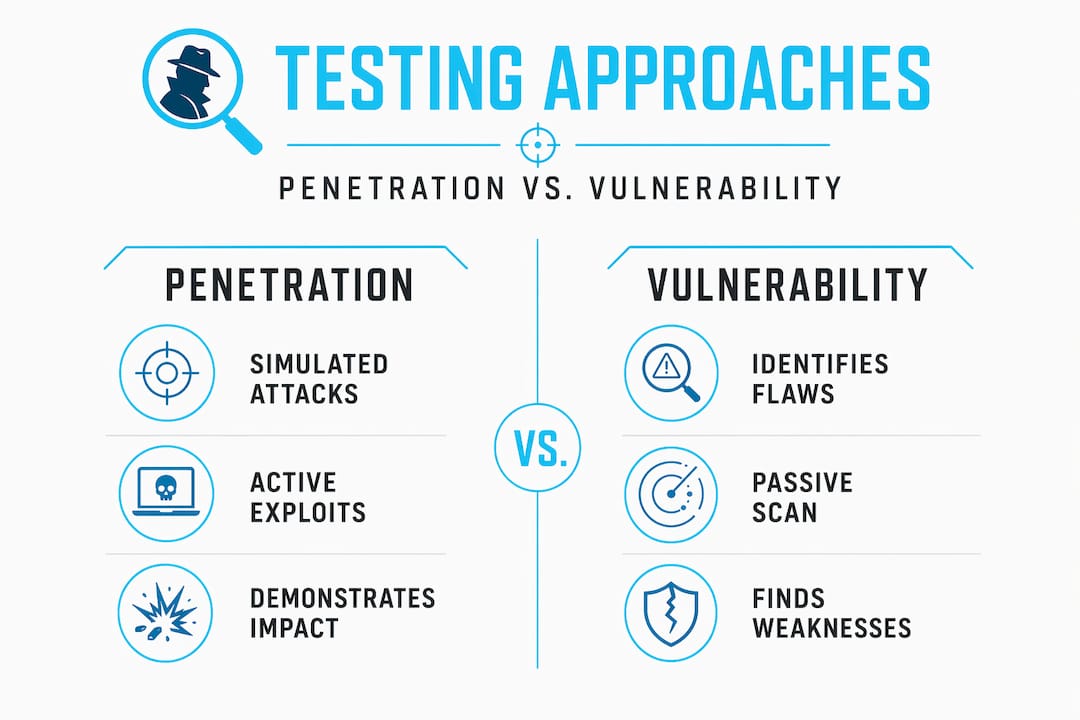
Pen testing demonstrates impact through active exploitation, while a vulnerability assessment identifies weaknesses without actually exploiting them. This distinction matters enormously in practice. A vulnerability assessment will tell you that a door lock is faulty. A penetration test will tell you that the faulty lock allowed entry, that a filing cabinet was accessible, and that client records could have been exfiltrated.

| Feature | Penetration test | Vulnerability assessment |
|---|---|---|
| Actively exploits weaknesses | Yes | No |
| Proves real-world risk | Yes | Partially |
| Suitable for compliance evidence | Yes (preferred) | Sometimes |
| Speed | Slower (days to weeks) | Faster (hours to days) |
| Cost | Higher | Lower |
| Human expertise required | High | Lower |
When deciding which to commission, consider:
- Compliance drivers: GDPR, NIS2, and FCA expectations typically favour penetration testing evidence over vulnerability scan reports
- Risk appetite: Higher-risk environments, such as those handling privileged legal information or financial transactions, warrant penetration testing
- Incident response: Following a suspected breach, a penetration test helps confirm attack paths and identify residual access
- Budget cycles: Vulnerability assessments are a reasonable interim measure between annual penetration tests, not a permanent substitute
The cybersecurity best practices required in most regulated UK sectors increasingly expect both tools to be used together, not as alternatives.
Legal and regulatory context for UK organisations
Understanding the technical tools is only part of the picture; legal professionals must also manage regulatory and contractual obligations.
CREST accreditation ensures testing by certified professionals following defensible standards, and it is often required for compliance with ISO 27001, PCI DSS, and FCA regulations. If your firm stores sensitive personal data, handles client funds, or operates within a regulated sector, the accreditation of your pen testing provider is not a minor administrative detail. It is foundational.
Key frameworks affecting UK organisations in 2026 include:
- UK GDPR and the Data Protection Act 2018: Organisations must implement “appropriate technical and organisational measures.” Penetration testing demonstrates that those measures have been tested against real attack conditions.
- NIS2 Directive: Applies to a growing range of sectors and requires demonstrable cyber resilience. Regulators will scrutinise the depth and frequency of security testing.
- ISO 27001: Explicitly references penetration testing as part of a mature information security management system.
- FCA Cyber and Technology Resilience requirements: Financial sector firms are expected to test their defences rigorously and document findings.
Pro Tip: When presenting penetration test results to insurers, regulators, or counterparties in due diligence, insist on a formal report from a CREST-accredited provider. Informal or undocumented testing carries negligible evidential weight.
Contracts commissioning penetration tests should specify the accreditation standard, the exact scope, liability caps, data handling obligations, and reporting formats. Gaps in any of these areas can undermine the legal value of the exercise entirely.
Knowing the signs of data breaches before commissioning a test also helps legal teams prepare for the findings and manage disclosure obligations if serious vulnerabilities are uncovered.
What to expect from a UK penetration test
Now that the legal background is clear, here’s what you can expect when commissioning a penetration test.
A typical engagement follows a structured process:
- Scoping: You and the testing team agree on which systems, applications, networks, and locations are in scope. Scope creep during testing can create legal and operational complications.
- Preparation and reconnaissance: The testers gather publicly available information about your organisation. This often reveals more than clients expect and mirrors exactly what an attacker would do before launching an assault.
- Simulated attacks: Testers actively attempt to exploit identified weaknesses across your agreed scope. This may include network attacks, web application exploitation, phishing simulations, and physical access attempts.
- Evidence gathering: All successful and unsuccessful attack paths are documented with evidence, including screenshots, logs, and extracted data samples.
- Reporting: You receive a detailed report with an executive summary for non-technical stakeholders, a technical findings section, and a prioritised remediation plan.
Typical findings include 15 to 30 critical vulnerabilities per engagement in application environments, and the average UK data breach cost underscores why even a single unaddressed weakness can prove catastrophic.
Common discoveries in UK penetration tests include:
- Outdated software with known, publicly documented exploits
- Misconfigured cloud storage exposing sensitive files without authentication
- Weak or reused passwords across administrative accounts
- Insufficient logging, meaning breaches go undetected for weeks or months
- Insecure APIs that allow data extraction without triggering security alerts
“A penetration test is not a one-off certificate. It is the beginning of an informed, evidence-based cycle of improvement.”
Realistic timeframes vary. A focused web application test may complete in five to ten days. A comprehensive infrastructure assessment for a medium-sized firm may take three to four weeks. You should not measure the quality of a test by its speed.
For organisations seeking guidance on corporate data protection, the findings from a penetration test provide the clearest possible picture of where investment is needed and where existing controls are genuinely working.
What most professionals miss about penetration testing
Having covered the process end-to-end, it is critical to reflect on what typical discussions about penetration testing often overlook.
The most dangerous misconception we encounter is the belief that a passed penetration test means you are secure. It means you were secure against the agreed scope, on the agreed date, using the agreed methodology. The threat landscape shifts constantly. New vulnerabilities emerge. Staff change. Cloud configurations drift. A test result that is twelve months old is not an assurance of current security.
Modern pen tests use MITRE ATT&CK for real-world simulation, cover cloud environments and APIs, and should be combined with ongoing vulnerability management rather than treated as standalone exercises. MITRE ATT&CK is a publicly maintained framework that catalogues the specific techniques used by real threat actors. Testing against it produces findings that are directly comparable to documented attacks, which makes them far more useful for prioritising remediation.
The concept of chained vulnerabilities is another area where shallow assessments consistently fail. A single misconfigured server might seem low-risk in isolation. But if that server is accessible from an internet-facing application, is on the same network segment as your document management system, and shares credentials with an administrative account, the combined risk is severe. Penetration testers who explore these chains uncover the scenarios that cause actual breaches.
Double-blind testing deserves more attention than it typically receives. In a double-blind exercise, your own security team does not know testing is underway. The results reveal not just technical weaknesses but the actual detection and response capability of your internal team. Most organisations that commission double-blind tests are uncomfortable with the findings. That discomfort is precisely the point.
We also note that regulators are becoming considerably more sophisticated in distinguishing between meaningful and performative security testing when investigating breaches. A shallow annual scan will not satisfy the ICO or FCA if a breach occurs and investigation reveals that exploited vulnerabilities were known but not properly assessed. The standard of care expected is rising, and the documentation produced by a well-scoped, CREST-accredited penetration test is what regulators and courts will look for.
How to take the next step in digital protection
With a full understanding in place, here is how your organisation can act now to strengthen digital resilience.
At Computer Forensics Lab, we support UK legal professionals and corporate clients with penetration testing, digital forensics, and incident response. Our London-based team works with solicitors, in-house counsel, and corporate compliance officers to ensure that cybersecurity assessments produce findings that hold up under regulatory and legal scrutiny. Whether you need a first penetration test, are responding to a suspected breach, or want to understand your forensics data solutions, we provide structured guidance tailored to your sector and risk profile. Explore our full range of digital forensics services to find the right starting point for your organisation’s security programme.
Frequently asked questions
How often should UK organisations conduct penetration testing?
Most experts recommend annual testing as a minimum, or after major system changes, new deployments, or significant organisational restructuring, to satisfy compliance requirements and keep pace with evolving threats.
Who is qualified to perform legal-grade penetration testing in the UK?
CREST-accredited providers ensure defensible, standards-based testing that is acceptable for UK legal, regulatory, and insurance purposes. Accreditation is not optional if you need the findings to serve as compliance evidence.
Is penetration testing mandatory for GDPR or FCA compliance?
While not always explicitly mandated by legislation, regular penetration testing is strongly advised and increasingly expected as evidence of compliance with UK GDPR, NIS2, and FCA requirements. Regulators take a dim view of organisations that cannot demonstrate proactive security testing.
What is the difference between a black-box and a white-box test?
A black-box test simulates an external attacker with no prior knowledge of your systems, while a white-box test is conducted with full system visibility and documentation, producing more thorough but less adversarially realistic results.
What are the most common findings in UK penetration tests?
Tests typically uncover 15 to 30 critical vulnerabilities in application environments, with outdated software, misconfigured cloud assets, and weak authentication appearing consistently across sectors, underscoring the genuine risk that untested infrastructure carries.