

TL;DR:
- Digital and financial forensics provide verifiable evidence that strengthens HR investigations.
- Proper forensic procedures ensure fairness, legal compliance, and tribunal defensibility.
- External forensic review is essential in complex cases to avoid procedural pitfalls and biases.
Forensic techniques are not reserved for criminal courts. In workplace misconduct investigations, they are increasingly the difference between a defensible outcome and a costly tribunal defeat. Many HR professionals and corporate investigators still treat forensics as an afterthought, assuming that witness accounts and written policies are sufficient. They are not. Modern misconduct cases routinely turn on digital evidence, financial trails, and device records. Ignoring these sources does not just weaken your case; it can actively harm the employee you are investigating, undermine trust in your process, and expose your organisation to serious legal risk.
Table of Contents
- Why forensics matter in HR misconduct investigations
- Key forensic techniques in the HR context
- Ensuring fairness, privacy, and compliance in forensic HR investigations
- Common pitfalls and case studies: unfairness, flawed evidence, and tribunal risks
- Our perspective: why balance still beats technology in HR investigations
- How Computer Forensics Lab supports robust HR investigations
- Frequently asked questions
Key Takeaways
| Point | Details |
|---|---|
| Forensics boost HR fairness | Using forensic evidence makes HR investigations more robust and defensible. |
| Compliance and privacy required | HR must balance rigorous evidence gathering with data protection and employee rights. |
| Procedural mistakes are costly | Sloppy or one-sided processes can trigger large tribunal awards against employers. |
| Balanced approach wins | The best outcomes combine forensic rigour, impartiality, and fair procedure. |
Why forensics matter in HR misconduct investigations
Forensic investigation in the HR context covers far more ground than most professionals expect. It spans digital forensics (email recovery, device imaging, access logs, and phone records) and financial forensics (transaction tracing, invoice analysis, and accounting anomalies). Together, these disciplines give investigators objective, verifiable evidence that witness testimony alone cannot provide.
The stakes are real. In one widely cited UK case, a £100k invoice fraud was only uncovered after an employee’s dismissal, when a forensic review of financial records revealed systematic manipulation. The case was a stark warning: had forensic accounting been applied earlier, the organisation could have acted sooner and with far greater precision.
Research into forensics discovery rates in HR consistently shows that digital evidence surfaces in the majority of workplace misconduct cases when investigators know where to look. Yet many HR teams still rely on informal interviews and paper trails alone.
Here is a direct comparison of what forensic-enhanced investigations deliver versus traditional approaches:
| Factor | Traditional HR investigation | Forensic-enhanced investigation |
|---|---|---|
| Evidence base | Witness accounts, paper records | Device images, logs, financial data |
| Objectivity | Subjective and variable | Verifiable and auditable |
| Tribunal defensibility | Moderate | High |
| Deterrent effect | Low | Significant |
| Time to resolution | Often prolonged | Faster with clear evidence |
Forensics strengthens HR investigations in three critical ways:
- Accuracy: Objective data replaces guesswork and conflicting accounts.
- Tribunal defensibility: Documented, verifiable evidence withstands legal scrutiny far better than informal notes.
- Deterrent effect: Employees aware of forensic capability are less likely to engage in misconduct in the first place.
The corporate investigations impact of applying forensic methods extends beyond individual cases. It shapes organisational culture, signals seriousness, and protects both employers and employees from unfair outcomes.
“An HR manager’s £100,000 invoice fraud, uncovered only after dismissal through forensic review, is a warning to all firms about the cost of delayed forensic scrutiny.”
Having established the hidden but crucial value of forensics, let us now define what forensic evidence typically entails in the HR context.
Key forensic techniques in the HR context
Understanding which forensic methods apply to HR cases is the first step to using them effectively. The main approaches fall into three categories: digital device analysis, communication record recovery, and financial transaction tracing.
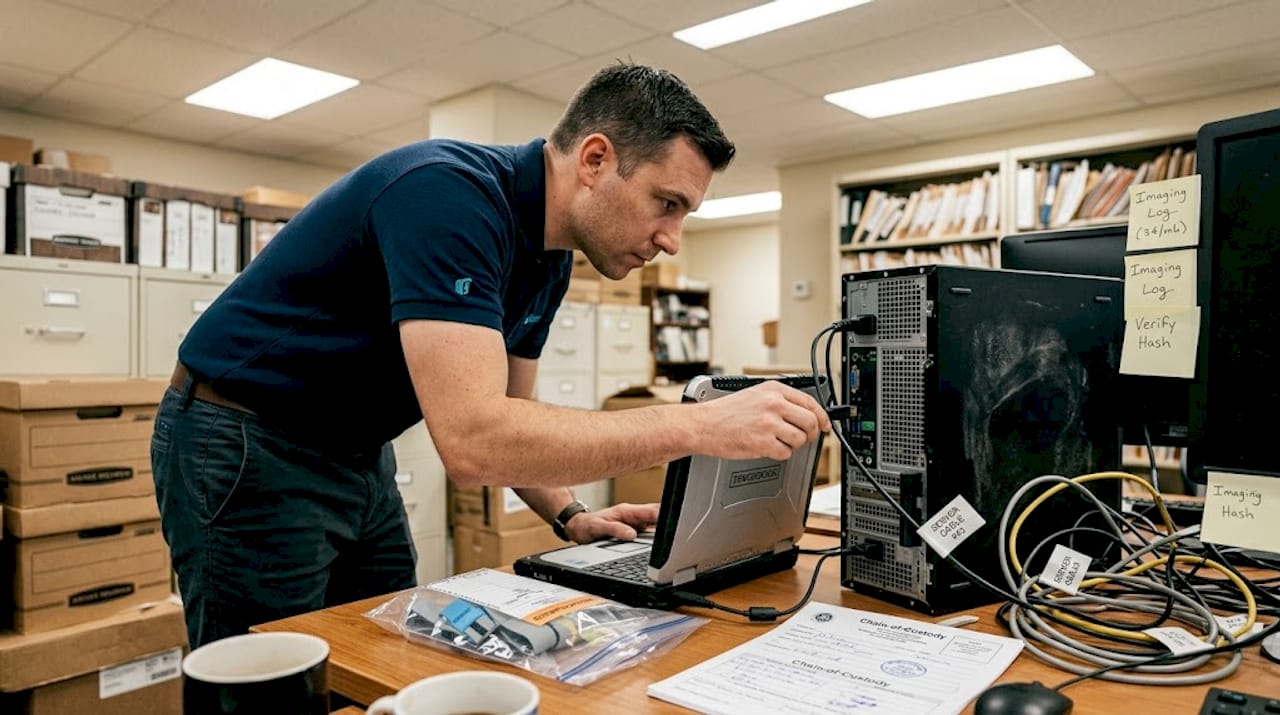
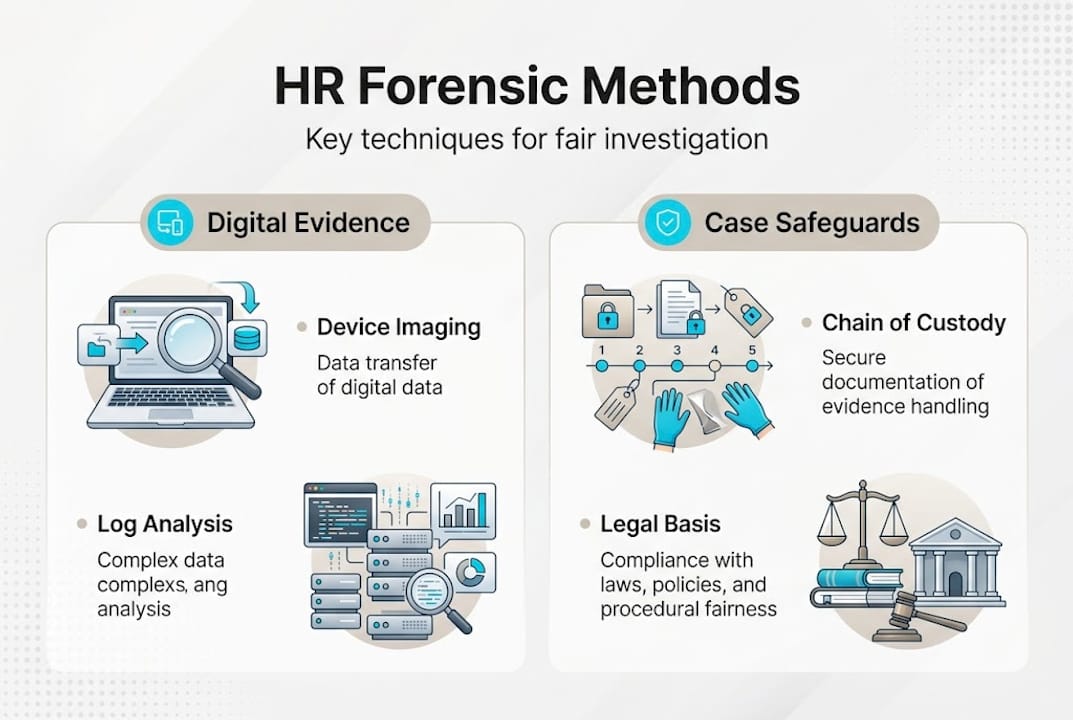
Digital device imaging creates a forensically sound copy of a device’s storage, capturing everything from deleted files to application usage history. This is critical when an employee is suspected of data theft or unauthorised access. Email and phone log recovery reconstructs communication histories, including messages the user believed were deleted. Transaction tracing follows financial flows through accounting systems to identify anomalies, duplicate payments, or fabricated invoices.
The table below summarises the key evidence types and their relevance:
| Evidence type | What it reveals | Common HR application |
|---|---|---|
| Emails and attachments | Communications, intent, timing | Harassment, data leaks, fraud |
| Device access logs | Login times, file access | Unauthorised system access |
| Deleted files | Hidden or removed documents | Concealment of misconduct |
| Financial transaction records | Payment patterns, anomalies | Expense fraud, invoice manipulation |
| Phone records | Call logs, messaging apps | Harassment, collusion |
For HR professionals, digital evidence in investigations follows a structured collection workflow. Here are the four essential steps:
- Identify: Determine which devices, accounts, and systems are relevant to the allegation.
- Capture: Create forensic images or certified copies before any original data is altered or deleted.
- Document: Record every action taken, by whom, and when, maintaining a clear chain of custody.
- Review: Analyse the captured data against the specific allegations using qualified forensic tools.
Pro Tip: Chain of custody is not a bureaucratic formality. If you cannot prove that evidence was collected, stored, and transferred without tampering, a tribunal or court may disregard it entirely. Document every step from the moment you decide to preserve data.
ACAS guidance explicitly recognises digital and documentary evidence as crucial for fair HR investigations, reinforcing that forensic rigour is not optional in serious cases. Applying best forensic practices from the outset protects both the integrity of your findings and the rights of the individual under investigation.
With core forensic methods defined, it is essential to consider how fairness and compliance are safeguarded in UK HR settings.

Ensuring fairness, privacy, and compliance in forensic HR investigations
Forensic capability without legal grounding is a liability. In the UK, every forensic step in an HR investigation must be lawful, proportionate, and transparent. GDPR does not disappear because misconduct is suspected.
The lawful basis for processing employee data during an investigation is typically legitimate interests or legal obligation. But this does not grant unlimited access. Investigators must minimise data collection to what is genuinely necessary, avoid accessing personal communications unrelated to the allegation, and document the justification for every data access decision.
ACAS guidance makes clear that GDPR directly limits the scope of workplace searches and evidence gathering, requiring proportionality at every stage. Understanding UK digital forensics compliance requirements is therefore not optional for HR leads handling sensitive investigations.
Key fairness rules every investigator must follow:
- Objectivity: The investigator must have no personal stake in the outcome.
- Credibility testing: All evidence, including forensic findings, must be tested against alternative explanations.
- Consistent procedure: The same standards must apply regardless of the employee’s seniority or relationship with management.
- Transparency: The subject of the investigation should be informed of the evidence gathered and given an opportunity to respond.
Procedural failures carry a direct financial cost. Tribunals can apply up to a 25% uplift in compensation awards where an employer has failed to follow fair procedures, even when the underlying dismissal was substantively justified. That is a significant penalty for process shortcuts.
Pro Tip: Before beginning any forensic data collection, prepare a brief written record noting the allegation, the lawful basis for access, the specific data targeted, and who will handle it. This single document can be decisive if your process is later challenged. Ensuring legal integrity from the start is far cheaper than defending a procedural challenge later.
Now we address what can go wrong when forensic fact-finding is incomplete, flawed, or misapplied, using UK tribunal results.
Common pitfalls and case studies: unfairness, flawed evidence, and tribunal risks
Forensic evidence is powerful. It is not infallible. The most instructive cases are not those where fraud was uncovered, but those where forensic over-reliance or procedural failure led to findings being overturned.
The case of Nayfeh v Barclays Bank UK plc is a striking example. A sexual harassment dismissal was overturned after a tribunal found the investigation had relied on one-sided forensic findings, failing to test the evidence against the employee’s account or consider alternative interpretations. The bank’s zero-tolerance stance, combined with flawed process, produced an unfair dismissal finding.
The three most common pitfalls in forensic HR investigations are:
- Prejudgement: Collecting forensic evidence to confirm a conclusion already reached, rather than to test an allegation objectively.
- Skipping alternative evidence: Treating digital findings as definitive without seeking corroboration or considering innocent explanations.
- Ignoring procedure: Failing to follow ACAS-compliant disciplinary steps, regardless of how strong the forensic evidence appears.
“Flawed, one-sided forensic investigations result in unfair dismissal findings, with tribunals awarding up to 25% uplifts or £12,000 in damages, even where the underlying allegation had merit.”
The digital evidence impact on tribunal outcomes is significant in both directions. Studies show an 85% discovery rate for relevant digital evidence in cases where forensic methods are applied, yet procedural fairness remains the deciding factor in whether that evidence leads to a sustainable outcome.
The lesson is not to avoid forensics. It is to use forensics as one component of a fair, structured, and fully documented process. Evidence that is gathered correctly but presented without procedural fairness will still fail.
With these risks clear, the final section before our perspective shows what HR professionals can do to apply forensics confidently and safely.
Our perspective: why balance still beats technology in HR investigations
We have worked on enough complex HR cases to say this plainly: the organisations that handle misconduct investigations best are not those with the most sophisticated forensic tools. They are those that combine forensic rigour with genuine procedural fairness and human judgement.
Digital forensics is potent. It can surface evidence that no interview ever would. But forensic results stripped of context create a dangerous illusion of certainty. A deleted file does not prove guilt. An unusual transaction does not confirm fraud. Seasoned investigators know that evidence must be interpreted, tested, and placed within the full picture of the case.
The uncomfortable truth is that many HR investigations fail not because they lacked forensic data, but because the investigator had already decided the outcome before the evidence was reviewed. Forensics then becomes a tool for confirmation rather than discovery.
For complex, contentious, or high-value cases, the best protection is external forensic review. Independent specialists bring objectivity that internal teams, however capable, cannot always guarantee. Our HR evidence discovery insights consistently show that external review changes findings in a meaningful proportion of cases.
Pro Tip: If a case involves senior staff, competing accounts, or significant financial exposure, commission an independent forensic review before reaching any conclusions. It is the single most effective way to protect both the outcome and your organisation’s credibility.
How Computer Forensics Lab supports robust HR investigations
At Computer Forensics Lab, we work directly with HR professionals and corporate investigators to ensure workplace misconduct investigations are built on solid, defensible evidence. Whether you need to find digital traces across devices and cloud systems, or require a full forensic audit of financial records, our London-based team delivers court-ready findings with a maintained chain of custody.
Our HR investigation forensics services cover device imaging, email recovery, deleted data analysis, and expert witness reporting. We also provide consultancy to help your team build forensically sound investigation protocols before an incident occurs. Explore how our forensic consultants can strengthen your next investigation. Contact us for a confidential discussion tailored to your organisation’s needs.
Frequently asked questions
What types of forensic evidence are most useful in HR investigations?
Emails, device logs, and financial records are typically most probative in UK workplace misconduct cases, providing objective, verifiable data that witness accounts alone cannot supply.
Can HR search employee devices without permission?
Searches must be legally justified, proportionate, and documented, with GDPR and privacy rights observed throughout, and a clear chain of custody maintained from the point of collection.
What are the risks of not using forensic methods in HR investigations?
Missed or mishandled evidence can lead to unfair dismissal findings and costly tribunal awards, including compensation uplifts of up to 25% and payouts reaching £12,000 or more.
Are external forensic experts needed for every HR case?
Complex, contentious, or high-value cases benefit significantly from specialist third-party expertise, as external forensic review provides the objectivity and credibility that internal teams may struggle to demonstrate independently.