

TL;DR:
- Forensic analysis is essential from the start to ensure credible, court-ready compliance evidence.
- Accreditation, especially ISO 17025, determines the admissibility and regulatory recognition of forensic evidence.
- Maintaining a documented chain of custody is crucial for evidence integrity and successful legal outcomes.
A compliance programme is only as reliable as the evidence underpinning it. Yet many UK organisations discover this too late, when a regulatory investigation unravels because forensic procedures were neglected, evidence was mishandled, or the appointed provider lacked proper accreditation. For legal professionals and corporate compliance officers, the consequences extend well beyond internal embarrassment: regulatory sanctions, collapsed prosecutions, and civil liability are all real outcomes. This guide cuts through the confusion, setting out the practical frameworks, evidential standards, and documentation practices that make forensic analysis an indispensable part of any credible compliance strategy.
Table of Contents
- Understanding forensic analysis in the context of compliance
- Meeting evidential standards: ISO 17025 and beyond
- Maintaining evidential integrity: documentation and chain of custody
- Forensic reports and compliance audits: bridging findings with regulatory obligations
- Our perspective: why compliance is only as strong as its forensics
- Next steps: deploying robust forensic solutions for compliance
- Frequently asked questions
Key Takeaways
| Point | Details |
|---|---|
| Forensics underpin compliance | Accurate forensic analysis is essential for trustworthy legal and regulatory compliance. |
| Adhere to ISO 17025 | Using accredited forensic providers ensures evidence stands up to scrutiny and audits. |
| Document and report thoroughly | Clear chain of custody and robust reporting link evidence to compliance requirements. |
| Invest in expertise | Bringing in professional forensic expertise can reduce the risk of compliance failures and legal challenges. |
Understanding forensic analysis in the context of compliance
Forensic analysis, in a corporate compliance context, refers to the systematic examination of digital and physical evidence to establish facts relevant to regulatory obligations, internal investigations, or legal proceedings. It is not simply a technical exercise reserved for criminal matters. For compliance officers and legal teams, it is a structured discipline that directly supports obligations under UK financial regulation, data protection law, and sector-specific codes of conduct.
The scope is broad. Forensic analysis can involve examining employee devices for policy violations, recovering deleted communications during an anti-fraud review, analysing cloud storage for unauthorised data transfers, or reconstructing timelines of suspicious transactions. Each of these activities must be conducted in a manner that preserves the evidential value of the material collected. That means following established protocols from the outset, not attempting to retrofit rigour after the fact.
In the UK, the regulatory landscape governing forensic practice is clear. Forensic science activities: statutory code of practice requires that forensic units achieve ISO 17025 accreditation and comply with the Forensic Science Regulator Code of Practice for evidential integrity in compliance matters. This is not optional guidance. It is a statutory obligation that directly affects whether forensic findings will be accepted by courts, regulators, and auditors.
Understanding digital forensics in compliance means recognising the distinct roles involved. Forensic specialists gather and analyse evidence. Compliance officers contextualise findings against regulatory requirements. Legal teams assess admissibility and strategic implications. When these three functions work in alignment, compliance investigations are far more likely to produce defensible, actionable outcomes.
Common triggers for forensic analysis in compliance settings include:
- Suspected internal fraud or financial misconduct
- Regulatory data breach notifications under UK GDPR
- Whistleblower disclosures requiring independent investigation
- Employment disputes involving alleged misuse of company systems
- Intellectual property theft or confidential data exfiltration
- Legal holds placed on electronically stored information ahead of litigation
- Anti-money laundering investigations requiring transaction trail analysis
“Forensic analysis is not a last resort. It is a first-line tool for organisations serious about meeting their regulatory obligations with credible, court-ready evidence.”
Each of these scenarios demands a structured forensic response from the very beginning. Waiting until a matter escalates to litigation before engaging forensic expertise is one of the most common and costly mistakes compliance teams make.
Meeting evidential standards: ISO 17025 and beyond
Establishing the role of forensics sets the stage for understanding what high-quality, legally defensible evidence really entails. The benchmark in the UK is clear: ISO 17025 accreditation sets the competency and quality management requirements that forensic units must meet to produce reliable evidence in compliance and legal proceedings.
ISO 17025 covers everything from laboratory competence and equipment calibration to staff qualifications and method validation. For digital forensics specifically, it means that the tools used to extract data, the processes applied to analyse it, and the reports generated from findings must all meet documented, auditable standards. A forensic unit operating without this accreditation introduces significant risk into any compliance investigation.
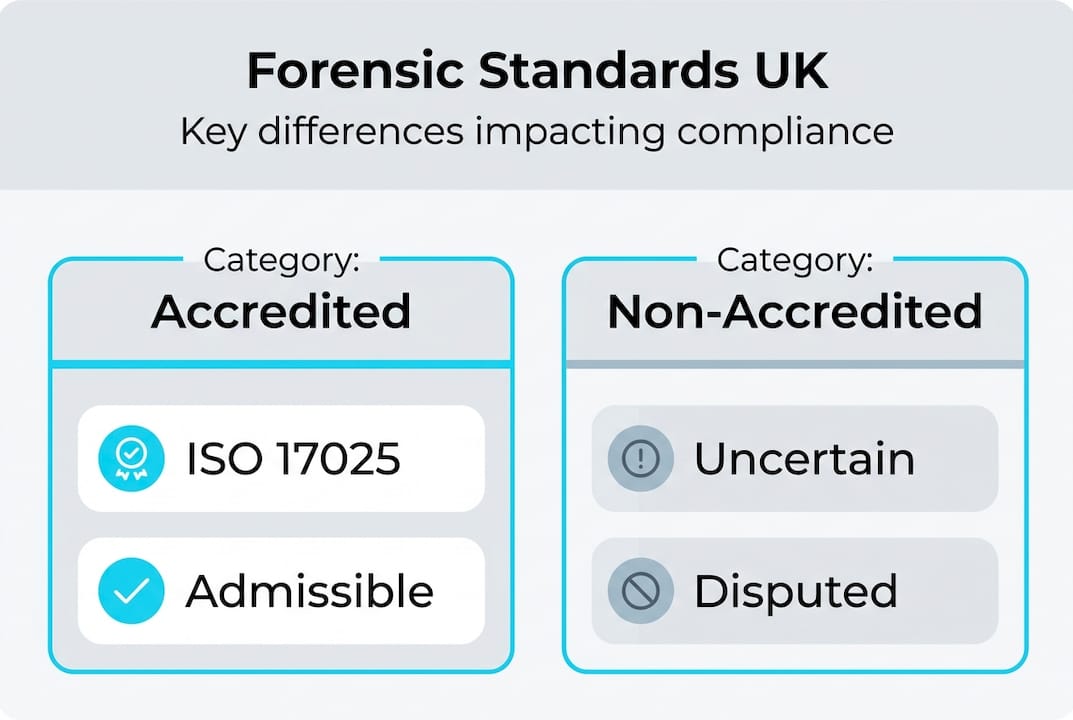

The Forensic Science Regulator Code of Practice adds a further layer of obligation. It addresses quality standards, reporting obligations, and the handling of forensic material. Compliance with this Code is now a statutory requirement in England and Wales following the Forensic Science Regulator Act 2021. Organisations engaging forensic providers who fall outside this framework are, in effect, building their compliance case on unstable ground.
The practical difference between accredited and non-accredited forensic evidence is stark.
| Factor | Accredited forensic evidence | Non-accredited forensic evidence |
|---|---|---|
| Admissibility in court | High, subject to disclosure rules | Vulnerable to challenge and exclusion |
| Regulatory acceptance | Recognised by FCA, ICO, and sector bodies | May be rejected or require re-examination |
| Chain of custody integrity | Documented and auditable | Often incomplete or inconsistent |
| Expert witness credibility | Supported by accreditation status | Easily undermined under cross-examination |
| Audit trail quality | Meets ISO 17025 requirements | Variable and potentially unreliable |
Consider a scenario where a financial services firm commissions an investigation into suspected insider trading. If the forensic provider lacks ISO 17025 accreditation, the FCA may refuse to accept the findings, requiring the entire investigation to be repeated by an accredited unit. The cost in time, money, and reputational exposure is substantial. This is not a hypothetical risk. It has occurred in UK regulatory proceedings.
Understanding forensics in legal cases and the standards that govern them is therefore not an academic exercise. It directly affects whether your compliance efforts hold up when scrutinised.
Pro Tip: To verify a forensic provider’s accreditation, request their UKAS (United Kingdom Accreditation Service) certificate number and cross-reference it directly on the UKAS website. Also ask for their Forensic Science Regulator compliance statement. Any reputable provider will supply both without hesitation. If they cannot, that is a significant warning sign. Reviewing digital forensics and UK compliance requirements before appointing a provider can save your organisation considerable difficulty later.
Maintaining evidential integrity: documentation and chain of custody
Once high standards are accepted, the focus shifts to maintaining trust and reliability throughout the investigation process. Chain of custody refers to the documented, unbroken sequence of possession and handling of evidence from the moment it is collected to the point it is presented in proceedings. In compliance investigations, a broken chain of custody can invalidate otherwise compelling evidence entirely.

The reason chain of custody matters so profoundly is that it answers a fundamental question: can we be certain this evidence has not been altered, contaminated, or tampered with? Without a complete and verifiable record, that question cannot be answered confidently. Courts and regulators will not accept evidence where the answer is uncertain.
The process for handling and documenting digital evidence in compliance investigations should follow these steps:
- Identification: Identify all potential sources of evidence, including devices, cloud accounts, email servers, and third-party platforms, before any collection begins.
- Preservation: Apply forensic write-blockers or equivalent tools to prevent any alteration of original data during collection.
- Collection: Create verified forensic images of all relevant media, generating cryptographic hash values (typically MD5 and SHA-256) to confirm integrity.
- Documentation: Record every action taken, by whom, at what time, and using which tools. This log begins the chain of custody record.
- Packaging and storage: Seal collected evidence in tamper-evident packaging, labelled with unique identifiers, and store in a secure, access-controlled environment.
- Transfer records: Log every movement of evidence between individuals or locations, with signatures from both parties at each handover.
- Analysis: Conduct all examination on forensic copies, never on originals, and document every analytical step and finding.
- Reporting: Produce a structured report that references the chain of custody record and confirms the integrity of all evidence examined.
Common documentation pitfalls include failing to record the time and date of each action, using inconsistent identifiers across different logs, and allowing unauthorised personnel access to evidence without recording it. Each of these errors creates vulnerabilities that opposing counsel or regulators can exploit.
The role of forensics in litigation often hinges on documentation quality rather than the technical findings themselves. Cases have been won and lost not on the substance of the forensic analysis, but on whether the evidence was demonstrably handled correctly throughout.
Pro Tip: Use a dedicated digital chain-of-custody logbook that timestamps entries automatically and restricts editing after submission. Cloud-based evidence management platforms designed for legal and forensic use provide an auditable record that is far more defensible than spreadsheets or handwritten logs. Treat the logbook as a legal document from the moment it is created.
Forensic reports and compliance audits: bridging findings with regulatory obligations
Meticulous handling is only valuable when findings are presented properly, making reporting a critical final stage in any compliance investigation. The forensic report is the document that closes the loop between technical findings and regulatory obligations. It must be structured, precise, and directly responsive to the questions the investigation was commissioned to answer.
Auditors and regulators reviewing forensic reports are not looking for technical complexity. They are looking for clarity, traceability, and a direct connection between the evidence gathered and the compliance issue under review. A report that is technically impressive but poorly organised will fail to serve its purpose.
The following table maps key forensic report sections to their compliance relevance:
| Report section | Compliance purpose |
|---|---|
| Executive summary | Provides regulators and auditors with immediate, accessible findings |
| Methodology | Demonstrates adherence to ISO 17025 and accepted forensic practice |
| Evidence log | Confirms chain of custody and evidential integrity |
| Technical findings | Documents what was discovered, with supporting artefacts |
| Expert opinion | Interprets findings in the context of the compliance question |
| Limitations | Discloses any constraints on the investigation’s scope or conclusions |
| Appendices | Provides supporting data, hash values, and tool validation records |
Regulatory bodies that routinely review forensic reports in UK compliance contexts include:
- The Financial Conduct Authority (FCA) in financial services investigations
- The Information Commissioner’s Office (ICO) in data protection breach matters
- The Serious Fraud Office (SFO) in fraud and bribery cases
- The Competition and Markets Authority (CMA) in antitrust investigations
- Employment tribunals in cases involving alleged workplace misconduct
- The Health and Safety Executive (HSE) where digital evidence supports incident investigations
Integrating forensic evidence into ongoing compliance programmes requires more than producing a report at the end of an investigation. The findings should feed directly into risk assessments, policy updates, and control improvements. A well-structured forensic audits process treats each investigation as a source of intelligence for strengthening future compliance posture, not simply a reactive response to an immediate problem.
Auditors specifically look for evidence that is traceable from collection through to conclusion, that the methodology was consistent and documented, and that the report’s conclusions are proportionate to the evidence. Overstatement is as problematic as understatement. A forensic report that claims certainty beyond what the evidence supports will be challenged, and that challenge can undermine the entire compliance case.
The statutory code of practice reinforces that forensic units must comply with the Forensic Science Regulator Code of Practice, which directly governs how findings are reported and what disclosures must be made. Compliance officers should review reports against these requirements before submission to any regulatory body.
Our perspective: why compliance is only as strong as its forensics
Having explored the mechanics and requirements, the reality check is worth stating plainly. In our experience working with legal teams and compliance officers across the UK, the most common source of compliance failures is not ignorance of regulations. Organisations generally know what the rules are. The failures occur because forensic frameworks are treated as an afterthought rather than a foundation.
There is a cultural dimension to this problem. Many compliance teams see forensic analysis as something that happens after a problem is discovered, not as a discipline that should be embedded in their operating model. This reactive posture means that when an investigation is needed urgently, the infrastructure to conduct it properly simply does not exist.
Resource constraints are real, but they are frequently overstated as a barrier. The cost of engaging an accredited forensic provider for a structured investigation is consistently lower than the cost of a failed investigation, a regulatory fine, or collapsed litigation. The role of forensic labs in supporting compliance is not a luxury. It is a risk management investment with a measurable return.
Our practical advice is straightforward: invest in upskilling your compliance team to understand forensic standards, establish relationships with accredited providers before you need them urgently, and build forensic review checkpoints into your compliance programme as a matter of routine. The organisations that do this are consistently better positioned when regulatory scrutiny arrives.
Next steps: deploying robust forensic solutions for compliance
Ready to strengthen your compliance programme? Computer Forensics Lab offers specialist digital forensics services designed specifically to support UK legal teams and corporate compliance functions. From evidence collection and chain of custody management to expert witness reports and regulatory submissions, our London-based team operates to the highest accreditation standards. We also provide detailed analysis of digital footprints analysis to support investigations involving data exfiltration, employee misconduct, and financial irregularities. Contact us to arrange a compliance forensics review for your organisation and ensure your evidential framework is fit for regulatory scrutiny.
Frequently asked questions
What is ISO 17025 and why does it matter for compliance forensics?
ISO 17025 accreditation sets the competency and quality benchmarks for UK forensic units, ensuring that evidence produced meets the standards required for acceptance in compliance proceedings, regulatory reviews, and court.
Which compliance scenarios require forensic investigation support?
Common scenarios include internal fraud reviews, regulatory data breach investigations under UK GDPR, and legal holds for litigation support, all of which require evidential integrity to be maintained from the outset.
How do I verify a forensic provider’s accreditation or suitability?
Request documentary proof of ISO 17025 accreditation via UKAS and confirm compliance with the Code of Practice issued by the Forensic Science Regulator before appointing any provider.
What happens if forensic evidence does not meet regulatory standards?
Non-compliant forensic evidence can be excluded from proceedings entirely, as the statutory code of practice makes clear, risking compliance failures, regulatory sanctions, and the collapse of audit or court cases.