

TL;DR:
- Remote forensics allows digital evidence collection without physical device access, crucial for urgent cases.
- Legal compliance, including ACPO, PACE, CPIA, and DPA, is essential for admissibility of remote evidence.
- Proper validation, audit trails, and handling procedures reduce risks of evidence exclusion and legal challenge.
Remote forensics for UK legal teams: key principles
Digital evidence now sits at the heart of modern criminal prosecution, yet the UK legal system is under serious strain. UK digital forensics backlogs now exceed 20,000 devices nationally, with some cases waiting over two years for examination, and more than 30,000 prosecutions collapsed between 2020 and 2024 due to digital evidence failures. Remote forensics has emerged as a critical response to this crisis, offering the ability to acquire and analyse evidence without physical access to a device. But speed without rigour is a liability. This guide cuts through the confusion and sets out what UK solicitors and law enforcement agencies need to know to deploy remote forensics responsibly.
Table of Contents
- What is remote forensics and why is it critical?
- Legal and technical foundations for remote forensics
- Methods, tools, and risks of remote forensic investigation
- Applying remote forensics in UK legal cases: real-world outcomes
- What most legal professionals miss about remote forensics
- Expert remote forensics and digital evidence support for UK legal teams
- Frequently asked questions
Key Takeaways
| Point | Details |
|---|---|
| Remote forensics defined | It is the acquisition and analysis of digital evidence without physical access, vital for urgent UK legal investigations. |
| Legal compliance is essential | Strict adherence to ACPO, PACE, CPIA, and DPA ensures evidence is admissible and defensible in court. |
| Evidence integrity matters | Audit trails, validated tools, and minimising data alteration are central for reliable remote forensics. |
| Impact on backlog reduction | Remote methods can address UK digital evidence backlogs, but must be balanced with procedural caution. |
| Expert support recommended | Specialist guidance enhances security, compliance, and case outcomes for UK legal teams deploying remote forensics. |
What is remote forensics and why is it critical?
Remote forensics refers to the acquisition and analysis of digital evidence without direct physical access to the source device or system. Rather than seizing a laptop and transporting it to a laboratory, investigators use secure digital channels, agent-based software, or cloud service interfaces to collect evidence from a distance. This is not a workaround. It is an increasingly necessary approach as the volume, variety, and geographic spread of digital evidence grows.
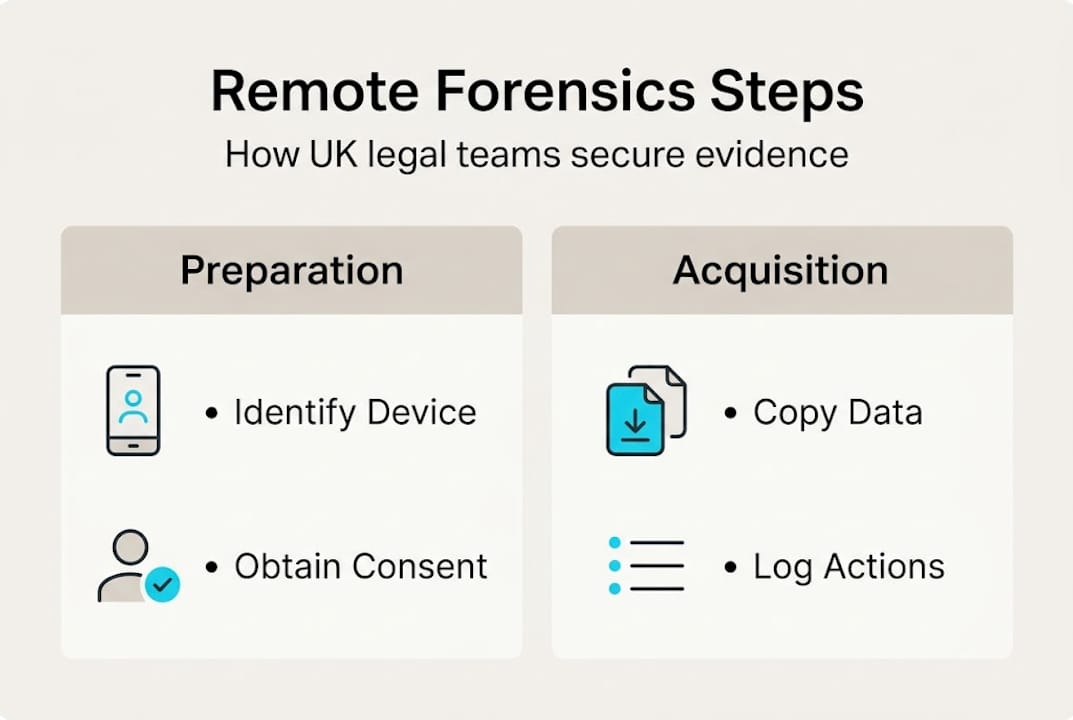

The scale of the challenge in the UK is significant. The POST briefing on digital evidence confirms that remote forensics enables timely evidence collection in scenarios where physical access is impractical, but it demands rigorous legal compliance to avoid exclusion. Understanding the digital forensic process steps is essential before deploying any remote approach in a legal context.
UK digital evidence backlog: key figures
| Metric | Figure |
|---|---|
| Devices awaiting examination nationally | Over 20,000 |
| Maximum wait time in some forces | Over 2 years |
| Prosecutions collapsed due to digital evidence failures (2020 to 2024) | Over 30,000 |
| Crimes with a digital element | 80 to 90% |
Over 80% of UK crimes now involve a digital element, which means that forensic examination of some form is relevant to the vast majority of serious cases. That figure cannot be served by traditional, device-by-device physical examination alone.
Remote forensics is typically deployed in the following scenarios:
- Seized cloud accounts: Where data is held on remote servers, often overseas, and must be preserved urgently before deletion or account closure.
- Offsite servers: Corporate servers belonging to a suspect organisation located at a premises not yet subject to a search warrant.
- Encrypted mobile devices: Where specialist remote decryption and extraction tools are required, and shipping the device creates unacceptable delays.
- Pandemic and remote access environments: Investigations involving systems accessed by multiple users across distributed networks.
- Cross-jurisdictional cases: Where data sits in multiple countries and physical attendance is either impractical or impossible.
Understanding forensics in UK courts is inseparable from understanding how remote forensics must be conducted. Evidence collected remotely faces the same admissibility tests as anything obtained through physical examination, and the courtroom consequences of getting it wrong are severe. The broader shift towards digital efficiency in legal services is well established, and digital forensics is no exception to this trend.
Legal and technical foundations for remote forensics
Compliance is not optional in remote forensic investigation. It is the difference between evidence that stands and evidence that collapses under cross-examination. The POST briefing on digital evidence is clear that remote forensics must comply with ACPO principles, PACE 1984, CPIA 1996, and DPA 2018, ensuring proportionality and an unbroken chain of custody at every step.
Physical vs. remote forensics: key comparison
| Factor | Physical forensics | Remote forensics |
|---|---|---|
| Access method | Direct, hands-on examination | Secure digital channel or agent software |
| Speed | Slower; device must be seized and transported | Faster; near-immediate data acquisition possible |
| Defensibility | High; well-established courtroom precedent | High if protocols are rigorously followed |
| Risk of alteration | Low; write-blockers used by default | Moderate; volatile data requires careful handling |
| Jurisdictional complexity | Lower for domestic cases | Higher; cloud data may span multiple legal systems |
| Best suited for | Physical devices with controlled access | Cloud accounts, remote servers, urgent situations |
The essential legal requirements for defensible remote forensics in the UK are as follows:
- ACPO principles: No action taken should change data on any device or storage medium. If access is necessary, a competent professional must carry it out. An audit trail of every action must be maintained. The senior investigating officer bears responsibility for ensuring compliance with these principles.
- PACE 1984 (Police and Criminal Evidence Act): Any access to a suspect’s data must be authorised under appropriate police powers or a court order. Improper access renders evidence inadmissible.
- CPIA 1996 (Criminal Procedure and Investigations Act): All material gathered during an investigation, whether used or not, must be properly disclosed. Remote forensic logs and all acquired data fall within disclosure obligations.
- DPA 2018 (Data Protection Act): Data collected during a remote forensic investigation must be handled lawfully, with processing limited to the specific investigation purpose.
Chain of custody and data integrity are the twin pillars of defensible remote forensics. Every tool used must be validated and capable of generating cryptographic hash values (typically MD5 or SHA-256) to verify that data has not been altered between collection and presentation in court. Audit trails must record every command, every access event, and every file retrieved.
The legal considerations for digital forensics apply with equal force regardless of whether evidence is collected remotely or physically. A practical digital evidence checklist can help teams avoid critical omissions during preparation and collection. For further reference on remote evidence compliance guidance, international approaches offer useful parallels.
Pro Tip: Document every step, every tool version, every hash value, and every access timestamp before, during, and after a remote forensic session. If you cannot reconstruct your exact actions from your notes alone, your evidence is vulnerable.
Methods, tools, and risks of remote forensic investigation
Remote forensic investigation encompasses several distinct approaches, each suited to different evidence types and investigative contexts. Practitioners should select methods based on the nature of the target system, the urgency of the investigation, and the legal authority available.
The main types of remote forensic investigation include:
- Endpoint forensics: Using agent-based software deployed to a target machine to acquire memory, system logs, browser history, and file system data without physical access.
- Server-based forensics: Remotely imaging or interrogating servers, including virtual machines and containerised environments, through secure administrative channels.
- Cloud forensics: Accessing evidence held in platforms such as Microsoft 365, Google Workspace, or social media services via legal process (preservation requests, production orders) or authorised account access.
- Network-based forensics: Capturing and analysing network traffic, firewall logs, and intrusion detection data to reconstruct communications or identify malicious activity.
“80 to 90% of UK crimes now involve digital evidence, making remote forensic methods not just useful but indispensable for modern legal practice.”
SWGDE guidance on remote forensic evidence emphasises that practitioners must minimise changes to source data, use validated tools capable of generating cryptographic hashes, and select methods appropriate to the target environment.
Common pitfalls in remote forensic investigation are well documented and largely avoidable:
- Data alteration: Running unapproved software on a live system, or failing to use write-blocking mechanisms, can modify timestamps and metadata, invalidating the evidence.
- Incomplete audit trails: Any gap in the record of who accessed what, when, and using which tool creates an opportunity for the defence to challenge admissibility.
- Jurisdictional mismatch: Cloud data stored in the United States or European Union may be subject to different legal regimes. Accessing it without the correct legal process can expose the investigation to legal challenge and the practitioner to liability.
- Encryption barriers: Encountering full-disk encryption without prior intelligence or legal authority to compel a decryption key can halt an investigation entirely if not anticipated.
Pro Tip: Volatile evidence (RAM contents, active network connections, running processes) disappears the moment a system is powered off. Always capture volatile data first using tools with built-in audit logging, before acquiring persistent storage. The forensic tools and techniques used matter enormously here. The forensic methods guide provides further detail on sequencing acquisition correctly.
The digital evidence briefing from the Parliamentary Office of Science and Technology reinforces that without validated methodologies, remote evidence is at significant risk of legal challenge. This is not a theoretical risk: courts have excluded remotely obtained digital evidence where acquisition procedures were poorly documented.
Applying remote forensics in UK legal cases: real-world outcomes
Theory without application is of limited value to a practising solicitor or investigating officer. The practical impact of remote forensics on UK case outcomes illustrates both its power and its limitations when compliance is not treated as a priority.
Over 30,000 UK prosecutions collapsed between 2020 and 2024 as a result of digital evidence failures. That is not a technical failure. It is a compliance and process failure, and remote forensics conducted without proper rigour adds to that figure rather than reducing it.
Best practice steps for applying remote forensics in criminal investigations:
- Obtain appropriate legal authority: Whether that is a production order, a Section 49 notice (requiring disclosure of an encryption key under RIPA), or consent, legal authority must precede any access.
- Identify and prioritise target data: Determine what evidence is sought, where it is likely held, and the legal basis for accessing each data type before beginning acquisition.
- Deploy validated tools: Use forensic software with established courtroom acceptance and built-in logging. Avoid generic IT tools, which offer no audit trail.
- Capture volatile data first: RAM, active processes, and network state should be acquired before any persistent storage, following the correct digital investigation workflow.
- Verify data integrity immediately: Generate and record cryptographic hashes at the point of acquisition. Any subsequent analysis should be performed on verified copies, never original evidence.
- Maintain a contemporaneous log: Record every action in real time. Post-event reconstruction is both unreliable and immediately challenged by the defence.
- Review disclosure obligations: All acquired material, including evidence not used in prosecution, must be assessed for CPIA disclosure.
Litigation support scenarios where remote forensics delivers particular value include:
- Cloud-stored evidence: Preserving emails, documents, and communications held in cloud platforms before a subject becomes aware of the investigation.
- Urgent data preservation: Preventing deletion of evidence in circumstances where a search warrant cannot be executed immediately, for example across a weekend or in a cross-border case.
- Cross-jurisdictional cases: Working with international legal assistance treaties (MLAT requests) to obtain data held by overseas providers.
Consider two illustrative outcomes. In the first, an urgent remote preservation order against a cloud account secures communications that conclusively link a suspect to organised fraud, with the evidence admitted because acquisition was properly authorised and hash-verified. In the second, an investigator remotely accesses a server using an IT administrator credential without proper authority. The data obtained is excluded under PACE, and the investigation collapses. The digital evidence handling guide and mobile phone forensics best practices demonstrate how proper process protects both the investigation and the investigator.
What most legal professionals miss about remote forensics
There is a persistent assumption in legal practice that remote forensics is simply a faster version of physical forensics, with the same reliability and fewer complications. This misreads what remote forensics actually is and understates the compliance demands it places on practitioners.
Speed is not a virtue in isolation. Evidence collected quickly but without a defensible audit trail is worse than no evidence at all, because it consumes investigative resources and then fails at the most critical moment. SWGDE guidance is explicit: prioritise validated tools with comprehensive audit trails, balance the need to capture volatile data against the risk of alteration, and always maintain jurisdictional awareness when cloud data is involved.
The uncomfortable truth is that remote forensics raises the compliance bar rather than lowering it. Physical examination has decades of established courtroom precedent. Remote methods are newer, more frequently challenged, and require practitioners to demonstrate a higher level of methodological rigour, not less. The UK compliance considerations are non-negotiable regardless of urgency.
Pro Tip: Treat every remote forensic session as though you are already in the witness box being cross-examined. If you cannot explain every decision, every tool choice, and every action from your contemporaneous notes, you are not ready to collect evidence.
Expert remote forensics and digital evidence support for UK legal teams
For solicitors and law enforcement agencies managing complex investigations, having access to specialist remote forensic expertise is not a luxury. It is a practical necessity. Computer Forensics Lab provides comprehensive digital forensics services to UK legal teams, combining technical rigour with courtroom-ready reporting. Whether you are dealing with urgent cloud evidence preservation, cross-jurisdictional server acquisition, or contested mobile device examination, our London-based team operates under strict chain-of-custody and ACPO-compliant procedures. The digital investigation workflow guide outlines how structured, defensible investigations are conducted from instruction to expert witness report. For a broader view of evidence types and their forensic significance, the digital footprints guide is an essential resource.
Frequently asked questions
How does remote forensics differ from traditional physical forensic methods?
Remote forensics acquires digital evidence without physical access to the device, relying on secure digital tools and legal process, whereas traditional methods involve direct hands-on examination with physical write-blockers. Traditional physical methods are generally preferred where defensibility is the primary concern, while remote forensics is essential where urgency or geography makes physical access impossible.
What UK laws must remote forensic evidence comply with?
Remote forensic evidence must adhere to ACPO principles, PACE 1984, CPIA 1996, and DPA 2018 to ensure admissibility and proper disclosure compliance. Proportionality and an unbroken chain of custody are mandatory throughout the process.
What are the biggest risks in using remote forensics?
The primary risks are inadvertent data alteration, incomplete audit trails, and jurisdictional errors, all of which can result in evidence exclusion. Using validated tools with cryptographic hash verification and contemporaneous logging significantly mitigates these risks.
Can remote forensics help with evidence backlogs in the UK?
Yes, remote forensics can accelerate access to digital evidence and reduce pressure on physical examination queues, but it must be deployed with full legal diligence. With over 20,000 devices awaiting examination nationally, responsible remote methods offer a meaningful contribution to reducing delays without compromising prosecution integrity.