

Many legal professionals assume that once digital data is deleted or corrupted, it vanishes forever beyond recovery. This misconception can severely undermine litigation strategy and case outcomes. Proper forensic data recovery, however, can retrieve critical evidence from seemingly lost files, preserving evidentiary integrity essential to cybercrime investigations, breach cases, and digital litigation. This guide equips UK legal professionals with the knowledge, workflows, and compliance requirements necessary to leverage data recovery effectively in legal proceedings.
Table of Contents
- Foundation Of Data Recovery In Legal Investigations
- Importance Of Data Recovery For Evidence Preservation
- Chain Of Custody And Legal Compliance In Data Recovery
- Practical Data Recovery Workflow For Legal Evidence
- Technological Advances Enhancing Data Recovery
- Common Misconceptions About Data Recovery
- Extended Benefits Of Data Recovery In Legal Contexts
- Conclusion: Leveraging Data Recovery For Legal Success
- Discover Expert Data Recovery And Digital Forensics Services
Key Takeaways
| Point | Details |
|---|---|
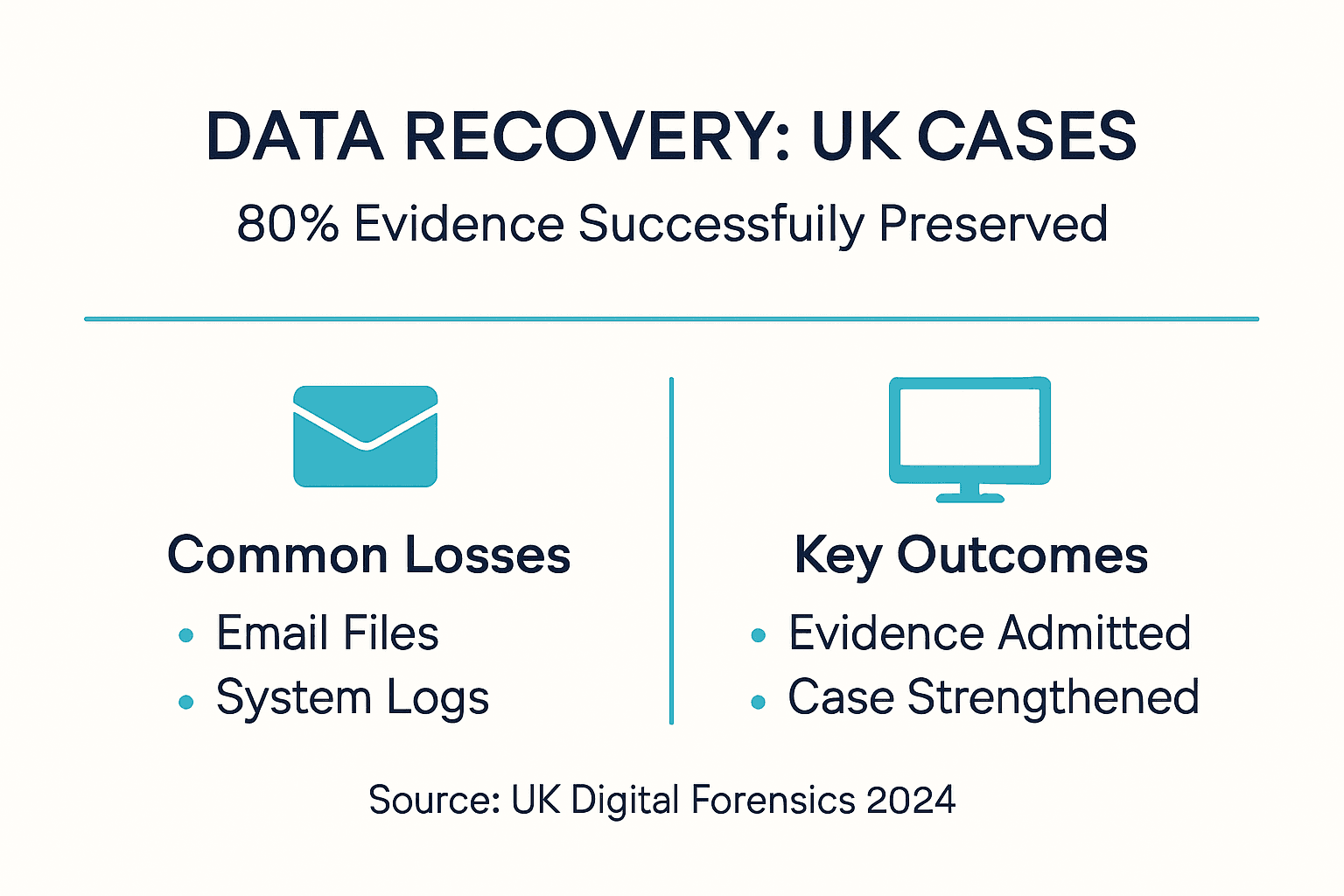
| Evidence preservation | Data recovery preserves evidence in over 80% of UK legal cases involving digital files. |
| Legal compliance | Chain of custody and UK regulatory adherence are essential for evidence admissibility in court. |
| Advanced technology | Certified forensic workflows and AI-driven tools improve recovery success and accuracy. |
| Realistic expectations | Not all data can be recovered; understanding limitations protects case integrity. |
| Expanded benefits | Video evidence recovery supports event timeline reconstruction and strengthens investigations. |
Foundation of Data Recovery in Legal Investigations
Data recovery in legal contexts refers to the retrieval of deleted, encrypted, or corrupted digital files that serve as key evidence in litigation. This process reconstructs timelines, establishes facts, and supports claims in cybercrime and breach investigations. Data recovery in legal cases helps retrieve deleted, encrypted, or corrupted digital files that constitute key evidence, reconstructing timelines and proving facts. Understanding the causes of data loss and the forensic tools required to address them is foundational for legal professionals relying on digital evidence.
Common causes of data loss in legal investigations include accidental deletion by employees or suspects, hardware failures, cyberattacks, and deliberate evidence tampering. Each scenario demands a tailored forensic approach to recover deleted data for legal investigations while maintaining evidentiary integrity. Without proper recovery techniques, critical files may remain inaccessible, jeopardizing case success.
Certified forensic tools and protocols are essential to preserve the original state of digital evidence. These tools create forensic images of storage devices, allowing investigators to work on exact copies without altering the original data. This approach prevents contamination and maintains the chain of custody required for court admissibility. Legal professionals should familiarize themselves with top data recovery techniques for legal investigations to ensure their cases benefit from reliable, defensible evidence.
Key considerations when initiating data recovery include:
- Identifying the type and location of lost data before beginning recovery
- Engaging certified forensic experts to avoid evidence contamination
- Documenting all recovery steps meticulously for legal compliance
- Utilizing validated forensic software to ensure data authenticity
- Maintaining secure storage and handling protocols throughout the process
Following data recovery best practices ensures that recovered files meet the stringent standards required for use in UK courts. Legal professionals who understand these foundational principles can better collaborate with forensic experts and anticipate recovery challenges.
Importance of Data Recovery for Evidence Preservation
Data recovery is not merely a technical exercise; it is a critical component of evidence preservation that directly influences legal outcomes. Recovered digital files reconstruct event timelines, prove or disprove allegations, and provide the factual basis for successful litigation. Over 80% of legal cases rely on intact digital evidence preserved through proper data recovery techniques. This statistic underscores the necessity of prioritizing data recovery in any investigation involving digital components.
Lost or corrupted evidence can irreparably damage case integrity. Without recovered emails, logs, documents, or metadata, legal arguments may lack substantiation, allowing opposing parties to challenge claims or dismiss evidence altogether. In cybercrime and breach cases, where digital footprints are the primary evidence source, failure to recover data often results in case dismissal or unfavorable settlements.

Pro Tip: Prioritize the recovery of emails, system logs, and transactional documents early in your investigation. These files typically contain timestamps, communication chains, and activity records that form the backbone of evidentiary support.
Effective data recovery accelerates investigation timelines and improves the reliability of findings. When forensic experts can quickly retrieve and validate digital evidence, legal teams gain more time to analyze, strategize, and build compelling cases. Safeguarding legal evidence with data recovery also enhances the credibility of expert witness testimony, as courts recognize the rigor and authenticity of properly recovered files.
The benefits of robust data recovery extend beyond immediate case needs:
- Strengthens the evidentiary foundation for litigation and settlements
- Reduces the risk of evidence challenges during trial
- Provides comprehensive digital trails for cross-examination and rebuttal
- Supports multi-jurisdictional cases requiring consistent evidence standards
By integrating forensic data recovery services into your legal strategy, you ensure that digital evidence remains accessible, authentic, and admissible, maximizing your chances of favorable outcomes.

Chain of Custody and Legal Compliance in Data Recovery
Maintaining chain of custody is paramount in data recovery for legal cases. Chain of custody refers to the documented, unbroken trail of evidence handling from collection through presentation in court. Every interaction with digital evidence must be recorded, including who accessed it, when, where, and why. This rigorous documentation prevents tampering allegations and ensures that recovered data is deemed credible and admissible.
A lapse in chain of custody can result in evidence being ruled inadmissible, regardless of its substantive value. UK courts scrutinize evidence handling meticulously, and any gap or inconsistency in documentation can undermine an entire case. Legal professionals must work with forensic experts who understand these requirements and implement forensic data recovery steps for legal professionals that prioritize compliance.
“The integrity of digital evidence hinges on an unbroken chain of custody. Without it, even the most compelling recovered data may be deemed unreliable by the court, jeopardizing your case.”
Beyond chain of custody, UK legal compliance now includes adherence to evolving data protection regulations. The UK Data (Use and Access) Act 2025 introduces new powers and compliance obligations affecting how data recovery and processing is conducted in litigation. Effective from mid-2026, this legislation enhances data subject rights and imposes stricter procedural requirements on how recovered data is handled, stored, and presented.
Steps to maintain chain of custody during data recovery:
- Secure the original device or storage media immediately upon identification.
- Create forensic images using write-blocking hardware to prevent alterations.
- Document every step with timestamps, personnel involved, and actions taken.
- Store forensic images and original devices in controlled, tamper-evident environments.
- Limit access to authorized forensic experts and legal team members only.
- Maintain detailed logs of all data access, analysis, and transfer activities.
Following data recovery best practices 2025 ensures that your evidence meets the heightened compliance standards introduced by recent UK legislation. Legal professionals who integrate these protocols into their workflows safeguard the admissibility and persuasiveness of digital evidence.
Practical Data Recovery Workflow for Legal Evidence
A structured, step-by-step workflow ensures that data recovery is conducted forensically, preserving the integrity and legal validity of recovered files. Legal professionals should collaborate with certified forensic experts to implement this workflow, ensuring that every stage meets court admissibility standards.
- Assess the source and scope of data loss. Identify the device, file types, and potential causes of loss. Understanding the legal context helps prioritize recovery efforts and allocate resources effectively.
- Prepare a controlled forensic environment. Establish a secure, contamination-free workspace with validated tools and documented protocols to prevent inadvertent evidence alteration.
- Capture forensic images before any recovery. Use write-blocking devices to create exact copies of storage media, preserving the original state. Validated stepwise forensic imaging and recovery techniques help maintain data integrity and documentation for use in legal proceedings.
- Use validated forensic tools for data extraction. Employ certified software that adheres to industry standards, ensuring that recovered data is authentic and court-defensible.
- Validate integrity and document every step. Hash values, checksums, and metadata verification confirm that recovered files match the originals. Detailed logs support chain of custody requirements.
Pro Tip: Engage forensic experts early in the investigation. Early involvement improves recovery success rates, ensures compliance, and provides strategic insights into evidence handling.
Following a data recovery workflow for legal evidence reduces the risk of procedural errors that could compromise case outcomes. Legal professionals who understand this workflow can communicate more effectively with forensic teams, anticipate challenges, and ensure that recovered evidence meets all legal requirements.
Additional considerations include:
- Coordinating with IT departments or service providers to access cloud or network data
- Addressing encryption or password protection through legal or technical means
- Preparing expert witness reports that explain recovery methods and findings
- Ensuring all recovery activities comply with UK GDPR and Data Use and Access Act 2025
By integrating data recovery tips for legal professionals into your practice, you enhance the reliability and persuasiveness of your digital evidence, strengthening your overall legal strategy.
Technological Advances Enhancing Data Recovery
Emerging technologies are transforming data recovery, making it faster, more accurate, and capable of handling increasingly complex digital environments. AI and machine learning now play pivotal roles in identifying relevant evidence, predicting data locations, and automating recovery processes that once required extensive manual effort. AI-driven predictive analytics and automated data carving significantly accelerate evidence recovery and pattern recognition beyond manual methods.
AI-powered tools analyze vast datasets to pinpoint files most likely to contain critical evidence, reducing investigation time and improving resource allocation. Automated data carving retrieves bit-level deleted or fragmented data, reconstructing files that traditional methods might miss. These capabilities are especially valuable in cases involving encrypted or corrupted evidence, where standard recovery techniques fall short.
Advanced forensic tools also handle encrypted and corrupted data more effectively. Modern software can decrypt files using legal authorizations, recover damaged file structures, and extract metadata that provides context for recovered evidence. These technologies reduce human error and increase forensic precision, ensuring that recovered data is both comprehensive and reliable.
Key technological advances in data recovery include:
- Machine learning algorithms that identify patterns and anomalies in digital evidence
- Cloud-based forensic platforms enabling collaborative, remote investigations
- Enhanced encryption-breaking tools authorized for legal use
- Real-time data validation and integrity checking during recovery
By leveraging best practice data recovery technologies, legal professionals can stay ahead of adversaries who use sophisticated methods to hide or destroy evidence. Understanding these technologies also helps you evaluate forensic service providers and ensure that your cases benefit from the latest innovations.
Common Misconceptions About Data Recovery
Despite its importance, data recovery is often misunderstood. Clarifying these misconceptions helps legal professionals set realistic expectations and avoid costly mistakes that could undermine case success.
- Not all data can be recovered. If data has been overwritten, physically destroyed, or permanently corrupted, recovery may be impossible. Forensic experts can maximize recovery chances, but they cannot guarantee retrieval of every deleted file.
- Using uncertified software or ignoring chain of custody invalidates evidence. Even if data is successfully recovered, improper methods render it inadmissible. Legal professionals must ensure that forensic teams follow certified protocols and maintain rigorous documentation.
- Data recovery alone does not guarantee case success. Recovered files must be analyzed, contextualized, and integrated into a broader legal strategy. Evidence without narrative or corroboration may lack persuasive power in court.
Pro Tip: Communicate the limits of data recovery clearly to clients and stakeholders. Managing expectations prevents disappointment and ensures that your legal strategy accounts for potential evidence gaps.
Understanding these misconceptions allows you to anticipate challenges and work proactively with forensic experts to develop contingency plans. Data recovery tips and misconceptions provide further guidance on navigating these complexities and ensuring that your cases are built on solid, realistic foundations.
Extended Benefits of Data Recovery in Legal Contexts
Beyond file restoration, data recovery offers broader benefits that enhance investigative outcomes and strengthen legal arguments. Recovered video footage, for example, establishes unbiased event timelines and causation, providing visual evidence that can be more persuasive than written records. Surveillance videos, dashboard cameras, and mobile recordings often capture critical moments that text-based evidence cannot convey.
Data recovery also supports comprehensive digital investigations extending beyond static file retrieval. Emails, system logs, metadata, and application data collectively paint a detailed picture of user behavior, intent, and actions. This holistic approach improves the accuracy and credibility of investigative reports, expert testimony, and legal claims.
Additional advantages include:
- Enhanced multi-disciplinary investigations involving cybercrime, breaches, and fraud
- Improved collaboration between legal teams, forensic experts, and law enforcement
- Stronger evidentiary foundations for settlements, negotiations, and trial presentations
- Greater confidence in case outcomes due to comprehensive, defensible digital evidence
By integrating digital forensic investigations into your legal practice, you unlock these extended benefits and position your cases for success. Data recovery is not just a technical necessity; it is a strategic asset that amplifies your ability to prove facts, establish liability, and achieve favorable outcomes.
Conclusion: Leveraging Data Recovery for Legal Success
Data recovery is indispensable for preserving critical digital evidence in UK legal cases. From reconstructing timelines to proving cybercrime allegations, properly recovered files form the backbone of successful litigation. Adherence to forensic workflows, chain of custody protocols, and UK legal compliance ensures that recovered data is admissible, credible, and persuasive in court.
Emerging technologies like AI and machine learning continue to improve recovery accuracy and efficiency, enabling legal professionals to tackle increasingly complex digital investigations. However, understanding the limitations and common misconceptions surrounding data recovery is equally important, as unrealistic expectations can jeopardize case integrity.
By integrating expert data recovery practices into your legal strategy, you gain a decisive advantage. Comprehensive digital evidence strengthens your arguments, enhances your credibility, and maximizes your chances of favorable outcomes. The future of legal practice in the UK increasingly depends on mastering digital forensics, and data recovery is at its core.
Discover Expert Data Recovery and Digital Forensics Services
Computer Forensics Lab offers certified forensic data recovery services tailored for UK legal professionals. Our London-based experts maintain rigorous chain of custody protocols, ensuring that recovered evidence meets court admissibility standards. We support comprehensive digital forensics services for cybercrime investigations, data breaches, and litigation, combining advanced technology with deep forensic expertise. Partner with us to strengthen your case evidence, maintain data integrity, and navigate the complexities of UK compliance requirements. Explore our forensic data recovery services and discover how best practice forensic data recovery can transform your legal outcomes.
Frequently Asked Questions
What is the role of data recovery in UK legal investigations?
Data recovery retrieves deleted, encrypted, or corrupted digital files that serve as essential evidence in legal cases. It reconstructs timelines, establishes facts, and supports claims in cybercrime and breach investigations. Maintaining forensic standards during recovery ensures that data is legally admissible and credible in court.
How does chain of custody affect data recovery admissibility in court?
Chain of custody documents every interaction with evidence, preventing tampering and ensuring admissibility. Courts require unbroken documentation of who accessed evidence, when, and why. Lapses in chain of custody can render recovered data inadmissible, jeopardizing case outcomes and undermining legal arguments.
Can all deleted data be recovered for use in litigation?
No, not all deleted data can be recovered, especially if it has been overwritten or permanently corrupted. Certified forensic processes maximize recovery chances by using advanced tools and techniques. However, legal professionals should set realistic expectations and understand that recovery success depends on factors like storage conditions and time elapsed since deletion.
What recent UK regulations impact data recovery in legal cases?
The UK Data (Use and Access) Act 2025 introduces compliance obligations effective in mid-2026 relevant to data recovery in litigation. This legislation enhances data subject rights and imposes stricter procedural requirements for handling recovered data. Legal professionals must update workflows to stay compliant and ensure evidence admissibility under the new regulatory framework.