

Think forensic reports are just technical documents stuffed with jargon? That misconception costs legal professionals dearly. In fact, 75% of legal professionals find jargon-heavy forensic reports impede case progress and need layman explanations. Forensic reporting translates complex digital evidence into clear, court-ready narratives vital for UK criminal and corporate investigations. This article clarifies forensic reporting principles, standards, structure, common myths, and practical application to enhance your litigation and corporate case outcomes.
Table of Contents
- Introduction To Forensic Reporting In Digital Investigations
- Legal Standards And Requirements For Forensic Reporting In The UK
- Anatomy Of A Forensic Report: Components And Structure
- Common Misconceptions About Forensic Reporting
- Comparing Forensic Reporting With Other Digital Documentation
- Practical Application: Leveraging Forensic Reports In Litigation And Corporate Investigations
- Explore Our Expert Digital Forensics Services
- Frequently Asked Questions
Key Takeaways
| Point | Details |
|---|---|
| Evidence Integrity | Forensic reports maintain evidence integrity through documented chain of custody and peer review processes. |
| Legal Admissibility | Clear, accessible reporting ensures UK court admissibility by adhering to ACPO and Forensic Science Regulator codes. |
| Expert Witness Impact | Proper forensic reports enhance expert witness effectiveness by up to 40%, significantly improving case success rates. |
| Common Misconceptions | Misunderstanding forensic reports as mere technical summaries leads to misuse and inadmissibility risks in legal proceedings. |
| Practical Application | Strategic use of forensic reports in litigation and corporate investigations requires early expert collaboration and methodical interpretation. |
Introduction to Forensic Reporting in Digital Investigations
Forensic reporting is the formal process of documenting digital evidence findings in a structured, legally compliant manner. It serves as the bridge between raw technical data and actionable legal intelligence. In UK criminal and corporate investigations, forensic reports provide the narrative framework that makes digital evidence comprehensible to judges, juries, and corporate decision makers.
The critical role of forensic reporting explained centres on ensuring evidence admissibility and case credibility. Without proper documentation, even the most damning digital evidence can be rendered inadmissible in court. Forensic reports support criminal prosecutions, civil litigation, employment tribunals, and internal corporate inquiries by providing transparent, methodical analysis.
UK digital forensics in courts demonstrates that forensic reporting must balance technical rigour with accessibility. Reports translate complex digital artefacts like metadata, file system structures, and network logs into narratives that legal professionals and lay audiences can understand. This accessibility is not optional; it is fundamental to evidence utility.
Three pillars guide effective forensic reporting:
- Integrity: Maintaining unbroken chain of custody and using validated forensic tools
- Transparency: Documenting every methodology step so findings can be independently verified
- Accessibility: Presenting technical information in clear language without sacrificing accuracy
Forensic reports also support forensic analysis in court by providing the foundation for expert witness testimony. A well-structured report enables forensic experts to explain their findings confidently under cross-examination. When reports lack clarity or methodological transparency, expert credibility suffers, and cases weaken.
The contexts requiring forensic reporting span criminal investigations involving cybercrime, fraud, and harassment, as well as corporate matters like intellectual property theft, employee misconduct, and regulatory compliance. Each context demands rigorous adherence to legal standards while addressing specific audience needs.
Legal Standards and Requirements for Forensic Reporting in the UK
UK forensic reporting operates under strict legal and procedural frameworks ensuring evidence credibility and admissibility. Adherence to ACPO and Forensic Science Regulator codes is crucial for report credibility and legal acceptance in both criminal and civil proceedings. These frameworks establish baseline quality standards that all forensic practitioners must meet.
The Association of Chief Police Officers (ACPO) Good Practice Guide provides four core principles for digital evidence handling. These principles mandate that actions taken must not change data, that persons accessing original data must be competent, that all processes must be documented and repeatable, and that the person in charge has overall responsibility for ensuring compliance. Forensic reports must demonstrate adherence to these principles throughout.
The Forensic Science Regulator’s codes of practice complement ACPO guidelines by establishing quality standards for forensic service providers. These codes require accreditation, regular competency assessments, and documented quality management systems. UK forensic reporting standards demand that practitioners maintain current certifications and follow validated methodologies.
Chain of custody documentation forms the backbone of forensic report credibility. Every report must detail who accessed evidence, when, where, and for what purpose. This documentation trail proves evidence integrity from seizure through analysis to court presentation. Gaps or inconsistencies in chain of custody documentation can result in evidence exclusion.

Peer review and validation stages are standard procedures in forensic report standards compliance. Before finalising reports, independent forensic practitioners review methodologies, findings, and conclusions. This peer scrutiny catches errors, biases, or methodological flaws that could undermine report credibility under legal challenge.
Key compliance requirements include:
- Documenting all forensic tools used, including version numbers and validation status
- Maintaining contemporaneous notes throughout the investigation process
- Ensuring all findings are reproducible by independent examiners
- Disclosing any limitations or caveats affecting conclusions
Pro Tip: Maintain detailed, timestamped logs for every evidence interaction, no matter how minor. These logs become your defence against chain of custody challenges during cross-examination and can make the difference between evidence admission and exclusion.
Compliance affects not just admissibility but also the weight courts assign to evidence. Reports demonstrating meticulous standard adherence receive greater judicial deference. Conversely, reports with procedural gaps face aggressive challenges from opposing counsel and reduced evidentiary impact.
Anatomy of a Forensic Report: Components and Structure
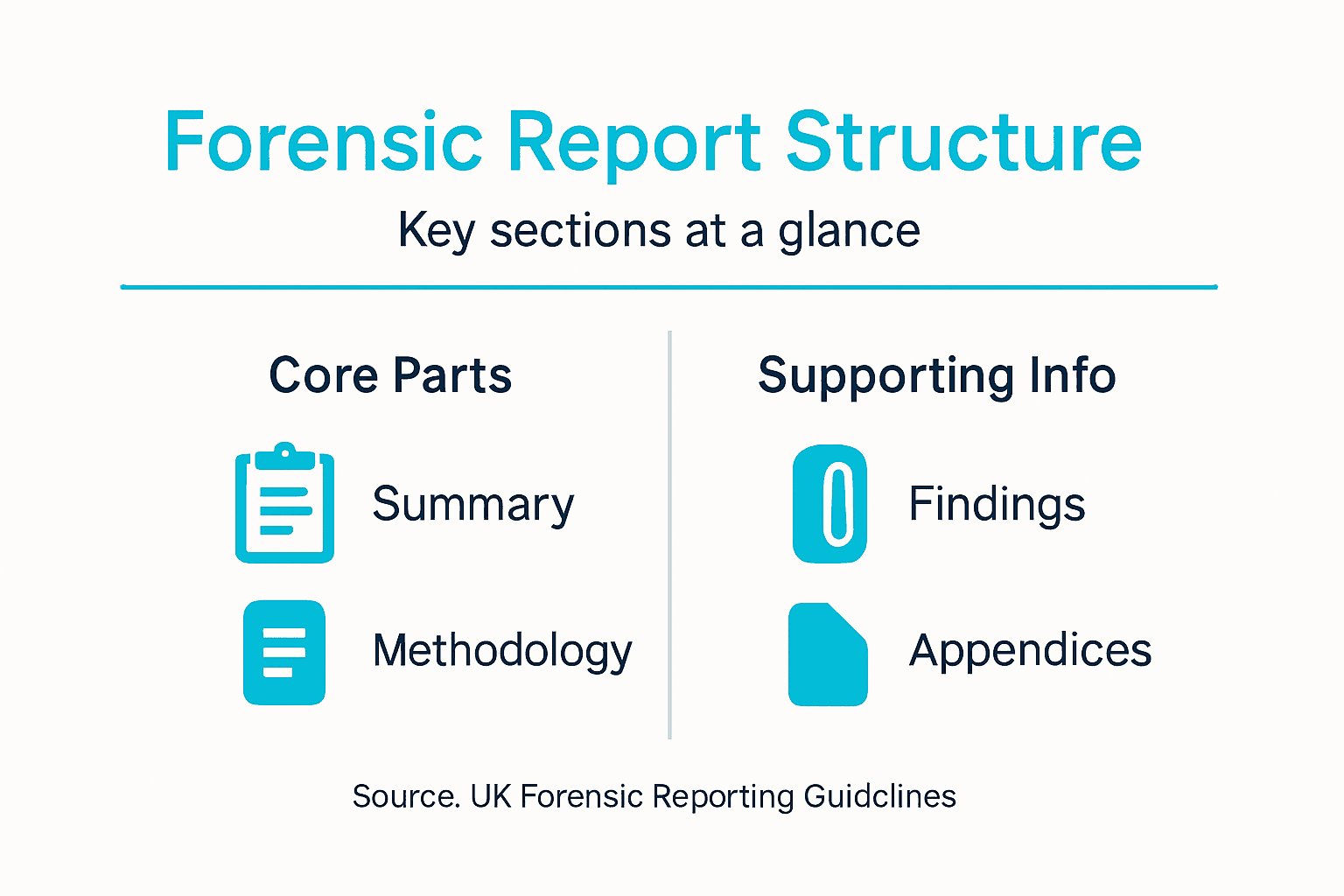
Effective forensic reports follow a standardised structure that facilitates understanding and legal scrutiny. Clear structuring with executive summary, methodology, findings, and appendices facilitates understanding and enables legal professionals to quickly grasp key points while providing depth for technical review.
The typical forensic report sections include:
- Executive Summary: Concise overview of the investigation scope, key findings, and conclusions suitable for non-technical readers. This section enables busy legal professionals to grasp the report’s essence quickly.
- Case Background: Context including the nature of the investigation, relevant parties, and specific questions the forensic examination aimed to answer.
- Methodology: Detailed description of forensic tools, techniques, and procedures used. This transparency enables independent verification and demonstrates compliance with legal standards.
- Findings: Presentation of discovered evidence organised logically, often chronologically or by evidence type. Findings should distinguish between facts and interpretations clearly.
- Analysis and Conclusions: Expert interpretation of findings, explaining their significance and addressing the investigation’s original questions.
- Appendices: Supporting materials including technical logs, screenshots, file listings, and tool validation documentation.
| Component | Primary Function | Target Audience |
|---|---|---|
| Executive Summary | Provides quick overview and key conclusions | Legal professionals, decision makers |
| Methodology | Demonstrates procedural compliance and reproducibility | Technical reviewers, opposing experts |
| Findings | Presents factual evidence discovered | All stakeholders |
| Analysis | Interprets evidence significance | Legal professionals, court |
| Appendices | Supports transparency and detailed review | Technical experts, auditors |
Each section serves distinct purposes while contributing to the report’s overall coherence. The executive summary allows time-pressed solicitors and barristers to understand the core findings without wading through technical details. Meanwhile, the methodology section withstands scrutiny from opposing forensic experts seeking procedural flaws.
Findings sections must present evidence objectively, avoiding speculative language or unsupported inferences. Analysis sections can interpret evidence but must clearly distinguish expert opinion from established fact. This separation preserves report credibility and prevents challenges based on overreach.

Pro Tip: Include multimedia elements like annotated screenshots, timeline graphics, and data visualisations in appendices. These visual aids enhance court presentation effectiveness and help non-technical audiences grasp complex digital evidence relationships quickly.
The sequence matters. Readers should progress from high-level understanding through detailed methodology to specific findings, then to expert interpretation. This logical flow mirrors how legal professionals consume technical information, building comprehension incrementally.
Common Misconceptions About Forensic Reporting
Several persistent misconceptions about forensic reporting hinder effective collaboration between legal professionals and forensic experts. Misconceptions like seeing forensic reports as mere technical summaries lead to misuse and inadmissibility risks, undermining case strategies and evidence utility.
The most damaging myth portrays forensic reports as impenetrable technical documents accessible only to IT specialists. This misconception causes legal professionals to avoid engaging deeply with reports, missing crucial nuances and limitations. In reality, well-crafted forensic reports balance technical rigour with accessibility, presenting findings in language that legal professionals can understand and use effectively.
Another common misunderstanding assumes any digital documentation qualifies as forensic reporting. IT audit reports, system logs, and technical assessments lack the evidentiary rigour, chain of custody documentation, and legal standard compliance that define true forensic reporting. This confusion leads to inadmissibility surprises when parties attempt to introduce non-compliant documentation as evidence.
A third misconception views forensic reports as simple data listings rather than analytical narratives. Effective reports do more than catalogue digital artefacts; they interpret evidence significance, explain technical relationships, and address specific legal questions. Reports lacking this analytical layer provide limited utility in litigation contexts.
Top three forensic reporting misconceptions:
- Forensic reports are too technical for non-specialists to understand or use effectively
- Any digital documentation can serve as forensic evidence if it looks official
- Forensic reporting is just about listing files and data without contextual analysis
These misunderstandings stem partly from poor report quality in some cases. When forensic practitioners prioritise technical detail over communication, they reinforce the myth that forensic reports must be impenetrable. The solution lies in demanding clear, accessible reporting that maintains technical rigour while serving legal audiences.
Forensic reports must serve as bridges between technical evidence and legal understanding, not as barriers requiring expert translation. When reports achieve this balance, they become powerful case tools rather than obstacles.
Correcting these misconceptions requires education on both sides. Legal professionals need exposure to well-crafted forensic reports that demonstrate accessibility. Forensic practitioners need training in legal communication and understanding of how their reports will be used in litigation contexts.
Comparing Forensic Reporting with Other Digital Documentation
Distinguishing forensic reports from other digital documents clarifies their unique value and rigour. Forensic reports maintain documented chain of custody and undergo peer review unlike typical IT audit reports, setting them apart in legal contexts.
| Criterion | Forensic Reporting | IT Audit Reports |
|---|---|---|
| Primary Purpose | Legal evidence for court proceedings | Internal compliance and risk assessment |
| Legal Admissibility | Designed for court admission with chain of custody | Not typically court-ready |
| Evidentiary Rigour | Strict adherence to ACPO and FSR codes | Business standards, variable rigour |
| Peer Review | Mandatory independent technical review | Optional or internal only |
| Target Audience | Legal professionals, judges, juries | Business management, auditors |
| Chain of Custody | Meticulously documented throughout | Rarely documented |
The forensic vs IT audit reporting distinction centres on legal scrutiny readiness. Forensic reports anticipate aggressive cross-examination and opposing expert challenges. Every methodology choice must withstand this scrutiny. IT audit reports face no such pressure and can employ less rigorous approaches.
Key differences include:
- Forensic reports require validated forensic tools with documented accuracy rates; IT audits may use standard system utilities
- Chain of custody documentation is mandatory in forensic reporting but typically absent from IT audits
- Peer review by independent forensic experts is standard for forensic reports but rare for IT audits
- Forensic reports must explain methodology transparency to enable independent reproduction; IT audits need not provide this detail
The peer review process distinguishes forensic reporting most significantly. Before finalising reports, independent forensic practitioners examine methodologies, tool selections, and conclusions. This scrutiny catches errors and biases that could prove fatal under legal challenge. IT audits rarely undergo comparable independent technical review.
Forensic reporting’s focus on courtroom readiness shapes every aspect of documentation. Language choices, structure, evidence presentation, and conclusion framing all anticipate legal use. IT audit reports serve internal business purposes and need not meet these stringent communication standards.
Understanding these distinctions prevents the costly mistake of attempting to use IT audit reports as forensic evidence. When litigation needs arise, proper forensic reporting following legal standards becomes essential, regardless of existing IT documentation.
Practical Application: Leveraging Forensic Reports in Litigation and Corporate Investigations
Effective use of forensic reports requires strategic engagement from investigation inception through court presentation. Expert witness success rates increase by up to 40% when supported by thorough forensic reports, demonstrating the tangible value of quality reporting in legal outcomes.
Forensic reports strengthen expert witness testimony by providing documented foundations for opinions. When experts testify, they rely on report findings to support their conclusions under examination. Well-structured reports enable experts to reference specific evidence points, methodology details, and analytical reasoning confidently. This preparation withstands aggressive cross-examination attempts to undermine credibility.
Best practices for interpreting forensic reports:
- Review the executive summary first to grasp key findings and conclusions before diving into technical details.
- Examine the methodology section to understand how evidence was collected and analysed, noting any limitations disclosed.
- Verify chain of custody documentation is complete and unbroken throughout the investigation timeline.
- Assess whether findings directly address the legal questions relevant to your case strategy.
- Identify any caveats or limitations that might affect evidence weight or admissibility.
- Consult with the forensic expert to clarify technical points and explore alternative interpretations.
Real-world applications demonstrate forensic report value. In a recent corporate intellectual property theft case, a detailed forensic report documenting unauthorised file transfers and external storage device usage provided the evidence foundation for successful prosecution. The report’s clear timeline and metadata analysis enabled the jury to understand complex digital evidence relationships.
In criminal investigations, forensic reports examining mobile phone data, social media activity, and cloud storage have proven decisive in using forensic reports in court cases. Reports that translate technical artefacts into comprehensible narratives help judges and juries understand defendant actions and intent.
Pro Tip: Engage forensic experts early in case development, not just when evidence interpretation becomes critical. Early engagement ensures evidence preservation, appropriate collection methods, and report utility aligned with case strategy needs.
Integrating forensic report findings into case strategies requires collaboration between legal teams and forensic experts. Solicitors should brief experts on case theories and legal questions, enabling targeted analysis. Conversely, forensic experts should communicate findings’ legal implications, highlighting evidence supporting or challenging case theories.
Successful corporate investigations leverage forensic reports to resolve employment disputes, investigate data breaches, and support regulatory compliance. Reports documenting employee misconduct through email analysis, file access logs, and internet history provide objective evidence for disciplinary proceedings or litigation.
The key to maximising forensic report value lies in treating them as living case tools rather than static documents. Regular consultation with forensic experts throughout proceedings enables dynamic evidence interpretation as case strategies evolve and opposing arguments emerge.
Explore Our Expert Digital Forensics Services
Computer Forensics Lab provides comprehensive digital forensics services supporting UK legal professionals and corporate clients with expert forensic reporting. Our experienced team adheres strictly to ACPO and Forensic Science Regulator standards, ensuring every report meets admissibility requirements and communicates complex evidence clearly. Whether you need support for criminal prosecution, civil litigation, or corporate internal investigations, our forensic experts deliver court-ready reports that strengthen your case position.
We specialise in evidence collection, analysis, and court presentation support across computing devices, mobile phones, social media platforms, and cloud environments. Our forensic reporting explained approach prioritises accessibility without sacrificing technical rigour, producing reports that legal professionals can confidently use in proceedings.
Contact our team to discuss how expert forensic reporting can support your investigation needs and enhance case outcomes.
Frequently Asked Questions
What is the main purpose of forensic reporting in legal cases?
Forensic reporting transforms complex digital evidence into clear, legally admissible narratives that courts and legal professionals can understand and rely upon. Reports document findings with transparent methodology and maintained chain of custody, enabling evidence to withstand legal scrutiny and support case strategies effectively.
How does chain of custody affect forensic report admissibility?
Chain of custody documentation proves evidence integrity from seizure through analysis to court presentation by tracking every person who accessed evidence and their actions. Gaps or inconsistencies can result in evidence exclusion because courts cannot verify that evidence remained unaltered. Meticulous documentation is therefore essential for admissibility.
Can non-technical legal professionals understand forensic reports?
Yes, well-crafted forensic reports balance technical accuracy with accessible language, enabling legal professionals without IT backgrounds to grasp key findings and use evidence effectively. Reports should include executive summaries, clear explanations of technical terms, and logical organisation that builds understanding incrementally from overview to detail.
What standards ensure the quality of forensic reports in the UK?
UK forensic reporting quality is ensured through adherence to ACPO Good Practice Guide principles and Forensic Science Regulator codes of practice. These standards mandate validated tools, documented methodologies, chain of custody maintenance, peer review processes, and practitioner competency requirements that collectively guarantee report reliability and legal credibility.
How can forensic reports influence court outcomes?
Forensic reports influence outcomes by providing objective, methodologically sound evidence that supports or refutes case theories. Expert witnesses supported by thorough reports demonstrate up to 40% higher success rates because reports enable confident testimony, withstand cross-examination, and help judges and juries understand complex digital evidence relationships clearly.
What happens if a forensic report does not meet UK legal standards?
Reports failing to meet UK legal standards risk evidence exclusion, reduced credibility, and case weakening. Courts may reject non-compliant reports entirely or assign them minimal weight. Opposing counsel will aggressively challenge methodology gaps, chain of custody breaks, or standard violations, potentially causing expert witness testimony to collapse under scrutiny.
Recommended
- 7 Essential Forensic Report Writing Tips for Legal Cases
- Preparing Forensic Expert Witness Reports for Legal Success
- Benefits of Forensic Data Analysis in London Cases
- Data Recovery UK Legal Cases: 80% Evidence Preserved
- BRCKS | Construction Project Communication Software
- Remote Job Platforms 2026: 93% Success Rate Revealed – BizDev Strategy