

TL;DR:
- Proper handling of digital evidence is crucial, as procedural errors can invalidate otherwise strong cases.
- Investigators must follow a disciplined, step-by-step process, starting with thorough preparation and evidence preservation.
- Early actions, especially preserving volatile data, significantly impact the integrity and success of forensic investigations.
When digital evidence is mishandled, cases collapse. A single procedural error, whether it is a failure to document chain of custody or an unprotected write to a suspect drive, can render otherwise compelling evidence inadmissible in court. Understanding the correct digital forensics steps is not optional for legal professionals, investigators, or corporate security teams. It is the difference between a prosecution that holds and one that falls apart under cross-examination. This guide walks through each stage of the forensic investigation process with the precision these situations demand.
Table of Contents
- Key takeaways
- The digital forensics steps every investigator must follow
- Preparation: building the forensic foundation
- Identification and preservation of evidence sources
- Collection and acquisition: capturing data correctly
- Examination and analysis: finding what matters
- Documentation, reporting, and legal presentation
- My perspective on what actually matters in digital forensics
- How Computerforensicslab supports your investigation
- FAQ
Key takeaways
| Point | Details |
|---|---|
| Preparation prevents failure | Establish incident response policies and deploy forensic tools before an investigation begins. |
| Preserve volatile data first | Capture RAM and active process data before any other action to avoid irreversible evidence loss. |
| Forensic imaging is non-negotiable | Bit-for-bit forensic copies, not standard file copies, are the only legally sound acquisition method. |
| Chain of custody must be continuous | Every person who handles evidence must be logged, from first contact through to courtroom presentation. |
| Reports must serve non-technical readers | Findings presented to courts or boards must translate technical data into clear, factual conclusions. |
The digital forensics steps every investigator must follow
The discipline of digital forensics is built on a repeatable, defensible workflow. Improvising at any stage introduces risk, not just to the investigation but to the legal outcomes that depend on it. DFIR operates as a continuous feedback loop where forensic findings inform response actions, and those response actions in turn preserve further evidence for analysis. That circularity is important. It means decisions made in the first hour of an investigation can shape what evidence remains available days later.
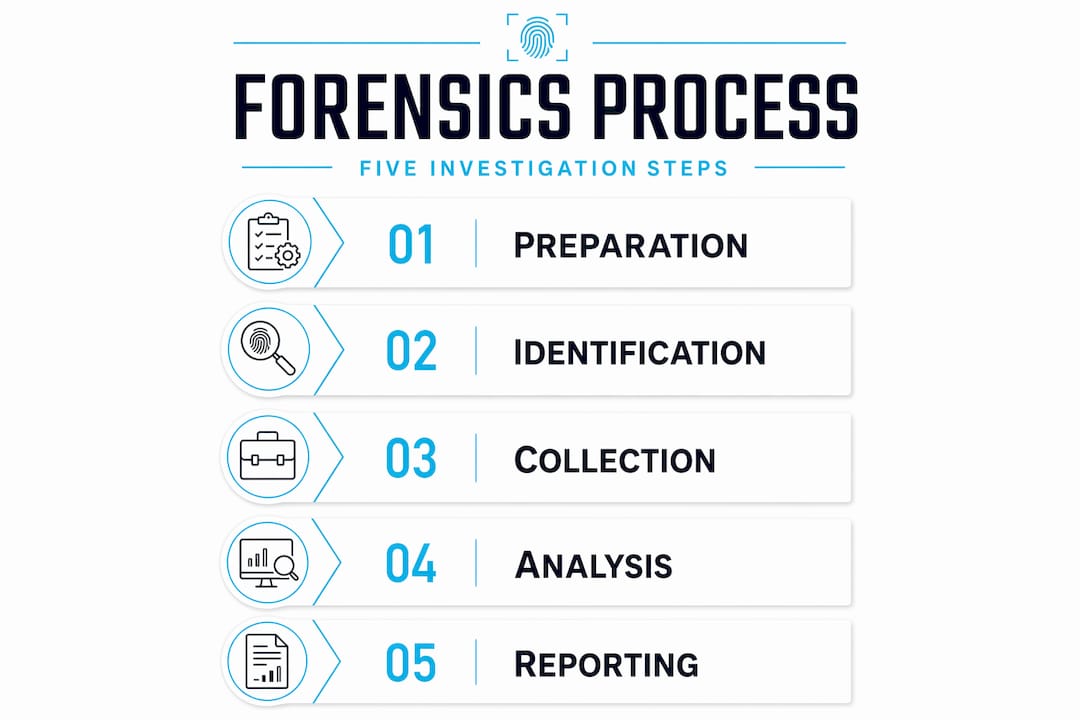
A computer forensics workflow typically moves through five core phases: preparation, identification and preservation, collection and acquisition, examination and analysis, and finally documentation and reporting. Each phase depends on the one before it. Skipping or shortcutting any stage creates gaps that opposing counsel, regulatory bodies, or internal auditors will find.

Preparation: building the forensic foundation
No competent forensic investigation begins at the moment of incident. The groundwork must be laid well in advance. Organisations that invest in pre-incident planning recover evidence more completely and respond more quickly when something goes wrong.
Key preparation activities include:
- Incident response policies and playbooks. Define in writing who has authority to initiate a forensic investigation, which personnel may access systems, and what steps must be followed in sequence. Ambiguity during a live incident leads to procedural errors.
- Tool deployment and validation. Forensic software must be licensed, tested, and validated before it is needed. Tools used in evidence collection may be scrutinised in court, so using unverified or outdated software creates unnecessary exposure.
- Logging and system readiness. Servers, endpoints, and network devices should be configured to generate detailed logs. Many investigators arrive at a scene only to discover that logging was disabled or that retention periods were too short to capture relevant activity.
- Chain of custody protocols. Forms, numbering conventions, and evidence bags should be ready before any device is touched. Chain of custody documentation provides a clear, unbroken record of who handled evidence and when, and its absence is one of the most common reasons digital evidence is challenged in court.
- Training. First responders, IT staff, and security personnel should know what not to do as much as what to do. Rebooting a device, opening files, or connecting to a network can alter or destroy evidence before a forensic specialist arrives.
Pro Tip: Build a forensic readiness checklist and review it quarterly. Incident response capabilities degrade over time if they are not tested and updated alongside changes to your infrastructure.
Identification and preservation of evidence sources
The first moments of an investigation carry disproportionate weight. Identifying which devices, accounts, and systems may hold relevant evidence, and then preserving that evidence without altering it, is where many investigations succeed or fail.
Potential evidence sources extend well beyond the obvious desktop computer or company laptop. Mobile phones, cloud storage accounts, email servers, network logs, CCTV systems, access control records, and even smart home or IoT devices may all be relevant depending on the nature of the case. Investigators must think broadly before narrowing their focus.
The distinction between volatile and non-volatile data is critical at this stage:
- Volatile data exists only while a device is powered on. This includes RAM contents, active network connections, running processes, and logged-in user sessions. Once a device is shut down, this data is gone permanently.
- Non-volatile data persists after shutdown. Hard drives, SSDs, USB drives, and cloud storage all retain data independently of power state.
Investigators should prioritise volatile data preservation before any other action, including containment measures that might require shutting down a device. This is a discipline that requires restraint under pressure.
Write blockers must be connected before any storage media is examined physically. These hardware or software devices prevent any data being written to the source drive during examination, ensuring the original evidence is not modified.
Pro Tip: Photograph the physical state of every device before touching it. Screen contents, cable connections, and surrounding environment may all be relevant, and photographs provide contemporaneous documentation that no written note can fully replicate.
Collection and acquisition: capturing data correctly
Acquisition is the most technically demanding phase of the digital forensic process steps, and it is where the quality of evidence is permanently set. Whatever is captured at this stage is what analysts will work with throughout the remainder of the investigation.

The foundational rule is this: forensic imaging captures every bit of a storage device, including deleted files, unallocated space, and file fragments that would be missed by a standard copy operation. A forensic image is an exact, bit-for-bit duplicate of the original. Working from a forensic image rather than the original device protects the source evidence from accidental modification.
| Method | What it captures | Legal standing |
|---|---|---|
| Standard file copy | Only active, visible files | Not suitable for court use |
| Forensic image (bit-for-bit) | All data including deleted files and unallocated space | Gold standard for legal proceedings |
| RAM capture | Volatile memory contents at point of capture | Critical for live system investigations |
| Cloud acquisition | Account data via API or legal process | Increasingly common; jurisdiction-dependent |
The acquisition process for a typical device follows this sequence:
- Connect a validated write blocker between the forensic workstation and the source device.
- Use approved forensic software to initiate a bit-for-bit image of the source media.
- Generate a cryptographic hash value (typically SHA-256 or MD5) of both the source device and the completed image.
- Verify that both hash values match, confirming the image is an exact copy.
- Store the forensic image on secure, write-protected media and log the acquisition in the chain of custody record.
- Repeat hash verification at each subsequent stage of handling.
Cloud and distributed environments present additional complexity. Data may span multiple jurisdictions, be subject to retention policies outside the investigator’s control, or require formal legal process to obtain. Planning for these scenarios during the preparation phase reduces delays when they arise.
Examination and analysis: finding what matters
Collection produces a large volume of data. Analysis transforms that data into evidence. The examination phase is where investigators apply skill, experience, and specialist tools to reconstruct what happened, when it happened, and who was responsible.
Filtering millions of files using keyword searches, metadata analysis, and file signature verification is the starting point. Not every file on a device is relevant, and experienced analysts develop efficient triage approaches to separate evidential material from background noise quickly.
Key analytical techniques include:
- Deleted file recovery. When files are deleted, the data often remains on the storage device until overwritten. Forensic tools can recover this data and reconstruct partial files from fragments.
- Timeline reconstruction. Correlating timestamps across logs and digital artefacts reveals the sequence of events and attacker behaviour in ways that isolated data points cannot.
- Registry and artefact analysis. On Windows systems, the registry retains detailed records of user activity, connected devices, and recently accessed files. These artefacts are frequently decisive in misconduct investigations.
- Network log correlation. Firewall logs, VPN records, and DNS query histories can establish when a user accessed specific systems, even when the device itself has been wiped.
| Data source | What it reveals | Common use case |
|---|---|---|
| RAM dump | Active processes, encryption keys, user sessions | Malware analysis, live system investigations |
| File system metadata | Creation, modification, and access timestamps | Timeline reconstruction |
| Browser history and cache | Websites visited, downloads, form data | Employee misconduct, fraud investigations |
| Email server logs | Message routing, sender details, delivery timestamps | Insider threat, corporate espionage cases |
Understanding the blast radius of an incident, meaning how widely an attacker or insider moved through a system, requires correlating data from multiple sources simultaneously. This is where specialist forensic platforms and experienced analysts add genuine value that generic IT tools cannot match.
Documentation, reporting, and legal presentation
Thorough documentation runs throughout every phase of a forensic investigation, not just at the end. By the time a report is produced, every action taken, every tool used, and every piece of evidence handled should already be recorded in contemporaneous notes and chain of custody logs.
The final report serves two distinct audiences. First, it must be technically accurate enough to withstand scrutiny from opposing experts. Second, it must be clear enough for judges, board members, or HR panels who have no technical background. Striking that balance is a professional skill in itself.
Effective forensic reports share several characteristics:
- A clear methodology section that describes exactly what tools and techniques were used, and why.
- An evidence log that maps every exhibit to its source, acquisition date, and handling history.
- Findings stated as facts, not opinions, unless explicitly presented as expert interpretation.
- Plain-language conclusions that a non-specialist can understand without misinterpreting.
- Appendices containing raw data, hash values, and technical detail for specialist review.
Presentation of findings must maintain legal admissibility, and this often requires an expert witness to attend proceedings and explain technical conclusions under cross-examination. Proposed Rule 707 in US federal courts is beginning to introduce Daubert-style authentication standards for machine-generated digital evidence, reflecting how courts globally are grappling with AI-generated artefacts and deepfakes. British legal practitioners should monitor these developments closely, as equivalent standards are likely to emerge in UK and European proceedings.
My perspective on what actually matters in digital forensics
I have seen enough investigations to know that the place where cases are won or lost is almost never the analysis phase. It is the preservation phase. Specifically, it is the ten minutes after an incident is first identified, before any forensic specialist has arrived, when someone with good intentions reboots the server or unplugs the device to “stop the damage.”
That instinct is understandable. It is also devastating. Volatile memory data, once gone, cannot be reconstructed from any other source. The running processes, the active network connections, the encryption keys held in RAM, all of it disappears with a power cycle.
What I have come to believe, after working through many complex cases, is that the forensic investigation steps are only as strong as the people executing the first response. Technical expertise matters, but it matters less than trained discipline in those early moments. Organisations that have rehearsed their incident response, that have briefed their IT teams on what not to do, consistently produce better forensic outcomes than those relying on purely technical capability deployed too late.
The other lesson I would pass on is this: documentation is not an administrative burden. It is the evidence. Courts do not take an investigator’s word for what they found. They scrutinise every step. Investigators who treat documentation as secondary to analysis will eventually face a challenge they cannot answer in the witness box. The role of forensics in legal cases is only as strong as the paper trail supporting it.
— Computer
How Computerforensicslab supports your investigation
When an investigation demands more than in-house capability can reliably deliver, Computerforensicslab provides professional forensic services covering the full spectrum of the digital forensics workflow. From device acquisition and forensic data analysis through to expert witness reporting, the team works with legal professionals, corporate security functions, and law enforcement across complex cases involving cybercrime, employee misconduct, data breaches, and intellectual property disputes. Engaging a specialist forensic laboratory at the right stage means evidence is collected to the standard courts require, chain of custody is maintained without interruption, and technical findings are presented in a form that withstands legal scrutiny. Explore Computerforensicslab’s digital forensics services to understand how professional support can strengthen your investigation from the outset.
FAQ
What are the main steps in digital forensics?
The core digital forensics steps are: preparation, identification and preservation, collection and acquisition, examination and analysis, and documentation and reporting. Each phase must be completed in sequence to maintain evidence integrity.
Why is chain of custody so important in digital investigations?
Chain of custody provides a continuous, documented record of who handled evidence and when. Without it, digital evidence can be challenged or excluded from legal proceedings entirely.
What is the difference between forensic imaging and a normal file copy?
A forensic image captures every bit of a storage device, including deleted files and unallocated space, whereas a normal file copy only captures visible, active files. Only forensic images meet the standard required for court use.
When should volatile data be collected during a forensic investigation?
Volatile data, such as RAM contents and active network connections, must be captured before any other action, including shutting down the device, as it is permanently lost once power is removed.
What makes a digital forensics report legally admissible?
A legally admissible report documents methodology clearly, maintains an unbroken chain of custody, states findings as verifiable facts, and is prepared by a qualified expert who can defend conclusions under cross-examination.