
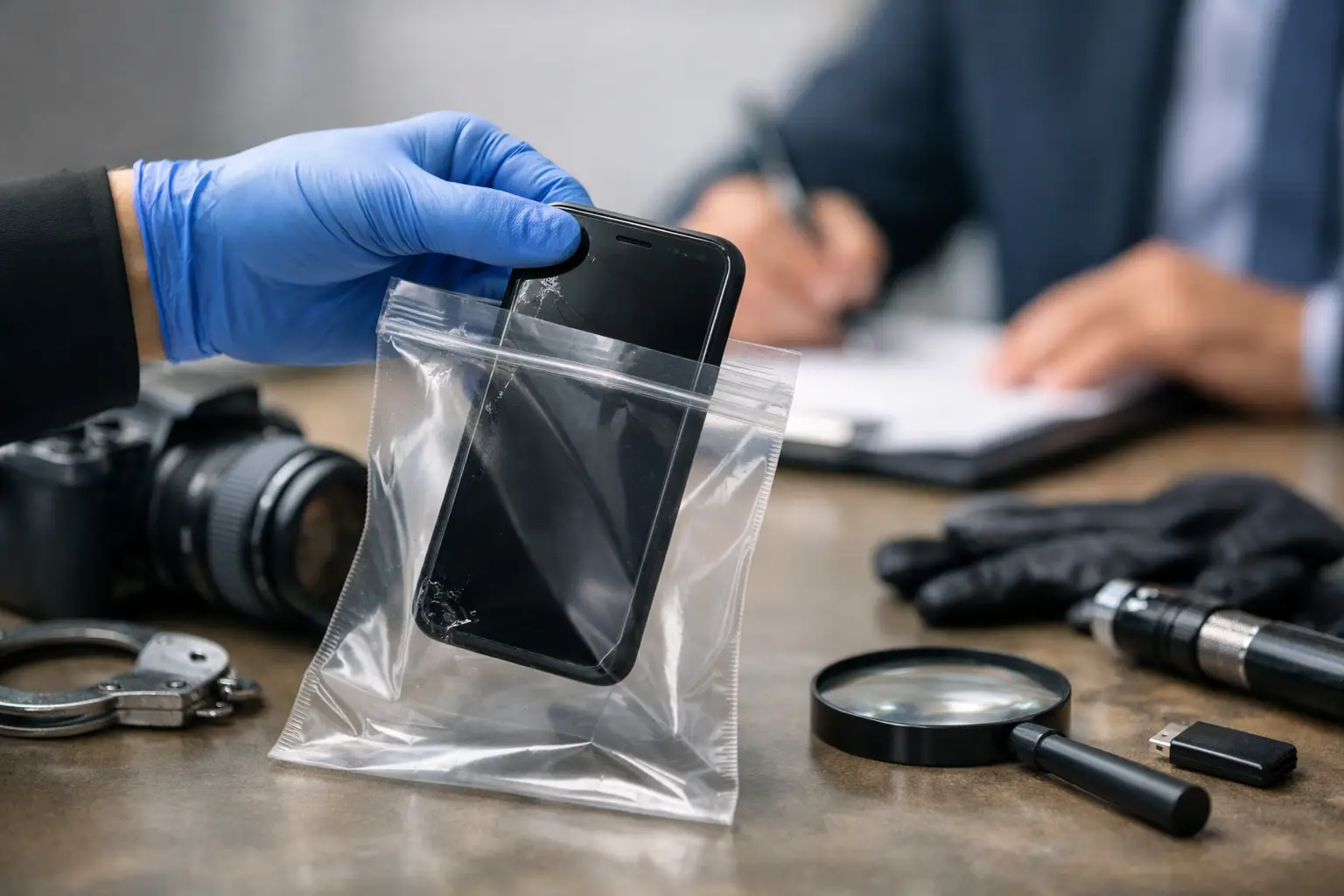
A phone that appears ordinary at first glance can become the central exhibit in a fraud case, family dispute, internal misconduct investigation or criminal defence. The problem is that most mistakes happen in the first few minutes. If you need to know how to preserve phone evidence, the priority is not to search the device yourself. It is to protect the data, record what happened, and avoid changing anything that may later matter in court.
Mobile phones are dense sources of evidence. Messages, call logs, app content, photographs, location data, cloud synchronisation records and deleted material can all become relevant. Yet the same device can also be altered quickly by a simple swipe, a biometric unlock, a charging decision, or an automatic sync. Good intentions often damage evidence. Proper preservation is about restraint, documentation and procedure.
Why phone evidence is so easily compromised
Phone evidence is unusually fragile because it is both physical and live. A handset may contain locally stored data, but it may also be linked to cloud services, messaging platforms, email accounts, remote wipe functions and security controls that continue to operate in real time. That means evidence can change without anyone deliberately tampering with it.
A device that is powered on may receive new messages, overwrite temporary data, update apps or alter usage records. A device that is powered off may trigger other problems, particularly if encryption prevents later access without the passcode. There is no single rule that fits every phone, which is why premature handling can create avoidable risk.
For legal professionals and clients, the key issue is not just whether relevant material exists. It is whether the evidence can be shown to be authentic, complete and preserved in a defensible manner. A screenshot taken casually by a party to a dispute may have some intelligence value, but it is rarely the same as forensically preserved device evidence with a clear chain of custody.
How to preserve phone evidence in the first hour
The first hour matters because it is when evidence is most often lost through panic or curiosity. If the device is found in connection with a dispute or investigation, start by treating it as a potential exhibit rather than a source of quick answers.
Record the basics immediately. Note who found the phone, when it was found, where it was located, whether it was on or off, whether it appeared locked, and whether it was connected to power or peripherals. If the screen is visible, record what can be seen without navigating through the device. A contemporaneous note can become highly important later if access, possession or condition is disputed.
Then limit handling. Do not scroll through messages, open apps, test the camera, charge the phone casually, or ask someone to “just have a look”. Every interaction risks changing timestamps, app states, notification records or user activity logs. If multiple people handle the device, the evidential picture becomes harder to defend.
The next step depends on context. If the device is unlocked and active, there may be a case for urgent specialist advice before any power decision is made. If the device is locked, leave it locked. Do not attempt repeated passcodes, do not use a fingerprint or face unlock unless advised, and do not allow anyone with access to interact with it informally. In some matters, simply keeping the device stable and isolated until a forensic examiner can assess it is the safest course.
Isolation matters more than most people realise
One of the main risks with phone evidence is remote alteration. That can include incoming communications, cloud updates, account changes and, in some cases, remote wiping. Preserving the handset often means preserving its digital environment long enough for proper acquisition.
Network isolation is therefore a serious consideration. In some scenarios, placing the phone in aeroplane mode may help, but doing so requires handling the device and may itself alter evidence. In others, shielding the device from network access without changing settings may be preferable. The right approach depends on the phone model, operating state, lock status and investigative objective.
This is where non-specialist handling often goes wrong. Well-meaning staff may switch a phone on and off, connect it to Wi-Fi, plug it into a computer, or place it on charge using an untrusted cable. Each of those actions can affect the evidence. Preservation is not simply about possession. It is about controlling change.
Chain of custody is not administrative box-ticking
If phone evidence may be used in legal proceedings, chain of custody should begin at once. That means documenting who had the device, when they had it, where it was stored, and what, if anything, was done to it. Gaps in that record create room for challenge.
In practice, chain of custody is one of the clearest dividing lines between evidence that can withstand scrutiny and evidence that becomes vulnerable to attack. If a handset passes through several hands with no notes, no secure storage and no clear timeline, an opposing party may argue that the device was interfered with, substituted or contaminated.
The same principle applies to associated items. SIM cards, memory cards, charging cables, written passcodes, packaging and even the location in which the device was recovered may all carry evidential significance. A disciplined record should capture those details from the outset.
What not to do when preserving phone evidence
The most common mistakes are predictable. People search the device for reassurance, take partial screenshots, send themselves copies of messages, delete private material they think is irrelevant, or let an internal IT team attempt extraction using consumer tools. These actions may not only alter the evidence but also create disclosure and admissibility problems later.
Another frequent issue is relying on screenshots alone. Screenshots can be useful as an urgent record of what was visible at a moment in time, but they rarely capture the full evidential picture. They may omit metadata, surrounding conversation context, account information, deleted content and signs of manipulation. Where the issue is serious, screenshots should not be treated as a substitute for forensic preservation.
There is also a trade-off with power. People often assume they should switch the phone off immediately. Sometimes that is sensible. Sometimes it is precisely the wrong choice if encryption or volatile data is a factor. The point is not that one rule always applies. It is that the decision should be made for forensic reasons, not instinct.
When specialist forensic intervention becomes necessary
If the phone may be relevant to litigation, criminal defence, employee misconduct, harassment allegations, breach of confidence, suspected infidelity, fraud or cyber intrusion, specialist input should be sought early. The later that happens, the greater the chance that critical data has already changed or vanished.
A forensic examiner can assess the handset type, lock status, operating condition and likely data sources, then determine the least destructive preservation route. That may involve forensic imaging, logical or physical acquisition, recovery of deleted material, cloud-linked preservation steps, or targeted extraction focused on the issues in dispute. The method matters because over-collection can raise privacy and proportionality concerns, while under-collection can miss decisive evidence.
For solicitors and corporate clients, the advantage of proper forensic handling is not merely technical. It creates a documented process that supports authenticity, continuity and expert reporting. Computer Forensics Lab regularly deals with matters where the core issue is not whether data exists, but whether it has been preserved and presented in a way the court can trust.
How to preserve phone evidence for court use
If court use is a realistic possibility, preserve the device as though every handling decision may later be examined. Store it securely. Restrict access. Keep a written custody log. Record passcode information separately and securely if it is voluntarily provided. Avoid any action that changes user data unless it is necessary and documented.
It is also wise to preserve surrounding context. That may include who used the phone, whether it was personal or company-issued, which accounts were linked to it, whether any backups exist, and whether there are companion devices such as tablets, laptops, smartwatches or cloud accounts that may hold synchronised evidence. A phone rarely exists in isolation.
From an evidential standpoint, proportionality matters. Not every case requires a full-scale examination of every app and account. In some matters, a narrow and carefully scoped exercise is better for privacy, cost and relevance. In others, especially where deletion, fabrication or concealment is alleged, a deeper examination may be justified. Preservation should support that later decision, not foreclose it.
The safest approach is usually the simplest one. Secure the handset, document its state, minimise interaction, and obtain specialist advice before anyone starts exploring. Evidence is easiest to defend when it has been disturbed the least.
When a phone may decide the outcome of a case, haste is understandable. Procedure is still what protects the truth.