

TL;DR:
- Forensic imaging creates a precise, unaltered clone of digital evidence, ensuring integrity.
- UK courts require proper handling, documentation, and chain of custody for digital evidence to be admissible.
- Skipping forensic imaging risks evidence being challenged or excluded due to procedural errors.
When a legal case hinges on digital evidence, the method used to capture that evidence is just as important as the evidence itself. Many solicitors and barristers assume that copying files from a device is sufficient preparation for court, but that assumption has cost cases their outcomes. Forensic imaging is the gold standard for preserving digital evidence, and without it, even the most compelling data can be rendered inadmissible. This guide explains exactly why forensic imaging matters, what UK courts expect, and how to ensure your evidence stands up to scrutiny.
Table of Contents
- What is forensic imaging and how does it protect evidence?
- Admissibility in UK courts: legal standards for digital evidence
- Risks and pitfalls: what goes wrong without forensic imaging
- Practical application: how to use forensic imaging for your legal case
- Why legal professionals should never compromise on forensic imaging
- Expert help with forensic imaging for your legal case
- Frequently asked questions
Key Takeaways
| Point | Details |
|---|---|
| Forensic imaging preserves integrity | Bit-for-bit copying ensures evidence remains unaltered and reliable for legal proceedings. |
| Hash verification offers proof | MD5 or SHA-256 hashing mathematically validates digital evidence for court acceptance. |
| Admissibility relies on protocol | Evidence is only admissible if forensic imaging procedures and chain of custody are strictly followed. |
| Common mistakes threaten cases | Errors like skipping write-blockers or incomplete hashing make evidence vulnerable to rejection. |
| Expert guidance prevents risk | Utilising professional forensic practitioners helps protect digital evidence and legal success. |
What is forensic imaging and how does it protect evidence?
Forensic imaging is the process of creating a precise, bit-for-bit duplicate of a digital storage device, capturing every single piece of data including deleted files, file fragments, and unallocated space. Unlike a standard file copy, which only transfers visible, accessible files, forensic imaging replicates the entire drive at the binary level. Nothing is left behind. Nothing is altered.
This distinction matters enormously in legal proceedings. When you copy files the ordinary way, the operating system updates file metadata, access timestamps change, and the original state of the evidence is subtly modified. A forensic image, by contrast, is created using write-blocking technology that prevents any data from being written back to the source device during the imaging process. The original remains untouched.
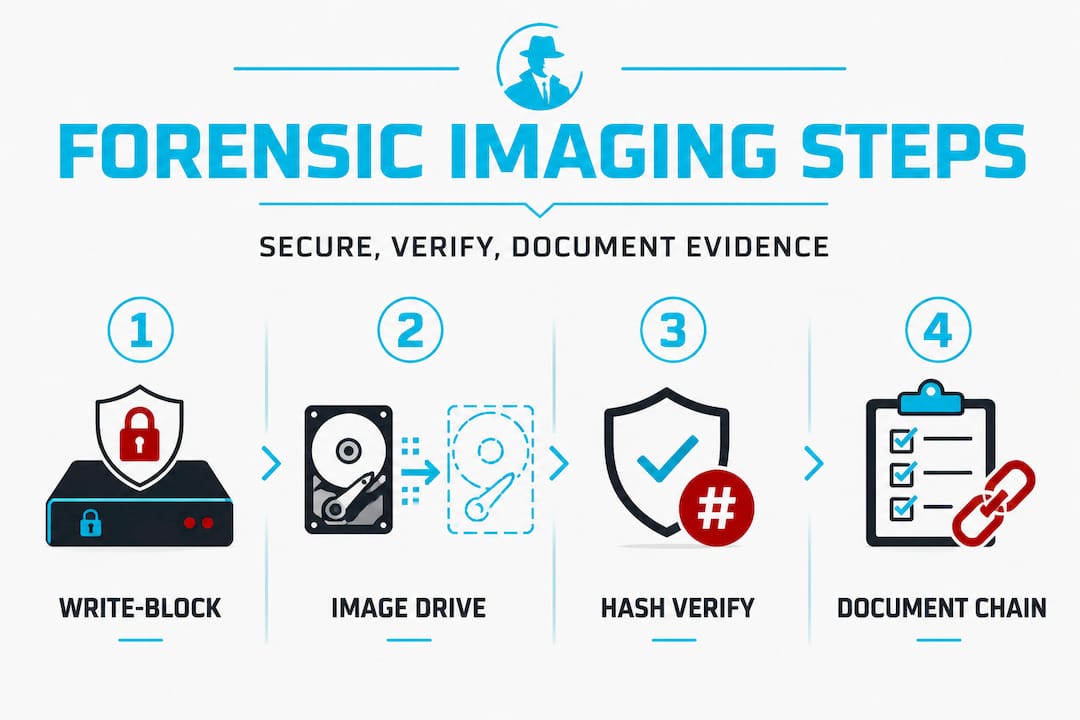

The key technical safeguard within forensic imaging is hash verification. Hash verification using MD5/SHA-256 confirms the image is identical to the original, providing mathematical proof of integrity for court. A hash is essentially a unique digital fingerprint of the data. If even a single bit changes, the hash value changes entirely, making any tampering immediately detectable.
Here is how forensic imaging compares to standard file copying:
| Feature | Standard file copy | Forensic image |
|---|---|---|
| Captures deleted files | No | Yes |
| Preserves metadata | Partial | Complete |
| Write protection | No | Yes (write-blocker) |
| Hash verification | No | Yes (MD5/SHA-256) |
| Court admissibility | Unreliable | High, when properly documented |
| Captures unallocated space | No | Yes |
Key protections that forensic imaging provides include:
- Bit-for-bit accuracy across all sectors of the drive, including slack space and unallocated areas
- Mathematical integrity verification through hashing algorithms that confirm the image has not been altered
- Write-blocked acquisition that prevents accidental or deliberate modification of the source device
- Full audit trail documenting the imaging process, tools used, and operator details
Understanding securing digital evidence at this level is what separates a solid evidentiary foundation from a fragile one that opposing counsel can dismantle in minutes.
Pro Tip: Always document every step of the imaging process, including the tool version, hash values before and after, the operator’s name, and the time and date. This documentation becomes part of your chain of custody record and is essential for defending the evidence in court.
For a more detailed walkthrough of the technical process, reviewing practical forensic imaging steps will give you a clearer picture of what a properly conducted imaging operation looks like from start to finish.
Admissibility in UK courts: legal standards for digital evidence
UK courts do not automatically accept digital evidence. Judges and opposing counsel scrutinise how evidence was obtained, handled, and preserved. The legal framework governing digital evidence in England and Wales draws on the Police and Criminal Evidence Act 1984 (PACE), the Civil Evidence Act 1995, and guidance from bodies such as the Association of Chief Police Officers (ACPO), now superseded by the College of Policing’s digital evidence guidelines.
The four core principles from the original ACPO Good Practice Guide remain highly influential in practice:
- No action should change data on a digital device that may be relied upon in court
- Any person accessing original data must be competent to do so and able to explain their actions
- An audit trail of all processes applied to digital evidence must be created and preserved
- The person in charge of the investigation has overall responsibility for ensuring these principles are followed
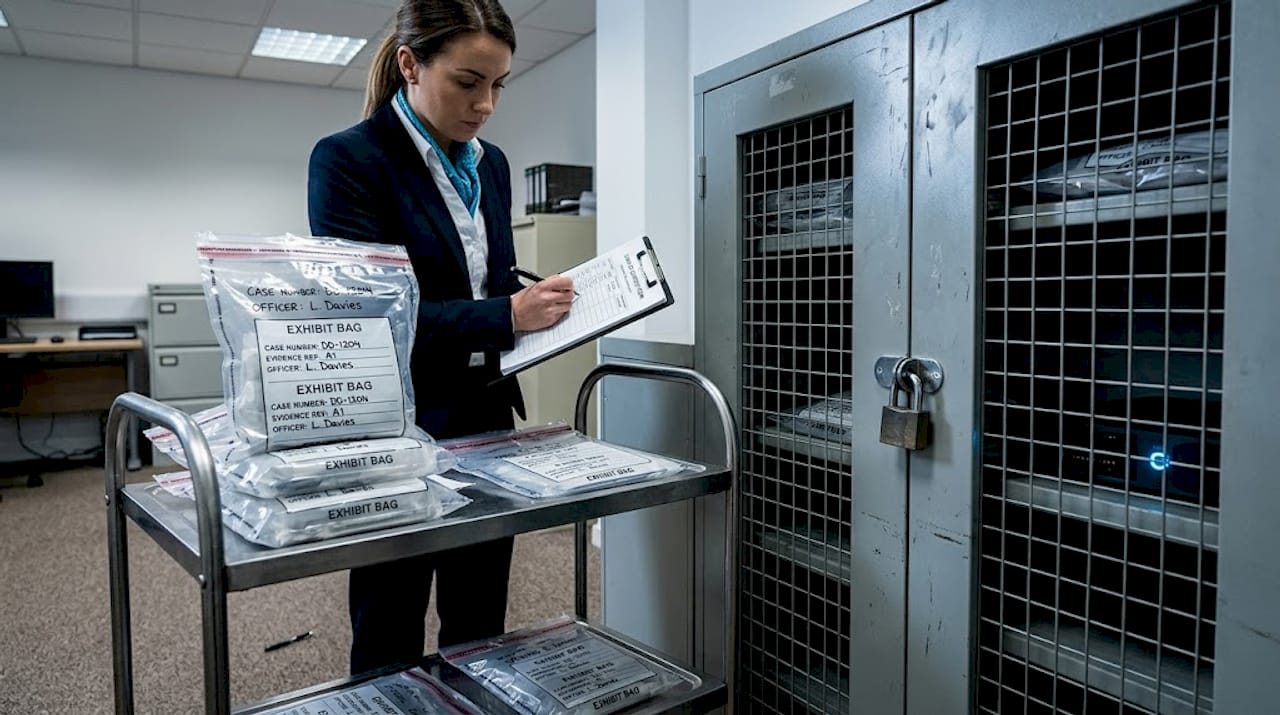
Preserving chain of custody is the practical expression of these principles. Every time a piece of digital evidence changes hands, it must be logged. Every tool used must be validated. Every decision must be documented. Gaps in this chain give opposing counsel grounds to challenge admissibility.
“Evidence that cannot be proven to be in the same state as when it was originally seized is evidence that a court may refuse to consider. The consequences of an inadmissible exhibit can be catastrophic for a case, particularly where digital data is the primary or sole source of proof.”
Common errors that lead to inadmissibility include no write-blocker, incomplete hashing, broken chain of custody, and unvalidated tools. Each of these failures creates a point of vulnerability that a skilled defence barrister or opposing solicitor will exploit without hesitation.
| Error | Consequence |
|---|---|
| No write-blocker used | Original data may have been altered; integrity unprovable |
| Incomplete hash verification | Cannot confirm image matches original |
| Broken chain of custody | Evidence may be excluded entirely |
| Unvalidated forensic tools | Results may be challenged as unreliable |
| Missing documentation | Operator cannot defend their process under cross-examination |
Safeguarding evidence integrity is not merely a technical task; it is a legal obligation. When you instruct a forensic expert, verifying that their process aligns with a reliable legal evidence process is part of your professional due diligence as the instructing solicitor.
Risks and pitfalls: what goes wrong without forensic imaging
The risks of bypassing forensic imaging are not theoretical. They play out in courtrooms across the UK with real consequences for clients and legal professionals alike. Understanding the specific failure modes helps you prevent them.
Here is a stepwise breakdown of how evidence typically fails when forensic imaging is skipped or mishandled:
- A device is seized and a technician copies files directly without using a write-blocker, inadvertently modifying timestamps and metadata on the original device.
- No hash value is generated at the point of acquisition, meaning there is no baseline to compare against later.
- The copied files are stored on a shared network drive accessible to multiple people, breaking the chain of custody immediately.
- The forensic tool used is not validated or documented, leaving the analyst unable to explain or defend the software’s reliability under cross-examination.
- Documentation is incomplete or retrospective, meaning the audit trail cannot be verified and the evidence becomes vulnerable to challenge.
Each step compounds the problem. By the time the case reaches court, opposing counsel has multiple angles from which to attack the evidence. Chain of custody tips can help you identify and close these vulnerabilities before they become courtroom disasters.
The importance of write-blocking technology cannot be overstated. Without it, even a read operation can write data to certain drives, particularly those with wear-levelling algorithms such as SSDs and USB flash drives. This is a technical reality that many non-specialist IT professionals are unaware of, and it is one reason why instructing a qualified forensic expert matters so much.
Understanding why chain of custody matters goes beyond procedural compliance. It is about ensuring that the truth, as captured in the digital evidence, reaches the court intact and credible.
Statistic callout: Research and case reviews in UK digital forensics consistently show that a significant proportion of digital evidence challenges in court relate not to the content of the evidence itself, but to procedural failures in how it was collected and preserved. In many instances, these failures were entirely preventable with standard forensic imaging protocols.
Pro Tip: Before instructing any digital forensics provider, ask them specifically which write-blocking hardware they use, which hashing algorithms they apply, and how they document their chain of custody. A competent expert will answer these questions immediately and confidently. Hesitation is a warning sign.
Practical application: how to use forensic imaging for your legal case
Knowing the theory is one thing. Applying it correctly in a live case is another. Here is a practical, stepwise process that UK legal professionals should follow when digital evidence is involved.
- Identify and preserve the device immediately. As soon as a device becomes relevant to a matter, take steps to prevent it being used, wiped, or updated. Time is critical, particularly with cloud-synced devices.
- Instruct a qualified forensic examiner. Do not allow IT staff or non-specialist technicians to access the device. Instruct a forensic professional who can conduct a properly documented acquisition.
- Ensure write-blocking is used during imaging. The examiner should use validated hardware or software write-blockers before connecting to the source device.
- Generate and record hash values. Hash verification using MD5/SHA-256 confirms the image is identical to the original, providing mathematical proof of integrity for court. Record these values in the case documentation immediately.
- Store the forensic image securely. The image should be stored in a secure, access-controlled environment with a full log of who has accessed it and when.
- Maintain a complete chain of custody record. Every transfer, every access, and every analysis step must be logged. Refer to a digital chain of custody guide to ensure your documentation meets the required standard.
- Commission a forensic report suitable for court. The examiner’s report should detail the tools used, the process followed, the hash values, and the findings in a format that can withstand cross-examination.
Essential tools that a competent forensic examiner should be using include:
- Hardware write-blockers such as Tableau or WiebeTech devices
- Validated imaging software such as FTK Imager, EnCase, or Cellebrite
- Hashing utilities capable of generating MD5 and SHA-256 values
- Secure, encrypted storage for the forensic image and case files
- Case management documentation that records every step of the process
Following a thorough digital forensics chain guide ensures that nothing is overlooked. It is also worth reviewing a security checklist for lawyers to ensure your own firm’s handling of digital case materials meets appropriate standards.
Pro Tip: Audit your documentation after every imaging operation before the case progresses further. Check that hash values are recorded, that the chain of custody log is complete, and that the examiner’s credentials are documented. Doing this early prevents scrambling later when a challenge arises.
Why legal professionals should never compromise on forensic imaging
Here is the uncomfortable truth that many in the legal profession have not fully absorbed: most digital evidence failures are not caused by sophisticated attacks or complex technical problems. They are caused by shortcuts that seemed reasonable at the time.
A client brings in a laptop. Someone copies the files. The case proceeds. Then, months later, opposing counsel challenges the evidence and the entire foundation of the case collapses because nobody used a write-blocker or generated a hash. This is not a rare scenario. It is a pattern we see repeatedly, and it is entirely avoidable.
The conventional wisdom is that digital evidence is inherently reliable because it comes from a machine. Machines do not lie. But that view misses the point entirely. The question courts ask is not whether the data is accurate. The question is whether you can prove it has not been altered since it was seized. Without forensic imaging, you cannot answer that question. Full stop.
There is also a professional responsibility dimension here that deserves direct acknowledgement. Solicitors instructing non-specialist technicians to handle digital evidence are taking a risk that extends beyond the immediate case. If evidence is excluded because of improper handling, that failure reflects on the instructing solicitor’s professional conduct as much as on the technician who made the error.
Understanding that chain of custody is crucial is not just about winning cases. It is about discharging your duty to your client properly. And the forensic imaging process is the mechanism through which that duty is fulfilled at the evidence collection stage.
The practical wisdom here is straightforward: build forensic imaging into your standard operating procedure for any case involving digital devices. Do not treat it as optional or as something to consider only when the stakes are high. By the time you realise the stakes are high, it may already be too late to go back and do it properly.
Expert help with forensic imaging for your legal case
Computer Forensics Lab works directly with solicitors, barristers, and legal teams across the UK to ensure digital evidence is collected, preserved, and presented to the highest standard. Our London-based team provides fully documented forensic imaging services with validated tools, complete chain of custody records, and court-ready expert witness reports. Whether you are dealing with a criminal investigation, a civil dispute, or an employment matter, our digital forensics services are built around the evidentiary standards UK courts demand. Explore our digital forensics data services or find out more about how our forensic investigations can support your next case from the very first stage of evidence preservation.
Frequently asked questions
Is forensic imaging legally required for digital evidence in UK courts?
Forensic imaging is not legally mandated, but it is strongly recommended because it ensures evidence integrity and maximises the likelihood of admissibility. Courts expect evidence to be handled in accordance with established good practice guidelines.
How does hash verification support evidence integrity?
Hash verification such as MD5 or SHA-256 mathematically proves the forensic image is identical to the original evidence, making any tampering immediately detectable and supporting the evidence’s integrity in court.
What are the most common forensic imaging mistakes?
Frequent mistakes include not using a write-blocker, incomplete hash verification, and errors in chain of custody documentation, all of which can lead to evidence being challenged or excluded entirely.
Can forensic imaging recover deleted files for legal investigations?
Yes, because forensic imaging captures the entire drive including unallocated space, it can reveal and recover deleted files and file fragments that would be invisible to a standard file copy, which can be crucial evidence in both criminal and civil cases.
Does forensic imaging guarantee evidence is admissible in court?
Forensic imaging greatly increases the chance of admissibility, but proper protocol, chain of custody, and validated tools remain essential. The imaging process must be conducted and documented correctly for the evidence to withstand legal scrutiny.