
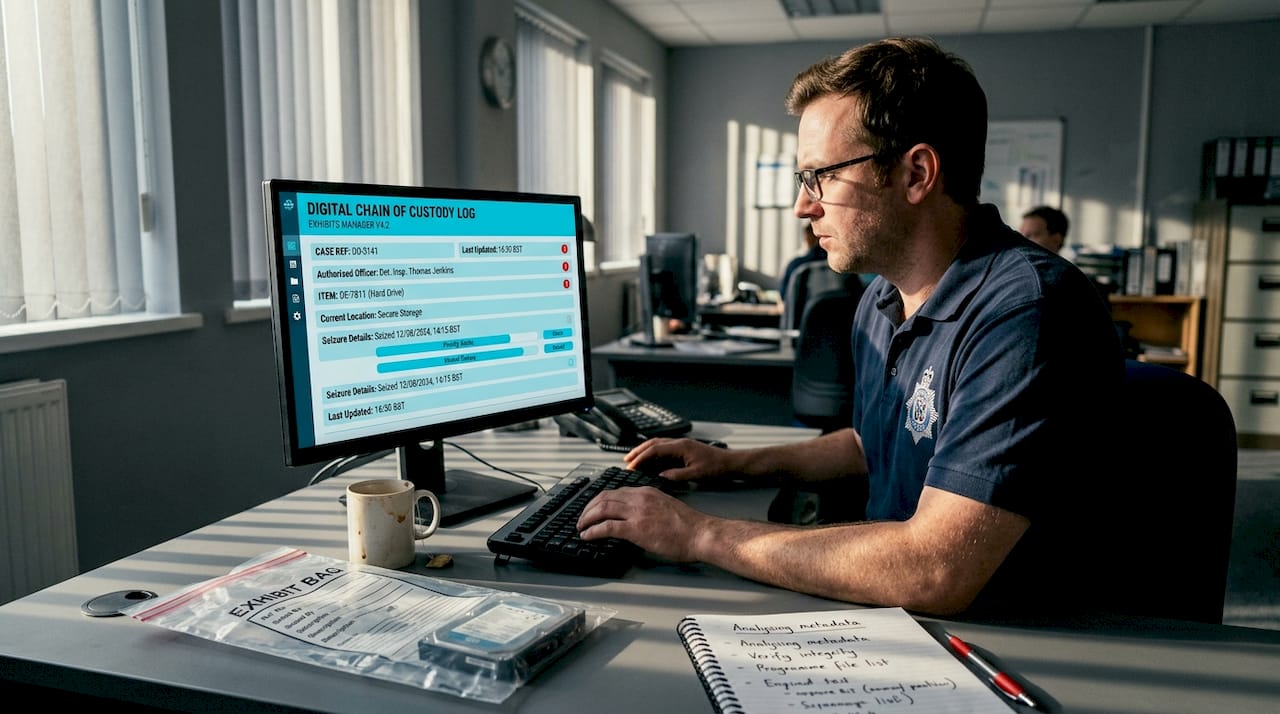
TL;DR:
- Rigorous forensic documentation ensures evidence admissibility, reliability, and court credibility.
- Maintaining an unbroken chain of custody is vital to prevent evidence tampering or contamination doubts.
- Ongoing method validation and detailed reports are essential for defending digital evidence in court.
Forensic documentation is routinely treated as an administrative afterthought, something to be completed once the “real” investigative work is done. That misconception is costly. In practice, the quality of documentation determines whether digital evidence is admissible, whether an expert’s conclusions will survive cross-examination, and whether a case holds together under regulatory scrutiny. For legal professionals, corporate security teams, and private clients pursuing justice in England, understanding what rigorous documentation looks like, and why it matters at every stage, is not optional. This guide explains the standards, the chain of custody requirements, method validation, and how to produce reports that courts actually trust.
Table of Contents
- Setting the standards: Regulatory requirements and risks
- The chain of custody: What must be documented and why
- Validation and evolving environments: Maintaining defensibility
- Reporting: Turning technical documentation into legal evidence
- Why documentation habits define forensic credibility
- Expert forensic support for your legal and corporate cases
- Frequently asked questions
Key Takeaways
| Point | Details |
|---|---|
| Defensible evidence relies on documentation | Rigorous, clear documentation underpins the legal acceptance of forensic evidence. |
| Regulatory standards are mandatory | Meeting statutory requirements for forensic documentation is essential to avoid quality failure and case reviews. |
| Ongoing validation is critical | Continuous method validation and transparent reporting maintain evidence integrity as technology changes. |
| Culture matters more than tech | Consistent documentation habits, not just sophisticated tools, ensure ultimate credibility in investigations. |
Setting the standards: Regulatory requirements and risks
Forensic documentation is not merely a professional courtesy. In England, it carries statutory weight. The Forensic Science Activities: Statutory Code of Practice makes clear that forensic science quality regulation expects documented and controlled procedures and validated methods. This is not guidance that forensic providers can selectively follow. It is a statutory expectation that shapes what judges, auditors, and opposing counsel will scrutinise when your evidence reaches court.
The Code treats documentation as a core pillar of any quality management system. A forensic provider’s procedures must be recorded, controlled, and reproducible. If a method cannot be traced through documented steps, it cannot be defended. If an analyst’s decision cannot be reconstructed from contemporaneous notes, its reliability is immediately questioned.
“Quality failures can have profound consequences, including the review of hundreds or even thousands of results.”
Forensic Science Activities Statutory Code of Practice, Version 2
That is not a theoretical risk. Reviews triggered by documentation failures have affected high-volume forensic providers in England, requiring systematic re-examination of cases and generating significant legal and reputational damage. For legal professionals, this is the single most important argument for ensuring your forensic provider has documentation controls embedded in their daily practice, not bolted on for audits.
What do auditors and judges actually need to see? The key indicators are:
- Documented and signed procedures covering each analytical method used
- Version-controlled records so that any update to a method is traceable
- Contemporaneous notes made at the time of examination, not reconstructed later
- Clear records of any deviations from standard procedure, with justification
- Evidence of peer review or technical oversight on significant examination decisions
When evidence integrity in documentation is treated as a continuous quality obligation rather than a one-off box-tick, the risk of a challenge unravelling weeks of analytical work falls dramatically. The providers who understand this do not wait for court to test their records. They build documentation cultures that make those records audit-ready from day one.
The cost of getting it wrong is significant. Cases where documentation has been found inadequate in England have led to acquittals where convictions were expected, successful civil challenges to corporate investigations, and regulatory sanctions against forensic providers. For a legal professional relying on digital evidence as the linchpin of a case, the quality of the documentation underpinning that evidence is as important as the evidence itself.
The chain of custody: What must be documented and why
With the standards and risks clearly mapped, the next step is to drill into the heart of forensic documentation: the chain of custody. This is the continuous, unbroken record of who handled evidence, when they handled it, and what they did with it. In digital forensics, the chain of custody begins the moment a device or data source is identified as potentially relevant and continues through seizure, transportation, storage, examination, and court presentation.
The legal importance of an unbroken chain is straightforward. If a gap exists, an opponent can argue the evidence was tampered with, contaminated, or substituted. Even a defensible gap, such as a brief handover between two trusted analysts, can generate enough doubt to undermine admissibility if it is not documented. As research on digital evidence documentation consistently confirms, what is not documented is treated as if it did not happen in a controlled manner.
The research published in the MDPI Forensic Sciences journal confirms that documentation must include exactly what was seized or collected, integrity verification mechanisms, and the full reporting scope, not merely the analysis results. That is a critical distinction. Many practitioners document their analytical conclusions thoroughly but leave the collection and transfer stages sparsely recorded. Courts and opposing counsel know exactly where to look for those weaknesses.
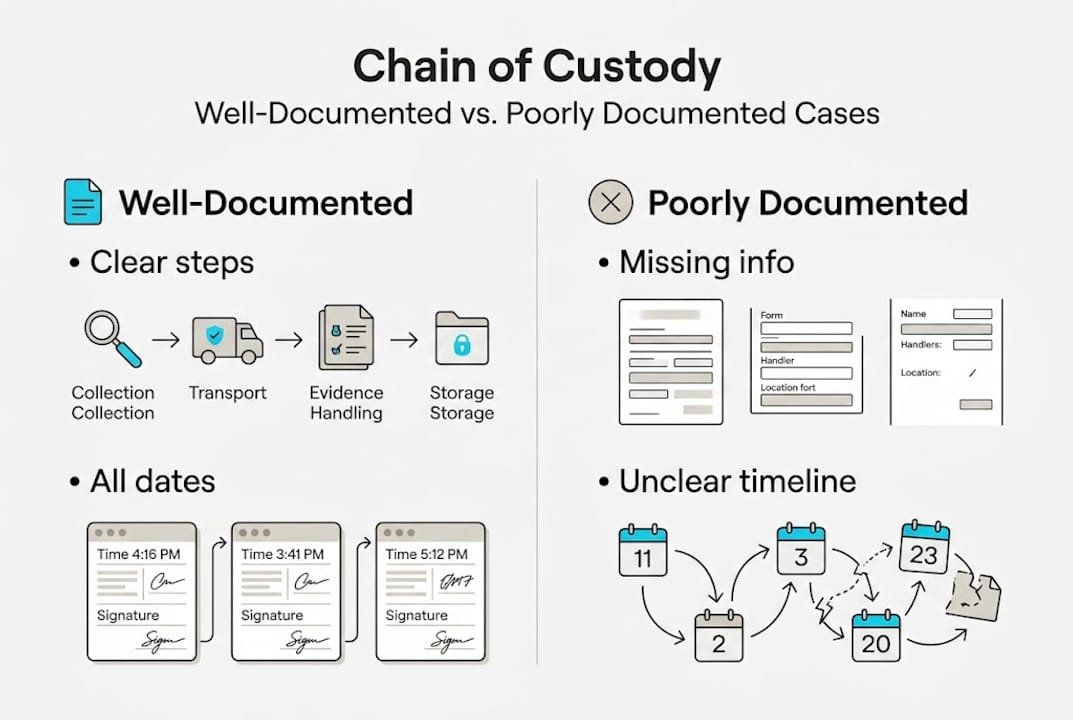

Comparison: Well-documented vs. poorly documented chain of custody
| Stage | Well-documented | Poorly documented |
|---|---|---|
| Collection | Device condition, time, location, collector ID, photographs | “Device received from client” |
| Integrity verification | Hash values recorded pre and post imaging | No hash values, or recorded only post-analysis |
| Transfer | Signed handover forms, packaging condition noted | Verbal confirmation only |
| Storage | Tamper-evident packaging, access log maintained | Stored in shared area, no access log |
| Analysis | Each tool, version, and action logged with timestamps | Summary notes only |
| Reporting | Explicit tie to collected items and verification records | Conclusions without traceable source |
The steps in handling digital evidence correctly follow a clear sequence:
- Identify and photograph the device and its immediate environment before touching it.
- Record the device’s state: powered on or off, visible damage, connected peripherals.
- Apply write blockers before any imaging to prevent data modification.
- Create a forensic image and generate hash values (MD5 and SHA-256 are standard) to verify integrity.
- Record the hash values in the case file immediately, signed and dated.
- Seal the original device in tamper-evident packaging and log it into secure storage.
- Document every subsequent access: who accessed it, why, and what was done.
- Repeat integrity checks at key milestones to confirm the evidence remains unaltered.
Pro Tip: Precise, contemporaneous notes about a device’s physical condition and the exact context of its collection, including the attending officer or investigator’s name, the location’s lighting, and any observed damage, can prevent procedural challenges in court that have nothing to do with your technical findings.
Validation and evolving environments: Maintaining defensibility
Understanding collection and custody is only part of the documentation equation. Evidence must remain credible as tools and threats change. This is where many forensic providers quietly fall short, and where the gap between technically competent teams and genuinely defensible ones becomes visible.
Method validation, the process of confirming that an analytical technique produces reliable and accurate results, is not a one-time exercise. Digital environments evolve constantly. Operating systems release major updates that change how data is stored and deleted. New file formats emerge. Encryption methods become more sophisticated. A tool that was fully validated for extracting deleted files from an Android 11 device may not perform identically on Android 14. If that difference is not documented and re-validated, a well-prepared defence barrister will expose it.
Documentation practices for method updates
| Trigger | Documentation required | Review frequency |
|---|---|---|
| New OS or firmware release | Updated validation records for affected tools | With each major release |
| New forensic tool version | Tool performance comparison against known test data | At each version update |
| New file format or encryption standard | Documented capability testing and known limitations | As encountered, then annually |
| Change in legal or regulatory standards | Procedure review and sign-off | Immediately upon change |
| Staff change or new analyst | Training records and supervised casework log | Before independent casework |
Signs that your forensic provider’s methods may be outdated include:
- No documented validation records for the specific tools used in your case
- Tool versions that do not match current releases without documented justification
- Absence of known-sample testing records to confirm tool accuracy
- Procedures last reviewed more than 12 months ago without a formal confirmation that no significant changes applied
- No documented policy for responding to published tool vulnerabilities or accuracy concerns
For legal teams, these are the questions to ask before accepting a forensic report. The digital method validation guide provides specific detail on what to look for when evaluating whether a provider’s validation records are sufficient for court use in England.
Pro Tip: A forensic provider who proactively documents known limitations of their tools, including what a particular tool cannot extract or may misrepresent, is a stronger expert witness than one who presents only successful results. Courts are far more impressed by acknowledged limitations than by silent gaps discovered during cross-examination.
Reporting: Turning technical documentation into legal evidence
With defensible documentation established, focus shifts to producing reports that successfully bridge technical and legal worlds. A forensic examination can be technically flawless and still fail in court if the written report cannot be understood, challenged constructively, or connected to its underlying evidence.
Documentation is part of the quality management system that reduces the risk of quality failure at every stage, including the reporting stage. A court-ready forensic report does not simply present conclusions. It builds a transparent, reproducible account of how those conclusions were reached, grounded in the underlying documentation.
“The admissibility and weight of forensic evidence depends as much on the quality of its documentation as on the underlying science.”
The key elements of a court-ready forensic report are:
- Case reference and scope: A clear statement of what was examined, why, and under what instruction.
- Exhibit identification: Every examined item linked to its chain of custody record, with hash values confirmed.
- Methodology: The tools, versions, and procedures used, with reference to validation records.
- Findings: Technical findings expressed in plain language, with technical detail in appendices.
- Limitations: Explicit acknowledgement of what could not be examined and why.
- Expert declaration: A signed statement that the report is accurate and the expert understands their duty to the court.
- Supporting exhibits: Raw logs, tool outputs, and photographs referenced and appended.
Common mistakes when documenting forensic findings for court include:
- Writing conclusions without stating the underlying evidence that supports them
- Using technical jargon without definition, alienating the judge and jury
- Failing to state the examiner’s qualifications and relevant experience
- Omitting a statement of limitations, which courts view as a credibility failure
- Presenting findings selectively, which exposes the expert to damaging cross-examination
Strong forensic report writing disciplines connect every conclusion back to a documented, verifiable source. The forensic report’s vital role in a criminal or civil matter is not merely informational. It is structural. It supports the entire edifice of a legal argument. Understanding forensic reporting in England as a discipline, not just an output, is what separates reports that influence outcomes from reports that are challenged and discarded.


Why documentation habits define forensic credibility
After years of supporting litigation and corporate investigations, one pattern stands out above all others. The cases that fall apart do not usually fail because of insufficient technical skill. They fail because someone, at some point, skipped a documentation step and assumed it would not matter. It always matters.
The forensic sector has a persistent tendency to overinvest in tools and underinvest in documentation culture. Sophisticated imaging platforms and AI-assisted analysis are genuinely impressive. But they mean nothing if the analyst did not record which tool version was used, or if the handover log is missing two signatures. Those omissions are not technical failures. They are habits. And habits are fixable.
Our experience in forensic reliability in litigation repeatedly confirms that the strongest expert witnesses are not necessarily those with the most advanced technical platforms. They are the ones who can open their case file, walk a court through every decision, and answer “why did you do it that way?” with a documented, contemporaneous record, not a reconstruction.
Most documentation errors are not dramatic. They are small: a timestamp not recorded, a hash value noted after the fact, a deviation from procedure left unjustified. The cumulative effect of those small failures is a case that cannot be defended. The teams that understand this make documentation a shared professional responsibility, built into every stage of their work, not a checklist completed under deadline pressure.
Expert forensic support for your legal and corporate cases
Understanding what rigorous forensic documentation requires is the first step. The next is ensuring the provider handling your evidence meets those standards consistently. At Computer Forensics Lab, our digital forensic investigations are built around documentation discipline at every stage, from initial seizure through to court-ready reporting. Our team supports legal professionals, corporate security teams, and private clients across England with evidence collection, chain of custody management, method validation records, and expert witness reports that withstand cross-examination. Explore our full range of digital forensics services to find out how we can support your case from the outset.
Frequently asked questions
What is the role of documentation in digital forensic investigations?
Documentation records every action taken during an investigation, ensuring the evidence remains admissible and its handling can be scrutinised at any point. The Statutory Code of Practice requires that forensic providers maintain documented, controlled procedures and validated methods throughout.
How does poor forensic documentation affect legal cases?
Poor documentation can lead to the exclusion of critical evidence, undermine an expert’s credibility, and trigger widespread case reviews. The Statutory Code of Practice warns that quality failures can cause the review of hundreds or even thousands of results, with serious legal consequences.
What should be included in effective forensic documentation?
Every collected item, its condition at seizure, all handling and transfer events, hash-value integrity checks, analysis steps, and method validation records must be meticulously recorded. Research confirms that documentation must cover exactly what was seized, integrity verification, and the full reporting scope.
Why must forensic methods be re-validated?
Digital environments change frequently, with new operating systems, file formats, and encryption standards emerging regularly, so ongoing validation is essential to maintain legal defensibility. Published research confirms that method validation is ongoing and that defensibility depends on current validation evidence and documented performance characteristics.