

TL;DR:
- Proper handling of digital evidence is critical to maintain its courtroom admissibility and integrity.
- Adherence to core principles and legal statutes ensures evidence remains untampered and legally valid.
- Accurate documentation, secure preservation, and chain of custody are essential to prevent challenges in court.
Digital evidence now features in 80 to 89% of UK crimes, yet mishandling remains one of the most avoidable reasons for evidence exclusion. A single procedural error, whether a broken chain of custody or an unverified device, can collapse a case that took months to build. For legal professionals and law enforcement agencies operating in 2026, the stakes have never been higher. This guide sets out the core principles, statutory requirements, and field-ready procedures you need to ensure every piece of digital evidence you handle is admissible, defensible, and robust under courtroom scrutiny.
Table of Contents
- Core principles of digital evidence handling in the UK
- Legal framework and compliance requirements
- Practical steps: handling, preservation, and documentation
- Chain of custody: maintaining evidence integrity
- Why core principles, not toolkits, are the real future of digital evidence handling
- How we support your digital evidence casework
- Frequently asked questions
Key Takeaways
| Point | Details |
|---|---|
| Follow ACPO principles | Adhering strictly to the original four ACPO principles ensures evidence is valid and defensible in court. |
| Meet legal requirements | Every step, from seizure to analysis, must comply with UK statutes such as PACE, CPIA, and the Data Protection Act. |
| Preserve integrity with documentation | A meticulous chain of custody, backed by digital tools, is vital to avoid exclusion of evidence. |
| Prioritise practical best practice | Using accredited labs, checklists and field protocols minimises risk of error and data loss. |
Core principles of digital evidence handling in the UK
Before anything else, you need to understand the foundation on which all UK digital evidence practice rests. The ACPO Good Practice Guide for digital evidence established four enduring principles that continue to govern professional practice, regardless of how technology evolves. There is a common misconception that newer unified guidance has replaced these principles. It has not. The NPCC and Home Office continue to reference them in current policy frameworks, and they remain the benchmark against which courts assess conduct.
The four principles are:
- Principle 1: No action taken by law enforcement or their agents should change data held on a digital device that may subsequently be relied upon in court.
- Principle 2: In exceptional circumstances where a person finds it necessary to access original data, that person must be competent to do so and able to explain the relevance and implications of their actions.
- Principle 3: An audit trail or other record of all processes applied to digital evidence should be created and preserved, enabling an independent third party to examine and replicate those processes.
- Principle 4: The person in charge of the investigation has overall responsibility for ensuring these principles are adhered to.
These handling principles are not bureaucratic formalities. They reflect practical realities about how digital data can be silently altered and how courts assess reliability. Understanding how digital differs from physical evidence is essential here, because digital material is uniquely fragile and uniquely replicable at the same time.
| ACPO principle | Core requirement | Real-world impact |
|---|---|---|
| Non-alteration | Do not change original data | Prevents challenges to evidence integrity |
| Competence | Only qualified personnel access originals | Reduces procedural errors |
| Audit trail | Document every process | Enables independent verification |
| Investigator responsibility | SIO accountable for compliance | Clear accountability in court |
The Home Office digital devices policy explicitly references these standards in the context of seizure and data extraction, confirming their continued relevance in 2026.
“The integrity of digital evidence depends not on the sophistication of the tools used, but on the discipline with which foundational principles are applied at every stage.”
Legal framework and compliance requirements
Understanding the principles is not enough without complying with the statutory framework that governs every step. Legal duties for digital evidence are embedded across several major UK statutes, each addressing a different dimension of evidence handling.
| Statute | Application to digital evidence | Key compliance note |
|---|---|---|
| PACE 1984 | Powers of seizure and search | Requires lawful authority and proportionality |
| CPIA 1996 | Disclosure obligations | All relevant material must be retained and disclosed |
| DPA 2018 | Personal data handling | Processing must be lawful, fair, and documented |
| UK GDPR | Data subject rights | Privacy impact must be assessed before extraction |
Every investigation involving digital devices must satisfy proportionality. Seizing a device without proper authority, or extracting data beyond the scope of a warrant, creates grounds for exclusion and potential civil liability. The legal considerations around digital forensics are complex, and a single oversight can undermine an otherwise solid case.
Here is a practical legal compliance checklist for digital evidence handling:
- Confirm the legal authority for seizure or access (warrant, consent, or statutory power).
- Assess proportionality: is the data sought necessary and relevant to the investigation?
- Issue privacy notices where required under DPA 2018 and UK GDPR.
- Document the scope of any search or extraction before it begins.
- Retain all material that may be relevant, including unused material, under CPIA 1996.
- Record all disclosure decisions with clear reasoning.
- Review compliance at each stage with a designated disclosure officer.
Understanding why securing digital evidence from the outset protects both the investigation and the individuals involved is central to good practice.
Pro Tip: Always verify the legal authority before accessing or seizing any device. If the authority is unclear, seek legal advice before proceeding. Acting outside your powers, even with good intentions, can render evidence inadmissible and expose your organisation to challenge.
Practical steps: handling, preservation, and documentation
Complying with the law is strengthened by following structured, practical processes in the field. Key steps span verifying authority, scene documentation, device isolation, secure packaging, and chain of custody documentation. Getting these right from the first moment of contact with a device is non-negotiable.
Follow this sequence every time:
- Verify authority. Confirm the legal basis for seizure or access before touching any device.
- Document the scene. Photograph the device in situ, noting its state (on, off, locked, connected to networks).
- Record the device state. Note make, model, serial number, visible damage, and any active screens.
- Isolate the device. Place mobile devices in a Faraday bag immediately to prevent remote wiping or network communication. Use anti-static packaging for storage media.
- Apply write-blockers. Before any forensic examination, use hardware or software write-blockers to prevent data modification.
- Create a forensic image. Use validated forensic tools to create a bit-for-bit copy of the original device.
- Generate hash values. Apply SHA-256 or MD5 hashing to verify the integrity of the forensic image against the original.
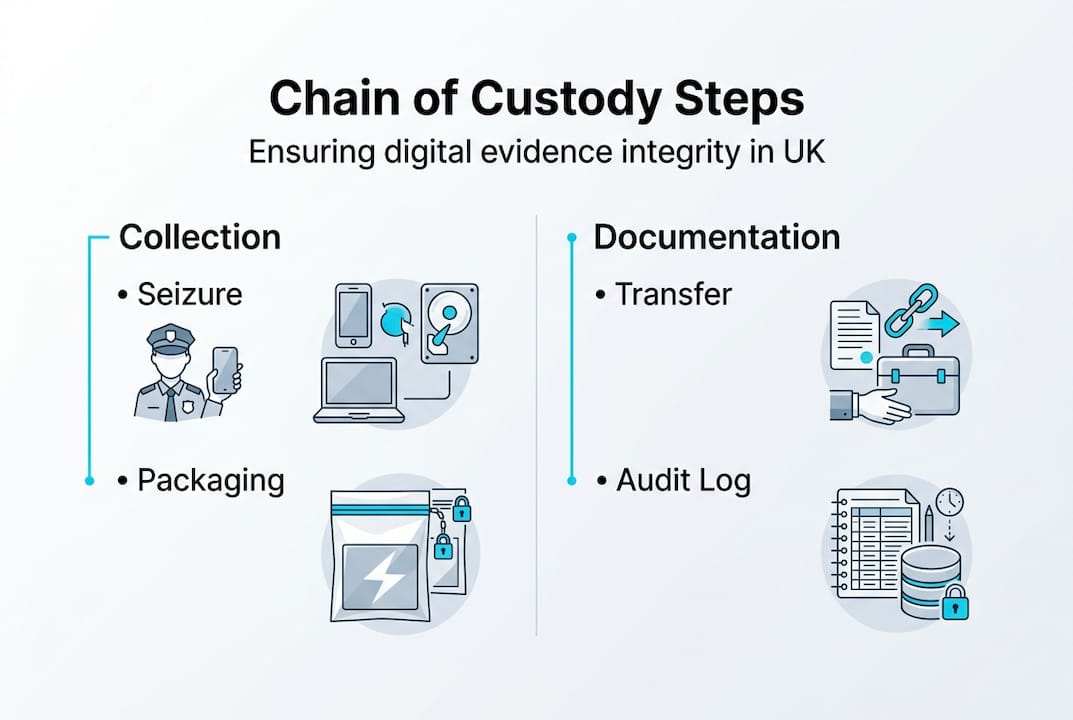
- Complete chain of custody documentation. Record every handler, transfer, and action from the moment of seizure.
The tools you use matter enormously. Faraday bags, tamper-evident packaging, and cryptographic hashing are not optional extras. They are the minimum standard. Reviewing forensic imaging steps in detail before fieldwork helps practitioners avoid costly mistakes. A comprehensive preservation checklist is also invaluable for ensuring nothing is overlooked under pressure.
The scale of the challenge is significant. Digital evidence features in up to 89% of UK crimes, and forensic backlogs in some forces now exceed 12 months. This makes getting the initial handling right even more critical, because errors discovered late in the process are far harder to remedy.

Pro Tip: Always generate and record hash values immediately after imaging. If the hash of your forensic copy matches the original, no court can credibly argue the data was tampered with during examination.
Chain of custody: maintaining evidence integrity
One key reason for discipline in handling is chain of custody, which underpins the evidence’s value in court. A well-maintained chain of custody, with full audit trails, is essential to avoid evidence exclusion. Put simply, it is the documented record of who had the evidence, when, where, and why.
Every chain of custody record should capture:
- The unique identifier of the exhibit
- The name and role of each person who handled it
- The date, time, and location of each transfer
- The purpose of each action (seizure, transport, examination, storage)
- The condition of the exhibit at each handover
- Signatures or digital authentication at every stage
Common pitfalls that break the chain include gaps in timestamps, undocumented transfers between officers or labs, failure to record the condition of packaging on receipt, and missing signatures at handover points. Each gap invites a defence challenge.
Consider a practical scenario: a mobile phone is seized at a scene, placed in a Faraday bag, and transported to a forensic lab. If the officer who transported it fails to log the handover, and the lab technician who received it does not record the time and condition of the package, there is now a gap. Defence counsel will exploit it. The phone’s contents may be entirely genuine, but the procedural failure creates reasonable doubt.
Reviewing your investigation workflow as a whole helps identify where chain of custody gaps are most likely to occur.
Pro Tip: Digital chain of custody platforms, which create timestamped, tamper-evident audit logs automatically, significantly reduce the risk of human error in documentation. If your organisation is not using one, it is worth evaluating the options available.
Why core principles, not toolkits, are the real future of digital evidence handling
With processes clearly mapped, it is worth reflecting on what truly protects evidence in the digital age. There is a growing tendency in legal and law enforcement circles to treat new software platforms, AI-assisted analysis tools, and digital case management systems as the primary safeguard for evidence integrity. This is a mistake.
Tools change. The ACPO principles referenced in current Home Office policy do not. No matter how sophisticated your forensic platform becomes, if the person operating it does not understand why non-alteration matters, or cannot explain their methodology under cross-examination, the tool is worthless.
We have seen cases where technically impressive analysis was rendered inadmissible because the practitioner could not demonstrate competence or produce an adequate audit trail. The mishandling risk is not primarily technological. It is procedural and human.
The professionals who consistently produce court-ready evidence are not necessarily those with the most advanced tools. They are the ones who understand the principles deeply enough to apply them correctly under pressure, in unfamiliar environments, with devices they have never encountered before. Invest in understanding, not just software licences.
How we support your digital evidence casework
At Computer Forensics Lab, we work alongside legal professionals and law enforcement agencies to ensure digital evidence is handled, preserved, and analysed to the highest standards. Our digital forensics services cover all device types, from mobile phones and laptops to cloud storage and social media accounts, with every case managed under a fully documented chain of custody.
Our London-based laboratory operates to accredited standards, and our forensic practitioners produce expert witness reports that are built to withstand courtroom scrutiny. Whether you need support at the point of seizure, during analysis, or at the expert witness stage, our digital evidence support ensures your casework meets the gold standard expected by UK courts in 2026.
Frequently asked questions
What makes digital evidence inadmissible in UK courts?
Digital evidence may be excluded if the chain of custody is broken or if data has been modified without proper documentation. Any unexplained gap in handling or alteration to the original data gives the defence grounds to challenge admissibility.
Which law regulates access to digital evidence in criminal investigations?
Access is regulated primarily by PACE and CPIA, with data protection obligations under the DPA 2018 and UK GDPR applying where personal data is involved.
What is the main purpose of a digital chain of custody?
It tracks every person and action involving the evidence, ensuring its authenticity and integrity are demonstrable in court. Without it, even genuine evidence can be successfully challenged.

How are devices protected from accidental modification during evidence collection?
Devices are isolated using Faraday bags and write-blockers to prevent any changes to original data, and cryptographic hashing confirms the integrity of forensic copies.
Are accredited forensic labs required for digital evidence in the UK?
While not always a legal requirement, using UKAS or ISO 17025 accredited labs is strongly recommended for reliability and legal defensibility, particularly in complex or high-value cases.