

TL;DR:
- Cyber threat intelligence involves transforming threat data into relevant, actionable knowledge that guides security decisions.
- Effective CTI requires clear stakeholder needs, contextual analysis, and integration into operational workflows tailored to IT and OT environments.
Cyber threat intelligence is one of those terms that gets used constantly in security discussions yet rarely explained with the precision it deserves. Simply put, what is cyber threat intelligence? It is the collection, processing, and analysis of data about existing and potential threats, transformed into knowledge that informs security decisions. The distinction matters: raw data is not intelligence. Without context, attribution, and relevance to your specific organisation, threat data is noise. For cybersecurity professionals and decision-makers, understanding this difference is what separates a reactive security posture from a genuinely proactive one.
Table of Contents
- Key takeaways
- What is cyber threat intelligence?
- CTI in IT versus OT environments
- How CTI supports proactive security
- Common CTI pitfalls and best practices
- My perspective on where CTI actually breaks down
- How Computerforensicslab supports your CTI programme
- FAQ
Key takeaways
| Point | Details |
|---|---|
| CTI is not raw data | Intelligence only emerges when threat data is contextualised, attributed, and mapped to organisational risk. |
| Three intelligence levels exist | Tactical, operational, and strategic CTI serve different audiences and decision-making needs. |
| IT and OT require different approaches | Standard IT threat feeds lack the context needed for operational technology environments. |
| Operational integration is critical | CTI embedded in SOC workflows delivers real value; static feeds sitting in isolation do not. |
| Requirements planning is often skipped | Defining what your stakeholders need before collecting data is foundational to an effective CTI programme. |
What is cyber threat intelligence?
At its core, the definition of cyber threat intelligence is straightforward: it is the product of turning raw threat data into knowledge that security teams can act on. CTI answers three core questions): who is attacking you, why they are doing it, and what they are likely to do next. That shift from “what happened” to “what comes next” is what moves an organisation from reactive incident response to anticipatory defence.
CTI is categorised into three primary levels: strategic, operational, and tactical. Each serves a different audience and a different purpose.
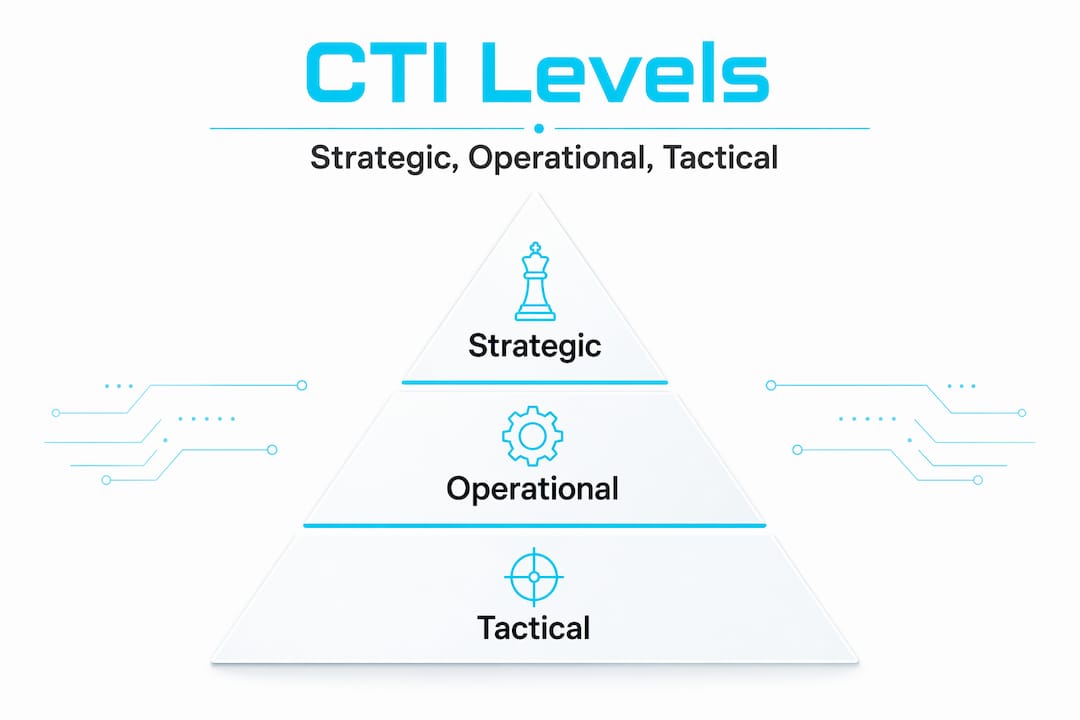

| Level | Audience | Focus |
|---|---|---|
| Strategic | C-suite, board, risk committees | High-level threat trends, geopolitical risks, business impact |
| Operational | Security managers, incident responders | Threat actor campaigns, TTPs, attack timelines |
| Tactical | SOC analysts, threat hunters | Indicators of compromise (IOCs), malware signatures, IP blocklists |
These levels are not interchangeable. Handing a SOC analyst a strategic briefing about nation-state motivations will not help them block an active intrusion. Equally, flooding a CISO with raw IP blocklists contributes nothing to board-level risk conversations. The maturity of a CTI programme is often measured by how well it produces intelligence tailored to each audience.
The intelligence cycle is the engine behind this transformation. It moves through six phases: planning and direction, collection, processing, analysis, dissemination, and feedback. The planning phase, where you define what intelligence your stakeholders actually need, is arguably the most consequential. Skip it, and every subsequent phase produces work that may be technically sound but strategically irrelevant.
What is threat intelligence in cyber security, if not this systematic process? It is not a product you buy off a shelf. It is a discipline. Vendors can supply data feeds, but the analytical layer that converts those feeds into decisions relevant to your organisation requires human expertise, process, and context.
CTI in IT versus OT environments
Most cyber threat intelligence frameworks were built with IT environments in mind. That creates a meaningful gap when you apply them to operational technology. IT-focused threat intelligence is insufficient for OT environments because OT systems operate on entirely different priorities and protocols.

In IT, confidentiality is typically the primary concern. In OT, including manufacturing plant controls, energy grid management systems, and water treatment facilities, availability is paramount. A patch that takes an IT server offline for 30 minutes is routine. The same approach applied to an industrial control system could cause physical damage, safety incidents, or production losses running into millions.
The key distinctions between IT and OT threat intelligence needs include:
- Protocol differences. OT environments use protocols like Modbus, DNP3, and IEC 61850 that most IT-focused threat feeds do not monitor or understand.
- Legacy infrastructure. Many OT systems run on decades-old hardware and software with no vendor support, making standard vulnerability management approaches unworkable.
- Threat actor profiles. Nation-state actors targeting critical infrastructure use techniques that rarely appear in commercially available IT threat feeds.
- Incident impact. Cyber events in OT environments can have physical and safety consequences that sit outside the scope of conventional IT risk models.
- Update cycles. OT systems often cannot be patched on standard IT schedules without significant operational planning.
OT cyber threat intelligence requires ongoing, tailored support beyond generic threat feeds. Organisations operating in both environments need to maintain parallel CTI programmes with distinct intelligence requirements, data sources, and analysis teams that understand the specific risk context of each environment.
Pro Tip: If your organisation operates OT systems, establish a separate intelligence requirements document specifically for those environments. Do not assume your existing IT CTI programme covers the relevant threat actors, vulnerabilities, or attack vectors.
How CTI supports proactive security
Understanding what is CTI in cyber security is one thing. Knowing how to use cyber threat intelligence in daily security operations is where most organisations struggle. The gap between having a threat intelligence subscription and actually operationalising that intelligence is wider than most security teams admit.
Effective CTI integration into security operations follows a structured workflow:
- Define intelligence requirements. Identify the specific questions your security team, risk managers, and executive leadership need answered. These become your collection priorities.
- Ingest and process data. Pull from structured sources (threat feeds, ISACs, vendor intelligence) and unstructured sources (dark web forums, open-source reporting, incident data).
- Analyse and contextualise. Map indicators to threat actors, attribute campaigns where possible, and assess relevance to your specific technology stack and sector.
- Convert to detection logic. Translate IOCs and TTPs into SIEM rules, endpoint detection policies, and firewall blocklists.
- Disseminate to the right audience. Push tactical intelligence to SOC analysts, operational briefings to incident response teams, and strategic summaries to leadership.
- Collect feedback and refine. Close the loop by measuring which intelligence produced useful detections and which generated false positives.
CTI requires integration with SOC workflows and customisation to your organisation’s specific technology stack. A threat feed that identifies a vulnerability in software you do not run is wasted analyst time. Relevance filtering is not optional.
Artificial intelligence is changing the speed at which this cycle operates. AI-driven threats are now executing multi-stage attacks autonomously, which means the time available for human analysis between detection and response is shrinking. Modern CTI platforms use machine learning to triage incoming data, score indicators by relevance, and surface the highest-priority intelligence for analyst review. Modern CTI platforms integrate AI to reduce noise and improve analyst throughput, but the analytical judgement about what matters for your organisation still requires human expertise.
Pro Tip: Treat your SIEM as the integration point for CTI, not the intelligence platform itself. Intelligence should inform detection rules and response playbooks; it should not live as unanalysed indicator lists inside a logging tool.
Common CTI pitfalls and best practices
The most persistent mistake in CTI programmes is conflating data collection with intelligence production. Raw threat data is not intelligence. Without contextualisation and attribution, teams face an overwhelming volume of indicators with no way to prioritise response. This is how analysts spend hours investigating IP addresses that were last associated with threat activity three years ago.
Understanding the common failure modes helps organisations build better programmes from the outset:
- Skipping the requirements phase. Defining stakeholder needs before data collection is fundamental to CTI effectiveness, yet it is routinely skipped in favour of standing up feeds quickly. The result is intelligence that answers questions nobody asked.
- Over-reliance on indicator-based intelligence. IOCs have a short shelf life. Threat actors rotate infrastructure regularly. Programmes that focus solely on IP blocklists and file hashes miss the deeper behavioural patterns that reveal how an adversary operates.
- Ignoring internal telemetry. External threat feeds tell you what the threat community is seeing. Your internal logs tell you what is actually happening in your environment. The most useful intelligence combines both.
- Failing to measure effectiveness. If you cannot answer whether your CTI programme detected threats it would otherwise have missed, you cannot justify its cost or improve it.
Intelligence must be relevant, trustworthy, and timely to produce value for security teams. Each of those three attributes can fail independently. Intelligence that is accurate but weeks late is useless for operational defence. Intelligence that arrives in real time but lacks verification creates false positives that erode analyst trust in the entire programme.
The organisations that get the most from threat intel are those that treat it as a programme, not a product. That means assigning ownership, building feedback mechanisms, and continuously refining intelligence requirements as the threat environment and the organisation itself evolve.
My perspective on where CTI actually breaks down
I have seen organisations invest substantially in threat intelligence platforms and still find themselves flat-footed when incidents occur. In my experience, the failure is almost never technical. It is structural.
The intelligence cycle starts with requirements. That means sitting down with stakeholders across the organisation, from legal and compliance through to engineering and the board, and asking what decisions they need intelligence to support. Most CTI programmes never do this. They ingest feeds, generate reports, and wonder why nobody reads them.
What I have found is that the IT and OT gap is the most underestimated problem in the field. Organisations running both environments often treat them as a single intelligence problem, when in practice they need separate collection strategies, separate analyst skill sets, and separate reporting products. Merging them produces intelligence that serves neither environment well.
The other shift worth acknowledging is that threat intelligence is now operational, not a research function. The organisations still producing quarterly PDF threat reports and calling that a CTI programme are not running threat intelligence. They are running a documentation exercise. Real CTI changes detection rules today, informs a response decision tomorrow, and tells a risk committee something they did not already know next week.
The forensic and investigative dimension of CTI is also chronically underutilised. Intelligence derived from incident investigations, properly preserved and attributed, feeds back into defensive posture in ways that commercial threat feeds simply cannot replicate.
— Computer
How Computerforensicslab supports your CTI programme
Understanding what is cyber threat intelligence is only the beginning. Applying it effectively, especially when an incident has already occurred, requires forensic expertise that goes beyond threat feeds and detection rules. Computerforensicslab provides specialist digital forensic investigations that support threat attribution, evidence preservation, and post-incident analysis. Whether you are working through a data breach, investigating insider threats, or building a legal case around a cyber incident, our team brings the forensic rigour that transforms raw incident data into defensible evidence. Explore our full digital forensics services to understand how forensic analysis and CTI work together in practice.
FAQ
What is the definition of cyber threat intelligence?
Cyber threat intelligence is the process of collecting, processing, and analysing threat data to produce contextualised, actionable knowledge that informs security decisions. It differs from raw data by incorporating attribution, relevance, and business context.
What are the three levels of CTI?
CTI is categorised into strategic, operational, and tactical levels. Strategic intelligence serves leadership with high-level risk trends, operational intelligence supports incident responders with campaign details, and tactical intelligence provides SOC analysts with specific indicators of compromise.
Why is IT threat intelligence insufficient for OT environments?
OT systems prioritise availability over confidentiality and use specialised protocols not covered by standard IT threat feeds. Threat actors targeting industrial infrastructure use techniques specific to OT environments that require dedicated intelligence sources and analysis.
How do organisations operationalise cyber threat intelligence?
Effective operationalisation integrates CTI directly into SOC workflows, converting intelligence into detection rules, response playbooks, and risk briefings tailored to specific stakeholder audiences. Static threat feeds without this integration produce minimal defensive value.
What is the biggest mistake in CTI programmes?
The most common failure is skipping the intelligence requirements phase. Without defining what questions stakeholders need answered before collection begins, programmes generate technically valid intelligence that addresses no actual organisational need.