
TL;DR:
- Social media analysis involves collecting and interpreting platform data for legal, business, and reputation decisions. Most organizations lack clear questions, leading to overload and ineffective use of social media evidence. Proper forensic and strategic analytics improve decision-making, reputation management, and compliance with legal standards.
Social media analysis is the systematic collection and interpretation of data from social platforms to drive informed decisions across legal, business, and reputational contexts. For legal professionals, businesses, and private individuals, understanding why analyse social media is no longer optional. 58% of consumers say following a brand on social media influences their purchasing decisions, and 71% are affected by social content generally. Those figures confirm that social platforms are not passive communication channels. They are live data environments that shape outcomes in courtrooms, boardrooms, and public opinion alike. Tools like Hootsuite, Later, and Xpoz have made structured social media analysis accessible to organisations of every size.
Why analyse social media for legal evidence gathering?
Social media analysis is the primary method for collecting, preserving, and verifying digital evidence from platforms including Facebook, Instagram, X (formerly Twitter), TikTok, and LinkedIn. Courts across England and Wales increasingly accept social media data as admissible evidence in both civil and criminal proceedings. The range of evidence types is broader than most people expect.
Forensic analysts extract the following from social platforms:
- Posts and comments with original timestamps and geolocation metadata
- Direct messages and deleted content recovered through forensic imaging
- Profile activity logs showing login times, device identifiers, and IP addresses
- Media files including photographs and videos with embedded EXIF data
- Network connections mapping relationships between accounts
Legal admissibility requires documented methodology and a maintained chain of custody throughout the collection process. This is where professional forensic analysis separates itself from a simple screenshot. A screenshot taken by a layperson carries no chain of custody and can be challenged in court. A forensically acquired copy, documented at every stage, carries evidential weight.
In civil litigation, social media evidence has proven decisive in personal injury claims, employment disputes, and family law proceedings. A claimant posting photographs of physical activity while claiming disability, for example, provides direct contradictory evidence. In criminal cases, social media forensics has supported prosecutions involving harassment, fraud, and organised crime by mapping communications between suspects.
Pro Tip: If you are a legal professional preparing a case involving social media evidence, instruct a forensic specialist before attempting any collection yourself. Improper handling can render evidence inadmissible and expose you to procedural challenge.
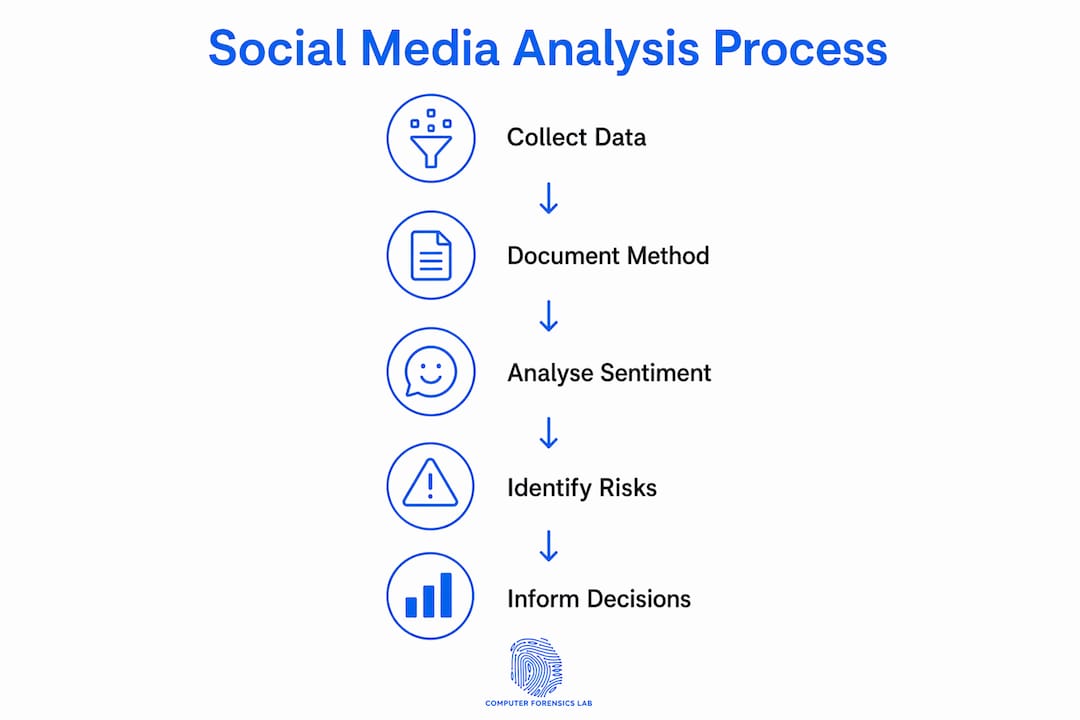
How does social media analysis protect reputation and prevent crises?
Reputation management is the most time-sensitive application of social media analytics. A negative story can reach hundreds of thousands of people within hours. Organisations that monitor social sentiment continuously detect problems before they become crises.
Sentiment analysis tools classify public mentions as positive, negative, or neutral in near real time. Platforms like Brandwatch and Sprout Social track share of voice, which measures how much of the online conversation about a topic your brand owns relative to competitors. A sudden drop in share of voice, or a spike in negative sentiment, signals a reputational threat that requires an immediate response.
The metrics that matter most for reputation oversight include:
- Net sentiment score: the ratio of positive to negative mentions over time
- Share of voice: your brand’s proportion of total industry conversation
- Response rate and speed: how quickly your team acknowledges public concerns
- Mention volume trends: spikes that indicate viral spread of a story
- Influencer amplification: which accounts are driving the narrative
Vanity metrics are less meaningful than strategic indicators. A post with ten thousand likes but overwhelmingly sarcastic comments is a reputational liability, not an asset. High engagement does not always equal positive sentiment; sentiment analysis or manual review is necessary to understand the true audience reaction.
Pro Tip: During an active crisis, run daily sentiment reports alongside your standard monthly trend analysis. The daily data tells you whether your response is working; the monthly data tells you whether the damage is lasting.
What are the benefits of social media analysis for brand strategy?
The importance of social media analysis for brand strategy is grounded in measurable commercial outcomes. 64% of marketing executives strongly agree that data-driven marketing is critical today. That consensus reflects a fundamental shift: brands that rely on instinct alone are outpaced by those that act on evidence.

Engagement rate benchmarks in 2026 vary from 0.04% to 3.5% by industry and platform. That range is wide enough to make industry averages meaningless without brand-specific baselines. A financial services firm achieving 0.3% engagement on LinkedIn may be outperforming its sector, while a fashion brand achieving the same rate on Instagram may be underperforming significantly.
The table below compares three widely used analytics platforms by their primary strengths for brand strategy:
| Tool | Primary strength | Best suited for |
|---|---|---|
| Sprout Social | Cross-platform reporting and team workflow | Mid-size to enterprise brands managing multiple channels |
| Later | Visual content planning with performance data | Brands prioritising Instagram and TikTok growth |
| Xpoz | AI-powered trend analysis and competitor benchmarking | Brands needing predictive and prescriptive insights |
Social media insights inform decisions beyond content calendars. Audience demographic data reveals whether your messaging is reaching the intended segment. Posting schedule analysis identifies the times when your specific audience is most active, not just generic platform averages. Conversion tracking links social activity directly to website visits, lead generation, and sales, closing the loop between content investment and commercial return.
Pro Tip: Avoid building a dashboard that tracks every available metric. Choose five to seven metrics that directly correspond to your current business objectives, then review them consistently. Consistency of measurement matters more than comprehensiveness.
How to analyse social media effectively: methods, metrics, and pitfalls
Effective social media analysis follows four tiers of increasing sophistication. Analytics tiers include descriptive, diagnostic, predictive, and prescriptive capabilities, and advanced tiers are now accessible beyond large enterprises.
- Descriptive analytics answers “what happened?” by reporting historical data such as follower growth, post reach, and impression counts.
- Diagnostic analytics answers “why did it happen?” by identifying correlations between content variables and performance outcomes.
- Predictive analytics answers “what is likely to happen?” by modelling trends based on historical patterns and external signals.
- Prescriptive analytics answers “what should we do?” by recommending specific actions based on predicted outcomes.
Most organisations operate at the descriptive tier and never progress further. Moving to diagnostic analysis alone produces a significant improvement in decision quality.
The key metrics for any structured analysis programme are engagement rate, reach, conversion rate, share of voice, and sentiment score. Each metric answers a different business question. Reach tells you how many people saw your content. Engagement rate tells you how many responded. Conversion rate tells you how many acted. Share of voice tells you how you compare to competitors. Sentiment score tells you how people feel.
Building dashboards without defining business questions is the most common pitfall in social media analysis. Metrics should be chosen based on the decisions they enable, not because a platform makes them easy to export. Aggregate metrics can mask key variations; segmenting data by content type, audience segment, or time period reveals the patterns that top-level numbers conceal.
Posting without examining data is ineffective. Analytics create a feedback loop that turns observation into consistent growth. The most effective social media analytics strategies avoid dashboard clutter by focusing on relevant metrics aligned with defined goals.
AI-powered tools now automate the most labour-intensive parts of analysis. Natural language processing classifies sentiment at scale. Anomaly detection flags unusual spikes in mention volume. Combining AI-powered sentiment analysis with manual review helps accurately interpret public discourse around a brand or legal subject. Neither method alone is sufficient. Automated tools miss irony and cultural context; manual review cannot scale to millions of mentions.
Pro Tip: Work backward from the decision you need to make, then identify the metric that would inform it. If you cannot name the decision a metric supports, remove it from your reporting.
Key takeaways
Social media analysis is the foundation of evidence-based decisions in legal proceedings, reputation management, and brand strategy.
| Point | Details |
|---|---|
| Legal evidence requires forensic rigour | Chain of custody and documented methodology determine whether social media data is admissible in court. |
| Sentiment beats engagement as a reputation signal | High engagement with negative sentiment is a liability; always analyse the quality, not just the volume, of reactions. |
| Brand strategy needs platform-specific benchmarks | Engagement rates vary from 0.04% to 3.5% by industry and platform, making generic averages unreliable for performance measurement. |
| Four analytics tiers exist | Descriptive, diagnostic, predictive, and prescriptive analytics each answer a different business question and require different tools. |
| Define questions before selecting metrics | Metrics chosen without a corresponding business decision create noise rather than insight. |
The uncomfortable truth about social media analysis
After years of working with legal teams, corporate clients, and private individuals on digital investigations, I have observed one consistent pattern: most organisations collect far more social media data than they ever act on. The problem is not access to analytics. The problem is the absence of a clear question before the data collection begins.
Legal professionals face a particular version of this challenge. The volume of social media content relevant to a case can be enormous, but only a fraction of it will withstand forensic scrutiny. I have seen cases where compelling evidence was rendered inadmissible because the collection method was not documented, or because metadata was stripped during export. The technical quality of the analysis matters as much as the content of the evidence itself.
On the business side, the shift from vanity metrics to strategic analytics is real but incomplete. Many brands now track sentiment, but few integrate that sentiment data with their content planning in a systematic way. The organisations that do this consistently hold a genuine advantage over those that treat analytics as a monthly reporting exercise rather than a continuous feedback mechanism.
Platform changes also create ongoing challenges. When a major platform alters its algorithm or restricts API access, the data pipelines that legal and business analysts depend on can break without warning. Regulatory considerations, particularly under the UK GDPR and the Online Safety Act 2023, add further complexity to what data can be collected, stored, and used as evidence. Staying current with both platform capabilities and legal constraints is not optional for anyone conducting serious social media analysis.
— Computer
How Computerforensicslab supports social media analysis for legal and business clients
Computerforensicslab provides professional digital forensics services to legal professionals, law enforcement, and businesses across the United Kingdom. The team specialises in collecting, preserving, and analysing social media evidence to the standard required for civil and criminal proceedings, including full chain of custody documentation and expert witness reporting. For businesses facing reputational threats or internal misconduct investigations, Computerforensicslab combines social media forensics with broader digital forensic investigations covering devices, cloud accounts, and communications data. If your case or organisation requires social media evidence that will hold up to legal scrutiny, contact Computerforensicslab to discuss your requirements.
FAQ
What does it mean to analyse social media?
Social media analysis is the systematic collection and interpretation of data from social platforms to inform decisions in legal, business, or reputational contexts. It covers everything from engagement metrics and sentiment scoring to forensic evidence extraction.
Why is social media evidence important in legal cases?
Social media evidence can establish timelines, contradict witness statements, and map relationships between individuals. Admissibility depends on documented collection methodology and a maintained chain of custody.
What are the main benefits of analysing social media for businesses?
The core benefits include understanding audience behaviour, measuring content performance against industry benchmarks, tracking brand sentiment, and linking social activity to commercial outcomes such as lead generation and sales.
How do you avoid common mistakes in social media analysis?
Define the business question before selecting metrics, segment data by content type and audience rather than relying on aggregates, and always combine automated sentiment tools with manual review to catch context that algorithms miss.
Can deleted social media content be recovered for legal use?
Forensic specialists can often recover deleted posts, messages, and media files through device imaging, platform data requests, and cached data analysis. Recovery success depends on how long ago the content was deleted and which platform hosted it.