
Criminal investigations in London increasingly rely on more than mobile phones or computers to uncover the truth. The rise of social platforms like Facebook, Instagram, TikTok, and X means crucial evidence now hides in posts, messages, and metadata unseen through traditional methods. Forensic specialists need clear strategies to handle this complexity. This guide demystifies social media forensics, highlighting legal, technical, and ethical practices that underpin reliable, admissible results in court.
Table of Contents
- Defining Social Media Forensics Methods
- Types of Evidence Across Major Platforms
- Analysing Data: Key Tools and Techniques
- Legal Admissibility and Chain of Custody
- Privacy, Ethical, and Data Protection Issues
Key Takeaways
| Point | Details |
|---|---|
| Specialised Methods Required | Social media forensics demands distinct techniques for data extraction and analysis, tailored to each platform’s structure and data handling protocols. |
| Evidence Collection and Chain of Custody | Maintaining a precise chain of custody is crucial to ensure evidence remains admissible in court, requiring meticulous documentation of every step in the forensic process. |
| Legal and Ethical Considerations | Forensic practitioners must balance investigative needs with privacy rights, ensuring compliance with data protection regulations and ethical standards while minimising unnecessary exposure of personal information. |
| Tools and Techniques | Utilising specialised software is essential for effective analysis, with emphasis on both automated tools for extraction and manual methods that help uncover patterns in the data. |
Defining Social Media Forensics Methods
Social media forensics represents a specialised branch of digital forensics focused on acquiring, preserving, and analysing evidence from social platforms such as Facebook, Instagram, TikTok, and X. Unlike traditional digital forensics which examines computer hard drives and mobile devices, social media forensics targets the unique data structures and artefacts created when users interact with these platforms. This distinction matters significantly for your investigations because social platforms generate metadata, communication records, and behavioural patterns that reveal intent, relationships, and timelines critical to legal cases. The methods involved are grounded in computer science principles, ensuring that evidence extracted from these platforms can withstand court scrutiny and maintain the chain of custody required by legal professionals.
The technical foundation of social media forensics involves several distinct methods. Digital evidence extraction from platforms requires understanding how these services store user data, manage authentication tokens, and retain deleted content. Modern forensic approaches utilise automated tools capable of efficiently harvesting user information across multiple platforms, extracting everything from publicly visible posts to private messages and deleted material. When conducting an investigation, you’re not simply downloading what users see on screen. You’re accessing cached data, recovering deleted posts, analysing timestamps that reveal when content was created versus when it was accessed, and identifying the device fingerprints associated with account activities. This technical depth separates legitimate forensic work from casual social media monitoring.
What makes social media forensics particularly valuable in criminal and civil litigation is its ability to map networks of communication, establish timelines with precision, and uncover evidence of intent through language analysis and pattern recognition. A suspect’s Instagram activity might corroborate or contradict their alibi. A deleted tweet, recovered from platform servers, could prove premeditation. Private messages between defendants reveal conspiracy. These artefacts, when properly documented and analysed using rigorous forensic methods, become admissible evidence that directly supports or undermines legal arguments. The methodology requires balancing technical expertise with legal awareness, ensuring that each step of extraction and analysis complies with data protection regulations and rules of evidence in British courts.
Professional tip When initiating social media forensics work, identify the specific platforms and account holders relevant to your case before deployment, as each platform stores data differently and may require distinct extraction techniques to preserve evidence integrity.
Types of Evidence Across Major Platforms
Each major social media platform stores and presents evidence differently, which means your forensic approach must adapt to the specific characteristics of each service. Facebook generates extensive evidence through user posts, comments, shared images, private messages, and friendship networks that establish relationships and communication patterns. Instagram emphasises visual content, yet stores crucial metadata within image files including timestamps, location data, and device information that reveals when and where photos were taken. TikTok contains video artefacts, user engagement patterns, and direct messages that can establish timelines and intent. X (formerly Twitter) preserves deleted tweets on platform servers, conversation threads that show public disputes or threats, and retweet patterns that demonstrate information spread. WhatsApp and Telegram, whilst encrypted, still generate metadata about message timing and participant involvement. The diversity of digital multimedia evidence across platforms means a single investigation may require multiple extraction techniques to capture the full picture.
Within each platform, different categories of evidence serve distinct purposes in legal cases. Text communications reveal intent, agreements, threats, and admissions. Photos and videos provide direct evidence of events, locations, and participant involvement. Timestamps establish when activities occurred, which can corroborate or contradict witness statements and alibis. Metadata embedded in images often includes geolocation coordinates that place suspects at specific locations during critical time periods. Interaction logs document who communicated with whom and how frequently, building networks of association crucial in conspiracy cases. Comments and reactions show public acknowledgement of events or involvement. Friends lists and follower relationships establish connections between suspects and victims. Deleted content, recoverable through forensic techniques, often proves most damaging because it suggests consciousness of guilt. What makes this evidence particularly powerful is that users typically create it without considering legal consequences, making it far more candid than statements given to police.
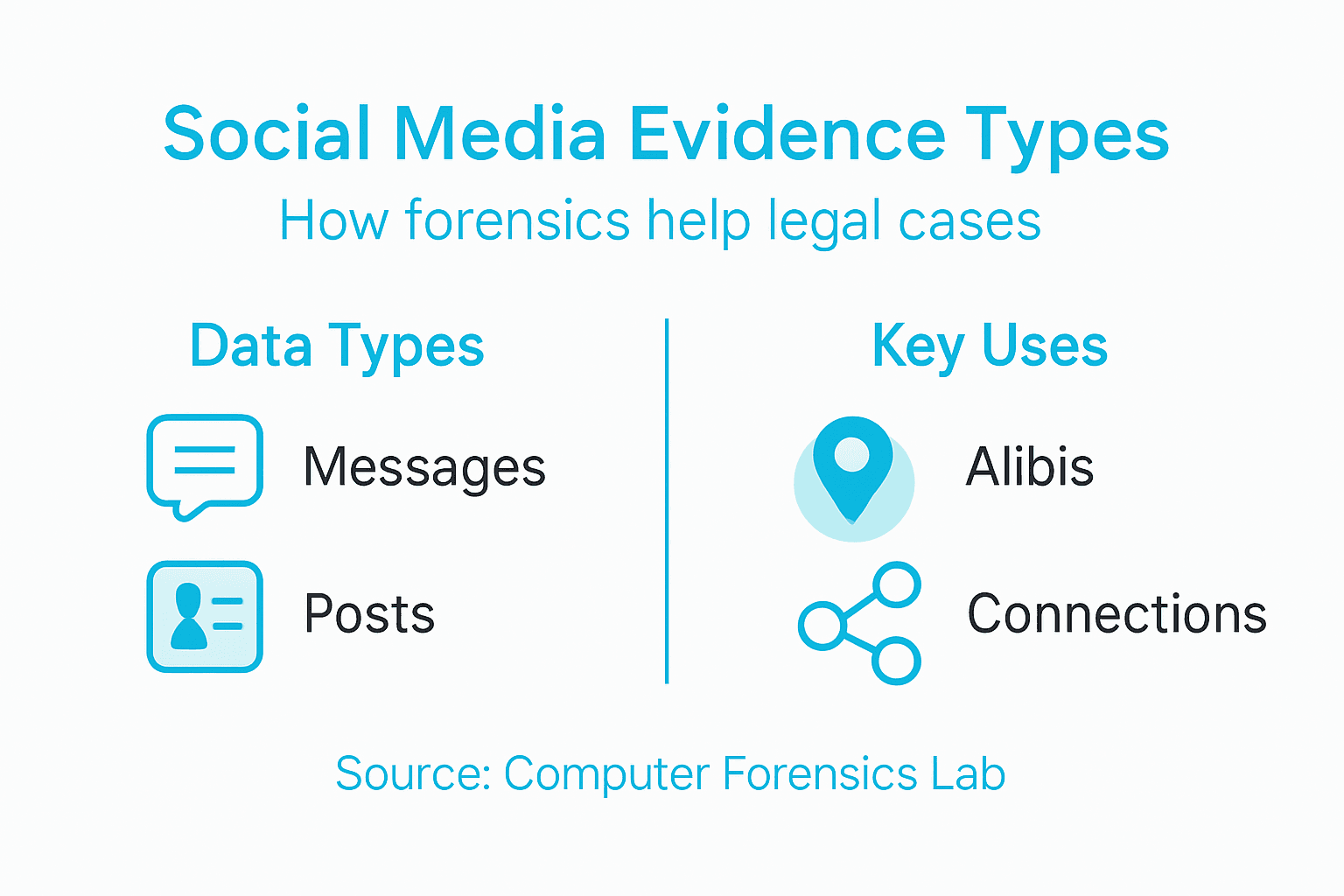
The challenges arise because evidence types and accessibility vary significantly by platform design and jurisdiction. Facebook stores substantial historical data but requires different authentication methods than Instagram. TikTok operates differently from X in terms of data retention and deletion policies. Some platforms encrypt communications, limiting access. Geographic variations in data storage mean servers might be located outside the United Kingdom, complicating acquisition under British legal frameworks. Your forensic methodology must account for these variations whilst maintaining the chain of custody and compliance with data protection regulations. Understanding platform specifics isn’t optional—it directly affects whether evidence is admissible in court and whether your investigation successfully reconstructs the events central to the case.
The following table summarises how digital evidence varies by social media platform:
| Platform | Key Evidence Types | Unique Forensic Challenge |
|---|---|---|
| Messages, posts, friendships | Large datasets, diverse data formats | |
| Photos, stories, metadata | Extracting location from images | |
| TikTok | Videos, comments, engagement logs | Rapid content turnover, short videos |
| X (Twitter) | Tweets, retweets, threads | Recovering deleted tweets |
| Messages, group metadata | End-to-end encryption limits access | |
| Telegram | Messages, channel participation | Encryption and secret chats |
Professional tip Document the exact platform version, timestamp of extraction, and any deleted content recovered separately, as courts require clear evidence that you obtained material through legitimate forensic methods rather than unauthorised access.
Analysing Data: Key Tools and Techniques
Analysing social media data requires more than manual examination of profiles and posts. You need specialised software tools designed to extract, preserve, and scrutinise evidence systematically. The analysis phase typically follows a structured methodology involving identification of relevant accounts and data, preservation through forensic imaging to prevent alteration, collection using validated tools, examination of extracted data, and finally analysis to establish facts central to your case. Digital forensics tools designed for this purpose include commercial platforms like EnCase and Forensic Toolkit, which automate data recovery from devices whilst maintaining integrity logs that prove nothing was altered during extraction. These tools create hash values of original data, generating a digital fingerprint that verifies the evidence hasn’t been tampered with. For social media specifically, you’ll often use platform-specific parsers and web extraction tools that navigate logged-in sessions to capture private messages, deleted posts, and metadata that ordinary downloads cannot access. Manual techniques complement automated tools, allowing you to identify patterns, connections, and inconsistencies that software alone might miss.

The technical challenges in analysing social media data stem from encryption, data fragmentation, and platform obfuscation. Many messaging services use end-to-end encryption, meaning data exists only on user devices, not on platform servers. This shifts focus to mobile device forensics, where deleted messages may remain in unallocated space. Data fragmentation means a single conversation spreads across multiple storage locations, requiring you to piece evidence together methodically. Platforms constantly update their storage methods and security protocols, forcing forensic specialists to adapt continuously. Handling corrupted or partially deleted data demands experience and knowledge of how platforms write and overwrite information. The identification and preservation phases establish whether evidence is accessible and recoverable before significant time and resources are invested in full analysis. Communicating limitations clearly to legal teams prevents unrealistic expectations about what can be extracted from particular devices or accounts.
Your analysis workflow should document every step with timestamps and software logs that demonstrate chain of custody. When examining Facebook messages, you record which tool extracted them, when extraction occurred, what filters or searches were applied, and which original source they came from. When analysing Instagram geolocation data, you map coordinates to actual locations and cross-reference with witness statements or CCTV footage. When reviewing deleted tweets recovered from servers, you establish the original publication date, deletion date, and content integrity. The presentation of findings requires clear visualisation of evidence that non-technical audiences can understand. A timeline showing message exchanges between suspects speaks louder than raw extracted data files. Network diagrams showing communication patterns reveal conspiracies more effectively than lists of usernames. This analysis transforms raw data into compelling narrative evidence that supports legal arguments in court.
Here is a comparison of three leading forensic tools used for social media investigations:
| Tool Name | Main Strength | Typical Use Case |
|---|---|---|
| EnCase | Integrity verification | Device imaging, evidence export |
| Forensic Toolkit | Automated data parsing | Email, chat, and social analysis |
| Platform Parser | Platform-specific access | Extracting hidden or deleted data |
Professional tip Establish baseline data about normal user behaviour on each platform before analysing case material, as unusual activity patterns often reveal deceptive conduct more reliably than individual posts or messages.
Legal Admissibility and Chain of Custody
Social media evidence means nothing in court if you cannot prove it came from a reliable source and remained unaltered throughout your investigation. This is where chain of custody becomes critical. The chain of custody is the documented record of who handled evidence, when they handled it, what they did with it, and what condition they found it in. For social media forensics, this means recording when you accessed an account, which tools you used to extract data, what original sources were examined, and how you stored the extracted files. Every person who touches the evidence, every tool that processes it, and every storage location must be documented with timestamps and digital signatures. Without this meticulous record, defence solicitors will challenge the integrity of your findings, and judges may exclude evidence entirely. The prosecution’s case collapses when the judge rules evidence inadmissible because you cannot demonstrate proper handling.
Maintaining chain of custody for social media evidence involves specific technical protocols beyond paper trails. Standardised forensic procedures ensure that evidence is handled consistently and reliably, regardless of which forensic specialist conducts the examination. When extracting data from a Facebook account, you must create a forensic image of the original data using validated tools that generate cryptographic hashes proving nothing was altered. You write-protect the original source to prevent any modification. You perform your analysis on a copy, never the original. You document which examiner accessed which files and when. You store original evidence securely, typically with limited access permissions. You use tamper-evident seals or encryption to demonstrate that no one has interfered with stored data. These aren’t bureaucratic inconveniences. They are the foundation of courtroom credibility. When you testify as an expert witness, you explain these procedures to the court, demonstrating why the evidence is trustworthy.
The legal landscape around social media evidence admissibility continues evolving, particularly regarding data acquired from platforms operating outside the United Kingdom. British courts apply the common law rules of evidence, which require that the authenticity, reliability, and handling of evidence be established beyond reasonable doubt. Standards and best practices for digital forensics emphasise procedural transparency and documentation to uphold the validity of digital evidence in legal processes. Courts increasingly recognise that digital evidence requires different handling than physical evidence because it can be altered invisibly. This means your chain of custody documentation must be more detailed, more technical, and more thorough than you might use for a stolen mobile phone. You must anticipate the defence’s scrutiny and provide irrefutable proof of proper procedure. If you followed correct protocols, your evidence stands. If you cut corners or failed to document adequately, years of investigation may be worthless.
Professional tip Create a comprehensive forensic report before any legal proceedings begin, detailing every step of evidence handling, tool specifications, and validation methods, as this documentation becomes your primary defence against challenges to evidence admissibility.
Privacy, Ethical, and Data Protection Issues
Social media forensics sits at the intersection of investigative necessity and personal privacy rights. Your work uncovers evidence that can prove guilt or innocence, yet accessing someone’s private messages, deleted posts, and location history raises serious questions about surveillance and consent. The tension exists because platforms contain intimate conversations, financial information, health disclosures, and family communications that extend far beyond what’s relevant to your investigation. When you extract a suspect’s entire messaging history to find one incriminating conversation, you’ve also accessed thousands of unrelated private exchanges with family members, friends, and colleagues. This data collection inevitably affects not just the suspect but innocent third parties who communicated with them. The challenge is balancing the investigative utility of social media evidence against privacy concerns and potential bias that disproportionately affect marginalised communities who use these platforms extensively.
Data protection regulations in the United Kingdom impose strict legal requirements on how you collect, store, and use personal information extracted from social media accounts. The General Data Protection Regulation (GDPR) and UK Data Protection Act 2018 establish that personal data obtained during investigations must be processed lawfully, fairly, and transparently. This means you cannot simply extract all available data from an account and sort through it later. You must have a legitimate basis for collection, which typically stems from a lawful investigation into suspected criminal activity. You must limit collection to information actually relevant to your investigation. You must store data securely with access restricted to authorised personnel. You must delete data once the investigation concludes or relevant legal proceedings end. Breach of these obligations creates liability not just for yourself but for the legal firms and police forces that commissioned your work. Courts increasingly scrutinise whether evidence was collected in compliance with data protection law, and improper handling can render even damning evidence inadmissible.
Ethical obligations extend beyond legal compliance. Your role gives you access to sensitive personal information about vulnerable individuals. You might discover evidence of domestic abuse, sexual exploitation, or mental health crises whilst searching for evidence of an entirely different crime. The ethical question becomes whether and how to report such information. Professional forensic standards require that you follow legal protocols and notify appropriate authorities, but this demands careful judgment. You must also consider confirmation bias, where evidence supporting a particular theory becomes prominent whilst contradictory material gets overlooked. Social media data is particularly susceptible to misinterpretation because context is often missing. A suspicious statement might have an innocent explanation. A pattern of communications might reflect normal social relationships rather than criminal conspiracy. Proactive data protection measures and awareness of your ethical responsibilities ensure that you handle sensitive information properly and present findings objectively to legal teams without allowing bias to distort your analysis.
Professional tip Document your scope of investigation clearly before accessing any accounts, defining specifically which data types are relevant to your case, as this limits unnecessary exposure of private information and demonstrates to courts that you acted proportionately rather than conducting dragnet surveillance.
Strengthen Your Legal Case with Expert Social Media Forensics
The article highlights the critical challenge of reliably extracting and analysing social media evidence while maintaining a rigorous chain of custody and complying with stringent UK data protection laws. Dealing with encrypted data, recovering deleted content, and mapping communication patterns are complex tasks that require specialised forensic expertise. If you are seeking to uncover hidden digital evidence from platforms like Facebook, Instagram, TikTok, or X, and want to ensure your evidence stands in British courts, professional support is essential.
At Computer Forensics Lab, our expert team understands these challenges and provides comprehensive Social Media Forensics services tailored to your investigation. We employ advanced forensic tools and meticulous procedures to safeguard evidential integrity while respecting privacy and legal standards. Whether you are involved in criminal litigation, civil cases, or corporate investigations, our specialists deliver precise digital evidence analysis and expert witness reports to strengthen your legal position.
Do not let complex social media data hinder your case. Discover how our trusted Digital Forensic Investigation solutions can bring clarity and confidence to your legal process today. Visit https://computerforensicslab.co.uk to get started with a confidential consultation and advance your investigation with forensic precision.
Frequently Asked Questions
What is social media forensics?
Social media forensics is a specialised branch of digital forensics that focuses on acquiring, preserving, and analysing evidence from social media platforms like Facebook, Instagram, and TikTok. It differs from traditional digital forensics by targeting data structures and artefacts unique to social interactions on these platforms.
How does social media forensics work in legal investigations?
Social media forensics helps in legal investigations by extracting important evidence such as metadata, communication records, and behavioural patterns from social media accounts. This evidence can establish timelines, map communication networks, and uncover intent, thus playing a crucial role in criminal and civil litigation.
What types of evidence can be collected from social media platforms?
Evidence types from social media include messages, posts, images, videos, timestamps, and metadata. Each platform has unique data characteristics, such as Instagram storing crucial metadata in images, while deleted tweets on X can still be recovered from servers.
What are the key challenges in conducting social media forensics?
Key challenges include the variations in data storage and retrieval methods across platforms, encryption of communications, and maintaining the chain of custody for evidence. Additionally, navigating data protection regulations is vital to ensure compliance during the forensic process.