
Analysing cloud data converts raw operational telemetry and audit trails into legally admissible, security-aware, and commercially actionable evidence. For UK legal professionals, business leaders, and data analysts, the case for systematic cloud data analysis rests on five pillars:
- Security and incident response — reconstruct attack timelines and attribute unauthorised access using audit logs from AWS CloudTrail, Microsoft 365, and Google Workspace
- eDiscovery and litigation — locate, preserve, and produce electronically stored information that meets UK disclosure obligations
- Regulatory compliance — satisfy GDPR, the Data Protection Act 2018, and ICO breach-notification requirements with documented evidence of data flows
- FinOps and cost control — identify billing anomalies, idle resources, and egress charges before they compound
- Operational optimisation — connect technical metrics to business outcomes and accelerate product decisions
Most enterprises now use cloud services, and more than 60% of corporate data resides in the cloud. When a dispute, breach, or regulatory enquiry arises, the evidence is almost certainly there — the question is whether your organisation can find and preserve it in time.
Table of Contents
- What types of cloud data matter for legal and security teams?
- Why analyse cloud data? The practical business case
- UK legal and regulatory considerations when analysing cloud data
- Forensic preservation and evidential best practice for cloud data
- Common technical challenges and how to mitigate them
- How should your organisation prepare before an incident?
- When should you engage a digital forensics specialist?
- Key takeaways
- A practitioner’s perspective on cloud forensic analysis
- How Computerforensicslab can support your cloud investigation
- Selected UK guidance and primary sources
What types of cloud data matter for legal and security teams?
Cloud data is not a single artefact. It spans several distinct layers, each with different ownership, retention windows, and evidential value.

| Data type | Where it lives | Primary use |
|---|---|---|
| SaaS application logs | Microsoft 365 audit logs / Microsoft Purview; Google Workspace audit logs | User activity, access events, eDiscovery |
| Cloud provider control-plane logs | AWS CloudTrail (management events) | API calls, identity, role assumption |
| Object/storage data events | AWS CloudTrail (data events); Google Cloud Storage Insights datasets | File access, modification, deletion |
| Storage metadata and journals | S3 metadata journals; Google Storage Insights | Object lifecycle, cost attribution |
| Collaboration and workspace data | Microsoft Teams, SharePoint, Google Drive | Internal communications, document history |
| SIEM ingestion | Splunk and equivalent platforms | Aggregated correlation, threat detection |
| Billing and FinOps records | AWS Cost Explorer, Azure Cost Management | Anomaly detection, budget governance |
Access to these datasets is rarely straightforward. Microsoft Purview requires appropriate licences and role assignments; AWS CloudTrail data events must be explicitly enabled per bucket or resource, and are not on by default. Provider API rate limits can throttle bulk export during time-sensitive investigations, so pre-incident configuration matters considerably.
Why analyse cloud data? The practical business case
The reasons to analyse cloud data are concrete and consequential, not theoretical.
-
Incident response and root cause analysis. When a breach occurs, audit logs from AWS CloudTrail and Microsoft 365 provide the identity context — role assumption chains, MFA status, session tokens — needed to reconstruct what happened, who did it, and when. Observability tools show what happened; analytics explains why and what action to take next.
-
eDiscovery and litigation support. UK courts and arbitral tribunals increasingly expect parties to produce cloud-resident communications and documents. Without pre-configured audit logging, relevant data may be unrecoverable or inadmissible.
-
Regulatory reporting and breach notification. The ICO requires breach notifications within 72 hours of awareness. Documented cloud analysis — showing which records were affected, when, and by whom — is the evidential foundation for that report.
-
FinOps and cost anomaly detection. Cloud bills can escalate rapidly. Self-service data catalogues empower finance and operations teams to query usage data without IT dependency, accelerating cost decisions. The shift from CapEx to OpEx that cloud economics enables is only sustainable when spending is actively monitored.
-
Product and operational optimisation. Usage telemetry, error rates, and access patterns reveal where engineering effort is wasted and where customers are encountering friction — intelligence that feeds directly into product roadmaps.
UK legal and regulatory considerations when analysing cloud data
UK organisations face a layered set of obligations that shape how cloud data may be accessed, processed, and disclosed.
Under the UK GDPR and the Data Protection Act 2018, any processing of personal data during a forensic investigation must have a lawful basis. Legitimate interest or legal obligation are the most commonly applicable bases, but both require a documented assessment. The ICO expects organisations to demonstrate that data access was proportionate and that appropriate safeguards were in place.
Pro Tip: Issue a litigation hold or preservation notice as soon as litigation is reasonably anticipated — before any routine deletion or log rotation occurs. Document the notice, the recipients, and the date issued. Failure to preserve can result in adverse inference orders in UK proceedings.
Disclosure obligations under the Civil Procedure Rules (CPR Part 31) extend to electronically stored information held by third parties, including cloud providers, where the organisation has a right to access that data. Solicitors should review provider contracts to confirm data access rights and export capabilities before a dispute arises.
Cross-border data access adds further complexity. Where cloud data is stored in jurisdictions outside the UK, mutual legal assistance treaties (MLATs) or provider-specific legal process channels may be required. Some US-based providers respond only to formal legal process under the US CLOUD Act, which operates in parallel with UK frameworks.
Preserving cloud evidence is not simply a technical act — it is a legal one. Every access, export, and copy must be documented with timestamps and authorisation records, or the chain of custody is broken before the investigation has properly begun.
Forensic preservation and evidential best practice for cloud data
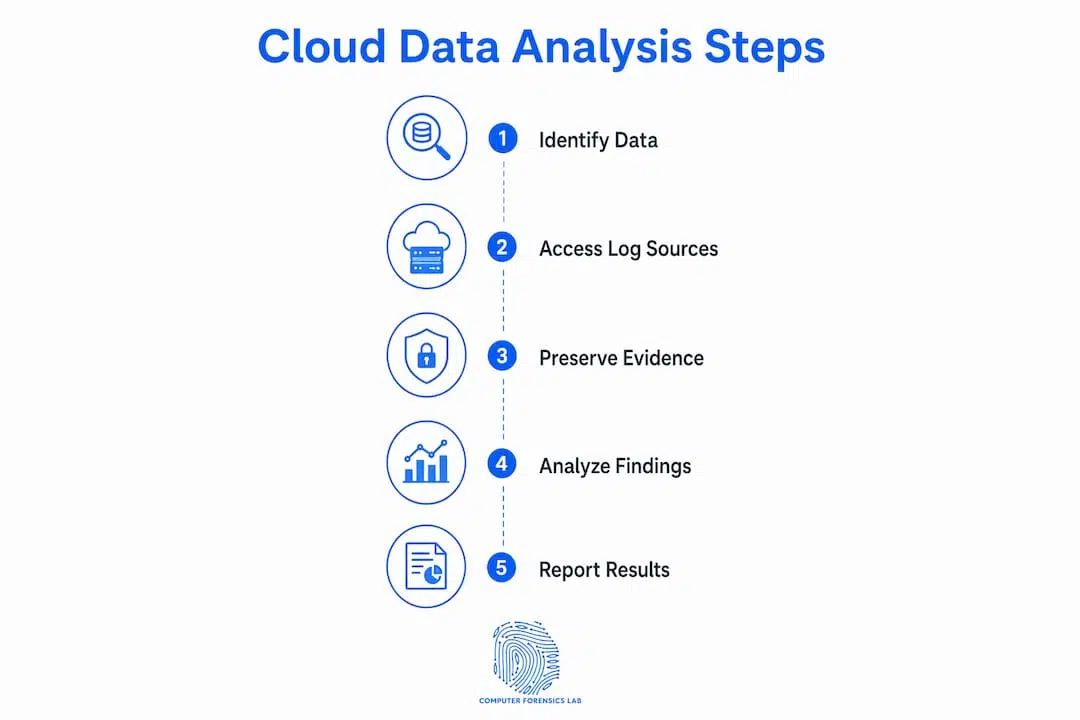
A defensible forensic process follows a clear sequence: preserve, collect, analyse, report.
-
Preserve. Issue preservation notices to internal custodians and, where contractually permitted, to the cloud provider. Enable immutable storage (e.g. S3 Object Lock) on relevant buckets immediately. Capture point-in-time snapshots of virtual machines and databases.
-
Collect. Export logs using provider APIs or native tools — AWS CloudTrail for identity-rich event data, Microsoft Purview for M365 content, Google Workspace audit logs for Workspace activity. S3 data events recorded in AWS CloudTrail provide the granular identity context — role assumption chains, MFA status, full session details — that server access logs alone cannot supply. Hash all collected artefacts (SHA-256 minimum) immediately upon acquisition.
-
Analyse. Correlate events across log sources using a SIEM such as Splunk. Reconstruct timelines, identify anomalies, and map access to specific user identities. Where AI-assisted analytics is used, document the tool, version, and methodology — legal teams must be able to explain and defend the analytical process.
-
Report. Produce a forensic report that documents methodology, findings, chain of custody, and the examiner’s qualifications. Expert witness reports for UK proceedings must comply with CPR Part 35 and the associated Practice Direction.
Pro Tip: Never access cloud evidence using a shared or privileged account without logging that access separately. Every action taken during collection becomes part of the chain of custody record and may be scrutinised in cross-examination.
The cloud data forensic preservation process is documented in detail for teams that need a step-by-step reference.
Common technical challenges and how to mitigate them
Cloud audit mechanisms differ materially in what they capture and how long they retain data.
| Mechanism | Evidential strength | Key limitation |
|---|---|---|
| S3 server access logs | HTTP-level request detail, performance analysis | No MFA, role assumption, or session context |
| AWS CloudTrail data events | Full identity context, API-level granularity | Must be explicitly enabled; additional cost |
| Google Storage Insights datasets | Object lifecycle, cost attribution, activity patterns | Snapshot-based; limited time-series depth |
| Microsoft Purview audit logs | M365 user activity, content access | Retention varies by licence tier |
| Splunk SIEM ingestion | Cross-source correlation, alerting | Requires pre-configured data pipelines |
Retention policies are a persistent risk. Many providers default to 90-day log retention, and some SaaS platforms retain audit logs for as little as 30 days without a premium licence. Organisations that have not configured extended retention before an incident may find critical evidence has already been purged.
Query costs can also escalate without controls. Poorly formed queries against large cloud data warehouses can generate significant charges overnight. Partition-aware querying, partition projection in AWS Athena, and query guards in BigQuery are standard mitigations. Without tagging conventions and governance, cost attribution becomes unreliable and analytical findings may be challenged.
How should your organisation prepare before an incident?
Pre-incident readiness reduces both the cost and the legal risk of cloud investigations considerably.
- Enable audit logging across all cloud services — CloudTrail management and data events, Microsoft 365 unified audit logs, Google Workspace audit — and set retention to a minimum of 12 months
- Define a tagging and ownership convention so every resource can be attributed to a team, project, and data classification
- Review cloud provider contracts for data access rights, export capabilities, and notification obligations
- Document internal approval workflows for emergency evidence preservation, including who can authorise access and under what conditions
- Maintain a chain of custody form template and a secure, write-once storage location for hashed evidence copies
- Establish a first-response playbook that identifies who to notify (legal counsel, DPO, CISO), in what order, and within what timeframe
- Test the playbook at least annually against a simulated incident scenario
The cloud investigation strategies guide provides a cross-team framework for organisations building or reviewing their response capability.
When should you engage a digital forensics specialist?
External forensic expertise is warranted in several specific circumstances: where data spans multiple cloud tenancies or providers; where the chain of custody has been or may be disputed; where high-value litigation or regulatory enforcement is involved; or where a CPR Part 35-compliant expert witness report is required.
Engaging a specialist early — before internal teams have accessed or modified potential evidence — is almost always less expensive than remedying a compromised chain of custody later. Courts take a dim view of evidence that cannot be traced from source to report without gaps.
When engaging a provider, expect a scoping phase to define the data sources, custodians, and relevant date ranges. Deliverables typically include preservation images, a detailed analysis report, and, where required, a signed expert witness statement. Timelines vary with data volume and complexity, but straightforward cloud investigations often complete within two to four weeks; multi-provider or cross-border matters take longer.
Budget expectations should account for provider API costs, data egress fees, and analyst time. Early engagement, before evidence is at risk, consistently reduces total cost compared with reactive engagement after data loss or chain-of-custody failure.
Key takeaways
Cloud data analysis is the foundation of defensible incident response, UK litigation readiness, and regulatory compliance — organisations that configure logging and governance before an incident face materially lower legal and financial risk.
| Point | Details |
|---|---|
| Preserve before anything else | Issue litigation holds and enable immutable storage the moment an incident or dispute is anticipated. |
| Prioritise identity-rich logs | AWS CloudTrail data events and Microsoft Purview supply the session context server logs cannot; enable them proactively. |
| Document chain of custody | Hash all artefacts on acquisition and log every access; gaps in custody records can render evidence inadmissible. |
| Set retention and contractual rights | Default provider retention is often 30–90 days; extend it contractually and technically before an incident occurs. |
| Computerforensicslab | Provides UK-based cloud forensic preservation, expert witness reports, and chain-of-custody workflows for legal and corporate cases. |
A practitioner’s perspective on cloud forensic analysis
The most consistent pattern in cloud investigations is not technical — it is organisational. Cases that resolve cleanly share one characteristic: someone configured logging and documented access rights before the incident occurred. Cases that become protracted, expensive, or legally precarious almost always involve a gap: a log that was never enabled, a retention window that expired, or an internal team that accessed evidence without recording what they did.
Cloud data holds extraordinary evidential value. A single CloudTrail event can place a specific user, with a specific role, performing a specific action, at a precise timestamp — the kind of granularity that physical evidence rarely achieves. Microsoft 365 audit logs can reconstruct document access, deletion, and forwarding across an entire organisation. Google Workspace audit logs can show exactly when a file was shared externally and with whom. The evidence is there. The question is always whether it was preserved in time and collected in a way that will survive scrutiny.
Computerforensicslab handles cases where that preparation did not happen, and where it did. The difference in outcome is significant. Expert witness reports produced from forensically sound, documented collections carry weight in UK proceedings. Reports produced from ad hoc internal exports, without hashing or custody records, are routinely challenged. The advantages of cloud forensics are only realised when the methodology is as rigorous as the technology.
How Computerforensicslab can support your cloud investigation
When a cloud investigation requires forensic rigour — whether for litigation, a regulatory enquiry, or an internal misconduct case — Computerforensicslab delivers end-to-end support from a London-based team with direct experience of UK legal proceedings. The core offering covers cloud data preservation and analysis, expert witness report preparation, chain-of-custody documentation, and data recovery from cloud-resident sources.
Before making contact, prepare a brief scope summary covering: the cloud platforms involved, relevant account IDs or tenant identifiers, the approximate date range of events in question, any preservation notices already issued, and the legal or regulatory context. This allows the team to assess data availability and advise on the most defensible collection approach from the outset.
To discuss a matter or request a scoping consultation, visit the digital forensics services page or contact the team directly.
Selected UK guidance and primary sources
- AWS S3 audit logging guidance — Amazon S3 audit logging: analysing server access logs with Amazon Athena: technical reference for understanding the difference between server access logs and CloudTrail data events; consult this when configuring forensic-grade logging on S3.
- Google Cloud Storage Insights — Google Cloud Storage Insights datasets overview: primary reference for activity insights, cost attribution, and object lifecycle analysis on Google Cloud Storage.
- Cloud analytics best practice — Qlik: what is cloud analytics: covers self-service data catalogues, governed analytics, and AI-assisted recommendations; relevant for operational and FinOps use cases.
- ICO guidance — ico.org.uk: primary source for UK GDPR breach notification obligations, lawful basis for processing, and data subject rights; consult directly for current regulatory requirements.
- Computerforensicslab resources:
- Cloud forensics best practices for experts — practical checklist for examiners and legal teams
- What is cloud forensics: a guide for UK legal professionals — introductory primer for legal audiences new to cloud evidence
- Challenges in cloud forensics — legal and technical hurdles encountered in cloud investigations