TL;DR:
- Smart home device forensics involves collecting digital evidence from IoT devices in homes to support legal cases. It requires acquiring data from onboard memory, smartphone apps, and cloud backends while following strict procedures and standards. Proper preparation and documentation are critical to ensure evidence is admissible and withstands court scrutiny.
Smart home device forensics is the systematic process of acquiring, preserving, and analysing digital evidence from IoT devices within domestic environments to support legal investigations. The number of connected devices in UK homes has grown sharply, and each one, from smart speakers to video doorbells, generates logs, location data, and interaction records that can be decisive in court. Forensic analysis of IoT devices follows established standards, most notably ISO/IEC 27037, which sets the quality principles governing lawful digital evidence collection. Legal professionals and law enforcement officers who understand the technical and procedural demands of this field are far better placed to secure admissible evidence and withstand courtroom scrutiny.
What are the primary sources of forensic evidence in smart home environments?
Smart home forensic evidence is distributed across three distinct locations: the device’s onboard flash memory, the paired smartphone application, and the vendor’s cloud backend. Each source holds complementary data. Failing to acquire from all three creates gaps that defence counsel will exploit.
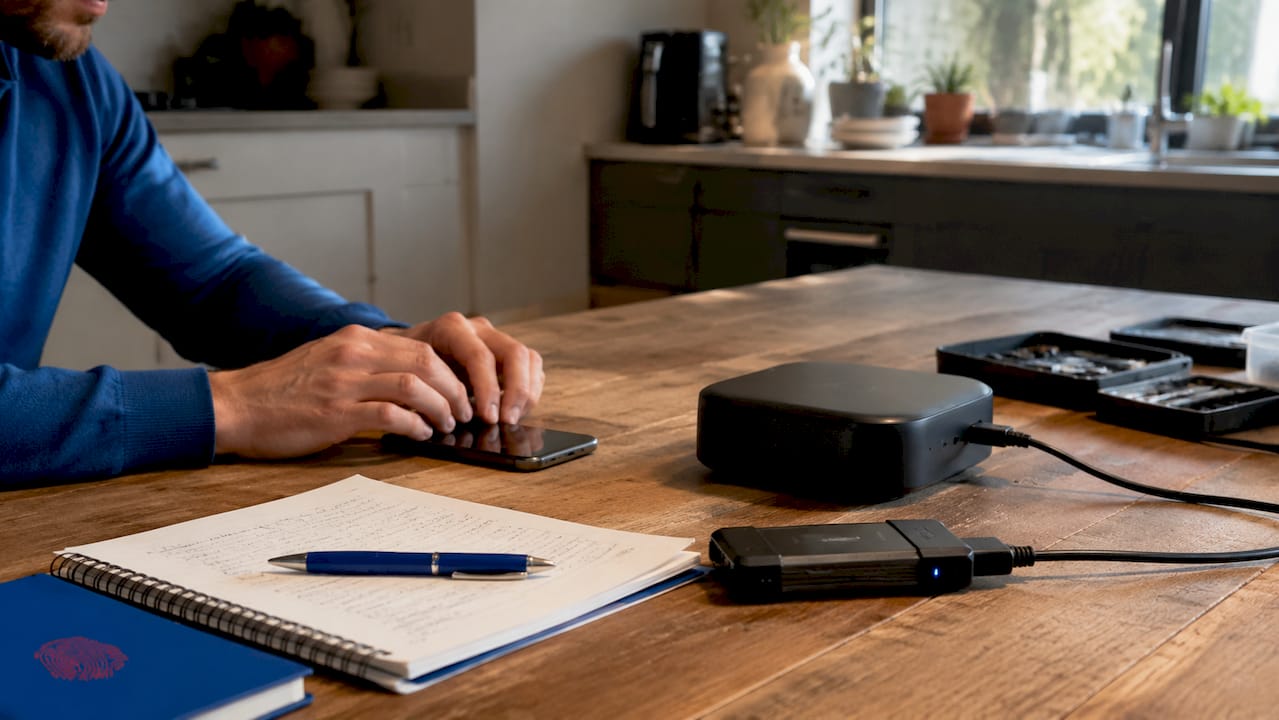
Onboard flash memory stores device configuration, firmware, event logs, and sometimes encryption keys. Access is rarely straightforward. Most consumer IoT devices have no forensic mode, no standard file system, and no documented extraction interface. The investigator must work around proprietary architectures, often with limited manufacturer cooperation.
Paired smartphone applications cache synced data locally, including command histories, device states, and authentication tokens. This layer is frequently overlooked, yet it can survive a factory reset of the primary device. Forensic analysis of the companion app mirrors mobile device forensics in its methodology, requiring logical or physical acquisition of the handset.
Vendor cloud backends hold the richest longitudinal data: timestamped event logs, voice command transcripts, geolocation records, and firmware update histories. Retention policies vary widely by vendor and jurisdiction. Cloud data is also the most legally complex to obtain, particularly when servers sit outside the UK.
Smart home devices commonly communicate via MQTT and CoAP protocols. Capturing network traffic at the router level during live acquisition can reveal device interactions that neither the device nor the cloud retains long term.
- Onboard flash memory: configuration files, event logs, encryption artefacts
- Paired smartphone app: cached commands, authentication tokens, synced states
- Vendor cloud: timestamped logs, voice transcripts, geolocation records
- Network traffic: MQTT and CoAP protocol exchanges captured at router level
Pro Tip: Before approaching the vendor for cloud data, image the paired smartphone application first. Vendors may notify the account holder of a legal request, triggering remote deletion of cloud records.
What are the legal and procedural requirements for collecting smart home device evidence?
Legal authorisation is the starting point, not the finish line. A search warrant or informed consent grants access to the physical device, but it does not automatically authorise access to cloud data held by a third-party vendor in another jurisdiction. Law enforcement officers must identify where each data tier resides before executing any warrant, then obtain the appropriate legal instrument for each location.
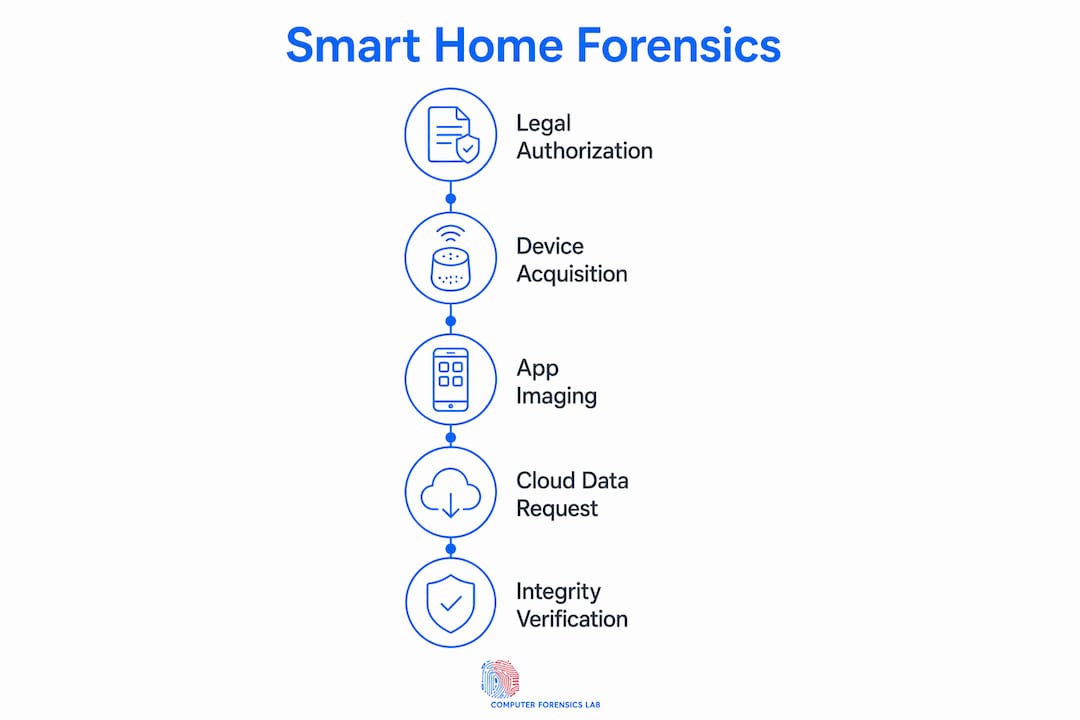
Cross-jurisdictional cloud data is one of the most persistent obstacles in smart home investigations. A UK-based smart speaker may store voice command logs on servers in Ireland, Germany, or the United States. Mutual Legal Assistance Treaties (MLATs) and, increasingly, the UK-US Data Access Agreement govern how investigators request that data lawfully. Delays in this process create real risk: vendor retention windows close, and data is deleted automatically.
Chain of custody is the procedural backbone of any forensic investigation. Courts do not simply ask whether evidence was collected lawfully. They scrutinise every step of the process, from the moment of seizure to presentation in court. Gaps in documentation or altered data frequently lead to evidence exclusion, regardless of the strength of the underlying legal authority.
The ISO/IEC 27037 standard defines four quality principles that every acquisition must satisfy: auditability, repeatability, reproducibility, and justifiability. Courts commonly challenge acquisition methodology rather than the evidence itself. Meeting these four principles is the most reliable way to defend your process under cross-examination.
- Identify all three data tiers (device, app, cloud) and their jurisdictions before executing any warrant.
- Obtain separate legal authority for each data location where required.
- Isolate the device from the network immediately upon seizure to prevent remote deletion or firmware updates.
- Document every action taken, including actions that produced no result, in a contemporaneous log.
- Apply cryptographic hashing (MD5, SHA-256) to every acquired image before any analysis begins.
- Maintain a complete chain of custody record from seizure through to court presentation.
Pro Tip: Assign a dedicated forensic first responder to the scene whose sole role is documentation. Investigators who simultaneously handle devices and write notes introduce errors that are difficult to correct later.
Which forensic techniques are effective for smart home device investigations?
The order of acquisition matters as much as the techniques themselves. Volatile memory must be captured first, before the device is powered off, to retain session keys, active network connections, and decrypted data held in RAM. Powering off a device without capturing volatile memory first causes permanent loss of artefacts that cannot be recovered from any other source.
Non-destructive acquisition methods
The Matter Multi-Admin standard offers a non-destructive path for devices that support it. By commissioning the target device into a forensic fabric, investigators can extract data without proprietary tools and without altering the device state. This approach has been validated on smart bulbs and is expected to expand as Matter adoption grows across the industry.
Logical acquisition via the vendor’s API or companion app is the next preferred method. It is non-destructive, produces structured data, and is repeatable. The limitation is that it returns only what the vendor exposes through the API, which may exclude deleted records or raw logs.
Firmware extraction as a last resort
Firmware analysis using chip-off, UART, JTAG, or eMMC techniques is reserved for situations where cloud access is blocked and logical extraction yields insufficient data. These methods require binary unpacking tools such as binwalk and Ghidra. They are time-consuming, carry a risk of physical damage to the device, and require specialist expertise. Any investigator considering chip-off extraction should document the justification thoroughly, as courts will ask why less invasive methods were not sufficient.
Evidence integrity through cryptographic hashing
Cryptographic hashing using MD5, SHA-1, or SHA-256 is applied to every forensic image immediately after acquisition. The hash value is recorded in the case log and verified again before analysis. Any discrepancy between the original and working copy hash values indicates tampering or corruption and renders the evidence inadmissible.
Maintaining IT asset security standards during the investigation, particularly around access controls for forensic workstations, is equally important for audit readiness.
What challenges and risks complicate forensic analysis of smart home devices?
Smart home forensics presents a set of technical obstacles that do not arise in conventional computer investigations. Understanding them in advance is the difference between a successful acquisition and a compromised case.
- Device heterogeneity: No two manufacturers implement storage, encryption, or communication protocols identically. There is no universal forensic mode. Each device type requires a tailored approach, and most IoT forensic frameworks lack empirical validation against real-world device populations.
- Remote deletion and firmware updates: A device left connected to the internet after seizure can receive a remote wipe command or an automatic firmware update that overwrites evidence. Network isolation at the scene is not optional.
- Volatile data fragility: RAM contents, active session keys, and decrypted communication buffers exist only while the device is powered. RFC 3227 order of volatility principles dictate that these are captured before anything else.
- Jurisdictional fragmentation: Cloud data for a single device may span multiple countries. Each jurisdiction has its own data retention laws and legal request procedures. Investigators who do not map this before seizure often find that data has expired by the time the correct legal instrument is in place.
- Automatic data expiry: Many vendors delete event logs after 30, 60, or 90 days. Time is the most unforgiving constraint in smart home investigations.
The absence of a standard forensic interface across the IoT ecosystem means that investigators must assess each device individually. This requires both technical knowledge and the discipline to document every decision made during acquisition.
Key takeaways
Smart home forensic investigations require coordinated acquisition from device, app, and cloud tiers, governed by ISO/IEC 27037 principles, to produce court-admissible digital evidence.
| Point | Details |
|---|---|
| Three-tier data acquisition | Collect from onboard flash, paired smartphone app, and vendor cloud to avoid evidence gaps. |
| ISO/IEC 27037 compliance | Meet all four quality principles: auditability, repeatability, reproducibility, and justifiability. |
| Volatile memory first | Capture RAM and active session data before powering off any device, per RFC 3227. |
| Network isolation at seizure | Disconnect devices from the internet immediately to prevent remote deletion or firmware updates. |
| Cryptographic integrity | Apply MD5 or SHA-256 hashing to every forensic image before analysis begins. |
The uncomfortable truth about smart home forensics in 2026
The field is moving faster than the frameworks designed to govern it. At Computerforensicslab, we see this directly in the cases that reach us. Investigators arrive with devices that no published acquisition guide covers, from proprietary home automation hubs to obscure sensor arrays that communicate on non-standard protocols. The assumption that a warrant and a forensic workstation are sufficient preparation is the most common mistake we encounter.
What actually determines case outcomes is preparation before the scene is entered. Knowing the device manufacturer, identifying the cloud provider, and mapping the jurisdictions involved before seizure gives investigators a genuine advantage. The technical extraction is often the simpler part. The legal coordination across jurisdictions, the race against vendor retention windows, and the documentation burden are where cases are won or lost.
The growing evidentiary value of smart home data is not in question. Voice command logs have placed suspects at scenes. Smart meter data has established timelines. Doorbell footage has corroborated or contradicted witness accounts. What is in question is whether the profession is keeping pace with the standardisation and training required to use that evidence reliably. The Matter protocol and ISO/IEC 27037 are steps in the right direction. But practitioners who wait for the field to standardise around them will find themselves behind in court.
— Computer
How Computerforensicslab supports smart home device investigations
Computerforensicslab provides specialist digital forensics services for legal professionals and law enforcement officers handling smart home and IoT device cases. The team conducts multi-tier acquisition across device flash memory, companion applications, and cloud backends, applying ISO/IEC 27037 principles and full chain of custody documentation at every stage. Expert witness reports are prepared to withstand cross-examination, and all forensic processes follow step-by-step forensic analysis protocols aligned with current legal standards. For complex cases involving cross-jurisdictional cloud data or firmware-level extraction, contact Computerforensicslab directly to discuss the scope and requirements of your investigation.
FAQ
What is smart home device forensics?
Smart home device forensics is the process of acquiring, preserving, and analysing digital evidence from IoT devices in domestic environments for use in legal proceedings. It covers data held on the device, in companion smartphone apps, and in vendor cloud backends.
Which legal standard governs digital evidence collection from smart home devices?
ISO/IEC 27037 is the primary international standard. It requires that all digital evidence acquisition meets four quality principles: auditability, repeatability, reproducibility, and justifiability.
Why must volatile memory be captured before powering off a smart home device?
Volatile memory holds session keys, active network connections, and decrypted data that disappear permanently when power is removed. RFC 3227 order of volatility principles require this data to be captured first.
Can smart home device evidence be used in court?
Yes, provided it is collected lawfully, documented rigorously, and its integrity is verified through cryptographic hashing. Courts scrutinise acquisition methodology heavily, so process compliance is as important as the evidence itself.
What is the biggest risk when seizing a smart home device at a scene?
Leaving the device connected to the internet is the primary risk. A connected device can receive a remote wipe command or an automatic firmware update that destroys evidence before acquisition begins. Network isolation must happen immediately upon seizure.