
When 30,000 criminal cases collapsed due to systemic forensic failures, the legal community faced a stark reality: inadequate expert reporting can derail even the strongest cases. For solicitors and barristers navigating criminal and civil litigation, understanding forensic reporting is no longer optional. This article clarifies the pivotal role of expert reports, the legal standards governing them, and practical strategies to ensure your cases benefit from robust, admissible forensic evidence that withstands judicial scrutiny.
Table of Contents
- What is forensic reporting and why does it matter?
- Legal standards: CrimPR Part 19 and expert code essentials
- The expert’s role: Objectivity, court duty, and practical impact
- Forensic reporting in action: Accounting, cybercrime, and digital evidence
- Best practice and expert insight: Building robust forensic reports
- Strengthening your cases with expert forensic reporting
- Frequently asked questions
Key Takeaways
| Point | Details |
|---|---|
| Compliant structure needed | UK courts require forensic reports to clearly outline methodology, findings, and expert duty. |
| Objectivity is crucial | An expert’s overriding duty to the court must guide every stage of forensic reporting. |
| Real-world impact | Strong forensic reports can protect against miscarriages of justice and help legal professionals build more robust cases. |
| Best practice matters | Collaboration, full evidence disclosure, and adherence to standards reduce risks of evidence challenge. |
What is forensic reporting and why does it matter?
Forensic reporting transforms technical findings into court-ready evidence. Whether you’re handling fraud allegations, cybercrime prosecutions, or civil disputes involving digital evidence, a forensic report presents objective analysis that guides case strategy and supports settlements. These reports serve criminal proceedings under the Criminal Procedure Rules and civil matters under the Civil Procedure Rules, providing the evidential foundation courts require.
The court expects forensic experts to fulfil an overriding duty: assisting the tribunal impartially, regardless of which party instructs them. Reports must comply with CrimPR Part 19, requiring comprehensive methodology explanations, expert qualifications, distinction between facts and opinions, and declarations of duty to the court overriding party obligations. This framework ensures transparency and reliability.
Many solicitors mistakenly view forensic reports as partisan advocacy tools. This misconception undermines case credibility. Effective forensic reports in litigation maintain strict objectivity, acknowledge limitations, and present findings that may not favour the instructing party. This approach enhances judicial confidence and reduces the risk of evidence exclusion.
“The expert’s duty to the court overrides any obligation to the party instructing or paying them. This principle protects the integrity of expert evidence and ensures courts receive impartial assistance.”
Key functions of forensic reporting include:
- Presenting objective technical analysis in accessible language
- Establishing chain of custody and evidence integrity
- Quantifying losses or damages with verifiable methodology
- Supporting settlement negotiations with credible data
- Providing expert testimony that withstands cross-examination
Understanding these fundamentals positions legal professionals to leverage forensic evidence effectively, improving case success rates through rigorous, compliant reporting.
Legal standards: CrimPR Part 19 and expert code essentials
Admissible forensic reports follow structured requirements that ensure consistency and judicial confidence. CrimPR Part 19 mandates specific sections and content, whilst the Code of Practice on Expert Evidence establishes professional obligations that extend beyond procedural compliance.
Every compliant report must include:
- Executive summary stating key findings and conclusions
- Detailed methodology explaining techniques and tools used
- Expert qualifications demonstrating relevant expertise
- Clear distinction between observed facts and professional opinion
- Declaration of overriding duty to the court
- Statement of truth confirming accuracy
The following table compares essential report sections:
| Section | Purpose | Key Requirement |
|---|---|---|
| Executive summary | Provide accessible overview | Summarise findings without technical jargon |
| Methodology | Establish reliability | Explain techniques, tools, and validation |
| Findings | Present evidence | Distinguish facts from interpretation |
| Conclusions | Offer expert opinion | Link findings to legal questions |
| Qualifications | Demonstrate expertise | Detail relevant experience and credentials |
| Duty declaration | Confirm impartiality | State overriding obligation to court |
The Code of Practice requires experts to work within expertise limits, consider all material including facts that may detract from their opinion, and use plain language accessible to non-specialists. These obligations protect against overreach and ensure courts receive balanced assistance.
Common pitfalls causing report rejection include:
- Failing to declare limitations or uncertainties
- Omitting methodology details that prevent replication
- Presenting advocacy rather than objective analysis
- Ignoring evidence that contradicts preferred conclusions
- Using technical language without adequate explanation
Pro Tip: Addressing all material, including facts that may not favour the instructing party, enhances credibility and demonstrates compliance with expert witness duties. Courts recognise and reward this integrity.
Solicitors should verify reports meet these standards before submission. Requesting clarification on methodology or asking experts to simplify technical sections ensures the tribunal can properly evaluate the evidence. These forensic report tips prevent costly delays and strengthen your position.
The expert’s role: Objectivity, court duty, and practical impact
The relationship between expert and instructing solicitor differs fundamentally from typical client-adviser dynamics. Experts owe their primary duty to the court, not the party paying their fees. This obligation shapes every aspect of report preparation and testimony.
Genuine objectivity requires experts to:
- Analyse evidence impartially without predetermined conclusions
- Acknowledge expertise boundaries and decline opinions outside their field
- Consider all material provided, including facts undermining their position
- Revise opinions when new evidence warrants reconsideration
- Communicate uncertainties and alternative interpretations
This approach protects cases from later challenge. Opposing counsel scrutinise expert reports for bias, methodological flaws, or selective analysis. Reports demonstrating rigorous objectivity withstand cross-examination and maintain credibility throughout proceedings.
“An expert must consider all material facts, including those which might detract from their opinion. Failure to address contradictory evidence undermines the entire report and invites judicial criticism.”
Practical advice for solicitors instructing experts:
- Provide complete, unedited material rather than curated selections
- Encourage plain English explanations for complex technical concepts
- Request preliminary discussions to clarify scope and methodology
- Allow sufficient time for thorough analysis and report preparation
- Avoid suggesting desired conclusions or preferred findings
The expert witness role extends beyond report writing to include conference attendance, responding to opposing expert reports, and courtroom testimony. Establishing clear communication early ensures experts understand case context whilst maintaining independence.
Pro Tip: Always provide the expert with complete, unedited material and encourage plain English for wider understanding. This transparency strengthens the report’s credibility and demonstrates your commitment to proper procedure.
Solicitors who respect expert independence whilst providing comprehensive instructions receive higher quality reports. This collaborative approach, detailed in expert report preparation guidance, balances legal strategy with evidential integrity. Understanding these dynamics helps you select appropriate experts and maximise their contribution to case success, following proven expert witness tips.
Forensic reporting in action: Accounting, cybercrime, and digital evidence
Forensic reporting supports diverse legal scenarios, each requiring specialised expertise and tailored methodology. Understanding how reports function across different case types helps solicitors identify when expert evidence adds value and what to expect from the analysis.
Forensic accounting reports quantify losses, trace assets, analyse transactions for fraud, and support Proceeds of Crime Act proceedings, providing expert testimony under CPR Part 35. These reports reconstruct financial activities, identify irregularities, and calculate damages with verifiable methodology.
Core elements in different forensic disciplines include:
- Loss quantification: Calculating financial impact with supporting documentation
- Asset tracing: Following funds through complex transaction chains
- Digital data authentication: Verifying electronic evidence integrity and chain of custody
- Malware analysis: Identifying malicious code and attack vectors
- Timeline reconstruction: Establishing sequence of events from digital artefacts
- Communication analysis: Extracting and interpreting email, messaging, and social media evidence
The following table summarises forensic reporting applications:
| Case Type | Forensic Focus | Value to Case |
|---|---|---|
| Fraud prosecution | Transaction analysis, asset tracing | Proves dishonesty, quantifies losses, supports confiscation |
| Cybercrime investigation | Digital evidence recovery, malware analysis | Establishes attribution, demonstrates unauthorised access |
| Employment dispute | Email analysis, device examination | Reveals misconduct, proves policy breaches |
| Intellectual property theft | Data exfiltration analysis, timeline reconstruction | Demonstrates copying, identifies perpetrators |
| Civil fraud claim | Financial reconstruction, expert valuation | Quantifies damages, supports liability findings |
Each discipline demands rigorous methodology and objective presentation. Forensic accountants must explain complex financial structures in accessible terms. Digital forensics experts must demonstrate evidence preservation and analysis techniques that courts can verify. This clarity ensures tribunals understand technical findings and their legal significance.

Effective reporting in investigations maintains consistent standards regardless of case type. Whether examining accounting records or digital devices, experts must document their process, acknowledge limitations, and present findings that withstand scrutiny. This approach minimises evidence challenges and supports successful outcomes, reducing evidence challenges through methodological rigour.
Best practice and expert insight: Building robust forensic reports
Collaborating effectively with forensic experts requires understanding both legal requirements and practical considerations. Solicitors who engage experts early, provide comprehensive instructions, and maintain clear communication receive reports that strengthen their cases and withstand opposing challenges.
When engaging a forensic expert:
- Define the scope clearly, identifying specific questions requiring expert opinion
- Provide all relevant material, including potentially adverse evidence
- Discuss timeline and budget constraints upfront
- Confirm the expert’s qualifications match case requirements
- Request preliminary meetings to clarify methodology and approach
Before submitting reports to court, review them against this checklist:
- Executive summary accessible to non-specialists
- Methodology explained with sufficient detail for replication
- Clear distinction between facts and expert opinion
- All material considered, including contradictory evidence
- Limitations and uncertainties acknowledged
- Duty declaration and statement of truth included
- Plain English used throughout with technical terms explained
Common reporting pitfalls include inadequate methodology disclosure, failure to address opposing evidence, and excessive technical jargon. Addressing these issues before submission prevents judicial criticism and reduces the risk of evidence exclusion.
Systemic issues affecting thousands of cases demonstrate the importance of robust reporting standards. Whilst empirical benchmarks remain sparse, the consequences of inadequate forensic evidence are clear: case collapse, miscarriages of justice, and wasted resources.
Pro Tip: Always confirm report structure matches procedural rules before final review. This simple check prevents costly delays and ensures compliance with court expectations.
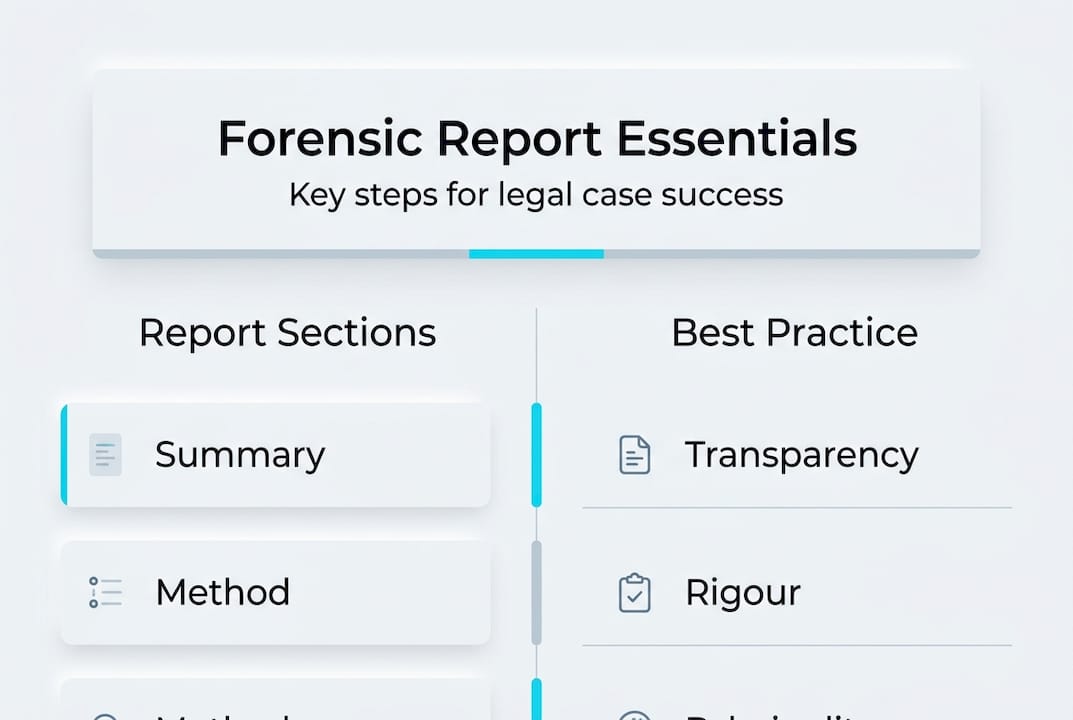
Transparency, rigorous methodology, and clear communication minimise evidence challenges. Experts who document their process thoroughly, acknowledge uncertainties, and present findings objectively provide courts with reliable assistance. Solicitors who facilitate this approach through proper instruction and adequate resources receive expert digital evidence reports that advance their cases effectively.
Investing time in expert selection and instruction pays dividends throughout litigation. Reports meeting professional standards withstand cross-examination, support settlement negotiations, and provide the evidential foundation for successful outcomes.
Strengthening your cases with expert forensic reporting
Navigating complex litigation demands reliable forensic evidence that courts can trust. Computer Forensics Lab provides comprehensive digital forensic services tailored to legal professionals’ needs, from initial evidence collection through expert witness testimony. Our London-based team maintains strict chain of custody protocols, employs validated forensic techniques, and produces reports compliant with CrimPR Part 19 and CPR Part 35 requirements.
We support criminal prosecutions, civil disputes, and regulatory investigations involving digital evidence. Our expertise spans device examination, data recovery, malware analysis, and cybercrime investigation. Whether you’re handling fraud allegations, intellectual property theft, or employment disputes, our forensic reports provide the objective analysis courts require. We’ve contributed to high-profile cases, including Discovery+’s ‘999 Murder Calling’, demonstrating our capacity to deliver under scrutiny.
Our forensic reporting services prioritise clarity, methodological rigour, and compliance with professional standards. We work collaboratively with instructing solicitors, providing preliminary consultations to clarify scope and methodology. Our reports distinguish facts from opinion, acknowledge limitations, and present findings in accessible language that tribunals can evaluate confidently. Contact us to discuss how expert forensic reporting can strengthen your case strategy and support successful outcomes.
Frequently asked questions
What are the main sections of a forensic report?
A forensic report typically includes an executive summary, methodology, findings, and conclusions to meet UK court requirements. These sections ensure transparency and enable judicial evaluation of the expert’s analysis.
Who can act as a forensic reporting expert in the UK?
An expert must be qualified in their field and comply with the overriding duty to the court. Relevant experience, professional credentials, and demonstrated expertise in the specific technical area are essential.
How does forensic reporting support fraud or asset tracing cases?
Forensic accountants quantify losses, trace assets, and provide court-ready analyses for criminal and civil proceedings. Their reports reconstruct financial activities and calculate damages with verifiable methodology.
What is the risk of poor forensic reporting?
Weak or non-compliant reports can lead to evidence being excluded and increase the risk of case collapse or appeal. Inadequate methodology, bias, or failure to address contradictory evidence undermines credibility and invites judicial criticism.
How early should I instruct a forensic expert?
Instruct experts as early as possible to allow thorough analysis and proper report preparation. Early engagement enables preliminary discussions about scope, methodology, and timeline, ensuring the expert understands case context whilst maintaining independence.