
Navigating the complexities of digital forensic evidence can determine whether cases succeed or fail in UK courts. Recent data reveals that 30% of forensic evidences are challenged in UK courts due to chain of custody failures, risking case outcomes and wasting investigative resources. This guide equips legal professionals and law enforcement with essential knowledge about forensic reporting standards, best practices, and techniques to ensure digital evidence withstands scrutiny and supports successful prosecutions.
Table of Contents
- Introduction To Forensic Reporting In Digital Investigations
- Legal Standards And Requirements For Forensic Reporting In The UK
- Structure, Components, And Best Practices In Forensic Reporting
- Maintaining Chain Of Custody And Evidential Integrity
- Common Misconceptions And Challenges In Forensic Reporting
- Comparison Of Forensic Reporting Methods And Technologies
- Practical Applications And Case Studies In Digital Forensic Reporting
- Conclusion And Actionable Tips For Legal And Law Enforcement Professionals
- Explore Expert Digital Forensic Services To Enhance Your Investigations
Key takeaways
| Point | Details |
|---|---|
| Forensic reporting transforms digital findings into legally admissible evidence | Structured documentation bridges technical analysis and courtroom requirements |
| Chain of custody maintenance prevents evidence rejection | Proper documentation and handling procedures safeguard evidential integrity throughout investigations |
| UK legal standards demand compliance with CrimPR Part 19 | Expert evidence rules ensure forensic reports meet admissibility criteria in criminal proceedings |
| Clear, accessible language enhances report usability | Plain English explanations enable legal teams to understand and leverage technical findings effectively |
| Automated tools improve reporting accuracy and speed | Modern software solutions reduce human error whilst accelerating report generation |
Introduction to forensic reporting in digital investigations
Forensic reporting is a structured process translating digital evidence into admissible, actionable legal information that courts and investigators can rely upon. This critical function transforms raw data extracted from devices, networks, and digital platforms into coherent narratives supported by verifiable facts. Without proper forensic reporting, even the most sophisticated technical analysis becomes unusable in legal proceedings.
Digital investigations typically unfold across three interconnected phases. Collection involves securing devices and data whilst preserving integrity. Analysis applies technical expertise to examine evidence, identify patterns, and extract relevant information. Reporting synthesises findings into documents that satisfy both technical accuracy and legal requirements.
Forensic reports serve multiple audiences with varying technical knowledge. Judges, barristers, and jury members need clear explanations without technical jargon. Investigators require detailed methodology to understand evidence limitations. Expert witnesses use reports to prepare testimony. This diversity demands reports that balance comprehensiveness with accessibility.
Key components of effective forensic reporting include:
- Executive summaries providing case context and principal findings
- Detailed methodology sections explaining tools, techniques, and validation steps
- Analysis results presented with supporting exhibits and visual aids
- Conclusions stating limitations and confidence levels appropriate to evidence
Pro Tip: Always maintain contemporaneous notes during investigations, as these support report credibility and help you recall details when preparing for court testimony months later.
The forensic report role in litigation extends beyond presenting findings. Reports often guide investigation strategy, inform charging decisions, and shape settlement negotiations. Quality reporting can prevent wrongful convictions by highlighting exculpatory evidence or revealing investigative gaps requiring further work.
Legal standards and requirements for forensic reporting in the UK
UK courts impose rigorous standards ensuring forensic evidence meets reliability and admissibility thresholds. CrimPR Part 19 outlines expert evidence requirements critical for forensic report admissibility, establishing fundamental obligations for expert witnesses and their reports. These rules mandate that experts provide objective, unbiased opinions within their competence areas, regardless of which party instructs them.
Admissibility criteria for digital evidence in UK criminal proceedings rest on several foundations. Reports must demonstrate evidence relevance to disputed facts. Examiners must possess appropriate qualifications, training, and experience in forensic disciplines. Methodology must follow recognised professional standards and be scientifically sound. Chain of custody documentation must account for evidence handling from seizure through analysis.
Disclosure obligations require prosecution teams to share all material evidence with defence, including forensic reports and underlying data. This principle ensures fair trials and prevents miscarriages of justice. Forensic examiners must document findings that undermine prosecution cases alongside incriminating evidence. Selective reporting violates professional ethics and legal requirements.
Key CrimPR Part 19 requirements include:
- Written reports containing case details, examiner qualifications, and instructions received
- Clear statements distinguishing factual observations from expert opinions
- Declarations confirming understanding of expert witness duties to courts
- Comprehensive explanations of methodology, tools, and analytical processes
Non-compliance carries serious consequences. Courts may exclude reports failing to meet standards, undermining prosecution cases or defence strategies. Judges can criticise experts whose reports contain bias or exceed competence boundaries. Professional bodies may sanction members for substandard work. Most significantly, inadequate reporting risks wrongful convictions or allowing guilty parties to escape justice.
Structure, components, and best practices in forensic reporting
Structured forensic reports with clear sections and plain language improve understanding and case outcomes, enabling legal teams to leverage evidence effectively. Well-organised reports guide readers through complex technical material whilst maintaining logical flow from investigation background to conclusions.
Executive summaries open reports with concise overviews. These sections state case context, key questions addressed, and principal findings in accessible language. Busy legal professionals often read only summaries initially, making this section critical for conveying report significance. Effective summaries avoid technical jargon whilst accurately representing detailed findings.
Methodology sections establish credibility by documenting examination processes. These components describe evidence received, tools employed, validation procedures performed, and analytical techniques applied. Transparent methodology enables peer review and helps courts assess reliability. Recording tool versions, settings, and parameters supports replication and verification.
Findings sections present analysis results organised logically. Clear headings, numbered paragraphs, and visual exhibits enhance readability. Screenshots, timeline diagrams, and data tables illustrate key points. Each finding should link explicitly to exhibits, enabling readers to verify claims. Negative findings deserve equal prominence to positive results, maintaining objectivity.
Common pitfalls to avoid:
- Excessive technical terminology without definitions or explanations
- Omitting limitations or caveats that qualify conclusions
- Presenting opinions as established facts rather than interpretations
- Failing to distinguish between direct observations and inferences
Pro Tip: Read your report aloud to identify unclear passages, as awkward phrasing often signals confused thinking that will perplex legal teams even more.
Effective forensic report writing tips emphasise plain English throughout. Replace “utilise” with “use”, “facilitate” with “help”, and “commence” with “start”. Define unavoidable technical terms on first use. Short sentences and active voice improve clarity. Bullet points and numbered lists break up dense paragraphs.
Maintaining chain of custody and evidential integrity
Chain of custody documentation tracks evidence movement and handling from seizure through presentation in court. This continuous record proves evidence authenticity and prevents contamination or tampering allegations. Without robust chain of custody, even perfectly executed forensic analysis becomes inadmissible.

Every evidence transfer must be documented with dates, times, individuals involved, and purposes. Seizure logs record initial collection details, including location, condition, and circumstances. Examination logs track who accessed evidence, when, why, and what actions they performed. Storage logs document secure holding between examination stages. Transport logs cover movement between facilities.
Common breaches occur through seemingly minor oversights. Leaving evidence unattended during transport creates gaps. Failing to seal containers properly allows contamination. Sharing login credentials means attribution becomes unclear. Inadequate storage security permits unauthorised access. Each breach provides defence teams ammunition to challenge evidence reliability.
Best practices to preserve evidential integrity include:
- Photographing evidence condition before and after handling
- Using tamper-evident seals on containers and storage areas
- Maintaining detailed logs with signatures from all handlers
- Restricting evidence access to authorised personnel only
- Creating forensic images rather than working on original devices
The chain of custody importance extends beyond procedural compliance. Judges increasingly scrutinise evidence handling procedures, particularly for digital material vulnerable to alteration. Demonstrating meticulous chain of custody enhances examiner credibility and strengthens overall case presentation.
Preserving chain of custody requires systematic processes embedded throughout investigations. Write-blocking devices prevent accidental modification during imaging. Hash values verify bit-by-bit copying accuracy. Secure storage rooms with access controls and surveillance protect evidence. Regular audits identify and correct procedural gaps before they compromise cases.
Common misconceptions and challenges in forensic reporting
Many believe forensic reports provide definitive proof of guilt or innocence. Reality proves more nuanced. 70% emphasise evidence context over absolute conclusions, recognising that digital evidence requires interpretation within broader case circumstances. Forensic examiners present findings and opinions, but juries ultimately determine facts.
Forensic reports rarely stand alone as prosecution foundations. Corroborating evidence from witnesses, physical exhibits, and circumstantial facts strengthens digital findings. Context determines evidence significance. Browser history showing weapon research becomes more probative when paired with physical evidence linking suspects to crime scenes. Isolated digital artefacts may prove ambiguous or explainable through innocent activities.
Misunderstandings about chain of custody persist despite its fundamental importance. Some investigators assume digital evidence immunity from tampering concerns affecting physical exhibits. Digital data proves equally vulnerable to alteration, requiring equivalent protective measures. Others believe technical safeguards like hash values eliminate documentation needs. Documentation remains essential for proving when and how technical protections were applied.
Balancing technical detail with clarity presents ongoing challenges. Oversimplification risks inaccuracy and misleads legal teams. Excessive technical depth overwhelms non-specialist readers. Finding appropriate middle ground requires understanding audience knowledge levels and case requirements.
Key challenges include:
- Explaining complex technical concepts to legal professionals without relevant background
- Conveying uncertainty and limitations without undermining report credibility
- Addressing contradictory evidence or alternative explanations fairly
- Managing expectations about what digital evidence can and cannot prove
Successful forensic reporting acknowledges these complexities whilst providing clear, actionable information. Examiners serve courts best by remaining objective, explaining limitations transparently, and resisting pressure to overstate conclusions. Reports should empower legal teams to make informed decisions rather than claiming certainty where none exists.
Comparison of forensic reporting methods and technologies
Forensic reporting approaches range from manual documentation to sophisticated automated platforms. Each method offers distinct advantages suited to different investigation types, resource constraints, and complexity levels.
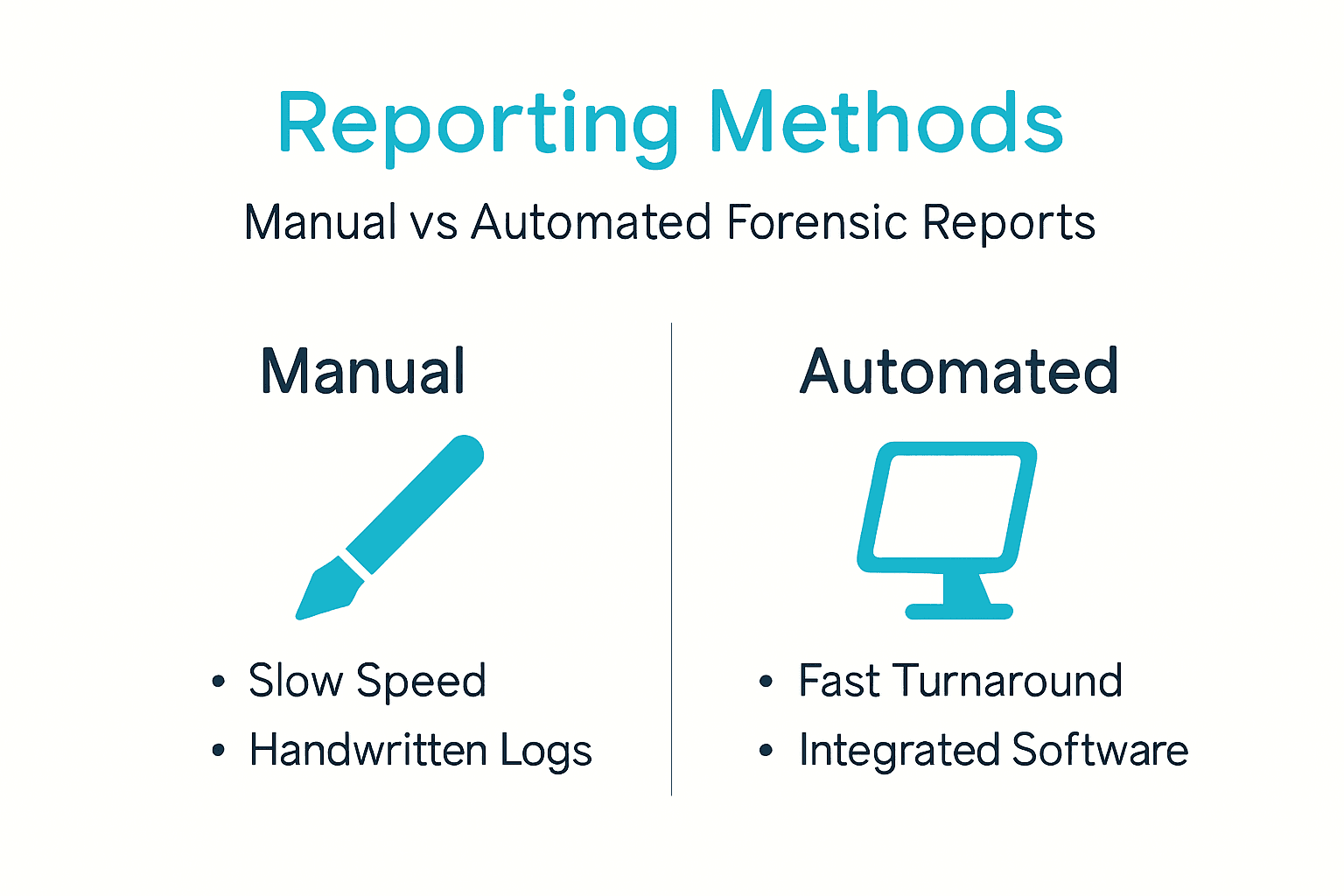
| Aspect | Manual Reporting | Automated Software |
|---|---|---|
| Speed | Slow, labour-intensive | Rapid generation from templates |
| Consistency | Varies by examiner | Standardised formatting and structure |
| Error Risk | Higher due to manual transcription | Lower with automated data extraction |
| Flexibility | Highly adaptable to unique cases | May require customisation for unusual scenarios |
| Cost | Lower upfront, higher labour costs | Higher upfront investment, lower ongoing costs |
| Visualisation | Manual creation of exhibits | Automated charts, timelines, and diagrams |
Manual reporting relies on examiners crafting documents using word processors and manually inserting exhibits. This approach allows complete customisation and works well for straightforward cases or organisations lacking software budgets. However, manual processes prove time-consuming and error-prone. Transcribing hex values, copying file paths, and creating exhibits manually introduces mistakes. Documentation inconsistency across examiners complicates quality assurance.
Automated forensic reporting software extracts data from analysis tools and populates report templates. These platforms maintain consistency across cases and examiners. Built-in quality checks flag missing sections or unsupported conclusions. Automated exhibit generation creates professional charts and timelines. Integration with forensic analysis tools eliminates manual data transfer, reducing errors.
Benefits of integration extend beyond individual reports. Multi-source evidence handling becomes manageable when platforms consolidate findings from mobile devices, computers, cloud services, and network logs. Cross-referencing data across sources reveals patterns manual processes might miss. Centralised evidence repositories improve collaboration amongst investigation team members.
Choosing appropriate methods depends on several factors:
- Case volume justifies automation investment for high-throughput organisations
- Complexity levels favour automated platforms for multi-device investigations
- Budget constraints may necessitate manual approaches for smaller teams
- Customisation needs influence whether standard templates suffice
Many organisations adopt hybrid approaches, using automated tools for routine cases whilst manually crafting reports for complex or unusual investigations. This flexibility maximises efficiency without sacrificing quality for cases requiring bespoke analysis and presentation.
Practical applications and case studies in digital forensic reporting
Real-world applications demonstrate forensic reporting’s tangible impact on UK investigations and prosecutions. Mobile device analysis frequently provides crucial evidence in criminal cases. One recent investigation involved suspected drug trafficking where call records, location data, and encrypted messaging revealed organisational hierarchy and distribution networks. Clear forensic reporting presented complex telecommunications data comprehensibly, enabling successful prosecution of multiple defendants.
Integration of multi-source digital evidence showcases reporting’s synthesising function. A corporate fraud investigation examined email servers, financial databases, and personal devices belonging to suspects. Forensic reports correlated transactions, communications, and file access patterns, establishing timeline evidence supporting conspiracy charges. Visual timeline exhibits helped jurors understand complex financial manipulations spanning months.
Clear forensic reporting influences legal decision-making at multiple stages. Crown Prosecution Service reviews rely on reports when determining charging decisions. Defence solicitors use reports to identify weaknesses and negotiate pleas. Judges consider report quality when ruling on admissibility and weighing evidence. Well-crafted reports expedite proceedings by reducing confusion and focused questioning.
Outcome improvements through effective reporting manifest in several ways:
- Higher conviction rates when juries understand technical evidence
- Reduced trial durations through clear, uncontested expert evidence
- Stronger plea negotiations backed by compelling documented findings
- Fewer appeals based on evidence handling or analysis challenges
Examining digital evidence cases reveals common patterns where reporting quality determined outcomes. Cases featuring comprehensive reports with clear methodology, transparent limitations, and accessible language typically proceeded smoothly. Conversely, cases with incomplete documentation, unclear conclusions, or technical jargon faced challenges and delays.
Successful forensic reporting also supports exculpatory findings. One investigation cleared a wrongly accused individual when detailed mobile device analysis proved they were kilometres from crime scenes during relevant timeframes. Location data presented through maps and timelines provided compelling alibi evidence, demonstrating forensic reporting’s role in preventing miscarriages of justice.
Conclusion and actionable tips for legal and law enforcement professionals
Forensic reporting stands as the critical bridge between technical forensic analysis and legal proceedings, transforming complex digital findings into evidence courts can rely upon. Understanding reporting principles, legal standards, and best practices empowers legal professionals and law enforcement to leverage digital evidence effectively whilst avoiding common pitfalls.
Practical tips for working with forensic reports:
- Engage forensic experts early in investigations to identify relevant evidence sources and plan collection strategies
- Request plain English explanations for technical concepts you find unclear, as understanding evidence strengthens case presentation
- Verify chain of custody documentation accompanies all forensic reports before relying on evidence in proceedings
- Review methodology sections critically to assess whether examination processes meet professional standards
- Consider alternative explanations for digital findings rather than accepting conclusions without scrutiny
- Maintain ongoing communication with forensic examiners throughout investigations to address emerging questions
Pro Tip: Schedule pre-trial conferences with forensic experts to review testimony plans, as preparation significantly improves courtroom performance and jury comprehension.
Chain of custody diligence cannot be overstated. Every evidence handling gap creates vulnerability to challenge. Implementing robust protocols from initial seizure through final presentation protects case integrity. Regular training ensures all team members understand their responsibilities in evidence preservation.
Professional development in digital forensics keeps pace with rapidly evolving technology. Attending training courses, reading industry publications, and participating in professional networks builds knowledge essential for effective collaboration with forensic experts. Understanding emerging challenges like encrypted communications, cloud evidence, and artificial intelligence prepares you for future investigations.
Explore expert digital forensic services to enhance your investigations
Partnership with experienced forensic professionals transforms investigation capabilities and case outcomes. Computer Forensics Lab provides comprehensive digital forensics services tailored specifically for UK legal professionals and law enforcement agencies. Our London-based team delivers expert digital forensic investigations combining technical excellence with clear, court-ready reporting that withstands scrutiny.
From mobile device analysis to complex multi-source investigations, we handle digital forensics data with meticulous attention to chain of custody and evidential integrity. Our experts prepare comprehensive reports meeting CrimPR Part 19 requirements whilst explaining technical findings in accessible language. Contact us to discuss how professional forensic support can strengthen your cases and streamline investigations.
Frequently asked questions
What is forensic reporting in digital investigations?
Forensic reporting is the structured documentation process that transforms digital evidence into legally admissible information for courts and investigations. It involves collecting, analysing, and presenting technical findings in formats that legal professionals, judges, and juries can understand and rely upon when making decisions.
What legal standards must forensic reports meet in the UK?
UK forensic reports must comply with CrimPR Part 19 requirements governing expert evidence, including declarations of expert duties, comprehensive methodology documentation, and clear distinctions between facts and opinions. Reports must also satisfy admissibility criteria regarding relevance, examiner qualifications, and scientific reliability of methods employed.
How can legal professionals improve understanding of forensic reports?
Request plain English explanations from examiners when encountering unfamiliar technical concepts. Attend forensic report writing training to build foundational knowledge. Engage experts early in cases to discuss evidence significance and limitations, enabling more effective collaboration throughout investigations.
What common challenges may cause forensic reports to be challenged in court?
Chain of custody failures account for many evidence challenges, alongside unclear methodology documentation, examiner bias, excessive technical jargon, and inadequate disclosure of limitations. Proper documentation, transparent processes, and objective reporting prevent most challenges whilst strengthening evidence credibility.