
British courtrooms face rising scrutiny of digital forensic evidence, with studies showing that nearly a third of reports are challenged on technical accuracy. For legal professionals in London, the quality of expert witness reports can make the difference between admissible evidence and rejected findings. This guide breaks down each step of the reporting process, providing clear strategies to help criminal lawyers and solicitors present robust, defensible digital evidence in cybercrime cases.
Table of Contents
- Step 1: Gather Relevant Digital Evidence And Documentation
- Step 2: Apply Forensic Analysis Techniques To Evidence
- Step 3: Structure The Expert Witness Report Clearly
- Step 4: Draft Findings With Professional And Neutral Language
- Step 5: Review And Verify Report Accuracy And Compliance
Quick Summary
| Important Insight | Detailed Explanation |
|---|---|
| 1. Systematic Evidence Collection | Gather digital evidence methodically to maintain its integrity and ensure it is legally admissible in court. |
| 2. Employ Forensic Analysis Techniques | Use specialised tools and methods to analyse digital evidence, revealing insights relevant to legal claims while preserving evidence integrity. |
| 3. Clearly Structure Expert Reports | Organise your report logically, utilising plain language to ensure understanding by non-technical legal professionals. |
| 4. Maintain Neutral Language | Use objective and precise language when drafting findings to enhance credibility and avoid subjective interpretations. |
| 5. Rigorous Review for Accuracy | Conduct a thorough review and verification of your report to ensure compliance with legal standards and technical accuracy before submission. |
Step 1: Gather relevant digital evidence and documentation
Gathering digital evidence requires a systematic and meticulous approach to ensure the integrity and legal admissibility of your findings. Your goal is to collect, preserve, and document electronic data that can substantiate or refute claims in legal proceedings.
Begin by identifying all potential sources of digital evidence, which might include computer systems, mobile devices, cloud storage, email accounts, and social media platforms. When collecting this data, it is crucial to follow standardised digital forensics procedures that maintain the evidence’s authenticity and chain of custody. This involves creating forensic disk images, carefully documenting each step of evidence collection, and ensuring no alterations occur during the extraction process.
Careful documentation is paramount. Record detailed information about each device or data source, including serial numbers, timestamps, acquisition methods, and storage conditions. Photograph and catalogue physical devices, and generate cryptographic hash values to verify data integrity. These meticulous records will become critical components of your expert witness report, demonstrating the scientific rigour and reliability of your digital forensic investigation.
Top tip: Always work on forensic copies of original evidence, preserving the source material in its original, unaltered state to maintain legal credibility and prevent potential challenges to your findings.
Step 2: Apply forensic analysis techniques to evidence
Applying forensic analysis techniques is a critical step in transforming raw digital data into meaningful legal evidence. Your objective is to systematically examine and interpret electronic information to uncover relevant insights that can support or challenge legal claims.
Begin by employing systematic forensic analysis methods that prioritise evidence preservation and integrity. This involves using specialised forensic tools to conduct deep examinations of digital artifacts, including recovering deleted files, analysing metadata, reconstructing digital timelines, and identifying potential patterns of activity. Each piece of digital evidence must be processed with meticulous attention to detail, ensuring that your analysis remains scientifically rigorous and legally defensible.
During the analysis, focus on correlating different pieces of digital evidence to build a comprehensive narrative. Examine file systems, email communications, network logs, and user activity records to establish context and trace digital interactions. Document every step of your analysis thoroughly, recording your methodologies, tools used, and specific findings. This detailed documentation will be crucial when preparing your expert witness report, as it demonstrates the systematic and objective nature of your forensic investigation.
Top tip: Always maintain a comprehensive audit trail of your forensic analysis, including screenshots, hash values, and detailed notes to ensure the credibility and reproducibility of your investigative process.
Refer to this table for commonly used forensic analysis tools and their functions:
| Tool Name | Main Function | Typical Use Case |
|---|---|---|
| EnCase | Disk imaging, data recovery | Comprehensive analysis of seized devices |
| FTK (Forensic Toolkit) | Indexing, file recovery | Efficient searching of digital evidence |
| Autopsy | Timeline creation, file analysis | Open source investigation of file systems |
| X-Ways Forensics | Metadata analysis, data carving | Advanced examination of complex data sets |
Step 3: Structure the expert witness report clearly
Creating a well-structured expert witness report is crucial for effectively communicating your digital forensic findings to legal professionals who may not have technical expertise. Your report must transform complex technical analyses into a clear, logical narrative that can be easily understood by judges, lawyers, and other stakeholders.

Begin by developing a comprehensive report structure that includes essential sections such as a title page, table of contents, executive summary, methodology, detailed findings, and conclusions. Each section should flow logically, presenting information in a manner that builds a coherent story of your digital forensic investigation. Your executive summary should provide a high-level overview that captures the key insights, while subsequent sections offer in-depth technical explanations that support your initial findings.
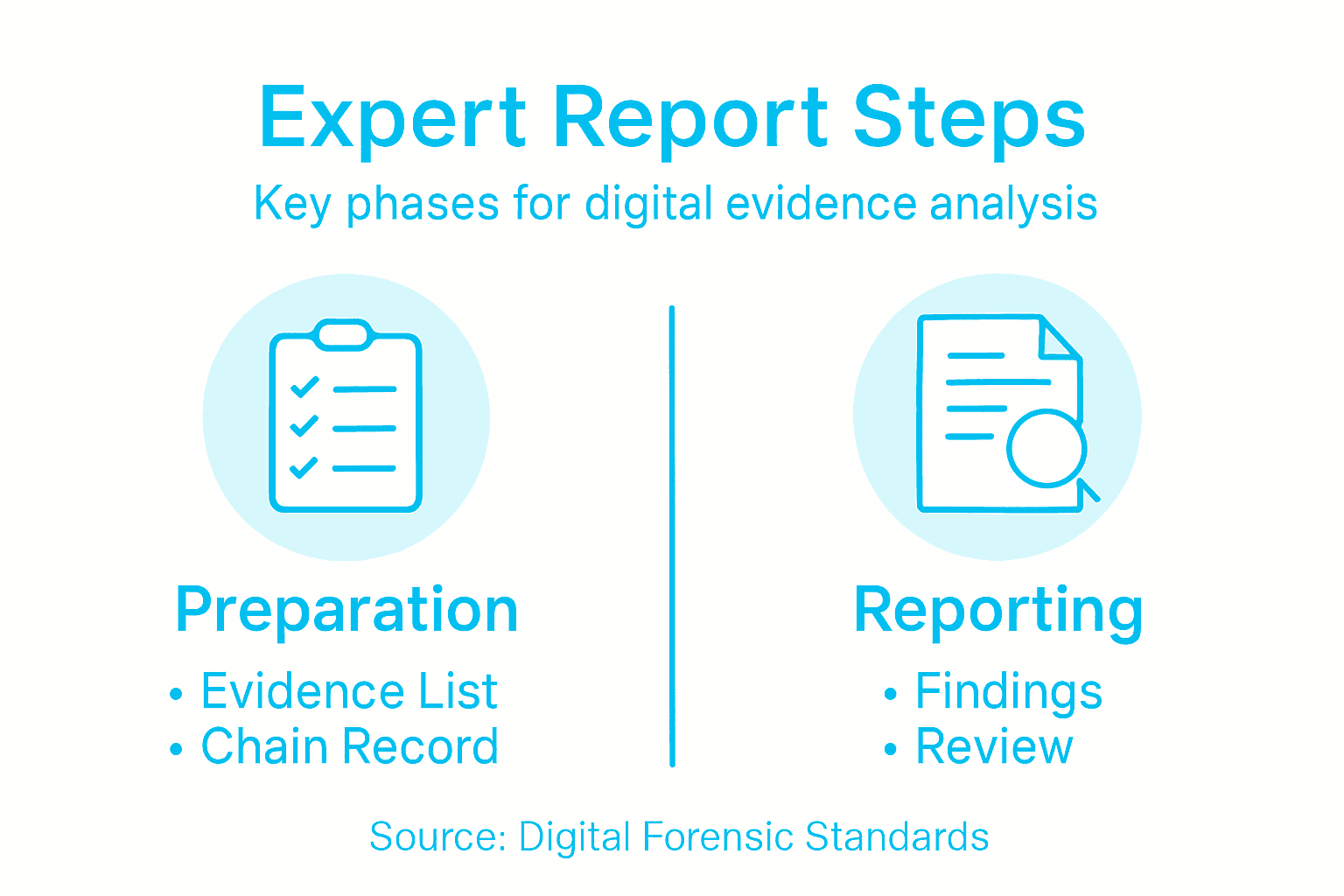
Ensure that your report maintains clarity by using plain language and avoiding unnecessary technical jargon. Organise your content to highlight critical evidence, explain your methodological approach, and draw clear connections between your analysis and the legal context. Include visual aids such as charts, screenshots, and timelines to help illustrate complex technical information. Remember that your goal is to present a transparent, objective account of your digital forensic investigation that can withstand rigorous legal scrutiny.
Top tip: Write your report as if you are explaining your findings to someone with no technical background while maintaining scientific precision and professional credibility.
Step 4: Draft findings with professional and neutral language
Crafting a professional and neutral expert witness report requires precision, objectivity, and a carefully measured approach to presenting digital forensic evidence. Your language must communicate technical findings with clarity and impartiality, avoiding emotional language or subjective interpretations that could undermine the credibility of your analysis.
Focus on creating a narrative that presents facts methodically, using clear and concise language that describes your observations without speculation or personal bias. Use passive voice strategically to maintain an objective tone, and rely on empirical evidence and verifiable data to support your conclusions. Articulate your technical findings using standardised terminology that can be understood by legal professionals who may not have advanced technical knowledge.
When describing digital evidence, prioritise precision and objectivity. Use specific, measurable statements that clearly outline what was discovered, how it was analysed, and what implications can be objectively drawn from the data. Avoid making definitive claims that cannot be substantiated by your forensic analysis. Each statement should be supported by documented methodology, forensic tools used, and a transparent explanation of your investigative process. Your goal is to present a report that serves as an authoritative and unbiased technical assessment that can withstand rigorous legal scrutiny.
Top tip: Always have a colleague or legal professional review your draft to ensure the language remains neutral, professional, and scientifically rigorous.
Step 5: Review and verify report accuracy and compliance
The final stage of creating an expert witness report involves a comprehensive review to ensure absolute accuracy, scientific integrity, and legal compliance. Your goal is to meticulously validate every aspect of your digital forensic documentation before submission.
Forensic investigation protocols demand a rigorous verification process that goes beyond simple proofreading. Conduct a systematic review that cross checks your technical findings against original evidence, ensuring that each statement is supported by verifiable data. Examine your methodology for consistency, verify that all digital evidence has been properly preserved, and confirm that your chain of custody documentation is complete and unambiguous.
Pay particular attention to jurisdictional requirements and legal standards. Scrutinise your report for potential vulnerabilities that could challenge its admissibility in court. This involves checking that your technical language is precise yet comprehensible, your conclusions are objectively drawn, and your entire document maintains a neutral, professional tone. Consider having a colleague with legal background review the report to identify any potential weaknesses or areas that might require additional clarification or supporting documentation.
Top tip: Create a final verification checklist that includes technical accuracy, legal compliance, clarity of language, and completeness of evidence documentation to ensure nothing is overlooked.
Here’s a summary comparing the main tasks in each step of creating a digital forensic expert witness report:
| Step Title | Primary Focus | Key Activities | Documentation Required |
|---|---|---|---|
| Evidence Gathering | Ensuring data integrity | Identifying sources, creating forensic copies | Detailed log of devices, hash values |
| Forensic Analysis | Deep examination and interpretation | Recover deleted files, analyse metadata | Audit trail of methods and findings |
| Report Structuring | Clear communication of findings | Organise sections logically, use plain language | Executive summary, methodology, conclusions |
| Drafting Findings | Neutral and professional language | Present observations factually, avoid bias | Reviewed draft, objective statements |
| Review & Verification | Accuracy and legal compliance | Cross-check findings, ensure completeness | Finalised checklist, chain of custody records |
Expert Witness Reports Backed by Trusted Digital Forensics Expertise
Creating precise and legally compliant expert witness reports for digital evidence can be overwhelming. Ensuring data integrity, applying rigorous forensic analysis techniques, and maintaining neutral, professional language are critical to supporting your case effectively. If you face challenges such as evidential authenticity, comprehensive forensic analysis, or clear communication of technical findings, our expert team at Computer Forensics Lab is here to help.
With extensive experience in delivering detailed expert witness reports, we specialise in preserving chain of custody and using advanced forensic methodologies to translate complex digital evidence into understandable, court-ready documents. Discover how our Expert Witness services and Computer Forensics Expert Witness solutions provide the support you need to navigate your digital investigations with confidence. Contact us today at Computer Forensics Lab to gain the clarity and expert guidance essential for your legal and investigative success.
Frequently Asked Questions
What are the key steps in creating an expert witness report for digital evidence?
Creating an expert witness report involves five key steps: gathering digital evidence, applying forensic analysis techniques, structuring the report clearly, drafting findings in professional language, and reviewing for accuracy and compliance. Follow these steps methodically to ensure a legally sound and credible report.
How can I maintain the integrity of digital evidence during collection?
To maintain the integrity of digital evidence, always work on forensic copies of original data and document every aspect of the collection process. Use standardised digital forensics procedures, such as creating forensic disk images and recording hash values, to preserve evidence authenticity.
What should be included in the methodology section of the expert witness report?
The methodology section should detail the processes and forensic techniques used during the analysis of digital evidence. Include specifics about the tools employed, the steps taken during analysis, and how findings were corroborated, ensuring transparency and reproducibility in your investigation.
How can I ensure my findings are presented in a neutral tone?
To present findings in a neutral tone, focus on objective descriptions of the data without including personal bias or speculation. Use clear, fact-based language and passive voice where appropriate, ensuring each observation is supported by documented methodologies and evidence.
What is the importance of reviewing the report before submission?
A thorough review of the report is vital to ensure accuracy, legal compliance, and clarity. Cross-check all findings against the original evidence, confirm that the language is precise and understandable, and use a checklist to ensure no critical elements are overlooked before submission.