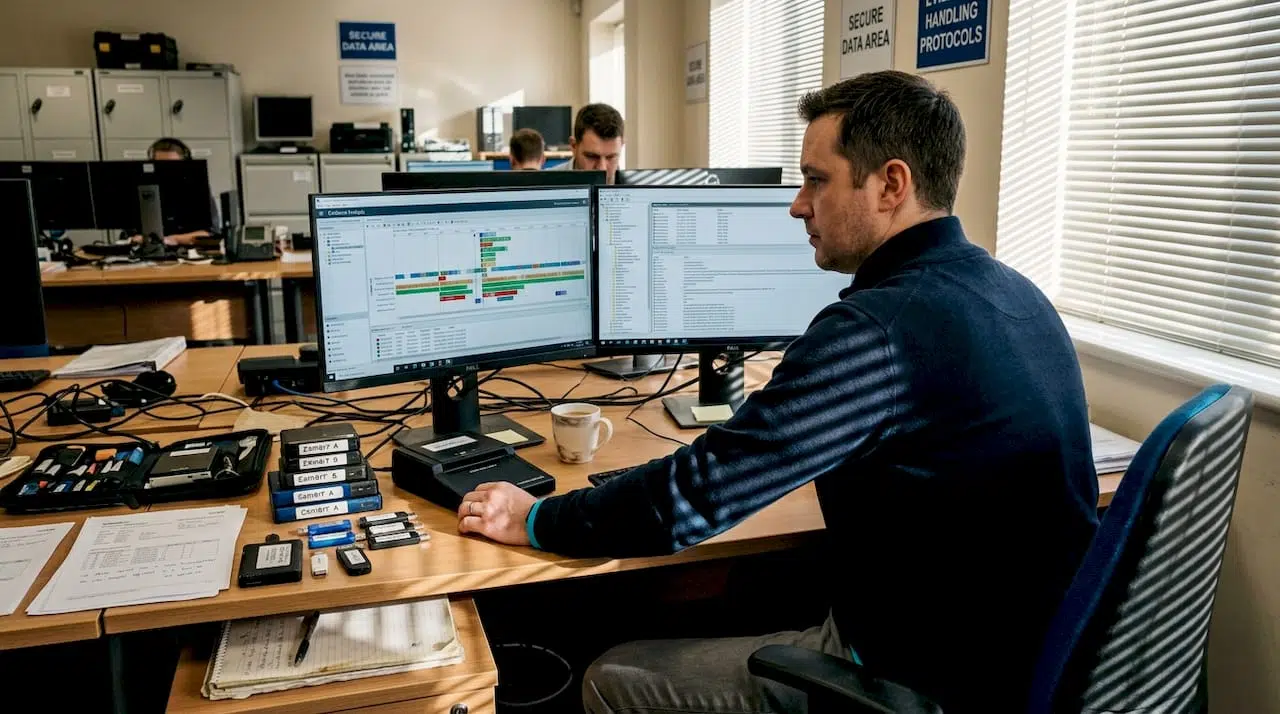
TL;DR:
- Forensic timeline analysis reconstructs digital events to support legal cases and establish key facts.
- Strict validation, documentation, and adherence to UK standards ensure evidence admissibility and reliability.
- Combining multiple tools and meticulous human review is essential for defensible, court-ready digital timelines.
Digital evidence rarely speaks for itself. In complex litigation, from fraud to insider threats, the sequence of events recorded across devices, servers, and cloud platforms can be the difference between a conviction and an acquittal. Yet forensic timeline analysis, the disciplined process of reconstructing that sequence from raw digital data, is frequently underestimated by legal professionals who assume the technology does the heavy lifting. It does not. The tools, standards, validation requirements, and potential pitfalls involved demand a level of rigour that goes well beyond pressing a button and reading a report. This guide addresses each of those dimensions in practical terms.
Table of Contents
- Defining forensic timeline analysis in digital evidence
- Key tools and methods for building digital timelines
- Common challenges and risks in timeline analysis
- Validation, admissibility, and best practices for UK legal cases
- Why ‘just building a timeline’ is a myth: A deeper look
- How expert forensic support can strengthen your case
- Frequently asked questions
Key Takeaways
| Point | Details |
|---|---|
| Timelines underpin digital evidence | Accurate timelines reveal crucial case details and must be handled with care in court. |
| Tool choice impacts admissibility | Selecting validated, court-accepted tools like EnCase or FTK can strengthen the legal position. |
| Challenges require expert handling | Missteps such as poor timestamp normalisation or chain of custody issues can undermine evidence. |
| Best practices win in UK courts | Following ACPO principles and documenting every process step ensures defensible results. |
Defining forensic timeline analysis in digital evidence
At its core, forensic timeline analysis is the structured sequencing of digital events to reconstruct activity relevant to a legal case. Think of it as building a chronological map: every file accessed, every message sent, every system configuration changed, and every website visited leaves a timestamp. Assembled correctly, those timestamps tell a story. Assembled poorly, they mislead.
The types of digital evidence most commonly incorporated into timelines include:
- File system activity (creation, modification, access, and deletion timestamps)
- Web browsing history and cached data
- Email and messaging metadata
- System log entries and registry changes
- Network connection records
- Application usage logs
Timelines serve several critical legal functions. They establish motive by showing what a subject accessed before an incident. They demonstrate opportunity by placing a person at a device at a specific time. They assign responsibility by correlating actions across multiple sources. In fraud cases, for instance, a timeline might show that a finance director accessed a supplier database, then created a fictitious invoice, then transferred funds, all within a 20-minute window.
For UK legal proceedings, the standards governing this work are exacting. As noted in legal standards for digital evidence, timeline analysis must maintain strict chain of custody, use validated tools compliant with ACPO and Forensic Science Regulator standards, ensure evidence admissibility on grounds of relevance, authenticity, and proportionality, and integrate into formal workflows covering identification, acquisition, examination, and analysis under CrimPR Part 19.
Understanding the full UK forensic investigation steps is therefore not optional. It is foundational. Each phase of the digital investigation workflow guide must be documented in a way that can withstand cross-examination.
“A timeline is only as reliable as the process used to construct it. Without documented methodology, even accurate findings can be excluded.”
With an understanding of why timeline analysis matters, it is essential to explore the tools that make it possible.
Key tools and methods for building digital timelines
No single tool dominates forensic timeline construction. Practitioners typically draw on a combination of commercial and open-source platforms, each with distinct strengths. The timeline analysis tools overview confirms that common tools include Autopsy, which offers open-source timeline views covering file system activity and web events; Belkasoft X, which aggregates over 1,500 artefact types; and Plaso, also known as log2timeline, which generates super-timelines from hundreds of sources simultaneously. Commercial platforms such as EnCase, FTK, and X-Ways remain the standard in high-stakes litigation.
| Tool | Type | Key strength | Court acceptance |
|---|---|---|---|
| EnCase | Commercial | Deep acquisition and reporting | High |
| FTK | Commercial | Speed and indexing | High |
| X-Ways | Commercial | Lightweight, precise analysis | High |
| Autopsy | Open-source | Flexible, extensible | Moderate |
| Plaso | Open-source | Super-timeline generation | Moderate |
| Belkasoft X | Commercial | Broad artefact coverage | High |
As the comparative analysis of forensic tools makes clear, commercial tools are robust in data acquisition and certification, while open-source options offer customisability but are less formally certified. Complementary use is advised, particularly where initial triage can be performed with open-source tools before deeper analysis with a validated commercial platform.
The primary methods for constructing timelines include:
- Event correlation: Cross-referencing timestamps from multiple sources to identify patterns
- Super-timelines: Aggregating all available artefacts into a single chronological view using tools like Plaso
- Targeted timelines: Focusing on a defined window or specific device to reduce noise
For solicitors reviewing forensic reports, understanding which method was applied matters. A super-timeline generated from 15 data sources carries different weight than a targeted review of a single device log. You can explore the leading options in more detail through our overview of top digital forensics tools.
Pro Tip: Document every normalisation process applied to timestamps and events during analysis. Courts will scrutinise any adjustment made to raw data, and undocumented changes are a common basis for challenge.
Having identified tools and methods, consider the practical and technical challenges practitioners face.
Common challenges and risks in timeline analysis
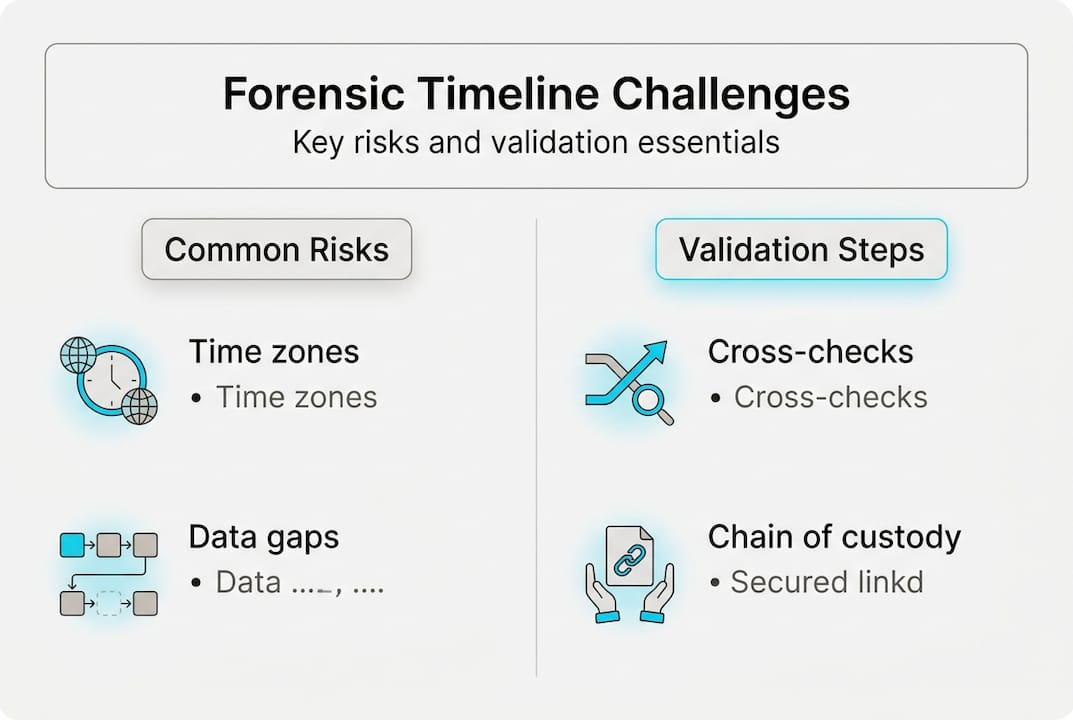
Timeline analysis is not a clean process. Several technical and procedural risks can undermine the reliability or admissibility of findings if not actively managed. As timeline analysis challenges confirms, the most significant include timestamp inconsistencies caused by differing time zones or formats, anti-forensic techniques such as log wiping and timestamp manipulation, volatile data loss from RAM and active network connections, information overload from millions of events requiring filtering, and encryption that conceals key data entirely.

| Risk | Description | Mitigation strategy |
|---|---|---|
| Timestamp inconsistency | Devices recording in local time or different formats | Normalise all timestamps to UTC |
| Anti-forensic attacks | Log deletion or timestamp manipulation by the subject | Cross-reference multiple independent sources |
| Volatile data loss | RAM contents lost on shutdown | Acquire volatile data first, before imaging |
| Information overload | Millions of events obscuring relevant activity | Apply targeted filtering and zooming |
| Encryption | Key data inaccessible without decryption | Document attempts and seek legal authority |
The steps to validate and cross-reference timeline integrity are:
- Acquire all relevant data sources before any analysis begins
- Verify hash values immediately after acquisition to confirm integrity
- Normalise all timestamps to UTC and record every conversion
- Cross-reference at least two independent sources for each key event
- Apply filtering to isolate the relevant time window before reviewing detail
- Document every analytical decision and tool setting used
Proper chain of custody guidance is inseparable from this process. A lapse at any stage, even something as minor as an undocumented reboot, can create grounds for a challenge to digital evidence integrity that an opposing expert will exploit. The admissibility standards applied by UK courts leave no room for procedural shortcuts.
Pro Tip: Always apply time zone normalisation to UTC as a first step, before any analysis begins. Record the original timestamp, the offset applied, and the resulting UTC value in your working papers for every source device.
Understanding the hurdles makes it clear why robust validation and standards are non-negotiable in UK litigation.
Validation, admissibility, and best practices for UK legal cases
The ACPO Good Practice Guide for Digital Evidence, alongside the Forensic Science Regulator’s codes of practice, sets the framework within which all UK forensic timeline work must operate. These are not aspirational guidelines. They are the benchmark against which courts assess whether evidence was gathered and analysed properly.
For forensic process steps for legal success, the key requirement is that practitioners prioritise tools with court validation, such as EnCase and FTK, and document all normalisation processes to defend against challenges on timestamp accuracy or chain of custody. This is not merely procedural caution. It reflects the reality that opposing counsel will question every assumption.
UK best practices for admissible timeline evidence include:
- Use only tools with documented validation and, where possible, court acceptance history
- Maintain a complete and unbroken chain of custody standards record from acquisition through to report
- Apply redundancy checks: verify findings using a second tool or method where possible
- Ensure proportionality: the scope of analysis should match the gravity of the allegation
- Produce a clear, jargon-free report that a non-technical judge or jury can follow
- Retain all working notes, tool logs, and intermediate outputs for disclosure
The Forensic Science Regulator requirements also demand that practitioners operate within an accredited quality management system. For solicitors instructing forensic experts, this means asking direct questions about accreditation, tool validation, and documentation practices before engagement.
“Timeline evidence is only as strong as the process that created it.”
This applies equally to fraud investigations, cybercrime prosecutions, and internal corporate matters. In each context, the strength of the timeline depends not on the sophistication of the software but on the discipline of the practitioner.
Armed with knowledge of standards, you can choose strategies fit for both day-to-day practice and complex litigation.
Why ‘just building a timeline’ is a myth: A deeper look
After years of working on high-stakes cases, one pattern stands out clearly: the cases that collapse under cross-examination are rarely those where the wrong tool was used. They are the cases where the process was not documented, the analyst could not explain a decision, or a timestamp conversion was applied without record.
Many legal professionals still assume that forensic timeline software produces a self-evidently reliable output. It does not. Every step from acquisition to final report involves human decisions, and each decision must be defensible. The comparative analysis of forensic tools notes that qualitative consensus favours integrated platforms for complex cases, with open-source tools sufficient for initial triage. But even the best platform cannot substitute for methodological rigour.
The analysts who consistently produce court-ready timelines use hybrid toolchains, validate findings across multiple sources, and document every step of the forensic analysis process in a way that anticipates challenge. Speed is not the priority. Defensibility is. That shift in mindset is what separates timeline evidence that holds up from evidence that does not.
How expert forensic support can strengthen your case
When the integrity of digital evidence is central to your case, the quality of the forensic process behind it is not a secondary concern. At Computer Forensics Lab, we provide digital forensics services that cover the full lifecycle of timeline construction, from initial case review and evidence acquisition through to court-ready reporting. Our work on digital forensic investigations spans fraud, cybercrime, employee misconduct, and intellectual property disputes, with documented chain of custody and validated tools throughout. Understanding how digital footprints evidence is identified and preserved is the first step. Contact us to discuss your case and find out how we can support your litigation strategy.
Frequently asked questions
What are the most robust forensic timeline tools for UK courts?
EnCase and FTK are widely accepted in UK legal proceedings due to their formal validation and certification, while open-source tools such as Autopsy are better suited to initial triage in less complex matters. Commercial tools are robust in acquisition and certification, whereas open-source options are less formally certified.
How do you address time zone inconsistencies in digital timelines?
All timestamps should be normalised to UTC at the outset, with every adjustment recorded in working papers to maintain court defensibility.
What legal standards must timeline analysis meet in UK cases?
Timelines must comply with ACPO principles and Forensic Science Regulator codes, and maintain a complete chain of custody. UK admissibility requirements also demand that evidence is relevant, authentic, and proportionate.
Are automated timeline tools enough, or is manual review required?
Manual review remains essential. Automated tools are fast but error-prone, and courts expect an analyst to explain and defend every finding under cross-examination.