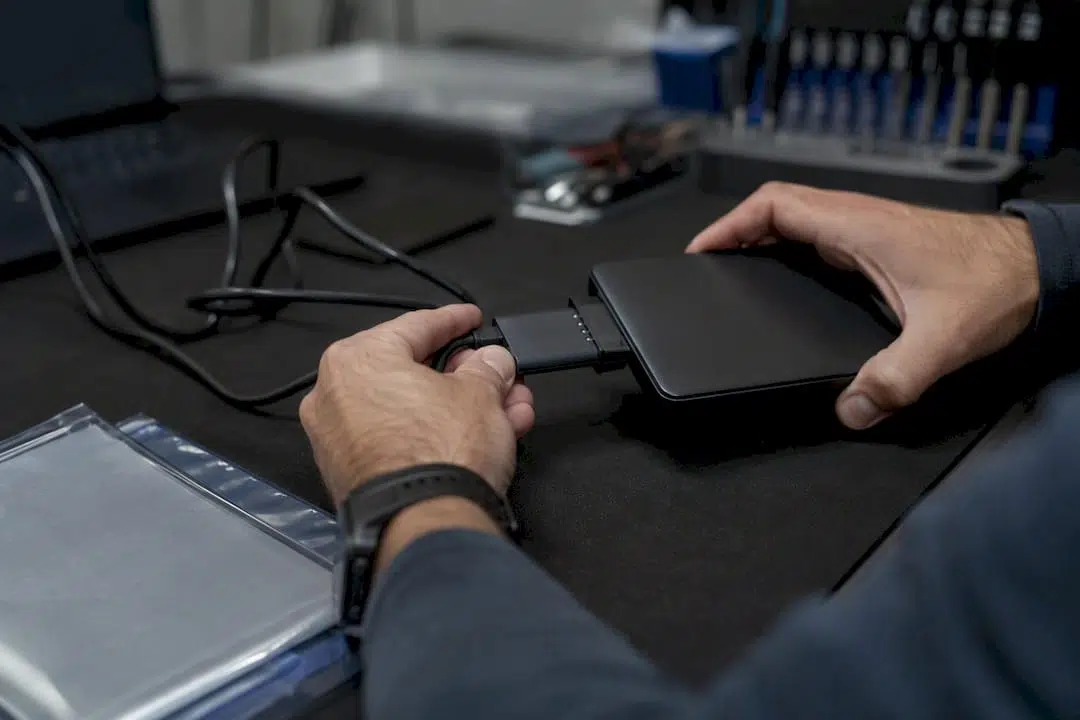
Forensic data recovery is the process of extracting and preserving digital evidence from computing devices so the result remains admissible in court. Unlike general IT recovery, it produces a bit-for-bit image, contemporaneous documentation, and acquisition hashes that permit another examiner to reproduce every step. Two frameworks anchor this discipline: the guidance issued by the Scientific Working Group on Digital Evidence (SWGDE) and technical standards from NIST. The expected outcome is not simply “getting the files back.” It is a verified, hash-authenticated copy of the original data, backed by a paper trail robust enough to survive cross-examination.
Key Takeaways
Forensic data recovery is only admissible when bit-for-bit imaging, cryptographic hashing, and an unbroken chain of custody are documented at every step.
| Point | Details |
|---|---|
| Definition matters | Forensic recovery preserves evidence with verifiable integrity, unlike general IT recovery that risks altering metadata. |
| Follow the ordered workflow | Identification, imaging, hashing, analysis on copies, and reporting must happen in sequence with contemporaneous notes. |
| Hashing proves integrity | Acquisition hashes using MD5 alongside a stronger algorithm confirm an image has not been altered since collection. |
| Know the limits | Overwritten data is rarely recoverable, and encrypted live systems may require immediate acquisition before shutdown. |
| Cross-check with multiple tools | No single recovery tool finds everything, so validated cross-checking strengthens defensibility. |
| Instruct specialists early | Computerforensicslab offers forensic imaging, recovery, and expert reporting built for court admissibility from first instruction. |
This article is general information, not a substitute for advice from a qualified lawyer. Consult a qualified legal professional about your own circumstances before acting on anything here.
Table of Contents
- What does forensic recovery actually involve, step by step?
- How is evidence integrity preserved during recovery?
- Can deleted or encrypted data always be recovered?
- Why do different forensic tools give different results?
- What makes recovered data admissible in court?
- How long does forensic recovery take and what drives the cost?
- Sources
What does forensic recovery actually involve, step by step?
A forensic lab does not open a device and start pulling files. Every action follows a sequence designed to withstand challenge, and legal teams should know what to expect before instructing an examiner.
The typical workflow runs in this order:
- Identification and seizure — devices, storage media, and cloud accounts are catalogued, photographed, and secured before anything is touched.
- Preservation — the device is isolated from networks to prevent remote wipes or automatic updates that could alter data.
- Live or dead acquisition decision — the examiner determines whether the device must be imaged while running (live) or powered down (dead).
- Bitstream imaging — a hardware write-blocker sits between the original media and the acquisition device, producing a bit-for-bit copy without changing a single byte on the source.
- Hash verification — the image is hashed immediately after acquisition to create a fixed reference point.
- Analysis on working copies — all examination happens on verified duplicates, never the original evidence, following SWGDE’s acquisition guidance.
- Reporting and archiving — findings are documented, the original image is sealed, and access is logged.
Live acquisition becomes necessary when a device is encrypted or holds volatile data in memory that would be lost on shutdown. The trade-off is real: capturing a live system can alter timestamps and file metadata, so examiners must justify the decision in their notes and weigh it against the risk of losing encryption keys entirely.
Documentation runs alongside every step. Legal teams should expect contemporaneous notes recording device identifiers, exact timestamps, the software versions used, and signatures from every person who handled the evidence.
Methodology matters here too: write-blocking hardware, forensic boot media, and memory-capture tools each leave their own audit trail, which is why the device seizure forensic process is documented as rigorously as the recovery itself.
Pro Tip: If a device is found powered on and encrypted, do not switch it off. Photograph the screen, note the time, and call a forensic examiner immediately — shutting down can trigger full-disk encryption that makes the data permanently inaccessible.
How is evidence integrity preserved during recovery?
Integrity rests on three pillars: hardware controls, cryptographic verification, and paperwork that never has a gap.
Examiners never work directly on original media. A hardware write-blocker physically prevents any write command from reaching the source device, which is why SWGDE’s examination standard requires analysis to happen only on a protected copy while the original image is archived untouched.
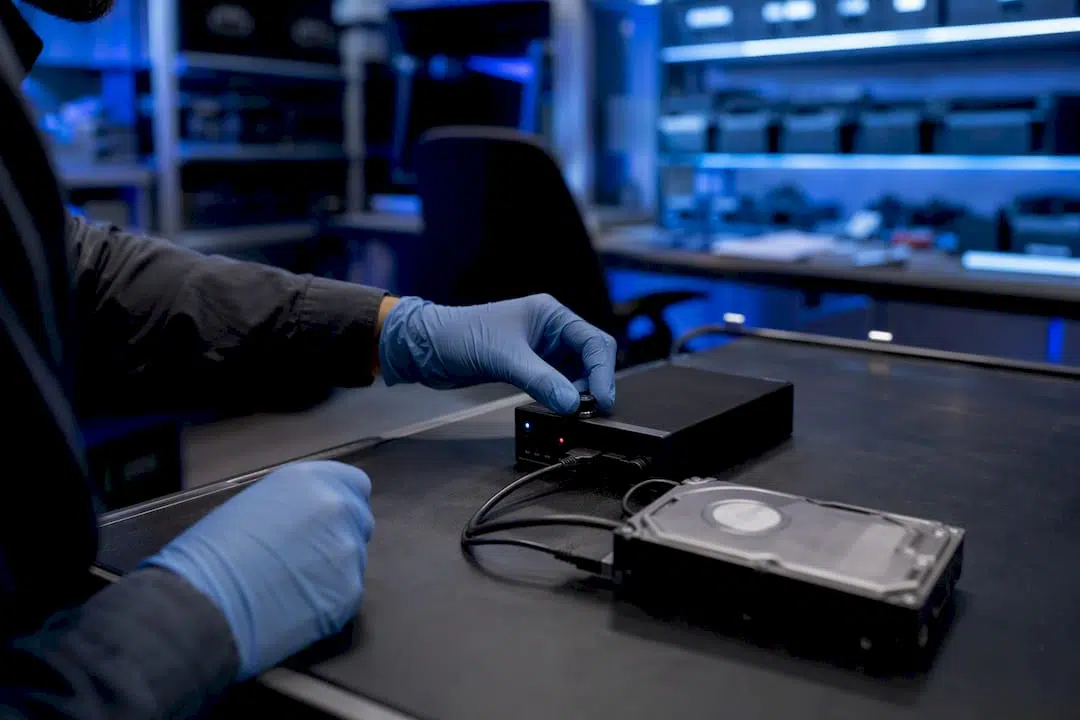
Hashing provides the mathematical proof of that untouched state. An acquisition hash, generated the moment imaging completes, acts as a fingerprint. Any single-bit alteration to the image, however small, produces a completely different hash value. Best practice calls for multiple hashing algorithms such as MD5 alongside SHA-1 or a stronger variant, reducing the already remote risk of a hash collision masking tampering.
A defensible chain of custody answers five questions at every handover:
- Who took possession of the evidence?
- What was transferred (device, image, or working copy)?
- When did the transfer occur?
- Where was it stored?
- How was it secured and verified on arrival?
A single missing signature or an unexplained gap in the custody log can undermine months of technical work, regardless of how sound the acquisition itself was.
Pro Tip: Ask your forensic provider whether verified images are stored with restricted, logged access. If nobody can tell you who touched the evidence and when, that gap will surface in cross-examination.
Can deleted or encrypted data always be recovered?
No, and any lab that promises otherwise is overstating what forensic recovery can do. Deleted files often survive in unallocated space or file slack until the operating system overwrites that area with new data. Recovery success depends heavily on how much time has passed and how actively the device has been used since deletion.
Overwritten data is a harder boundary. Once new data has physically replaced the old sectors, full reconstruction is generally not possible, though fragments occasionally survive on certain media types, allowing partial reconstruction rather than a complete file.
Encryption raises a different problem entirely. If a device is encrypted and running, live acquisition may be the only realistic route to capturing usable keys before shutdown destroys that opportunity, a point SWGDE’s acquisition guidance addresses directly. Where keys cannot be captured, legal teams may need to pursue compelled disclosure or obtain copies directly from a cloud provider through lawful process.
Recovered deleted documents from unallocated space have delivered genuine investigative leads in real cases, underscoring why recovering deleted data for legal cases remains one of the most requested services in this field.
- Tool limitations can produce false positives or fragmented, conflated results.
- Not every recovered artefact will be relevant. Examiner judgement is required to separate signal from noise.
Digital investigation techniques are reliable when applied correctly, but recovered items can be incomplete, and not all evidence will necessarily be discovered or fully recovered.
Why do different forensic tools give different results?
No single tool recovers everything a device holds. Empirical testing across five recovery tools found that no two produced identical results, and each tool presented its findings differently even when working from the same image, according to a comparative evaluation from the University of Glasgow.
The variation comes from how each tool handles file-system quirks, configuration settings, and areas like alternate data streams or slack space. A tool tuned for one file system may simply miss artefacts that another tool surfaces.
- Cross-check significant findings across at least two validated tools before relying on them in a report.
- Never treat a single tool’s output as a complete inventory of what a device contains.
- Record tool names, version numbers, and configuration settings used during every examination.
Pro Tip: When instructing a lab, ask which tools were used and whether results were cross-validated. A one-tool report is a weaker report, however confident the summary sounds.
What makes recovered data admissible in court?
Admissibility hinges on documentation as much as technical skill. A report that cannot be scrutinised, replicated, or defended under cross-examination carries little weight regardless of what was recovered.
A defensible report typically includes:
- A concise executive summary written for a non-technical reader, since clear summaries strongly influence legal decision-makers.
- The methods and tools used, including versions and configuration.
- Acquisition and verification hashes proving the image matches the original.
- A complete chain-of-custody record.
- Stated limitations, including anything the examiner could not recover or verify.
- Appendices with raw output for technical review where required.
Reproducibility is the test that separates forensic-grade work from ordinary IT recovery. Another competent examiner should be able to take the same image, the same hashes, and the same lab notes, and arrive at comparable conclusions, as outlined in SWGDE’s examination best practices.
An examiner’s qualifications, training, and willingness to stand behind findings under questioning often matter as much as the recovery technique itself.
Legal teams facing a Daubert-style challenge or its common law equivalent should confirm the expert witness instructed can speak to methodology, not just results.
How long does forensic recovery take and what drives the cost?
Timelines vary by case complexity, but broad bands help with planning:
- Initial triage: hours to a day or two for a single device.
- Standard imaging and preliminary analysis: several days.
- Deep forensic analysis, including deleted-file recovery and reporting: one to several weeks.
Cost is driven by several variables working together, and no two instructions look identical:
- Number and type of devices (a phone differs sharply from a server array).
- Whether encryption or live acquisition is required.
- Depth of analysis requested, from a targeted search to a full device review.
- Time needed for a court-ready report and expert witness preparation.
- Rush instructions, which compress the same workload into a shorter window.
Legal teams can manage both time and cost by scoping the instruction tightly, issuing early preservation notices, and requesting staged reporting rather than waiting for one final document.
Why instruct a specialist forensic lab rather than general IT support?
Specialist labs bring validated tools, trained examiners, and a documented methodology that general IT recovery simply does not need to maintain. Computerforensicslab provides forensic imaging, data recovery, expert reporting, and court support built around chain-of-custody stewardship from the first point of contact. Confidentiality is treated as a baseline obligation, not an add-on, because the evidential value of a case can hinge on how discreetly it was handled before it ever reached a courtroom.
How can Computer Forensics Lab help with your case?
If you need data recovered from a device involved in litigation, a criminal matter, or an internal investigation, the priority is preserving evidence before anything else happens to it. Computerforensicslab’s digital forensics services cover forensic imaging, recovery from deleted or encrypted sources, and expert reports built to withstand cross-examination. Solicitors, police, and corporate legal teams can instruct the lab directly, with clear guidance on preserving chain of custody from the moment a device is identified. Every engagement includes a willingness to provide expert witness testimony where the case requires it, backed by contemporaneous documentation rather than a summary produced after the fact. Get in touch to discuss instruction steps for your specific device and jurisdiction.
Sources
- SWGDE — Best practices for digital evidence collection (18-F-002)
- NIST — Digital investigation techniques: a scientific foundation review
- University of Glasgow — Comparative evaluation of data recovery tools (ePrints ID71698)