An incident response plan (IRP) is a formally documented, organisation-wide framework that defines how a business detects, contains, investigates, and recovers from a cybersecurity incident, with the explicit objectives of limiting damage, restoring normal operations as quickly as possible, and meeting legal obligations including regulatory notification requirements. As TechTarget defines it, incident response is an organised, strategic approach to detecting and managing cyberattacks that aims to minimise damage, recovery time, and total cost. Understanding what an incident response plan in cyber security entails is not optional for UK organisations: it is a governance requirement that sits at the intersection of technical operations, legal compliance, and executive accountability.
Before reading further, verify three things about your current IRP:
- Senior approval confirmed? The plan must carry a named executive sponsor’s signature and a dated approval, not simply exist as a draft in a shared drive.
- Named incident lead assigned? A specific individual, not a team or a job title, must be designated as the incident manager with documented authority to act.
- At least one tested playbook in place? A ransomware or data breach playbook that has been walked through in a tabletop exercise counts; an untested document does not.
Pro Tip: The IRP is a governance instrument as much as a technical one. Secure executive sign-off and a defined budget before investing heavily in tooling, because authority and resources matter more than software during the first hours of a real incident.
Key takeaways
An incident response plan in cyber security is only as effective as its governance structure, its tested playbooks, and its forensic readiness provisions.
| Point | Details |
|---|---|
| Define and approve before an incident | The IRP must carry named executive sign-off and a defined budget before any incident occurs. |
| Embed regulatory timelines | ICO 72-hour notification and NIS reporting obligations must be built into playbooks, not handled ad hoc. |
| Test at least annually | Tabletop exercises, functional drills, and technical simulations each surface different gaps; use all three. |
| Forensic readiness reduces legal exposure | Pre-defined evidence acquisition procedures and a forensic retainer protect the organisation’s position in regulatory and legal proceedings. |
| Governance outweighs tooling | A mature IRP with clear roles and tested procedures delivers more value than enterprise tooling without documented governance. |
7-day actions: Confirm executive sponsor; verify the plan has a dated sign-off; identify the named incident manager.
30-day actions: Audit existing playbooks against the component checklist above; confirm ICO notification workflow is embedded; verify forensic retainer or external provider contact.
90-day actions: Run a tabletop exercise; close identified gaps with named owners and deadlines; schedule the next annual review; obtain refreshed executive sign-off.
Organisations requiring professional forensic support or incident response assistance can contact Computerforensicslab’s digital forensics team directly.
Table of Contents
- Why a formal incident response plan matters for UK organisations
- What every incident response plan must include
- How the incident response lifecycle maps to practical actions
- Who should be on your incident response team and what each role must do
- How to build an incident response plan: a step-by-step checklist
- Evidence preservation and when to engage forensic specialists
- Testing the plan: tabletop exercises, live drills, and learning from incidents
- UK legal and regulatory requirements that must shape your IRP
- Tools and technologies commonly used in incident response
- Quick IRP playbook examples you can adapt
- Why forensic readiness belongs at the centre of your IRP
- Sources
Why a formal incident response plan matters for UK organisations
A well-maintained IRP directly reduces the financial and operational impact of a cyber incident. Organisations with a tested plan in place contain breaches faster, spend less on recovery, and present a materially stronger position to regulators, insurers, and clients in the aftermath. The NCSC advises UK boards to plan for response and recovery, define roles clearly, and test plans regularly, framing this as a board-level responsibility rather than a purely technical one.
The UK regulatory environment makes a formal IRP particularly consequential. Under the UK GDPR and the Data Protection Act 2018, organisations must notify the Information Commissioner’s Office (ICO) of a qualifying personal data breach within 72 hours of becoming aware of it. Without a pre-defined notification workflow embedded in the IRP, that window closes before most organisations have even confirmed the scope of an incident. The Network and Information Systems (NIS) Regulations 2018, and the evolving NIS2 considerations for operators of essential services and digital service providers, impose additional reporting obligations that require documented, repeatable processes to satisfy consistently.
Beyond compliance, the business case is clear:
- Reduced downtime: Pre-defined containment and recovery procedures cut the time systems remain offline, directly protecting revenue and service continuity.
- Lower recovery cost: Organisations that contain incidents quickly spend less on forensic investigation, system rebuild, and legal response.
- Faster regulatory reporting: Embedded notification workflows mean the 72-hour ICO clock does not catch teams unprepared.
- Stakeholder confidence: Clients, partners, and insurers increasingly ask for evidence of a tested IRP as a condition of contracts and cyber insurance policies.
- Executive decision support: Pre-approved escalation authorities and decision trees prevent paralysis at the moment when speed matters most.
The key benefits of a mature IR capability extend beyond the incident itself: organisations that invest in IR readiness typically negotiate better cyber insurance premiums and demonstrate a credible security posture to prospective clients.
What every incident response plan must include
An IRP is not a single document; it is a structured set of artefacts that together give an organisation the authority, knowledge, and procedures to act under pressure. The following components represent the minimum viable content for a plan that will hold up during a real incident and satisfy regulatory scrutiny.
Core document structure:
- Scope and policy statement: Which systems, data types, and incident categories the plan covers, and the policy authority under which it operates.
- Roles and RACI matrix: Named individuals and their responsibilities across the incident lifecycle, with clear decision authorities.
- Incident classification matrix: A tiered severity framework (typically P1 to P4) that maps incident type and impact to response speed, escalation path, and notification obligations.
- Playbooks: Scenario-specific step-by-step procedures for common incident types (ransomware, data exfiltration, compromised credentials, denial-of-service).
- Communication plan: Internal escalation scripts, external stakeholder messaging templates, media holding statements, and regulator notification drafts.
- Forensic and evidence handling procedures: Guidance on preserving live evidence, maintaining chain of custody, and engaging specialist forensic support.
- Escalation rules: Defined triggers for involving executive leadership, legal counsel, law enforcement, and external forensic providers.
- Third-party and vendor contacts: Pre-agreed contacts for managed security service providers, cloud platform support, legal advisers, and forensic retainers.
- Testing schedule and maintenance process: Documented exercise cadence, review triggers, and version control.
Mini audit checklist — assess your current plan against these questions:
- Does the plan have a named owner and a dated executive sign-off?
- Is the classification matrix tested against at least three realistic scenarios?
- Do playbooks include evidence capture steps, not just technical remediation?
- Are communication templates pre-approved by legal and PR?
- Has the third-party contact list been verified in the last six months?
- Is the plan version-controlled and stored in a location accessible during a network outage?
IRP vs BCP vs DR: An IRP addresses the immediate technical and legal response to a cybersecurity event. A Business Continuity Plan (BCP) covers how the organisation sustains critical operations during a prolonged disruption. Disaster Recovery (DR) focuses on restoring IT infrastructure and data. These three documents are complementary and should cross-reference each other, but they serve distinct purposes and must not be conflated.
Standards and frameworks that inform IRP design include NIST SP 800-61, the SANS Institute’s six-step model, ISO/IEC 27001 (particularly Annex A controls relating to incident management), and NCSC guidance. Technology platforms from vendors such as IBM (QRadar SIEM), Palo Alto Networks (Cortex XSOAR), CrowdStrike (Falcon), and Splunk (SIEM and SOAR capabilities) are commonly used to operationalise detection and response workflows, though the plan itself must function independently of any single vendor.
How the incident response lifecycle maps to practical actions
The most widely referenced models, NIST’s four-phase cycle and the SANS six-step model, describe the same operational reality at different levels of granularity. NIST groups activity into Preparation, Detection and Analysis, Containment/Eradication/Recovery, and Post-Incident Activity. SANS expands this into Preparation, Identification, Containment, Eradication, Recovery, and Lessons Learned. In practice, UK teams typically operate a six or seven-phase model that aligns with both, adding a discrete Notification phase to address ICO and NIS reporting obligations. TechTarget’s IRP build guidance recommends mapping playbooks and communication plans to these recognised frameworks and testing them regularly.
Phase-by-phase practical actions:
- Preparation: Maintain asset inventories, deploy detection tooling, train staff, run tabletop exercises, and confirm that forensic retainers and legal contacts are current.
- Detection and identification: Correlate alerts from SIEM, EDR, and network monitoring tools; triage to confirm whether an event constitutes a notifiable incident; assign severity classification.
- Containment: Isolate affected systems (short-term containment), then implement longer-term network segmentation or credential resets to prevent lateral movement without destroying evidence.
- Eradication: Remove malware, close exploited vulnerabilities, and verify that threat actor persistence mechanisms have been eliminated before moving to recovery.
- Recovery: Restore systems from verified clean backups, monitor for re-infection, and confirm operational integrity before returning to production.
- Notification: Execute ICO, NIS, and contractual customer notifications within required timeframes, coordinated by legal counsel.
- Post-incident review: Conduct a blameless retrospective, document findings, update playbooks, and close identified gaps within agreed timescales.
First 24–72 hours: priorities and what not to break
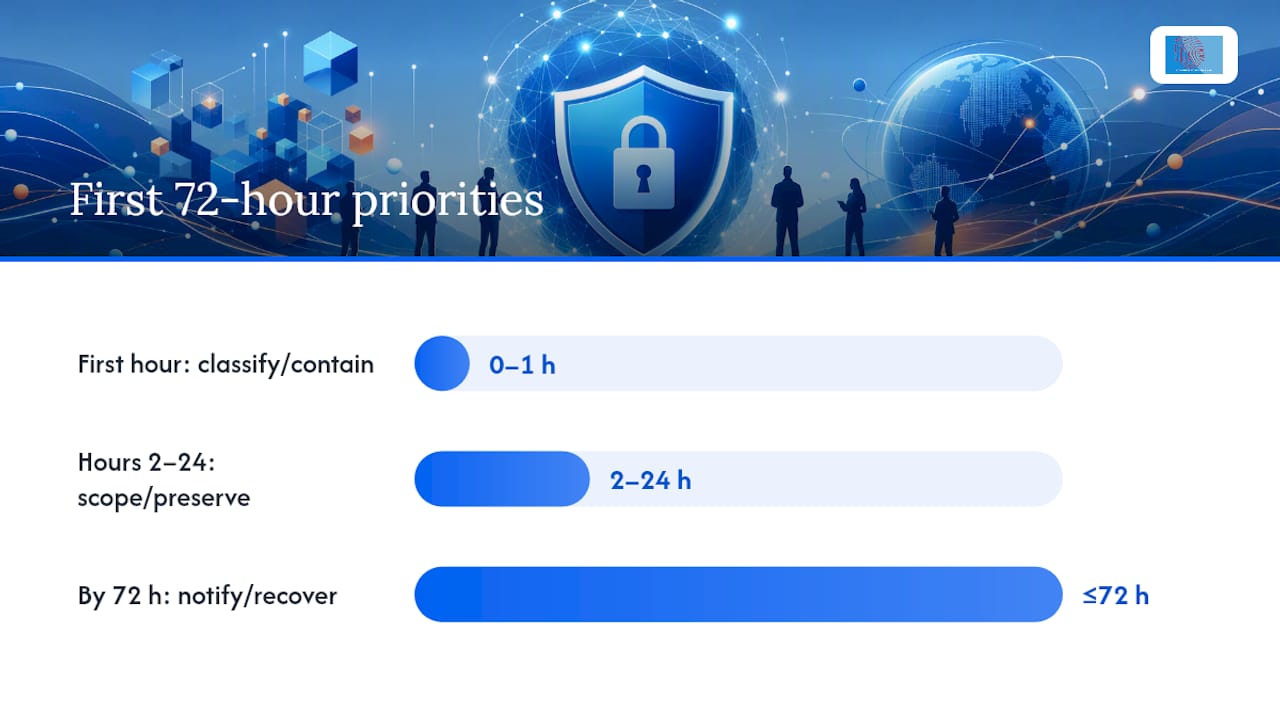
Within the first hour, confirm the incident classification, activate the incident manager, and initiate containment without wiping or reimaging affected systems. Evidence destruction in the first hours is one of the most common and costly mistakes. Between hours 2 and 24, focus on scope determination, stakeholder notification (internal), and evidence preservation. By hour 72, the ICO notification decision must have been made and, where required, submitted. Recovery activities should not begin until eradication is confirmed.
Pro Tip: Triage on impact, not alert volume. A single confirmed credential compromise on a privileged account warrants a higher severity classification than fifty low-fidelity endpoint alerts. Noisy alerting environments punish teams that have not pre-defined their severity thresholds.
Who should be on your incident response team and what each role must do
Microsoft’s incident response guidance stresses that effective IR requires a cross-functional team with defined procedures for detection, containment, eradication, and recovery, with communications and legal considerations embedded from the outset. The Canadian Centre for Cyber Security similarly recommends including non-technical decision-makers, specifically legal, communications, and HR, in IR planning to manage liability, regulatory reporting, and reputational risk.
| Role | Primary responsibilities | Decision authority / escalation |
|---|---|---|
| Incident Manager | Coordinates the overall response; owns the incident timeline and status updates | Activates the IRP; escalates to Executive Sponsor |
| Technical Lead | Directs containment, eradication, and recovery activities | Authorises system isolation and credential resets |
| Communications Lead | Manages internal updates, external statements, and media enquiries | Approves all external messaging with Legal |
| Legal Counsel | Advises on regulatory obligations, evidence handling, and liability | Authorises ICO and NIS notifications |
| HR Representative | Manages employee-related aspects (insider threat, disciplinary process) | Advises on employment law constraints |
| Executive Sponsor | Provides organisational authority and resource allocation | Approves major decisions (system shutdown, public disclosure) |
| Forensic Specialist | Preserves evidence, maintains chain of custody, performs technical analysis | Determines evidence acquisition scope |
| IT Operations | Executes technical tasks under Technical Lead direction | Implements containment and recovery actions |
| Third-Party Liaison | Manages communication with vendors, cloud providers, and managed service providers | Escalates supplier SLA breaches |
Escalation sequence:
- Escalate to the Executive Sponsor when the incident reaches P1 severity, when regulatory notification is triggered, or when the response requires expenditure beyond pre-approved budgets.
- Notify the ICO when a personal data breach meets the threshold for mandatory reporting; involve Legal Counsel before submission.
- Involve law enforcement (Action Fraud, the National Cyber Security Centre’s incident reporting service, or the police) when criminal activity is confirmed or suspected, particularly in cases of data theft, ransomware with extortion, or insider fraud.
- Engage external forensic specialists when internal capability is insufficient to preserve evidence to a legally admissible standard, or when the incident has regulatory or litigation implications.
Pro Tip: Require formal senior leadership approval and a defined budget allocation as part of the IRP sign-off process. An incident manager who lacks pre-approved authority to isolate a production system or engage an external forensic provider will lose critical time seeking approval during the incident itself.
How to build an incident response plan: a step-by-step checklist
The simplest route to a usable IRP follows six sequential steps: establish policy, assemble the team, write playbooks, build the communication plan, test, and maintain. TechTarget’s build guidance confirms this structure aligns with NIST and SANS frameworks and represents recognised best practice.
Step-by-step build plan with milestones:
- Days 0–10: Policy and scope. Draft the IRP policy statement, define scope (systems, data, incident types), and identify the executive sponsor. Obtain initial sign-off to proceed.
- Days 11–20: Team assembly and RACI. Assign named individuals to each role. Document decision authorities and escalation contacts. Confirm availability of legal counsel and forensic retainer.
- Days 21–30: Classification matrix. Define severity tiers (P1–P4), map each tier to response timescales, notification obligations, and escalation triggers. Review against ICO and NIS thresholds.
- Days 31–50: Playbook development. Write scenario-specific playbooks for at least three incident types: ransomware, data exfiltration, and compromised credentials. Each playbook must include evidence capture steps.
- Days 51–60: Communication plan. Draft internal escalation scripts, external notification templates, and media holding statements. Obtain legal and PR approval for all external-facing content.
- Days 61–75: First tabletop exercise. Run a facilitated tabletop scenario against the ransomware playbook. Document gaps and assign remediation owners with deadlines.
- Days 76–90: Review, sign-off, and maintenance schedule. Incorporate tabletop findings, obtain formal executive sign-off on the completed IRP, and establish a review cadence (minimum annually, or after any significant incident or material change to the environment).
Integration considerations:
- ISO/IEC 27001: Map IRP controls to Annex A clause A.5.26 (response to information security incidents) and A.5.27 (learning from incidents) to support certification or audit readiness.
- Supplier contracts: Verify that key suppliers’ incident notification obligations to your organisation are documented and align with your IRP timescales.
- Cyber insurance: Share the IRP structure (not necessarily the full document) with your insurer; many policies require evidence of a tested plan as a condition of coverage.
- IR retainer: Consider engaging an external forensic or IR provider on retainer before an incident occurs. Pre-agreed terms, scoped access, and established relationships reduce response time materially.
For sector-specific guidance, the cybersecurity guide for legal professionals addresses the particular obligations of solicitors and law firms handling client data under SRA requirements.
Evidence preservation and when to engage forensic specialists
Preserve live evidence only when it is safe, authorised, and technically feasible to do so without compromising the integrity of the data or the safety of the investigation. The governing principle is that evidence integrity takes precedence over speed of remediation: a system reimaged before forensic acquisition may resolve the immediate operational problem but will destroy the evidentiary record needed for regulatory enquiries, insurance claims, or criminal prosecution. Forensic readiness, including chain-of-custody procedures and defined evidence preservation processes, is frequently overlooked yet materially affects legal outcomes and insurance claims.
First-responder forensic checklist:
- Do not power off affected systems unless there is an immediate risk of further data destruction; live memory (RAM) contains volatile artefacts that are lost on shutdown.
- Capture volatile data first: running processes, active network connections, logged-in users, and system time.
- Take forensically sound disk images using write-blocking hardware or verified imaging tools before any remediation activity.
- Preserve log files from SIEM, endpoint agents, firewalls, and cloud platforms; export to a secure, isolated location.
- Photograph physical equipment and document the physical environment before moving anything.
- Do not attempt to access or open suspected malicious files on the affected system.
- Record every action taken on affected systems from the moment of detection, including who performed it and at what time.
Chain of custody documentation fields:
- Item description and unique identifier (serial number, hash value for digital evidence)
- Date, time, and location of collection
- Name and role of the person who collected the item
- Reason for collection
- Storage location and access controls applied
- Every transfer: from whom, to whom, date, time, and purpose
- Verification hash (MD5, SHA-256) recorded at acquisition and verified at each transfer
When to escalate to external forensic specialists or law enforcement:
- Data theft or exfiltration is confirmed or suspected, particularly involving personal data, intellectual property, or legally privileged material.
- The incident has potential criminal dimensions (ransomware with extortion, insider fraud, unauthorised access by a third party).
- Internal technical capability cannot produce forensically sound evidence to a standard that will withstand legal scrutiny.
- Regulatory exposure is significant and the organisation anticipates an ICO investigation or litigation.
- The scope of compromise extends to cloud infrastructure, mobile devices, or third-party systems where specialist acquisition tools are required.
The step-by-step evidence collection guide from Computerforensicslab provides a practical acquisition checklist for first responders, and the digital forensic investigations service page details the full forensic process for incidents with legal or regulatory implications.
Testing the plan: tabletop exercises, live drills, and learning from incidents
Test annually at minimum; organisations in high-risk sectors, including financial services, healthcare, and critical national infrastructure, should exercise quarterly. A single exercise type is insufficient: tabletop discussions, scenario-based drills, and technical intrusion simulations each surface different categories of gap. NCSC guidance explicitly recommends regular testing of incident response and recovery plans as a board-level concern.
Exercise types and what each tests:
- Tabletop exercise: A facilitated discussion where the team walks through a scenario (e.g., ransomware discovery on a Monday morning) without executing technical actions. Tests decision-making, role clarity, and communication flows.
- Functional drill: Selected teams execute specific IRP procedures in a controlled environment, such as activating the communication plan or performing a simulated ICO notification. Tests procedural accuracy and timing.
- Full-scale simulation: A realistic, unannounced or semi-announced scenario that exercises the complete IRP, including technical containment, executive escalation, and external communications. Tests integration and resilience under pressure.
- Red team / adversary simulation: An external team attempts to compromise the environment using real attack techniques. Tests detection capability and the effectiveness of containment playbooks against a live threat actor.
Facilitator checklist for a tabletop exercise:
- Define the scenario and inject timeline in advance; share only the initial trigger with participants.
- Assign an independent observer to record decisions, timings, and gaps without participating.
- Introduce scenario injects at defined intervals to test escalation triggers (e.g., “the attacker has now accessed the HR database”).
- Time each phase against IRP-defined response windows.
- Conduct a hot debrief immediately after the exercise while observations are fresh.
- Produce a written lessons-learned report within five working days, with named owners and deadlines for each gap identified.
Metrics to track programme health:
- Mean time to detect (MTTD): the average elapsed time between incident occurrence and confirmed detection.
- Mean time to contain (MTTC): the average elapsed time between detection and effective containment.
- Mean time to recover (MTTR): the average elapsed time from containment to full operational restoration.
- Lessons-closed rate: the percentage of post-incident or post-exercise findings closed within the agreed remediation window.
Post-incident retrospectives must be conducted on a blameless basis. When staff fear personal consequences for disclosing mistakes, they conceal the information that would prevent the same failure recurring. The retrospective’s purpose is to identify systemic weaknesses in process, tooling, or training, not to assign individual fault.
For scenario templates suited to UK legal and corporate environments, the cyber security scenarios guide provides structured exercise inputs that can be adapted directly.
UK legal and regulatory requirements that must shape your IRP
IRP design must enable compliance with UK notification obligations, most critically the ICO’s 72-hour reporting window for qualifying personal data breaches, and must generate the documented evidence trail that regulators and courts will scrutinise after an incident. Embedding notification workflows into the IRP before an incident occurs is the only reliable way to meet these timescales under operational pressure.
Key legal steps and timelines to embed in your IRP:
- ICO notification (UK GDPR / Data Protection Act 2018): Where a personal data breach is likely to result in a risk to individuals’ rights and freedoms, notify the ICO within 72 hours of becoming aware. The IRP must include a notification decision checklist and a pre-drafted notification template. Guidance is available directly from the ICO.
- NIS Regulations 2018: Operators of essential services and relevant digital service providers must notify the competent authority of incidents with a significant impact on service continuity. Thresholds and timescales vary by sector; legal counsel should confirm the applicable threshold for your organisation.
- Contractual notification to customers and partners: Many commercial contracts require notification of security incidents within defined windows (often 24–72 hours). The IRP communication plan must include a contractual notification checklist.
- Law enforcement notification: Where criminal activity is confirmed, report to Action Fraud (the UK’s national fraud and cybercrime reporting centre) and, for serious incidents, engage directly with the National Crime Agency or regional police cyber units. The NCSC incident reporting service provides a parallel channel for significant incidents affecting UK organisations.
- Sector-specific regulators: Financial services firms must consider FCA notification obligations; healthcare organisations must consider CQC and NHS Digital requirements. These sit alongside, not instead of, ICO obligations.
Pro Tip: Involve in-house or external legal counsel in IRP design, not just during an incident. Counsel can identify notification triggers specific to your sector, review communication templates for legal risk, and advise on the distinction between voluntary disclosure and mandatory reporting.
Criminal investigations and regulatory reporting are distinct processes with different objectives and timescales. Notifying the ICO does not substitute for reporting to law enforcement, and vice versa. The decision to involve police should be made with legal counsel and should not be delayed solely because regulatory reporting is in progress. For a detailed breakdown of the ICO reporting process, the UK data breach reporting guide provides a step-by-step compliance reference.
Primary authoritative sources for UK regulatory guidance include the NCSC, the ICO, GCHQ, and the NPSA for broader organisational resilience considerations.
Tools and technologies commonly used in incident response
Tools enable detection, containment, analytics, and forensic acquisition, but governance structures and tested playbooks deliver more value than any single technology platform. An organisation with a mature IRP and basic tooling will outperform one with enterprise-grade technology and no documented procedures. That said, the right tooling materially accelerates every phase of the response lifecycle.
Tool categories and their function in IR:
- Endpoint Detection and Response (EDR) / Extended Detection and Response (XDR): Provides telemetry from endpoints and, in the case of XDR, across network, cloud, and identity layers. CrowdStrike Falcon and Palo Alto Networks Cortex XDR are widely deployed examples in enterprise environments.
- Security Information and Event Management (SIEM) / log management: Aggregates and correlates log data from across the environment to support detection and investigation. IBM QRadar and Splunk are established platforms in this category.
- Security Orchestration, Automation, and Response (SOAR): Automates repetitive response tasks and orchestrates workflows across tools. Palo Alto Networks Cortex XSOAR is a commonly referenced example.
- Backup and recovery platforms: Verified, isolated backups are the primary recovery mechanism for ransomware incidents. The IRP must specify backup verification frequency and restoration procedures.
- Secure remote access: Enables the IR team to access affected systems without introducing additional risk through uncontrolled remote connections.
- Forensic imaging tools: Write-blocking hardware and verified imaging software (such as those used in forensically sound acquisition workflows) are required for evidence preservation that will withstand legal scrutiny.
Selection criteria for UK organisations:
- Telemetry coverage across the full environment, including cloud workloads and remote endpoints.
- Evidence preservation features: does the tool maintain audit logs in a tamper-evident format?
- Integration with existing security stack and IT infrastructure.
- Supplier SLAs and UK data residency: confirm that log and evidence data does not leave UK or EEA jurisdiction without legal basis.
- Vendor incident response support: does the supplier offer a rapid-response retainer or 24/7 support for IR engagements?
For guidance on malware detection strategies suited to UK legal and corporate environments, Computerforensicslab provides technical and procedural guidance that bridges the gap between tooling and legal admissibility requirements.
Quick IRP playbook examples you can adapt
Playbooks convert policy into repeatable, executable action. A ransomware playbook and a data exfiltration playbook cover the two incident types most likely to trigger regulatory notification obligations for UK organisations.
Ransomware playbook (abbreviated):
Trigger: Endpoint agent or user reports encrypted files, ransom note, or inability to access systems.
- Classify as P1; activate Incident Manager and Technical Lead immediately.
- Isolate affected endpoints from the network (disable network adapters; do not power off).
- Capture volatile memory and running process list before any further action.
- Identify the scope of encryption: which systems, which data classifications, which backups are affected.
- Confirm whether data exfiltration preceded encryption (check egress logs, dark web monitoring alerts).
- Notify Executive Sponsor and Legal Counsel; initiate ICO notification decision process.
- Do not pay any ransom without legal counsel advice and law enforcement consultation.
- Initiate recovery from verified clean backups only after eradication is confirmed.
Data exfiltration playbook (abbreviated):
Trigger: DLP alert, SIEM correlation rule, or third-party notification indicating unauthorised data transfer.
- Classify severity based on data type (personal data = P1 if ICO threshold likely met).
- Preserve egress logs, email gateway logs, and endpoint activity records immediately.
- Identify the exfiltration vector: email, USB, cloud upload, or remote access session.
- Contain: revoke access credentials associated with the exfiltration path.
- Determine data subject scope for ICO notification assessment.
- Notify Legal Counsel; prepare ICO notification draft within two hours of classification.
- Notify affected individuals where required under UK GDPR Article 34.
One-page IRP template layout:
- Section 1: Plan title, version, date, owner, and executive sign-off signature.
- Section 2: Scope statement and definitions (what constitutes an incident, severity tiers).
- Section 3: Roles and responsibilities (names, contact numbers, decision authorities).
- Section 4: Incident classification matrix (P1–P4 with triggers and response timescales).
- Section 5: Playbook index (list of attached playbooks with version numbers).
- Section 6: Communication plan (internal escalation, external notification, media holding statement).
- Section 7: Evidence handling and forensic procedures (chain-of-custody form reference).
- Section 8: Third-party contacts (legal, forensic, insurer, cloud provider, NCSC).
- Section 9: Testing schedule and review cadence.
- Section 10: Document history and change log.
First-response checklist (print and keep offline):
- Confirm incident classification and severity.
- Activate Incident Manager; log activation time.
- Do not reimage or power off affected systems.
- Preserve volatile evidence (RAM, active connections).
- Isolate affected systems from the network.
- Notify Executive Sponsor and Legal Counsel.
- Start the incident log: every action, every decision, every time.
- Initiate ICO notification decision process if personal data is involved.
The incident response procedures guide for UK legal teams provides additional playbook structures tailored to the specific obligations of legal sector organisations.
Why forensic readiness belongs at the centre of your IRP
The most common gap Computerforensicslab observes when reviewing organisational IRPs is not in the technical response procedures. It is in forensic readiness: the absence of pre-defined evidence acquisition procedures, chain-of-custody documentation, and a clear decision point for engaging specialist forensic support. That gap has direct consequences. Evidence destroyed or contaminated in the first hours of an incident cannot be reconstructed, and its absence weakens the organisation’s position in regulatory enquiries, insurance claims, and any subsequent litigation.

The practical recommendation for any organisation reviewing its IRP in the next 30 days is to add a forensic readiness annex. This annex should specify the evidence acquisition sequence for each playbook scenario, name the external forensic provider on retainer, include a blank chain-of-custody form, and define the decision criteria for escalating to external specialists. Computerforensicslab provides digital forensics services including expert witness reporting, forensically sound data acquisition, malware analysis, and chain-of-custody management for incidents with legal or regulatory implications. Organisations that establish this relationship before an incident occurs consistently achieve faster, cleaner evidence acquisition when it matters.
The broader point is this: governance and forensic readiness are not separate concerns from technical IR capability. They are the conditions under which technical capability produces legally usable outcomes.
Sources
- Planning your response to cyber incidents | NCSC
- What is Incident Response? | Microsoft Security
- Developing your incident response plan (ITSAP.40.003) | Canadian Centre for Cyber Security