A deleted WhatsApp message, a disputed login, a laptop said to have been wiped, or an image with uncertain provenance can change the direction of a case. But the value of that material depends not only on what it appears to show, but on who examines digital evidence, how it is acquired, and whether every stage can withstand challenge.
For legal proceedings, internal investigations and private disputes, digital evidence should be examined by an appropriately qualified digital forensic practitioner. Their role is not simply to find data. It is to preserve it without alteration, analyse it using repeatable methods, explain its significance within proper limits, and produce evidence that can be independently tested.
Who examines digital evidence?
The principal specialist is a digital forensic examiner, sometimes called a computer forensic investigator, mobile phone forensic examiner or digital forensics expert. The title may vary according to the device or issue, but the essential discipline is the same: examination of electronic material in a way that protects evidential integrity.
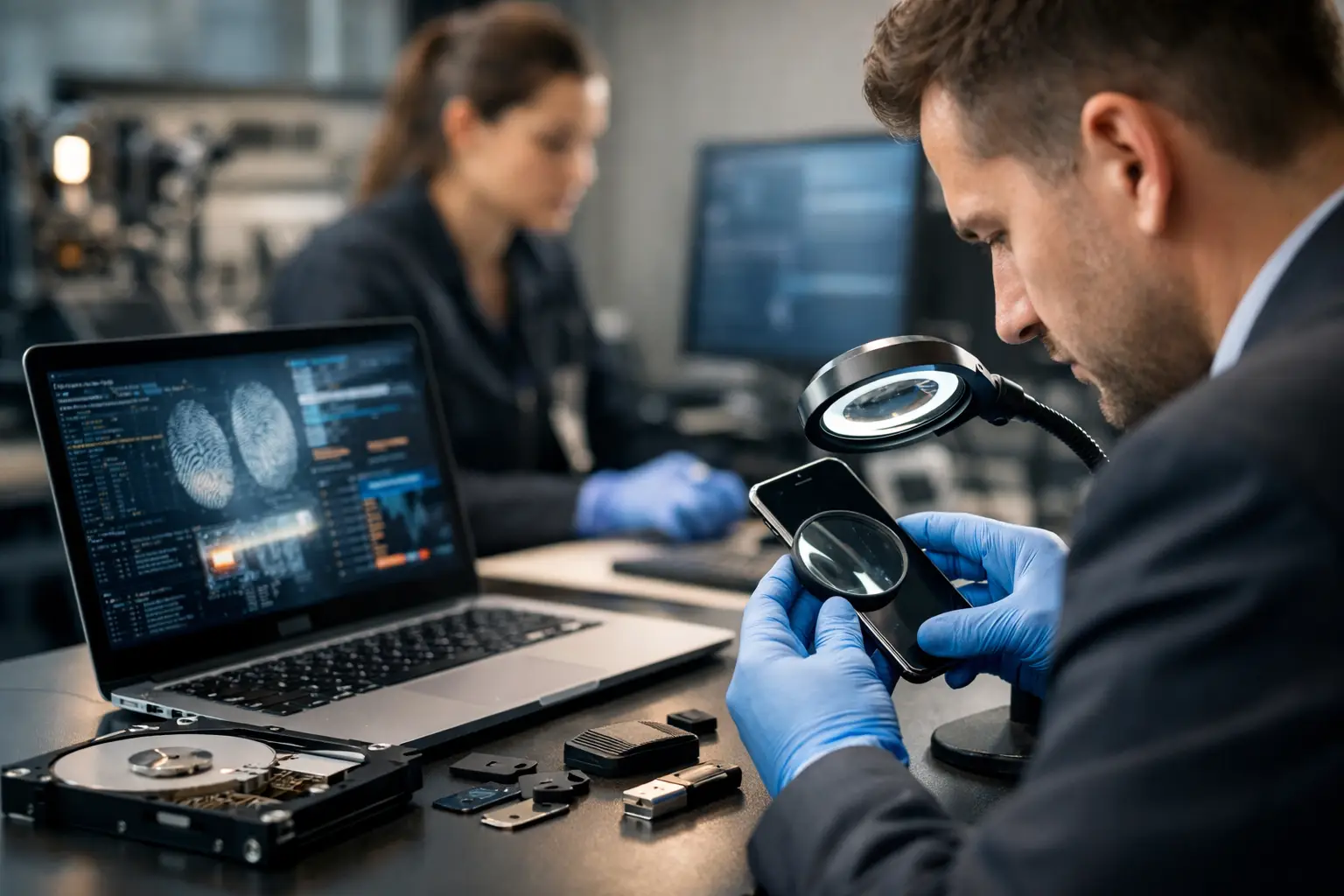
A forensic examiner may investigate mobile phones, computers, tablets, USB devices, servers, CCTV systems, cloud-synchronised accounts, vehicle data, social media records and recovered storage media. They can identify user activity, recover deleted material where technically possible, establish timelines, assess artefacts of access or transfer, and distinguish between what the data demonstrates and what remains uncertain.
In a UK legal context, the examiner’s work is often commissioned by solicitors, barristers, insurers, businesses, law enforcement bodies or private clients. In contentious matters, independence matters greatly. An expert’s duty is to the court or tribunal, not to the party paying for the instruction. Findings must therefore be impartial, transparent and based on the available evidence rather than an assumed narrative.
A forensic examiner is not the same as an IT technician
An IT professional may be highly capable of repairing a machine, resetting an account or removing malware. Those are valuable skills, but they are not automatically forensic skills. Routine IT work can overwrite logs, change system dates, alter files, trigger synchronisation or otherwise affect material that may later be relevant.
A forensic examiner works differently. Before analysis begins, they consider preservation, scope, authority and chain of custody. A forensic copy is normally created using methods designed to avoid changing the original data. The original device or media is secured, while analysis is conducted on verified forensic copies wherever possible.
This distinction is especially significant where evidence is disputed. A screenshot supplied by a client may assist an investigation, but it rarely carries the same weight as material recovered directly from the source device with acquisition records, hash verification and a documented handling history.
The specialists involved in a digital evidence examination
Digital investigations often require more than one discipline. The right examiner depends on the devices, the questions to be answered and the stage of the matter.
Mobile phone forensic examiners
Mobile devices are central to many investigations because they contain messages, call records, photographs, location artefacts, app data, browser activity and cloud-linked content. A mobile phone forensic examiner uses specialist tools and methods to acquire and interpret that data while recording the device condition, identifiers, security status and extraction process.
Not every phone can be examined to the same depth. Encryption, passcodes, operating system version, device damage and remote management settings can limit what is available. A disciplined report should make those limitations clear rather than implying that absence of recovered data proves absence of activity.
Computer forensic investigators
Computer forensic investigators examine desktops, laptops, external drives and removable media. Their work may address allegations of unauthorised access, employee misconduct, intellectual property theft, inappropriate communications, document manipulation or concealed data.
They may assess user accounts, log-in activity, USB connection history, internet artefacts, file metadata, deleted files, application records and operating system logs. In a workplace dispute, for example, the question may not simply be whether a file exists. It may be whether it was opened, copied to a removable device, uploaded to a cloud service or accessed by a particular account at a particular time.
Cyber incident and network specialists
Where the issue is hacking, ransomware, data exfiltration or unauthorised access, a cyber incident responder or network forensic specialist may be required. They examine event logs, endpoint telemetry, firewall records, email headers, network traffic and indicators of compromise.
Speed is often essential in an active incident, but speed must not become an excuse for poor preservation. Containment action may be necessary to protect the organisation, while a parallel forensic process preserves logs and affected systems for later investigation, regulatory obligations or litigation.
E-discovery and disclosure professionals
Large civil disputes can involve thousands or millions of documents, emails, chats and files. E-discovery professionals help identify, collect, filter, review and disclose electronically stored information in a proportionate and defensible manner.
Their role differs from device forensics, although the two frequently overlap. E-discovery is focused on managing potentially relevant material across large data sets. Forensic examination is often needed when authenticity, deletion, provenance, timing or user activity is in issue.
Digital forensic expert witnesses
An expert witness is a forensic practitioner who provides an independent opinion within their area of expertise and may be required to prepare a court-compliant report or give oral evidence. They must explain their methodology in terms the court can understand, disclose material limitations, and remain objective under cross-examination.
A good expert witness does not argue the client’s case. They assist the court by addressing properly framed technical questions. That may include whether data was present on a device, whether it appears to have been created or altered at a stated time, or whether an alleged account compromise is supported by the available records.
What makes a digital evidence examiner credible?
Technical capability is only one part of credibility. In high-stakes matters, the process must be as reliable as the result.
A credible examiner records how the device was received, who handled it, its condition, serial or identifying numbers, and any relevant security state. They preserve the original evidence, use validated tools where appropriate, retain acquisition and analysis records, and ensure findings can be reviewed. This documented chain of custody helps show that the evidence presented is the same material that was originally obtained.
The examiner should also define the scope before undertaking broad searches. A matrimonial case may require a focused review of communications and images. An employment dispute may require analysis of file transfer and account activity. A criminal defence instruction may involve testing whether the prosecution’s interpretation of device data is justified. Scope protects privacy, manages cost and reduces the risk of irrelevant material being unnecessarily examined.
Qualifications, experience and quality procedures matter, but no certificate alone guarantees a sound examination. Solicitors and organisations should ask practical questions: Has the examiner handled comparable matters? Can they provide a clear methodology? Will they report both inculpatory and exculpatory findings? Are they able to explain limitations? Can their work be peer reviewed and, if required, defended in court?
When should a forensic examiner be instructed?
The earlier, the better. Devices and cloud accounts change constantly. Messages can be deleted, logs may roll over, systems can synchronise, and well-intentioned users may continue using a device that could be evidentially significant.
Early instruction is particularly valuable where there is an allegation of hacking, a departing employee is suspected of taking confidential information, digital communications are central to a family dispute, or a party challenges the authenticity of documents or screenshots. An examiner can advise on lawful preservation and proportionate collection before key material is lost.
That does not mean every matter requires a full forensic examination. If both sides accept a small, agreed set of documents, a targeted review may be enough. If the issue concerns deleted data, attribution, device usage or alleged manipulation, a deeper forensic process is more likely to be justified. The right approach depends on the evidential question, the available material, proportionality and the consequences of getting it wrong.
What a court-ready examination should provide
A court-ready examination should produce more than a collection of exported messages or technical screenshots. It should provide a clear account of the instruction received, material examined, preservation steps, methods used, findings, interpretation and limitations.
The report should separate fact from opinion. It may state that a specific file was recovered from a device, that artefacts indicate a USB drive was connected, or that messages were present in an extraction. It should be cautious about conclusions the data cannot support, such as identifying the person physically operating a device without sufficient corroborating evidence.
At Computer Forensics Lab, examinations are approached with this evidential discipline: preserve first, analyse carefully, report transparently, and ensure the findings are capable of scrutiny.
When digital material could affect a prosecution, civil claim, workplace outcome or personal dispute, treat the device as evidence before treating it as a source of answers. Secure it, avoid unnecessary use, record who has handled it, and obtain specialist advice early. That first decision can determine whether the truth remains available to be proved.