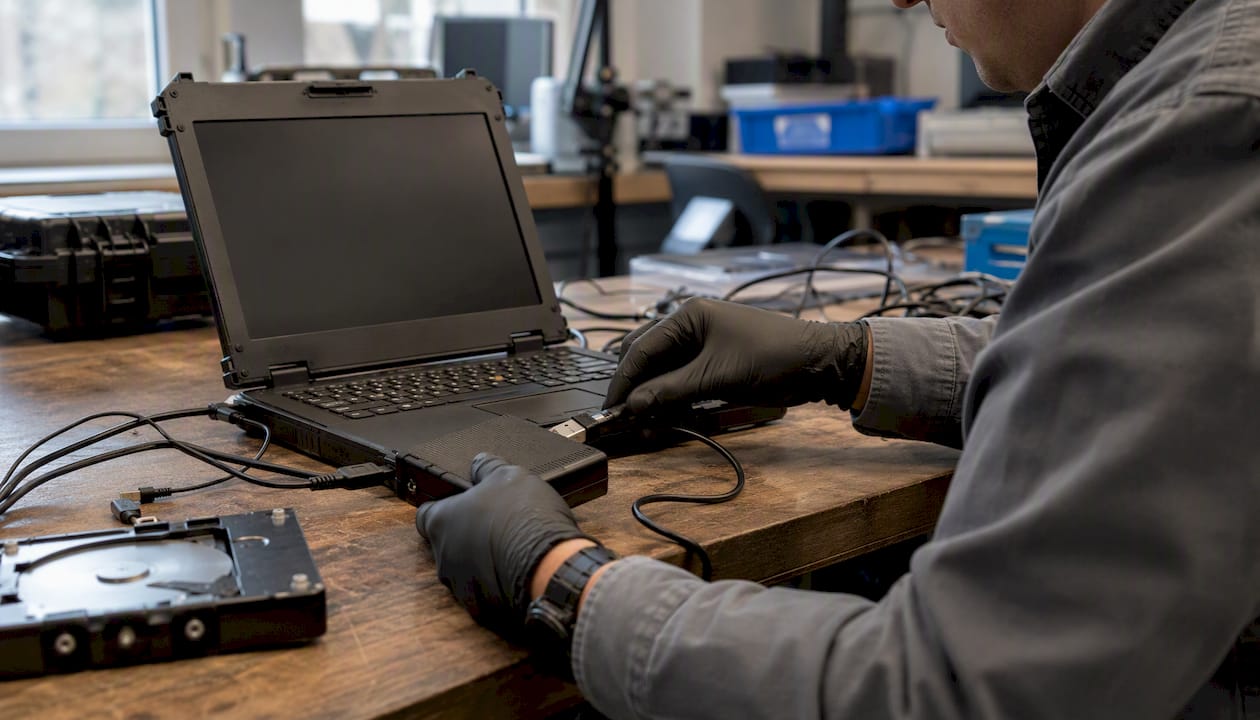
Forensic analysis in cyber security, more precisely termed digital forensics or computer forensics, is the structured, forensically sound process of collecting, preserving, examining, and analysing digital evidence so that findings can support remediation, regulatory compliance or legal proceedings. CISA defines it as the application of scientific methods to collect, analyse and present evidence in a manner admissible in court. The standard process follows four phases:
- Acquisition: capturing data from live systems and storage media without altering it
- Examination: locating artefacts, recovering deleted files and parsing system logs
- Analysis: reconstructing a timeline of events and attributing activity
- Reporting: documenting findings, methodology and chain of custody for legal or regulatory use
The core goals are evidence integrity, accurate attribution, effective remediation and legal admissibility. Every decision an investigator makes, from which device to image first to how findings are worded in a report, is shaped by those four objectives.
Key takeaways
Forensic analysis in cyber security is the structured, evidence-preserving process that determines what happened in an incident, how it happened, and what proof can be brought to court or a regulator.
| Point | Details |
|---|---|
| Four-phase process | Every investigation follows acquisition, examination, analysis and reporting, in that order. |
| Volatile evidence first | RAM, active connections and encryption keys are lost on shutdown; capture them before imaging storage. |
| Chain of custody is mandatory | Every handler, action and hash value must be documented from collection to court; gaps exclude evidence. |
| Forensic readiness cuts investigation time | Logging policies, retention windows and pre-drafted authorisation templates preserve evidence automatically. |
| Computerforensicslab | Provides court-ready forensic investigations, expert witness reports and full chain of custody documentation for UK legal and corporate cases. |
Table of Contents
- Why forensic analysis matters after a cyber incident
- Core concepts every forensic investigator must understand
- What are the main types of digital forensics?
- Which tools do forensic analysts use?
- How does forensic analysis fit into incident response and UK legal proceedings?
- What skills and certifications do forensic analysts need?
- Is your organisation forensically ready?
- What are the main challenges in forensic analysis?
- What should your organisation do in the first 72 hours after a breach?
- A practitioner’s perspective on what actually matters in an investigation
- How Computerforensicslab supports your investigation
- Sources
Why forensic analysis matters after a cyber incident
A breach is not over when the attacker leaves. Without a structured forensic investigation, an organisation cannot determine what data was accessed, how the attacker entered, whether persistence mechanisms remain, or whether the incident triggers a legal reporting obligation. TechTarget notes that computer forensics is a structured investigation aimed at preserving integrity so that evidence can be presented in court, which means the discipline serves both technical and legal audiences simultaneously.
Business and operational reasons:
- Identifying the root cause prevents the same attack vector being exploited again
- Uncovering hidden persistence, such as backdoors or scheduled tasks, that standard detection tools may miss
- Validating that remediation has actually removed the threat, not merely suppressed visible symptoms
- Preserving evidence for cyber insurance claims, which increasingly require documented forensic findings
Legal and compliance reasons:
- Under UK GDPR, organisations must report certain personal data breaches to the Information Commissioner’s Office within 72 hours of becoming aware; forensic evidence determines whether the threshold is met
- Evidence gathered without proper procedures may be inadmissible, exposing organisations to civil or criminal liability
- Regulators and courts expect documented chain of custody and reproducible methodology
- The NCSC, NIST and CISA all publish guidance emphasising that evidence collection must follow authorised, documented procedures to withstand legal scrutiny
Pro Tip: If your organisation holds cyber insurance, check the policy wording before an incident. Most policies require prompt notification and may specify that a forensic provider be engaged before remediation begins. Remediating first and investigating second can void coverage.
Preserving digital evidence for legal outcomes is not a secondary concern; it is a condition of both regulatory compliance and effective recovery.
Core concepts every forensic investigator must understand
Before examining the process in detail, several foundational concepts underpin every competent digital forensic investigation.
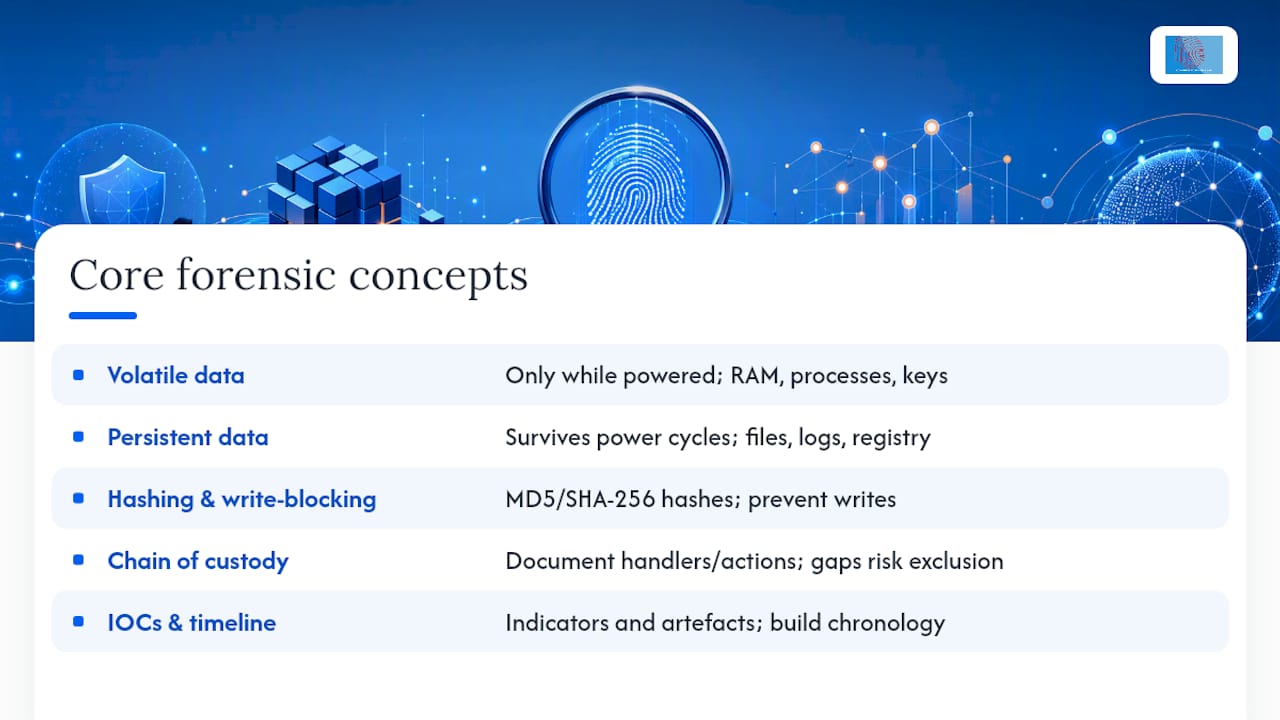
Volatile versus persistent data
Volatile data exists only while a device is powered: RAM contents, active network connections, running processes and encryption keys held in memory. Persistent data survives power cycles: files on disk, registry entries, event logs and database records. The distinction determines collection order. Volatile evidence is lost the moment a machine is shut down, so live capture of memory must precede any static imaging of storage media.
Hashing and write-blocking
A cryptographic hash, typically MD5 or SHA-256, generates a unique fingerprint of a dataset at the moment of acquisition. Any subsequent alteration, however minor, produces a different hash value, providing mathematical proof that evidence has not been tampered with. Write-blockers, either hardware devices or software controls, prevent any write operation to the source media during imaging, preserving the original state. TechTarget confirms that write blockers and hashing are standard integrity-preservation techniques in forensic practice.
Chain of custody
Chain of custody is the documented record of every person who handled a piece of evidence and every action taken on it, from the moment of collection through to presentation in court. A gap in that record, even a brief one, is sufficient grounds for a court to exclude the evidence. Computerforensicslab provides detailed guidance on safeguarding digital evidence integrity through proper chain of custody documentation.
Indicators of compromise, artefacts and timeline reconstruction
An indicator of compromise (IOC) is an observable piece of evidence, such as a suspicious IP address, a malicious file hash or an anomalous registry key, that suggests a system has been compromised. Artefacts are the digital traces left by user or system activity: prefetch files, browser history, USB connection records, event log entries. Timeline reconstruction correlates artefacts across multiple sources to produce a chronological account of what occurred and in what sequence.
Pro Tip: Capture volatile memory before touching anything else. TechTarget notes that practitioners sometimes use mouse jigglers to keep systems awake during live memory acquisition, preventing the OS from entering a sleep state that could flush RAM contents before capture is complete.
The four phases of a forensic investigation in detail
Acquisition
Acquisition is the most time-critical phase. For live systems, investigators perform a memory dump first, capturing RAM contents, active processes, open network connections and any encryption keys present. Static acquisition follows: a forensic image of storage media is created using a write-blocker, and the image is hashed immediately. NIST SP 800-86 provides technical guidance on live data collection procedures and recommended enterprise logging practices that support this phase. Investigators must operate in a controlled environment to avoid contaminating evidence.
A practical priority list for capture within the first few days involves capturing live RAM from affected systems promptly and sequentially collecting active network logs, forensic images of storage devices, email and authentication logs, imaging secondary systems accessed laterally, and gathering mobile device data and cloud storage artefacts in a timely manner.
Examination
Examination involves searching the acquired data for relevant artefacts. Investigators carve deleted files from unallocated disk space, parse Windows Registry entries or macOS plists, extract browser history and cached credentials, and review event logs for anomalous activity. The goal is to surface every potentially relevant artefact without drawing conclusions yet.
Analysis
Analysis is where artefacts are correlated across systems and a coherent narrative is constructed. Timeline reconstruction places events in chronological order, revealing the attacker’s entry point, lateral movement and data access. Advanced techniques such as cross-drive correlation, which compares artefacts across multiple storage devices, can detect insider data theft even when explicit logs are sparse. Attribution, however, carries inherent limits: an IP address or user account may have been compromised, and responsible analysts express certainty in degrees rather than absolutes.
Reporting
A forensic report must be reproducible, meaning another qualified examiner using the same tools and methodology should reach the same conclusions. Standard structure includes: executive summary, scope and methodology, chain of custody record, detailed findings with evidence references, timeline, conclusions and recommendations. Splunk emphasises that evidence must be identified, extracted, documented and preserved so it is admissible and usable in legal or civil processes, and the report is the primary vehicle for demonstrating that standard has been met.
What are the main types of digital forensics?
Digital forensics is not a single discipline. Investigations routinely span several branches, and understanding which type applies to a given incident determines which tools and specialists are needed.
- Disk and storage forensics: examines hard drives, SSDs and removable media for deleted files, partitions and file system artefacts; primary evidence source in ransomware and data theft cases
- Memory forensics: analyses RAM captures for running processes, injected code, encryption keys and network connections that leave no trace on disk; critical in fileless malware investigations
- Network forensics: reviews packet captures, flow data, firewall logs and proxy records to reconstruct communications; the primary approach for data exfiltration and command-and-control investigations
- Mobile device forensics: extracts call records, messages, application data and location history from smartphones and tablets; frequently required in fraud, harassment and employment disputes
- Cloud forensics: acquires logs, access records and stored data from cloud platforms such as Microsoft 365 or AWS; complicated by multi-tenancy, jurisdictional issues and provider access policies
- Malware forensics: reverse-engineers malicious code to determine its capabilities, persistence mechanisms and origin; informs both remediation and threat intelligence
- Database forensics: examines database transaction logs and records for unauthorised queries, data modification or exfiltration; relevant in financial fraud and insider threat cases
- Email forensics: analyses headers, metadata and content to establish authenticity, routing and authorship; used in phishing investigations and business email compromise cases
A ransomware incident, for example, typically requires disk forensics to identify encrypted files and the dropper, memory forensics to capture the encryption key before shutdown, and network forensics to trace the initial intrusion vector. Rarely does a serious investigation rely on a single branch.
Which tools do forensic analysts use?
Forensic analysts draw on a combination of commercial platforms, open-source utilities and specialist hardware. The choice of tool matters not just for capability but for courtroom credibility: tools must be validated and their outputs reproducible. A full overview of forensic analysis tools for legal teams covers the broader toolkit in depth.
Core platforms:
- Autopsy: an open-source digital forensics platform built on The Sleuth Kit; widely used for disk image analysis, keyword searching, timeline generation and file carving; suitable for both lab and field use without licensing costs
- EnCase (OpenText): a commercial platform used extensively by law enforcement and corporate investigators; supports disk, mobile and cloud acquisition with a court-accepted evidence format (.E01); the EnCE certification is tied directly to this tool
- FTK (Forensic Toolkit, by Exterro): a commercial platform known for its pre-indexing approach, which speeds up keyword searches across large datasets; used in both criminal and civil investigations; supports email analysis and registry parsing
Specialist and open-source tools:
- Volatility: the standard open-source framework for memory forensics; analyses RAM captures for process artefacts, injected code and network connections
- Wireshark: open-source packet capture and analysis; the primary tool for network forensics
- KAPE (Kroll Artifact Parser and Extractor): rapid triage collection tool for Windows artefacts; useful in time-critical field acquisitions
| Tool | Primary use | Typical context |
|---|---|---|
| Autopsy | Disk image analysis, file carving, timeline | Lab and field; open source |
| EnCase | Full-disk acquisition, mobile, cloud | Law enforcement, corporate lab |
| FTK | Pre-indexed search, email, registry | Corporate and legal investigations |
| Volatility | Memory analysis, malware detection | Lab; incident response |
| Wireshark | Packet capture, network traffic analysis | Field and lab; network incidents |
| KAPE | Rapid Windows artefact triage | Field; first-responder collection |
Tool validation matters. Courts may challenge findings if the tool used has not been tested against known datasets or if its methodology cannot be independently reproduced. Analysts working on cases destined for UK courts should document tool versions, validation tests and any known limitations in their reports.
How does forensic analysis fit into incident response and UK legal proceedings?
Forensic analysis and incident response are complementary but distinct activities. Incident response prioritises containment and restoration of business operations; forensics prioritises evidence preservation and attribution. The tension between these objectives, as Splunk observes, is that corporate IR teams often favour speed and continuity while law enforcement demands rigid procedural compliance for admissibility. Organisations that understand this distinction can plan for both.
Where forensics sits in the IR lifecycle:
- During triage, forensic considerations determine whether systems are isolated (preserving volatile evidence) or shut down (destroying it)
- During containment, forensic imaging of affected systems should precede any remediation activity
- During eradication, forensic findings identify every persistence mechanism that must be removed
- During recovery, forensic reports provide the evidence base for regulatory notifications and insurance claims
UK legal and compliance considerations:
- UK GDPR and the Data Protection Act 2018 govern how personal data may be collected and processed during an investigation; investigators must have documented legal authority before accessing personal data on employee devices
- Evidence admissibility in UK courts follows principles analogous to those in CISA and NIST guidance: documented procedures, unbroken chain of custody and reproducible methodology
- The NCSC’s incident management guidance and NIST SP 800-86 both stress that collection must be authorised and documented to withstand challenge
- For UK-specific legal compliance in digital forensics, organisations should review their authorisation templates before an incident occurs, not during one
Chain of custody checklist:
- Record the date, time and location of collection
- Document the identity of every person who collected, transported or accessed the evidence
- Note the condition of the device at collection (powered on/off, visible damage)
- Record the hash values of all acquired images immediately after acquisition
- Log every tool used, including version numbers
- Store evidence in a secure, access-controlled environment and log every access
When to contact police or regulators:
Notify Action Fraud or the relevant police force if criminal activity is suspected. Contact the ICO within 72 hours if personal data has been compromised at a reportable level. Engage the NCSC’s incident reporting service for significant attacks on critical national infrastructure or government systems. The FBI’s guidance on piecing together digital evidence illustrates how law enforcement expects methodical, verified evidence handling, and UK investigators should apply the same standard.
Pro Tip: Before engaging any external forensic provider, obtain written legal authority from the data controller and confirm the scope of the investigation in writing. Undocumented or overly broad collection is a common ground for evidence challenge in UK proceedings. HG Law’s data and cyber security practice offers a useful reference for understanding the legal authorisation framework in cross-border investigations.
What skills and certifications do forensic analysts need?
A forensic analyst’s day-to-day work spans technical investigation, legal documentation and, in some cases, expert witness testimony. Splunk’s overview of the investigator workflow confirms that the role requires both deep technical capability and the ability to communicate findings clearly to non-technical audiences, including judges and juries.
Typical daily tasks:
- Acquiring forensic images and memory captures from affected systems
- Parsing logs, registries and file system artefacts for IOCs
- Performing malware reverse engineering to determine capabilities and persistence
- Writing detailed, reproducible forensic reports
- Providing expert witness statements or appearing in court proceedings
Core technical skills:
- Operating system internals: Windows, Linux and macOS file systems, registry structures and process management
- Network protocols: TCP/IP, DNS, HTTP and authentication protocols
- Scripting: Python or PowerShell for automating artefact parsing and log analysis
- Tool proficiency: EnCase, FTK, Autopsy, Volatility and Wireshark at minimum
Widely recognised certifications:
- GCFA (GIAC Certified Forensic Analyst): validates competency in advanced incident response and memory forensics; widely respected in both corporate and law enforcement contexts
- EnCE (EnCase Certified Examiner): vendor-specific certification for EnCase; signals validated proficiency with the tool most commonly accepted in UK and international courts
- CISSP (Certified Information Systems Security Professional): a broader security management credential that signals strategic understanding of information security, including forensic readiness and incident response governance
Career pathways typically begin with a degree in computer science, cybersecurity or digital forensics, followed by entry-level roles in IT security or incident response. Practical tool experience, often gained through platforms such as Hack The Box or SANS training courses, is as valued as formal qualifications in most hiring decisions.
Is your organisation forensically ready?
Kaspersky identifies forensic readiness as the single most significant factor in improving investigation outcomes. Without it, critical volatile evidence and temporary logs are frequently lost during the initial chaos of incident handling, before a forensic investigator is even engaged.
Forensic readiness means having the policies, technical controls and documented procedures in place before a breach occurs, so that evidence is automatically preserved and investigators can begin work immediately rather than reconstructing what should have been captured.
Concrete elements of a forensic readiness programme:
- A logging policy that defines which events are logged, at what verbosity and on which systems
- Centralised log retention with a minimum retention window (90 days is a common baseline; regulated sectors often require 12 months or more)
- Secure time synchronisation across all systems using NTP, so that timestamps are consistent and reliable for timeline reconstruction
- Defined roles: who authorises an investigation, who performs collection and who manages legal liaison
- Legal authority templates: pre-drafted authorisation documents for common investigation scenarios
- Secure evidence storage: an isolated, access-controlled repository for acquired images and logs
- Incident response playbooks that include explicit forensic preservation steps before any remediation action
For regulated industries, enterprise compliance platforms can automate log retention, access auditing and evidence chain controls, reducing the manual burden of maintaining forensic readiness at scale.
Pro Tip: Prioritise capturing volatile artefacts and preserve logs before any system restart or software update. A single reboot during incident response can destroy RAM contents, overwrite prefetch data and rotate logs, eliminating evidence that no amount of disk forensics can recover. Build a “preserve before you patch” rule into your incident response playbook.
For detailed technical and legal standards on data preservation best practices, organisations should review current guidance before an incident forces the issue.
What are the main challenges in forensic analysis?
Forensic analysis operates under constraints that no amount of skill or tooling can fully eliminate. Setting realistic expectations about what an investigation can and cannot prove is part of responsible practice.
Key challenges:
- Encryption: full-disk encryption, end-to-end encrypted communications and ransomware all limit what investigators can recover without the relevant keys; even with legal authority, obtaining decryption keys from third-party providers can take weeks
- Ephemeral and volatile evidence: cloud-native architectures, containerised workloads and serverless functions generate evidence that exists only briefly; without forensic readiness controls, this evidence is gone before an investigator arrives
- Multi-jurisdiction cloud data: data stored across AWS, Azure or Google Cloud may span multiple legal jurisdictions, each with different access and disclosure rules; obtaining cloud provider logs often requires formal legal process
- Poor or absent logging: organisations without a logging policy frequently discover that the systems most relevant to an investigation generated no useful logs, or that logs were overwritten before collection
- Tool and method validation: courts may challenge findings if the tool used lacks documented validation; analysts must record tool versions and test results in their reports
- Attribution limits: digital evidence can establish what happened and often how, but attributing activity to a specific individual or nation-state requires corroborating evidence beyond digital artefacts alone
Mitigation approaches:
- Defensive design: build logging and retention into system architecture from the outset
- Forensic readiness programmes: as described above, these directly address the ephemeral evidence and poor logging problems
- Cloud forensic agreements: negotiate data access and preservation clauses with cloud providers before an incident
- Validated tooling: use tools with published validation studies and document their use in every report
- Qualified language in reports: express attribution as a probability or a supported inference, never as a certainty, unless the evidence is unambiguous
What should your organisation do in the first 72 hours after a breach?
The decisions made in the first 72 hours after discovering a suspected breach determine whether a forensic investigation succeeds or fails. The following ordered steps reflect best practice for preserving evidence while managing operational continuity. For a detailed procedural reference, Computerforensicslab’s step-by-step evidence collection guide covers each stage in depth.
First 24 hours:
- Isolate affected systems from the network without powering them down, to preserve volatile memory while preventing further spread
- Capture live RAM from affected systems immediately, before any shutdown or reboot
- Secure and export SIEM, firewall and authentication logs; confirm they are not being overwritten
- Photograph or record the physical state of devices and their screens before touching them
- Begin a chain of custody log: record who discovered the incident, when, and every action taken since
- Notify your legal team and confirm the scope of authorisation for evidence collection
- Assess whether the incident meets the UK GDPR 72-hour reporting threshold for the ICO
Hours 24–48:
- Create forensic images of affected storage devices using write-blockers; hash all images immediately
- Engage external forensic support if internal capability is insufficient or if legal proceedings are likely
- Notify Action Fraud or the relevant police force if criminal activity is suspected
- Begin preliminary timeline reconstruction from available logs and artefacts
- Communicate internally on a need-to-know basis; avoid using potentially compromised systems for incident communications
Hours 48–72:
- Extend collection to secondary systems that may have been accessed laterally
- Gather mobile device data, cloud access logs and backup records
- Confirm regulatory notification obligations and submit reports where required
- Brief legal and senior management on preliminary findings, using only verified evidence
Roles to involve: IT security lead, legal counsel, data protection officer, HR (if insider threat is suspected), communications lead and, where appropriate, external forensic investigators and law enforcement liaison.
A practitioner’s perspective on what actually matters in an investigation
The procedural framework of digital forensics is well-documented, but the gap between documented procedure and effective practice is wider than most guides acknowledge.
Evidence integrity is the non-negotiable foundation. Every other aspect of an investigation, the quality of the analysis, the clarity of the report, the credibility of expert testimony, depends entirely on whether the evidence was collected and preserved correctly from the first moment. Investigators who cut corners at acquisition, even under time pressure from a client demanding rapid answers, create problems that cannot be fixed downstream. A forensic image taken without a write-blocker, or a memory capture delayed until after a reboot, is not a minor procedural lapse; it is a potential case-ending error.
Clear, reproducible reporting is the second priority that practitioners underestimate. A technically brilliant analysis presented in ambiguous language, or without a complete methodology section, gives opposing counsel exactly the opening they need. Reports must be written for two audiences simultaneously: the technical reviewer who will scrutinise the methodology, and the judge or jury who will rely on the executive summary. Getting that balance right is a skill that takes years to develop.
The third reality is that collaboration with legal teams must begin before collection, not after. Documented authorisation, agreed scope and a clear chain of custody record are not administrative formalities; they are the conditions under which findings become admissible. Investigators who treat legal liaison as a post-investigation task consistently produce work that is technically sound but legally vulnerable.
How Computerforensicslab supports your investigation
When an incident requires court-ready evidence, impartial analysis or expert witness testimony, an external forensic provider offers advantages that internal teams rarely can match: validated tools, documented methodology, professional indemnity and the credibility that comes from independence.
Computerforensicslab provides digital forensic investigation services across the full spectrum of cyber incidents, from data breach investigations and malware analysis to mobile device examination and e-discovery for litigation. Every engagement produces a forensically sound evidence package with a complete chain of custody record, suitable for use in UK civil or criminal proceedings. The team also provides expert witness reports and court testimony, supporting legal professionals who need a qualified examiner to present findings to a judge or jury.
For organisations that need to understand the full scope of what an investigation involves before committing, the complete guide to online investigations sets out the process, timelines and deliverables in plain terms. Contact Computerforensicslab directly to discuss the specifics of your case and confirm how quickly an investigation can begin.
Sources
The following authoritative references underpin the guidance in this article and provide further detail for practitioners and organisations seeking to deepen their understanding.
- Cisa
- What is computer forensics? | Definition from TechTarget
- NIST Special Publication 800-86
- Piecing together digital evidence | FBI
This article is general information, not a substitute for advice from a qualified lawyer. Consult a qualified legal professional about your own circumstances before acting on anything here.