Expert testimony in writing is a formal report in which a qualified specialist sets out objective opinions, technical analysis or scientific conclusions to help a court understand evidence that sits outside common knowledge. Its purpose is not to persuade but to inform: the report must present reliable data, clearly separate established fact from professional opinion, and give the court a basis on which to reach its own decision.
TL;DR:
- Expert reports must clearly justify their methodology and be built on recognized standards to withstand judicial scrutiny and avoid exclusion.
- The report should distinguish facts from assumptions and include raw data, images, and exhibits to ensure transparency and reproducibility.
- Qualification depends on a combination of education, experience, and independence, with the expert’s primary duty being to the court rather than the instructing party.
- Proper instruction agreement and scope definition before analysis are crucial to prevent scope creep and irrelevant opinions that risk challenges.
- Digital forensics reports require meticulous documentation of tools, chain of custody, raw data, and plain-language findings to support admissibility and defend against cross-examination.
Table of Contents
- Definition and purpose of a written expert opinion
- Who qualifies as an expert, and what do they owe the court?
- Format and required elements of a written expert report
- How to write a clear, admissible expert report
- Common drafting pitfalls and exclusion risks
- Admissibility standards and judicial gatekeeping across common-law systems
- Applying good report-writing practice to digital forensics evidence
- A quick pre-submission checklist and one-page report template
- A practitioner’s note on objectivity and preparation
- Expert witness reports for digital evidence: what to expect
- Sources
- FAQ
Definition and purpose of a written expert opinion
A written expert report is the vehicle through which specialised knowledge reaches a court before a single word is spoken in the witness box. Cornell’s Legal Information Institute frames expert testimony as a formal document presenting objective opinions or technical analysis where a matter falls beyond ordinary understanding, whether that is a forensic image of a hard drive, a toxicology result, or a structural engineering assessment.
The report itself contains several distinct components: the expert’s opinions, the methods used to reach them, the underlying data, and any supporting exhibits. None of these elements is optional, because a court reading the report needs to trace the line from raw evidence to conclusion without gaps.
Written expert testimony differs sharply from ordinary factual witness evidence. A factual witness describes what they saw or did. An expert witness, by contrast, may either give an opinion or provide what Cornell describes as a technical exposition, explaining a body of knowledge so the court can apply it themselves. As the Legal Information Institute notes, the test is whether the expert’s specialised knowledge helps the trier of fact understand the evidence or decide a disputed issue.
In practice, a written report performs several functions across the life of a case:
- It forms part of pre-trial disclosure, giving the opposing party advance notice of the expert’s position.
- It narrows the issues in dispute, often prompting parties to agree facts that no longer need to be tested at trial.
- It becomes the foundation for cross-examination, since counsel will test the report’s assumptions, methods, and conclusions against the written record.
- It stands as the primary record of the expert’s reasoning if the case settles before oral evidence is ever given.
That last point matters more than many first-time experts realise. Most disputes never reach a courtroom, which means the written report is often the only expert evidence anyone ever sees. A weak report can undermine settlement leverage long before cross-examination becomes relevant.
Who qualifies as an expert, and what do they owe the court?
Qualification rests on four overlapping factors: education, training, experience, and demonstrable skill. No single factor is decisive on its own. A postgraduate qualification without practical casework carries less weight than a decade of hands-on forensic examination backed by relevant certification, and courts routinely test both.
The more important rule, though, concerns duty rather than credentials. UK judicial guidance is explicit that an expert’s overriding duty is to the court, not to whoever is paying the invoice. That duty takes precedence over any obligation to the instructing solicitor or client, and it is the single most scrutinised aspect of any report a judge will read.
Independence is not a courtesy; it is the mechanism by which expert evidence retains its value. A report that reads as advocacy for one side, rather than an impartial technical opinion, risks being given little weight or excluded outright.
There is also a practical distinction between testifying and consulting experts that shapes how disclosure and privilege operate:
- A testifying expert’s report will typically be disclosed to the opposing party and can be relied upon at trial.
- A consulting expert advises the legal team privately, and that advice usually remains protected by privilege unless the expert is later redesignated to testify.
- Redesignating a consulting expert to a testifying role can expose prior working papers to disclosure, so instructing parties should decide the expert’s status early.
Pro Tip: If you are approached informally before formal instructions exist, ask for the intended role in writing before you start any analysis. Retrospectively reclassifying your position from consultant to testifying witness can create disclosure complications neither side wants to deal with mid-case.
Format and required elements of a written expert report
Court and tribunal guidance is unusually consistent on structure, because a predictable format helps judges and opposing counsel find what they need quickly. A compliant report generally follows this sequence:
- Instructions received — a summary of who instructed the expert, when, and for what purpose, ideally quoting the written instructions verbatim.
- Scope of the report — the specific questions the expert has been asked to address, and, just as importantly, what falls outside that scope.
- Qualifications and experience — a concise statement of relevant credentials, often supported by an attached CV rather than a lengthy narrative in the body text.
- Methodology — the techniques, standards, and tools used, explained in enough detail that another qualified expert could assess or replicate the approach.
- Facts relied upon — a clear list of the factual material the expert has treated as established, distinguished from facts merely assumed for the purpose of analysis.
- Analysis — the reasoning that connects the facts and methodology to the conclusions, including how alternative explanations were considered and ruled out.
- Conclusions — the expert’s opinions stated plainly, each one traceable back to a specific part of the analysis.
- Summary — a short recap for readers who need the headline findings without wading through technical detail.
- Appendices and exhibits — raw data, images, correspondence, and any material too voluminous for the main body.
Beyond structure, several formal requirements are non-negotiable. UK guidance requires that expert evidence be set out in a written report made available in advance, and that the report distinguish facts from assumed facts while confirming the opinions genuinely represent the expert’s professional views. In practice, this means every report needs:
- A statement of truth, confirming the contents represent the expert’s honest professional opinion.
- A signature and date, without which the report has no formal standing.
- An attached or referenced CV, evidencing the qualifications claimed in the body.
- Explicit treatment of limitations, including where data was incomplete, where access was restricted, or where a conclusion is provisional pending further material.
Where facts are genuinely disputed, the expert should record alternative opinions tied to alternative factual scenarios, rather than picking one version of events and ignoring the rest. This keeps the report useful whichever way the factual dispute eventually resolves.
How to write a clear, admissible expert report
Producing a report a court will actually rely on is a sequential discipline, not a single drafting session. The process below reflects how experienced experts typically work from instruction through to sign-off.
- Agree written instructions before any analysis begins. Judicial guidance identifies the failure to agree instructions and define scope as one of the most common causes of reports being challenged. Instructions should state the purpose of the report, relevant background, and the precise issues to be addressed.
- Collect and preserve the evidence you will rely on. Record where each item came from, when it was obtained, and who has handled it. Chain of custody is not a formality; it is the record that lets a court trust the evidence has not been altered.
- Select your methodology and be ready to justify it. Reference recognised standards or published literature where they exist, and explain why the chosen method suits the specific facts of the case rather than simply asserting it is standard practice.
- Draft the analysis with reasoning the reader can follow. State assumptions explicitly, note where alternative interpretations were considered, and explain why they were rejected. A conclusion without visible reasoning invites challenge.
- Prepare appendices and exhibits that support, rather than replace, the main text. The body of the report should be readable on its own; appendices exist for supporting detail, not for facts essential to following the argument.
- Write a succinct conclusion that mirrors the scope agreed at the outset. If the instructions asked five questions, the conclusion should answer five questions, no more and no fewer.
- Sign and declare the statement of truth, confirming the report reflects genuine professional opinion rather than a position adopted to favour the instructing party.
Pro Tip: Draft your limitations section before you draft your conclusions. Writing down what you could not verify, what data was missing, or where access was restricted forces honesty into the analysis before you have committed to a headline finding, rather than as an afterthought bolted on at the end.
The order matters here. Experts who skip straight to analysis before instructions are properly agreed often find themselves answering the wrong question entirely, a mistake that surfaces expensively once the report reaches disclosure.
Common drafting pitfalls and exclusion risks
Reports rarely fail because the underlying science was wrong. They fail because of avoidable drafting errors that a careful second read would have caught.
- Undocumented assumptions. If a conclusion depends on an assumed fact, that assumption must be stated explicitly, not buried in a footnote or left implicit.
- Scope creep. Answering questions nobody asked, or straying into territory outside the expert’s instructed remit, invites the opposing side to challenge the entire report on relevance grounds.
- Perceived advocacy. Judicial guidance is direct on this point: an expert who appears to argue for the instructing party’s case, rather than assist the court impartially, risks having their evidence excluded or discounted regardless of technical merit.
- Unjustified methodology. Using a technique without explaining why it is reliable, or without referencing an accepted body of practice, exposes the report to a Rule 702 style challenge in jurisdictions that apply that standard.
- Missing sign-off. A report without a dated signature and statement of truth is procedurally deficient, however sound the analysis inside it.
- Incomplete exhibits. Referring to data or images that are not actually attached forces the court, and opposing counsel, to take the expert’s word for content they cannot inspect.
- Blurring fact and opinion. The moment a report states an assumption as though it were an established fact, its credibility on every other point comes under suspicion.
Most of these pitfalls share a root cause: treating the report as a persuasive document rather than an explanatory one. The fix is procedural, not stylistic, which is exactly why the format above exists.
Admissibility standards and judicial gatekeeping across common-law systems
Every common-law jurisdiction applies some version of judicial gatekeeping, checking that an expert’s methods are sound before their opinion reaches the fact-finder. The mechanics differ, but the underlying question does not: is this report reliable enough to help, rather than mislead, the court?
- England and Wales (Civil Procedure Rules, Part 35). Expert evidence must be restricted to what is reasonably required, disclosed in advance, and presented in a report that distinguishes facts from assumed facts while confirming the opinions are the expert’s genuine professional view.
- United States (Federal Rule of Evidence 702 and Daubert). Expert testimony must be based on sufficient facts or data, be the product of reliable principles and methods, and reflect a reliable application of those methods to the case facts.
- Judicial scrutiny of methodology. Gatekeeping analysis under Daubert-style principles examines whether a conclusion is grounded in an accepted body of learning or experience, not merely whether the expert holds impressive credentials.
- Scotland (COPFS guidance). The Crown Office and Procurator Fiscal Service publishes its own expert witness guide setting out expectations for prosecution experts, reflecting the same core principles of independence and methodological transparency found across common-law systems.
The practical lesson for drafters is the same regardless of jurisdiction: anticipate the admissibility challenge before it happens. Build your methodology section as though a judge will ask you to justify every step, because in a contested case, one eventually will. Rules and thresholds vary by jurisdiction and by court, so always confirm the specific practice direction or evidentiary rule that applies to your case rather than assuming the general principle transfers exactly.
Applying good report-writing practice to digital forensics evidence
Digital forensics sits at the sharp end of expert reporting, because the underlying evidence is invisible to the naked eye and can be altered by a single careless click. Every principle covered above applies with extra weight in this field.
- Preserve forensic images and record hash values. A verified hash confirms the image examined in the lab is bit-for-bit identical to the original device, which is often the first thing opposing counsel will ask to see.
- Document tool versions used during analysis. Forensic software updates frequently, and results can shift between versions; recording the exact version used lets another examiner replicate the process.
- Maintain a documented chain of custody. Every point at which a device or image changed hands should be logged, timestamped, and attributable to a named individual.
- Include raw output alongside reconstructed timelines. A timeline built from log data is an interpretation; the raw logs behind it let another expert check that interpretation independently.
- Separate descriptive findings from interpretive opinion. “The device contained 47 recovered image files in unallocated space” is a finding. “This pattern is consistent with deliberate deletion” is an opinion, and the two must never be blended into a single unlabelled statement.
- Write technical sections in plain English, with detail reserved for appendices. A judge or jury needs to follow the argument in the main body; the technical specialist reviewing the report on the other side needs the full detail in an appendix.
Computerforensicslab’s own guidance on creating expert witness reports for digital evidence reflects the same underlying discipline: reproducibility and clarity are not separate goals, they support each other.
A quick pre-submission checklist and one-page report template
Before any report leaves your desk, run it against a short checklist rather than relying on memory alone.
- Have written instructions been agreed and quoted or summarised in the report?
- Is the scope stated explicitly, including what falls outside it?
- Is every method justified with reference to a recognised standard or literature?
- Are all exhibits, appendices, and data tables actually attached, not just referenced?
- Is the statement of truth signed and dated?
- Are facts and opinions visibly separated throughout the analysis?
A one-page template, adapted for the case at hand, typically covers these headings:
| Heading | What belongs under it |
|---|---|
| Instructions and scope | Who instructed you, when, and the precise questions to answer |
| Qualifications | Brief summary, with full CV attached as an appendix |
| Methodology | Techniques and standards used, with justification |
| Facts relied upon | Established facts, clearly separated from assumed facts |
| Analysis and opinions | Reasoning connecting evidence to conclusions |
| Summary and statement of truth | Headline findings, signature, and date |
Appendices, data tables, and the CV should sit at the end in that order, referenced by number from the main body so a reader can locate supporting material without hunting through the document.
A practitioner’s note on objectivity and preparation
The reports that survive cross-examination are rarely the most technically impressive. They are the ones where every decision is documented, so nothing the expert says under pressure contradicts what they wrote weeks earlier. Insist on written instructions before starting, and refuse to opine beyond the scope agreed, however tempting it is to answer a question nobody actually asked.
Prepare specifically to explain your limitations and methodological choices, because that is where cross-examination concentrates. If your reasoning is verifiable on paper, it survives being questioned aloud.
— Computer
Expert witness reports for digital evidence: what to expect
Some digital forensics providers offer expert reports designed to hold up to scrutiny rather than those drafted in general terms and hoping they fit the case. Certain digital forensic labs handle investigations, expert witness reporting, and chain-of-custody management for cybercrime, data breach, and misconduct cases, with documentation built around principles such as agreed written instructions, justified methodology, and a clearly signed statement of truth.
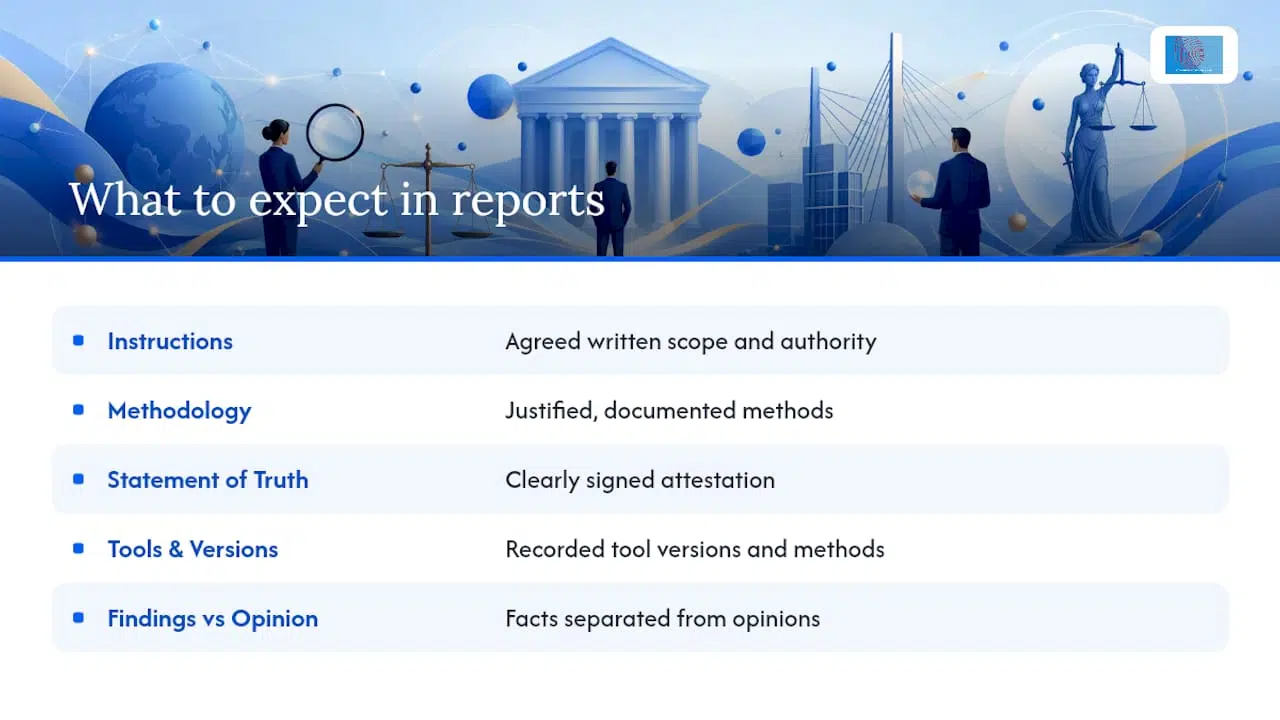
When instructing a digital forensics provider, clients can expect methods and tool versions recorded transparently, findings separated from opinion, and exhibits prepared for submission to court. Explore the full range of digital forensics services on offer, or get in touch to scope your case and discuss what a written expert report would need to cover before instructions are finalised.
This article is general information, not a substitute for advice from a qualified lawyer. Consult a qualified legal professional about your own circumstances before acting on anything here.
Sources
FAQ
What is an example of expert testimony in writing?
A forensic accountant’s written report analysing a company’s transaction records to identify fraudulent entries, or a digital forensics expert’s report reconstructing a deleted file timeline for a criminal case, are both typical examples of written expert testimony.
What does expert testimony mean in a legal context?
It means a formal opinion or technical explanation given by a qualified specialist to help a court understand evidence or decide an issue that falls outside the ordinary knowledge of a judge or jury.
What is the definition of expert testimony in evidence law?
Expert testimony is evidence, written or oral, in which a qualified person presents an opinion or technical exposition based on reliable methods and sufficient data, rather than firsthand factual observation alone.
What makes an expert testimony admissible and credible?
Credible expert testimony rests on demonstrable qualifications, a reliable methodology applied consistently to the facts, clear separation of fact from opinion, and independence from the instructing party’s interests, as judicial guidance consistently requires.
How does written expert testimony differ from oral testimony in court?
The written report is the disclosed, considered statement of an expert’s opinion prepared in advance, while oral testimony tests that same opinion through live cross-examination; the written version is what most cases rely on, since the majority never reach a full hearing.