Data theft covers any act that compromises the confidentiality, integrity or availability of information, whether through hacking, deception or physical loss. The principal categories are credential theft, phishing and social engineering, ransomware and extortion, insider theft, supply chain compromise, cloud misconfiguration and physical device theft. Each leaves distinct forensic traces and demands a different response, which this article maps out alongside detection steps and prevention measures.
TL;DR:
- Credential theft and phishing are the most common initial access vectors, often leaving forensic traces such as login anomalies and suspicious email headers.
- File access spikes, unusual outbound data at odd hours, and unexplained privilege escalations signal potential insider theft or data exfiltration.
- Data category impacts harm, with personal data increasing identity fraud risk, credentials enabling account takeover, and health data causing lasting damage.
- Preserving evidence properly and quickly is crucial, as rebooting devices or logging into suspicious accounts can destroy vital forensic information.
- Tailored security controls, like multi-factor authentication and asset tracking, significantly reduce the risks specific to each theft type.
Table of Contents
- Types of data theft: definitions and real-world examples
- How each attack type unfolds: vectors and forensic indicators
- What gets stolen and why the data type changes the stakes
- Detecting theft and what to do in the first hours
- What forensic investigations actually find
- When data theft becomes a reportable breach
- Matching prevention controls to the theft type you’re worried about
- What investigators wish organisations understood sooner
- How Computer Forensics Lab supports you after data theft
- Where to check definitions and guidance yourself
- Sources
- FAQ
Types of data theft: definitions and real-world examples
Every category of data theft exploits a different weakness, whether that is a careless click, a misconfigured server, or a disgruntled employee with too much access. Understanding the distinctions matters because the response to a phishing incident looks nothing like the response to a lost laptop.
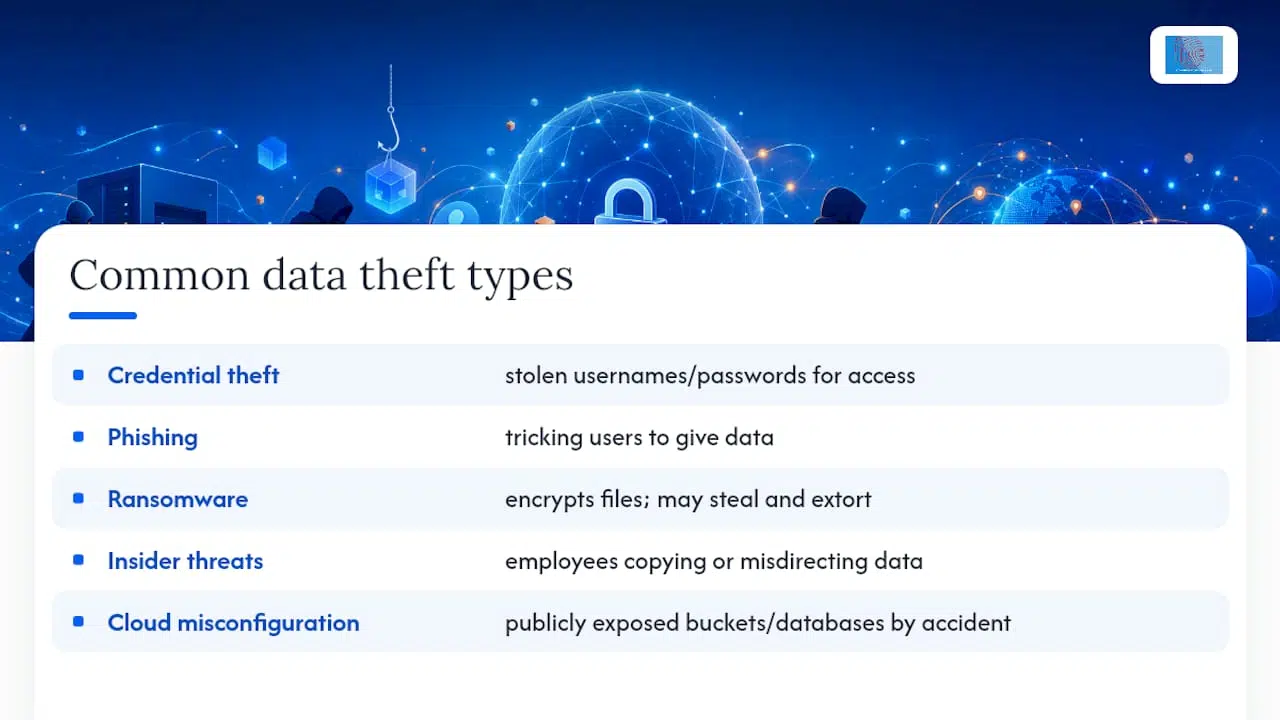
Credential theft involves stealing usernames and passwords, often through fake login pages or leaked password databases, then using them to access accounts as if the attacker were the legitimate user. It remains one of the most common entry points into corporate networks, precisely because a valid login raises far fewer alarms than a forced entry.
Phishing and social engineering trick people into handing over data or clicking malicious links, usually via convincing emails, text messages or phone calls that impersonate a trusted source. A finance clerk receiving a spoofed invoice email from what looks like their usual supplier is a textbook example.
Ransomware and extortion attacks encrypt files and demand payment, but modern variants increasingly steal a copy of the data first. Attackers then threaten to publish it even if the ransom is paid, a tactic known as double extortion.
Insider threats come from people already inside the organisation, whether a departing employee copying client lists before resigning or a well-meaning staff member misdirecting a spreadsheet full of customer records. Both cause the same harm, though intent changes how an investigation and any disciplinary or legal response unfolds.
Supply chain and third-party breaches happen when an attacker compromises a supplier, contractor or software vendor to reach the real target. A compromised update mechanism at a small software vendor can hand an attacker access to hundreds of downstream organisations at once.
Cloud misconfiguration and exposure occurs when storage buckets, databases or admin consoles are left publicly accessible, usually by accident rather than by attack. Security researchers routinely find unsecured cloud databases containing millions of customer records simply left open to anyone who finds the address.
Physical device and removable-media theft includes stolen laptops, phones and USB drives, plus the older but still relevant practice sometimes nicknamed “podslurping”: quietly copying files onto a portable device while sat at an unattended workstation, as documented cases of removable-media data theft show.
Technical exploit vectors, such as SQL injection and API abuse, let attackers query databases directly or pull data through poorly secured application interfaces, often without ever touching a login screen.
Infostealers and keystroke logging run quietly on infected devices, harvesting saved passwords, browser session tokens and typed credentials, then sending them back to the attacker in bulk.
Prevalence data backs up why credential and phishing defences deserve priority. Industry analysis from IBM identifies phishing and stolen credentials as the leading initial access vectors across breach investigations, with human error contributing to a substantial share of incidents. The UK’s Cyber Security Breaches Survey 2025 similarly finds phishing the most commonly experienced attack type among businesses that identified breaches or attacks over the past year.
How each attack type unfolds: vectors and forensic indicators
Most data theft follows a similar lifecycle, regardless of category: initial access, escalation of privileges, exfiltration of data, then either persistence for future access or a move to extortion. Where the categories diverge is in the specific artefacts each stage leaves behind.
Credential theft typically starts with a phishing email or a leaked password from an unrelated breach, followed by a login from an unfamiliar location. Forensic investigators look for login logs showing impossible travel (a login from London followed by one from Southeast Asia minutes later), unusual IP or geolocation anomalies, and new multi-factor authentication devices registered without the account holder’s knowledge.
Ransomware incidents usually begin with a phishing attachment or an exposed remote-access service, escalate through lateral movement across the network, then culminate in mass file encryption alongside a ransom note. Investigators check for spikes in file modification events, unusual process activity tied to encryption tools, and outbound network traffic to unfamiliar servers in the hours before encryption began, a pattern ENISA’s threat landscape reporting flags as increasingly common ahead of double-extortion demands.
Insider theft often shows up in access logs long before anyone notices: an employee querying records well outside their normal role, downloading unusually large volumes of files, or plugging in a USB drive shortly before resigning. USB mount logs, storage access-control lists and print logs are the artefacts that matter most here.
Supply chain and cloud incidents tend to surface through third-party alerts or automated scanning, and the forensic trail runs through vendor access logs, API call histories and storage bucket permission changes rather than anything on the victim’s own network.
- Credential theft: login logs, MFA registration changes, IP anomalies
- Phishing: email headers, sender authentication failures, link redirect chains
- Ransomware: ransom notes, encryption timestamps, lateral movement logs
- Insider theft: USB mount logs, access-control changes, unusual query volume
- Supply chain/cloud: vendor access logs, permission change history, API call anomalies
Pro Tip: Never log into a suspect account or reboot an affected device before evidence is preserved. Rebooting clears volatile memory that often holds the clearest sign of what an attacker actually did, and logging in overwrites the very access logs you need.
What gets stolen and why the data type changes the stakes
The category of data stolen determines the shape of the harm that follows, which is why triage should start with what was actually taken rather than how it was taken. Personal identifiable information (PII) such as names, addresses and dates of birth enables identity fraud. Credentials allow account takeover well beyond the original breach. Payment card data leads to direct financial loss. Health and genetic records carry a particular sensitivity because they cannot be changed the way a password can, and their exposure often causes lasting reputational and personal harm. Intellectual property and source code theft threatens competitive position rather than individual privacy, which changes who needs to be told and how urgently.
Combinations of data types multiply the risk. A leaked email address alone is a minor irritant; that same email address paired with a password and a home address becomes a ready-made identity fraud kit. The EDPB’s guidance on personal data breaches explicitly frames severity around this kind of aggregation, not just the volume of records involved.
Scale compounds the problem further. Breach cost research from IBM consistently finds that incidents involving stolen credentials and extensive customer PII take longer to identify and contain than other breach types, and longer containment windows correlate with higher overall cost.
Detecting theft and what to do in the first hours
Early signs of data theft are rarely dramatic. Watch for unusual outbound data transfers at odd hours, unfamiliar user accounts with administrative rights, mass file downloads from a single account, unexplained privilege escalations, and, in ransomware cases, a ransom note appearing on affected systems.
- Isolate affected systems from the network without powering them off, to stop further exfiltration while preserving volatile evidence.
- Change credentials for any account showing signs of compromise, starting with privileged and administrative accounts.
- Enforce multi-factor authentication across all accounts if it is not already mandatory, closing the most common re-entry route.
- Create forensically sound images of affected devices before any remediation work begins, so the evidence survives the clean-up.
- Preserve logs from firewalls, authentication systems and cloud platforms immediately, since many default to short retention windows.
Evidence preservation has its own rules, and breaking them can render evidence unusable later. Maintain a clear chain of custody for every device and log file collected, work only from forensically sound images rather than live systems, and resist the urge to log into a suspect account “just to check”, since that action alone can overwrite the very evidence an investigation needs.
Pro Tip: Bring in legal counsel alongside a forensic specialist as soon as theft is suspected, not after internal review. Early legal input often determines whether findings remain protected and admissible later, and a specialist such as those covering employee data theft investigations can preserve evidence before it degrades.
What forensic investigations actually find
A typical forensic engagement follows a consistent workflow: triage the scope of the incident, image affected devices, reconstruct a timeline of events, analyse any malware recovered, then compile a report suitable for legal or regulatory use. The chain of custody and evidential standards applied at each stage are what make the difference between findings that hold up in court and findings that get dismissed.
Two patterns recur often enough to be worth flagging. In employee exfiltration cases, the clearest indicator is almost always a spike in file access volume in the days immediately before resignation, paired with USB activity that does not match the employee’s normal role. In ransomware cases involving exfiltration, investigators frequently find outbound transfers to unfamiliar cloud storage services hours or days before the encryption itself began, which is often the strongest evidence that data left the building at all.
Investigators often find that the technical trail matters less than whether it was collected properly. A perfectly identified indicator of compromise is worthless in a tribunal or court if the chain of custody has a gap in it.
- Triage → image → timeline → malware analysis → reporting
- Reports must use reproducible methods to support regulatory notifications and legal proceedings
When data theft becomes a reportable breach
Whether an incident needs formal notification usually turns on the CIA framing: has confidentiality, integrity or availability been compromised in a way that creates risk to the people affected? The ICO’s guidance on personal data breaches makes clear that not every security incident meets this bar; only incidents that risk real harm to individuals typically require notification.
Regulators generally weigh three factors: the sensitivity of the data involved, the volume of records affected, and the likely harm to those individuals. Where notification is required, guidance built around the EDPB’s framework points to a prompt window from becoming aware of the breach as a common benchmark.
Before contacting a regulator or affected individuals, compile:
- The scope of the breach (how many records, which systems)
- The categories of data involved
- Remedial steps already taken
- A contact point for follow-up questions
Matching prevention controls to the theft type you’re worried about
Generic advice to “improve security” wastes limited budget. Controls work best when matched directly to the theft type they counter.
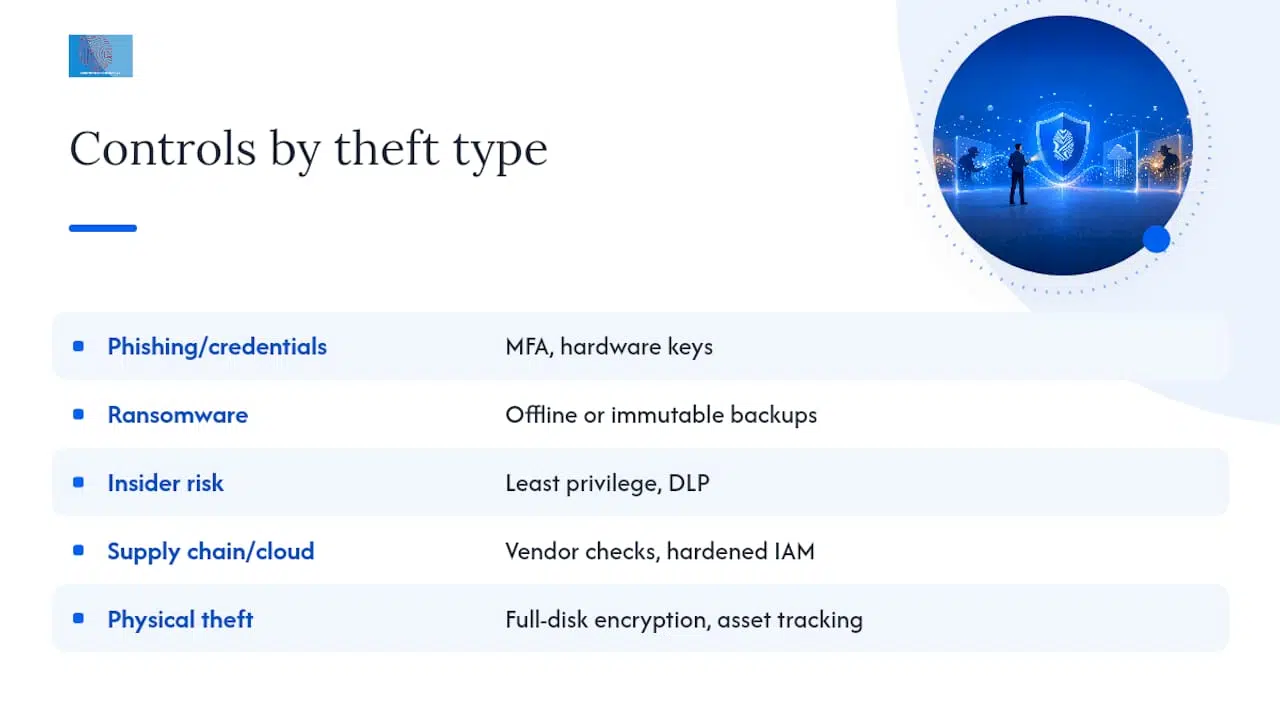
Against credential theft and phishing, multi-factor authentication, phishing-resistant authentication methods such as hardware security keys, regular staff training and credential monitoring services close the most common entry points. Against ransomware, offline or immutable backups, network segmentation, endpoint detection and response tools, and regular recovery drills reduce both the likelihood of infection and the pressure to pay when it happens, since resilient backup strategies materially cut ransom payment rates. Insider risk responds best to least-privilege access, formal exit procedures, data loss prevention tools and user behaviour analytics that flag anomalous access patterns.
Supply chain and cloud risk need vendor risk assessments, software bill-of-materials tracking, automated configuration checks and hardened identity and access management. Physical theft is countered with full-disk encryption, secure storage for devices left unattended, and asset tracking so a missing laptop is noticed within hours rather than weeks. Employers with legal obligations around staff data handling should also review data protection compliance duties that apply to how insider risk is managed.
Pro Tip: Pick one control from each category above rather than trying to implement all of them at once. A partially deployed comprehensive plan protects less than a fully deployed narrow one.
What investigators wish organisations understood sooner
The single biggest factor in how well a case turns out is how quickly evidence gets preserved, not how sophisticated the attacker was. Organisations often assume IT’s instinct to remediate immediately is the right first move. It usually is not: wiping a machine to “fix” it destroys the very evidence that proves what happened and to whom. Get a forensic view before you clean anything up.
— Computer
How Computer Forensics Lab supports you after data theft
Once theft is suspected, the priority shifts from guessing to proving. Professional digital forensics services include forensic imaging, data recovery, malware analysis and expert witness reporting for organisations dealing with suspected data theft, whether that involves a departing employee, a ransomware incident or a compromised cloud account. Unlike an internal IT response, which often prioritises getting systems back online over preserving evidence, forensic engagement is built around chain of custody from the first device imaged onwards.
Clients typically receive a defined scope of investigation, a forensically sound record of what was accessed or removed, and a technical report suitable for litigation or regulatory review. If you suspect data theft and need to understand what happened before deciding on next steps, Computerforensicslab’s digital forensics services are a direct next step, with enquiries handled case by case rather than through a fixed package.
Where to check definitions and guidance yourself
- EDPB guidelines on personal data breach notification
- ICO: personal data breaches, a guide
- NCSC incident management collection
- ENISA threat landscape 2025
- IBM: what is a data breach?
This article is general information, not a substitute for advice from a qualified lawyer. Consult a qualified legal professional about your own circumstances before acting on anything here.
Sources
- EDPB guidelines on personal data breach notification
- What is a data breach? | IBM
- ENISA threat landscape 2025
- NCSC incident management collection
FAQ
What are the top data breaches of all time?
There is no single official ranking, but the largest incidents on record typically involve hundreds of millions to billions of exposed accounts, usually caused by unsecured databases or large-scale credential theft rather than a single sophisticated hack.
What are the main types of cyber security an organisation needs?
Coverage typically spans network security, application security, endpoint security, cloud security, identity and access management, data security, and incident response, each addressing a different point in the attack lifecycle described above.
What are the most common types of cybercrime?
Beyond the theft categories covered in this article, common cybercrimes include fraud, business email compromise, denial-of-service attacks, and the sale of stolen data on criminal marketplaces.
What are the top causes of data breaches?
Phishing and stolen credentials are consistently the leading causes, followed by exploited vulnerabilities and misconfigured systems, with human error running through most categories.
When must a data breach be reported to a regulator?
Notification is generally required when the breach risks real harm to individuals, based on the sensitivity and volume of data involved, with guidance emphasizing timely notification upon becoming aware of the incident.