Digital forensics is producing rapid technical progress even as vendor supply chain risk and capacity pressure both rise. Explainable AI tools are reaching courtroom relevance, a major vendor faces serious federal allegations, and labour shortages are lengthening case backlogs. The immediate priority for practitioners is straightforward: preserve raw evidence independently of any single vendor tool, and demand explainability from any AI system used in an investigation.
TL;DR:
- Investigators must separate raw evidence and checksums from AI-processed data to ensure verifiability and defendability in court.
- Due diligence requires verifying vendor ownership, development jurisdiction, and procurement transparency, especially following allegations like those against Oxygen Forensics.
- Building workflows that include independent corroboration and explainability in AI tools is essential to maintain evidence integrity and courtroom admissibility.
- Workforce shortages and increasing case backlogs emphasize the need for targeted training in mobile forensics, cloud analysis, and AI validation techniques.
- AI tools built around provenance and explanation are now more relevant than speed, as they better withstand legal scrutiny and ensure reliable evidence.
Table of Contents
- Latest headlines in digital forensics and cybersecurity
- How new research is changing forensic workflows
- The Oxygen Forensics case and what it means for vendor vetting
- Skills gaps and lab capacity under strain
- Turning the news into a workable checklist
- What our casework and background bring to this analysis
- The gap between what AI promises and what courts will accept
- Getting expert support for an investigation
- Where to follow ongoing developments
- Sources
- FAQ
Latest headlines in digital forensics and cybersecurity
The past month has produced several stories that practitioners should read in full rather than skim.
- 24 September 2026: Independent reporting corroborated the allegations and examined the broader procurement implications for law enforcement software contracts.
- 5 September 2026: Researchers published FACT, an agent style forensic tool that improves detection of AI-generated images across generators it was not originally trained on, addressing a persistent weak point in deepfake detection.
- 14 March 2026: A neuro-symbolic offline LLM framework for Windows forensics was proposed, offering automated interpretation without sending case data to external cloud services.
- 19 September 2025: GOV.UK published its annual cyber security skills report, noting that digital forensics remains a comparatively small but growing specialism within the wider cybersecurity workforce.
- 9 September 2026: Digital Forensics Magazine’s roundup covered further sector developments worth tracking for ongoing context.
Each of these stories points in the same direction: tools are becoming more capable, but trust in those tools now depends on provenance, explainability and independent verification rather than vendor assurance alone.
How new research is changing forensic workflows
Several recent papers reshape how triage and reconstruction are likely to be performed. ForenGRAF-AI proposes a graph-temporal architecture that models provenance and uncertainty explicitly, producing hypotheses an investigator can verify rather than an opaque score. FACT and the related PATE-Forensics work apply an agent, tool-use paradigm to deepfake and AI-image detection, improving robustness against unseen generation methods. X-ForensicNet pairs an offline large language model with neuro-symbolic validation, aiming to keep case data off external servers while retaining explainable output.
The shared risk across all of this work is that black-box AI conclusions are difficult to reproduce and therefore difficult to defend under cross-examination. Explainability is not a courtesy feature: it is what separates a persuasive finding from an inadmissible one.
- Keep original raw artefacts and checksummed images separate from any AI-processed output.
- Favour tools that expose their reasoning steps or provenance graphs over those that return a single confidence score.
- Run validation checks against a second, independent method before relying on an AI finding in a report.
Pro Tip: Treat any AI-generated forensic finding as a lead to verify, not a conclusion to cite.
The Oxygen Forensics case and what it means for vendor vetting
The allegations against Oxygen Forensics principals are serious but narrow: the Department of Justice complaint alleges concealment of Russian ownership in connection with sales to US agencies, and coverage confirms the DOJ stopped short of alleging malicious code within the software itself. The practical lesson is about procurement discipline, not a verdict on the tool’s technical output.
Practitioners and procurement teams should apply the same checklist to any forensic vendor going forward:
- Confirm ultimate beneficial ownership and the jurisdiction where development actually takes place.
- Request contractual warranties covering ownership disclosure and code provenance.
- Preserve original extraction outputs and vendor version logs independently of the vendor’s own case management system.
- Where feasible, corroborate a critical extraction with a second, independently sourced tool chain.
Until any related legal proceedings conclude, evidence produced by affected tools should be treated as usable but worth corroborating, not automatically excluded.
Skills gaps and lab capacity under strain
The Gov found that digital forensics remains one of the smaller specialisms within cybersecurity, even as demand for it grows faster than the supply of trained practitioners. That gap shows up operationally as longer turnaround times and growing backlogs in labs handling device examinations and e-disclosure work.
- Prioritise training in mobile extraction, cloud forensics and AI-output validation, since these are the areas where demand is outstripping current capability.
- Build triage protocols that flag high-priority devices early, rather than processing evidence strictly in the order it arrives.
- Engage an external lab for overflow work before a backlog affects a filing deadline, not after.
Turning the news into a workable checklist
News and research are only useful once they change what happens at the evidence bench. Three checks matter most right now.
- Capture volatile data and full device images first, before any triage software touches the device, and log hash values immediately.
- Where an AI tool assists analysis, retain its raw input and output alongside a note of the model version used, so the finding can be reproduced later.
- Vet any new vendor against ownership, update cadence and third-party audit history before relying on its output in a report intended for court.
For teams building longer-term processes, our guide to digital forensics trends and our overview of evidential standards in court cover these points in more depth.
Pro Tip: A reproducible pipeline, however slower, will survive cross-examination better than a faster black-box one.
What our casework and background bring to this analysis
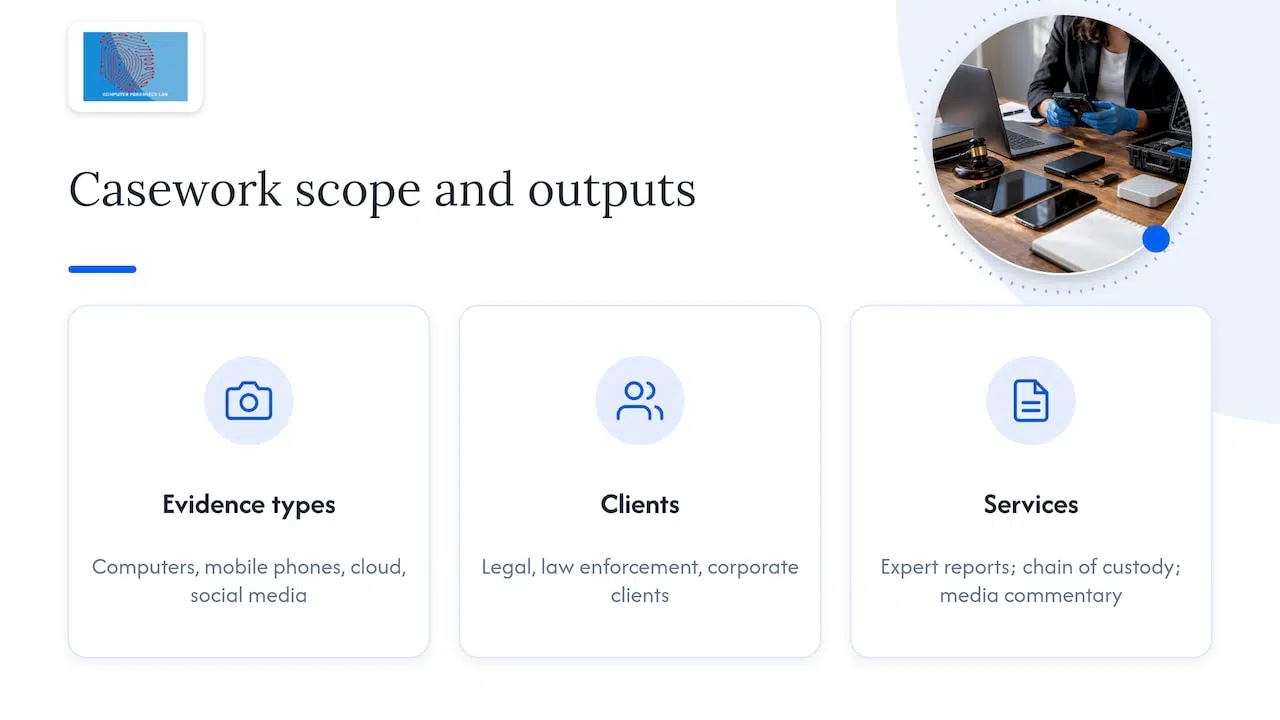
A professional digital forensics provider handles computers, mobile phones, cloud data and social media evidence for legal professionals, law enforcement and corporate clients. Such providers may produce expert witness reports and maintain chain of custody throughout engagements, and may contribute to media coverage of investigations. Readers wanting more detail on how forensic evidence is used in litigation can see our page on digital forensics in corporate investigations. For commentary or case enquiries, contact routes are listed on our main site.
The gap between what AI promises and what courts will accept
The conventional advice in this field still treats AI adoption as an efficiency question: which tool processes more devices per hour. That misses the actual bottleneck. The tools reaching real relevance this year, ForenGRAF-AI, FACT, X-ForensicNet, are the ones built around provenance and explainability, not raw speed. A faster tool that cannot show its working is a liability in front of a judge, not an asset in the lab.
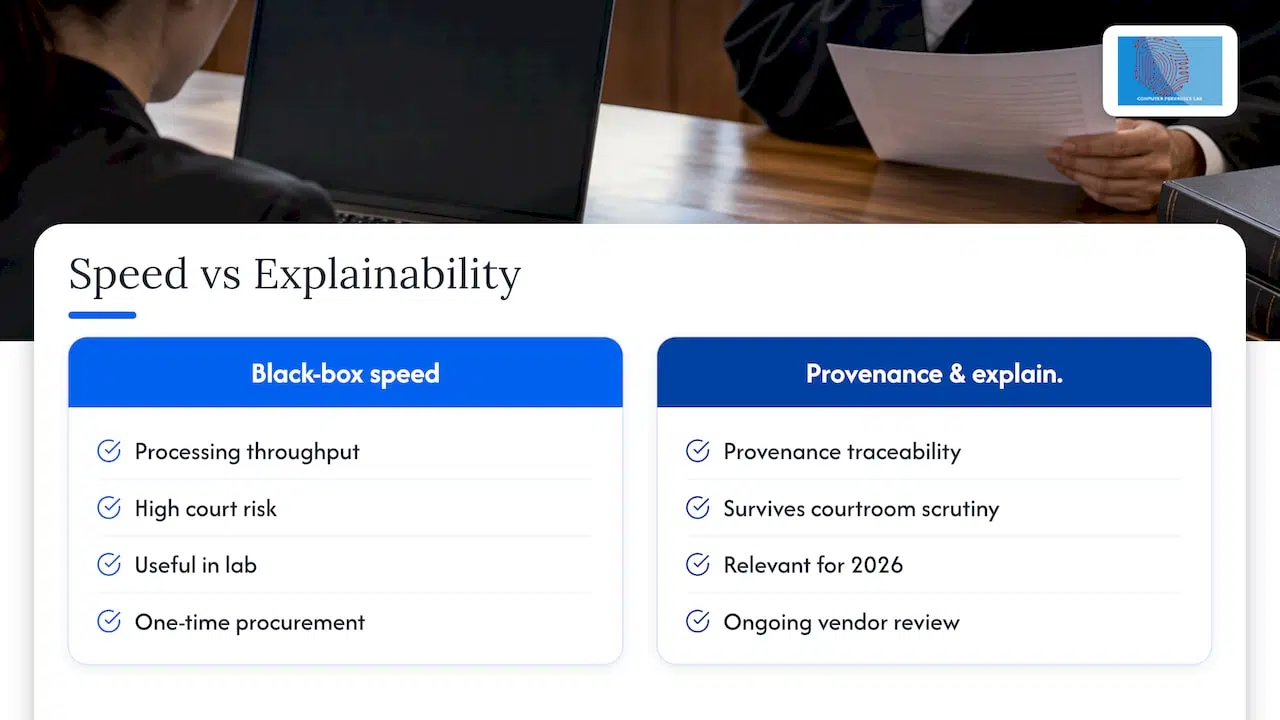
The Oxygen Forensics case reinforces a point the industry has been slow to act on: vendor trust has been treated as a one-time procurement decision rather than an ongoing check. Ownership, jurisdiction and code provenance deserve the same periodic review as a software licence renewal.
If there is one priority for 2026, it is this: build workflows that do not collapse if a single vendor tool is later challenged. Independent corroboration and explainable output are not extra steps, they are the difference between evidence that survives scrutiny and evidence that does not.
— Computer
Getting expert support for an investigation
Rapid data recovery, court-ready reporting and expert witness testimony require the same discipline this article has described: independent verification, clear provenance and defensible methodology. Computer Forensics Lab applies that approach across computer forensics services, mobile device examinations and e-disclosure work. To discuss an investigation or instruct an expert report, visit Computerforensicslab or use our contact page if you need a faster route to a specific team.
Where to follow ongoing developments
Readers who want to track this space directly should follow a small set of primary and trade sources rather than relying on secondary summaries.
- The DOJ press office publishes original filings on cases affecting forensic vendors.
- GOV.UK’s cyber security labour market series tracks skills gaps annually.
- arXiv hosts pre-print research on forensic AI methods, including the FACT and X-ForensicNet papers referenced above.
- Digital Forensics Magazine and ForensicFocus publish frequent short-form roundups for practitioners.
- Legal teams managing AI-assisted content or evidence documentation may find this AI content optimisation guide for legal marketers useful background on managing AI output responsibly.
Our own news index collects further developments as they emerge.
FAQ
Will AI replace digital forensics investigators?
No. Current research, including ForenGRAF-AI and FACT, positions AI as a triage and reconstruction aid that still requires human verification before conclusions are admissible in court. Explainable design matters precisely because investigators, not the model, remain responsible for the final finding.
Is Cellebrite available to the public?
Cellebrite’s forensic extraction tools are sold to law enforcement, government and licensed forensic providers rather than to the general public. Individuals seeking data recovery or mobile evidence extraction typically need to engage a professional forensic service.
Is digital forensics in high demand right now?
Demand is rising faster than the supply of specialist practitioners, according to GOV.UK’s 2025 labour market report, which lists digital forensics as a growing but still comparatively small specialism within cybersecurity. That gap is contributing to longer case turnaround times in some labs.
What are the major challenges facing digital forensics today?
The main pressures are workforce shortages, vendor supply chain trust following cases like the Oxygen Forensics allegations, and the need to make AI-assisted findings explainable enough to survive court scrutiny. Reproducibility and provenance are becoming as important as raw extraction capability.
How can investigators verify AI-assisted forensic findings?
Investigators should retain the original raw evidence and run a second, independent method alongside any AI tool’s output before relying on it in a report. Explainable frameworks such as ForenGRAF-AI are designed specifically to expose that reasoning trail for verification.